Common Language Infrastructure (CLI)
© <2012> Ecma International
This document may be copied, published and distributed to others, and certain derivative works of it may be prepared, copied, published, and distributed, in whole or in part, provided that the above copyright notice and this Copyright License and Disclaimer are included on all such copies and derivative works. The only derivative works that are permissible under this Copyright License and Disclaimer are:
works which incorporate all or portion of this document for the purpose of providing commentary or explanation (such as an annotated version of the document),
works which incorporate all or portion of this document for the purpose of incorporating features that provide accessibility,
translations of this document into languages other than English and into different formats and
works by making use of this specification in standard conformant products by implementing (e.g. by copy and paste wholly or partly) the functionality therein.
However, the content of this document itself may not be modified in any way, including by removing the copyright notice or references to Ecma International, except as required to translate it into languages other than English or into a different format.
The official version of an Ecma International document is the English language version on the Ecma International website. In the event of discrepancies between a translated version and the official version, the official version shall govern. The limited permissions granted above are perpetual and will not be revoked by Ecma International or its successors or assigns.
This document and the information contained herein is provided on an "AS IS" basis and ECMA INTERNATIONAL DISCLAIMS ALL WARRANTIES, EXPRESS OR IMPLIED, INCLUDING BUT NOT LIMITED TO ANY WARRANTY THAT THE USE OF THE INFORMATION HEREIN WILL NOT INFRINGE ANY OWNERSHIP RIGHTS OR ANY IMPLIED WARRANTIES OF MERCHANTABILITY OR FITNESS FOR A PARTICULAR PURPOSE.
I.6 Overview of the Common Language Infrastructure
I.7 Common Language Specification
I.10 Name and type rules for the Common Language Specification
I.11 Collected Common Language Specification rules
II.3 Validation and verification
II.6 Assemblies, manifests and modules
II.8 Visibility, accessibility and hiding
II.13 Semantics of value types
II.14 Semantics of special types
II.15 Defining, referencing, and calling methods
II.16 Defining and referencing fields
II.22 Metadata logical format: tables
II.23 Metadata logical format: other structures
II.24 Metadata physical layout
II.25 File format extensions to PE
III.2 Prefixes to instructions
III.4 Object model instructions
IV.4 Kernel Profile feature requirements
IV.6 Implementation-specific modifications to the system libraries
VI.Annex C CIL assembler implementation
VI.Annex D Class library design guidelines
VI.Annex E Portability considerations
Index
This sixth edition cancels and replaces the fifth edition which has been technically revised
This Standard is fully aligned with ISO/IEC 23271:2012.
The following features have been added, extended or clarified in the Standard:
The presentation of the rules for assignment compatibility (§I.8.7, §III.1.8.1.2.3) has been extensively revised to a more precise and clearer relation-based format.
The presentation of the verification rules for many IL instructions has been revised to be more precise and clearer by building upon the revisions to the presentation of assignment compatibility.
The presentation of delegate signature compatibility has been revised along the same lines as assignment compatibility.
The verification rules for the IL newobj instruction
have been extended to cover general delegate creation.
The dispatch rules for variance (§II.12.2) have been extended to define resolutions for the ambiguities that can arise.
Type forwarders have been added to support the relocation of types between libraries (§II.6.8)
The following changes of behavior have been made to the Standard:
The semantics of variance has been redefined making it a core feature of the CLI. In the previous edition of the Standard variance could be ignored by languages not wishing to support it (§I.1.8); as exact type matches always took precedence over matches-by-variance. In this edition the dispatch rules for interfaces (§II.12.2) allow a match-by-variance to take precedence over an exact match, so all language implementation targeting the CLI must be aware of the behavior even if it is not supported in the language (§I.1.8).
Additional requirements on ilasm to metadata conversion. The left-to-right order of interfaces listed in a type header (§II.10.2) must now be preserved as a top-to-bottom order in the InterfaceImpl table (§II.22.23); and the top-to-bottom of method definitions (§II.10.2, §II.25) must now be preserved as a top-to-bottom order in the MethodDef table (§II.22.26). Both these additional requirements are required to support the revised variance semantics.
System.Math and System.Double have been
modified to better conform to IEEE (see Partition IV and IEC
60559:1989)
The following types have been added to the Standard or have been significantly updated (* represents an update).
| Type | Library |
|---|---|
System.Action |
BCL |
System.Action`1<-T>* …
System.Action`8<-T1..-T8> |
BCL |
System.Comparison`1<-T>* |
BCL |
System.Converter`2<-T,+U>* |
BCL |
System.IComparable`1<-T>* |
BCL |
System.Predicate`1<-T>* |
BCL |
System.Collections.Generic.IComparer`1<-T>* |
BCL |
System.Collections.Generic.IEnumerable`1<+T>* |
BCL |
System.Collections.Generic.IEqualityComparer`1<-T>* |
BCL |
System.Guid |
BCL |
System.MulticastDelegate |
BCL |
System.Reflection.CallingConventions |
Runtime Infrastructure |
System.Runtime.InteropServices.GuidAttribute |
Runtime Infrastructure |
System.Func`1<+TResult>…System.Func`9<-T1..-T8, +TResult> |
BCL |
System.Collections.Generic.Comparer`1<T> |
BCL |
System.Collections.Generic.EqualityComparer`1<T> |
BCL |
System.Collections.Generic.ISet`1<T> |
BCL |
System.Collections.Generic.LinkedList`1<T> |
BCL |
System.Collections.Generic.LinkedList`1<T>.Enumerator |
BCL |
System.Collections.Generic.LinkedListNode`1<T> |
BCL |
System.Collections.Generic.Queue`1<T> |
BCL |
System.Collections.Generic.Stack`1<T> |
BCL |
System.Collections.Generic.Stack`1<T>.Enumerator |
BCL |
System.Collections.Stack |
BCL |
System.DBNull |
BCL |
System.Runtime.InteropServices.Marshal |
Runtime Infrastructure |
System.Runtime.InteropServices.SafeBuffer |
Runtime Infrastructure |
System.Runtime.InteropServices.SafeHandle |
Runtime Infrastructure |
System.Threading.AutoResetEvent |
BCL |
System.Threading.EventWaitHandle |
BCL |
System.Threading.ManualResetEvent |
BCL |
System.WeakReference |
BCL |
System.Runtime.CompilerServices.TypeForwardedToAttribute |
BCL |
System.Runtime.CompilerServices.TypeForwardedFromAttribute |
BCL |
System.Threading.EventResetMode |
BCL |
System.Runtime.InteropServices.DllAttribute* |
Runtime Infrastructure |
System.Math* |
BCL |
One type, INullableValue, has been removed from the
Standard. INullableValue is incompatible with the semantics
of boxing as defined in the previous edition of the Standard. The
references to it were included in error from an earlier draft and no
implementations are known to have ever included it.
Technical Report 89 (TR89), which was submitted during the third edition of this Ecma standard, will no longer be part of the submission. TR89 specified a collection of generic types, to help enhance inter-language interoperability, under consideration for inclusion in a future version of the standard. That consideration has now occurred and TR89 has fulfilled its role. A selection of the types covered in TR89 has been introduced into this edition of the standard. An archive version of TR89 will continue to be available from Ecma.
The following companies and organizations have participated in the development of this standard, and their contributions are gratefully acknowledged: Eiffel Software, Kahu Research, Microsoft Corporation, Novell Corporation, Twin Roots. For previous editions, the following companies and organizations are also acknowledged: Borland, Fujitsu Software Corporation, Hewlett-Packard, Intel Corporation, IBM Corporation, IT University of Copenhagen, Jagger Software Ltd., Monash University, Netscape, Phone.Com, Plum Hall, and Sun Microsystems.
This International Standard defines the Common Language Infrastructure (CLI) in which applications written in multiple high-level languages can be executed in different system environments without the need to rewrite those applications to take into consideration the unique characteristics of those environments. This International Standard consists of the following parts:
Partition I: Concepts and Architecture – Describes the overall architecture of the CLI, and provides the normative description of the Common Type System (CTS), the Virtual Execution System (VES), and the Common Language Specification (CLS). It also provides an informative description of the metadata.
Partition II: Metadata Definition and Semantics – Provides the normative description of the metadata: its physical layout (as a file format), its logical contents (as a set of tables and their relationships), and its semantics (as seen from a hypothetical assembler, ilasm).
Partition III: CIL Instruction Set – Describes the Common Intermediate Language (CIL) instruction set.
Partition IV: Profiles and Libraries – Provides
an overview of the CLI Libraries, and a specification of their factoring
into Profiles and Libraries. A companion file,
CLILibrary.xml, considered to be part of this Partition,
but distributed in XML format, provides details of each class, value
type, and interface in the CLI Libraries.
Partition V: Debug Interchange Format – Describes a standard way to interchange debugging information between CLI producers and consumers.
Partition VI: Annexes – Contains some sample programs written in CIL Assembly Language (ILAsm), information about a particular implementation of an assembler, a machine-readable description of the CIL instruction set which can be used to derive parts of the grammar used by this assembler as well as other tools that manipulate CIL, a set of guidelines used in the design of the libraries of Partition IV, and portability considerations.
A system claiming conformance to this International Standard shall implement all the normative requirements of this standard, and shall specify the profile (see Partition IV Library – Profiles) that it implements. The minimal implementation is the Kernel Profile. A conforming implementation can also include additional functionality provided that functionality does not prevent running code written to rely solely on the profile as specified in this standard. For example, a conforming implementation can provide additional classes, new methods on existing classes, or a new interface on a standardized class, but it shall not add methods or properties to interfaces specified in this standard.
A compiler that generates Common Intermediate Language (CIL, see Partition III) and claims conformance to this International Standard shall produce output files in the format specified in this standard, and the CIL it generates shall be correct CIL as specified in this standard. Such a compiler can also claim that it generates verifiable code, in which case, the CIL it generates shall be verifiable as specified in this standard.
[Note that many of these references are cited in the XML description of the class libraries.]
Extensible Markup Language (XML) 1.0 (Third Edition), 2004 February 4, http://www.w3.org/TR/2004/REC-xml-20040204/
Federal Information Processing Standard (FIPS 180-1), Secure Hash Standard (SHA-1), 1995, April.
IEC 60559:1989, Binary Floating-point Arithmetic for Microprocessor Systems (previously designated IEC 559:1989).
ISO 639, Codes for the representation of names of languages.
ISO 3166-1:2006, Codes for the representation of names of countries.
ISO/IEC 646:1991, Information Technology — ISO 7-bit coded character set for information interchange
ISO/IEC 9899:1999, Programming languages — C.
ISO/IEC 10646, Information Technology — Universal Coded Character Set (UCS).
ISO/IEC 11578:1996, Information Technology — Open Systems Interconnection — Remote Procedure Call (RPC).
ISO/IEC 14882:2011, Programming languages — C++.
ISO/IEC 23270:2006, _Programming languages — C#.
RFC-768, User Datagram Protocol. J. Postel. 1980, August.
RFC-791, Darpa Internet Program Protocol Specification. 1981, September.
RFC-792, Internet Control Message Protocol. Network Working Group. J. Postel. 1981, September.
RFC-793, Transmission Control Protocol. J. Postel. 1981, September.
RFC-919, Broadcasting Internet Datagrams. Network Working Group. J. Mogul. 1984, October.
RFC-922, Broadcasting Internet Datagrams in the presence of Subnets. Network Working Group. J. Mogul. 1984, October.
RFC-1035, Domain Names – Implementation and Specification. Network Working Group. P. Mockapetris. 1987, November.
RFC-1036, Standard for Interchange of USENET Messages, Network Working Group. M. Horton and R. Adams. 1987, December.
RFC-1112. Host Extensions for IP Multicasting. Network Working Group. S. Deering 1989, August.
RFC-1222. Advancing the NSFNET Routing Architecture. Network Working Group. H-W Braun, Y. Rekhter. 1991 May. http://tools.ietf.org/html/rfc1222
RFC-1510, The Kerberos Network Authentication Service (V5). Network Working Group. J. Kohl and C. Neuman. 1993, September.
RFC-1741, MIME Content Type for BinHex Encoded Files: Format. Network Working Group. P. Faltstrom, D. Crocker, and E. Fair. 1994, December.
RFC-1764. The PPP XNS IDP Control Protocol (XNSCP). Network Working Group. S. Senum. 1995, March.
RFC-1766, Tags for the Identification of Languages. Network Working Group. H. Alvestrand. 1995, March.
RFC-1792. _TCP/IPX Connection Mib Specification._Network Working Group. T. Sung. 1995, April.
RFC-2236. Internet Group Management Protocol, Version 2. Network Working Group. W. Fenner. 1997, November.
RFC-2045, Multipurpose Internet Mail Extensions (MIME) Part One: Format of Internet Message Bodies. Network Working Group. N. Freed. 1996, November.
RFC-2616, Hypertext Transfer Protocol – HTTP/1.1. Network Working Group. R. Fielding, J. Gettys, J. Mogul, H. Frystyk, L. Masinter, P. Leach, and T. Berners-Lee. 1999 June. http://www.ietf.org/rfc/rfc2616.txt
RFC-2617, HTTP Authentication: Basic and Digest Access Authentication. Network Working Group. J. Franks, P. Hallam-Baker, J. Hostetler, S. Lawrence, P. Leach, A. Luotonen, and L. Stewart. 1999 June, http://www.ietf.org/rfc/rfc2617.txt
The Unicode Consortium. The Unicode Standard, Version 4.0, defined by: The Unicode Standard, Version 4.0 (Boston, MA, Addison-Wesley, 2003. ISBN 0-321-18578-1).
The divisions of this International Standard are organized using a hierarchy. At the top level is the Partition. The next level is the clause, followed by subclause. Divisions within a subclause are also referred to as subclauses. Partitions are numbered using Roman numerals. All other divisions are numbered using Arabic digits with their place in the hierarchy indicated by nested numbers. For example, Partition II, 14.4.3.2 refers to subclause 2 in subclause 3 in subclause 4 in clause 14 in Partition II.
This International Standard is intended to be used by implementers, academics, and application programmers. As such, it contains explanatory material that, strictly speaking, is not necessary in a formal specification.
Examples are provided to illustrate possible forms of the constructions described. References are used to refer to related clauses or subclauses. Notes are provided to give advice or guidance to implementers or programmers. Annexes provide additional information.
Except for whole clauses or subclauses that are identified as being informative, informative text that is contained within normative clauses and subclauses is identified as follows:
The beginning and end of a block of informative text is marked using rectangular boxes.
As some informative passages span pages, informative text also contains a bold set of vertical black stripes in the right margin.
By the use of the following pairs of markers: [Example: … end example], [Note: … end note], and [Rationale: … end rationale]. Unless text is identified as being informative, it is normative.
For the purposes of this International Standard, the following definitions apply. Other terms are defined where they appear in italic type.
ANSI character: A character from an implementation-defined 8-bit character set whose first 128 code points correspond exactly to those of ISO/IEC 10646.
ANSI string: A string of ANSI characters, of which the final character has the value all-bits-zero.
argument: The expression supplied for a parameter at the point of the call to a method.
assembly: A configured set of loadable code modules and other resources that together implement a unit of functionality.
attribute: A characteristic of a type and/or its members that contains descriptive information. While the most common attributes are predefined, and have a specific encoding in the metadata associated with them, user-defined attributes can also be added to the metadata.
behavior, implementation-specific: Unspecified behavior, for which each implementation is required to document the choice it makes.
behavior, unspecified: Behavior, for a well-formed program construct and correct data, that depends on the implementation. The implementation is not required to document which behavior occurs.
behavior, undefined: Behavior, such as might arise upon use of an erroneous program construct or erroneous data, for which this International Standard imposes no requirements. Undefined behavior can also be expected in cases when this International Standard omits the description of any explicit definition of behavior.
boxing: The conversion of a value having some value
type, to a newly allocated instance of the reference type
System.Object.
Common Intermediate Language (CIL): The instruction set understood by the VES.
Common Language Infrastructure (CLI): A specification for the format of executable code, and the run-time environment that can execute that code.
Common Language Specification (CLS): An agreement between language designers and framework (class library) designers. It specifies a subset of the CTS and a set of usage conventions.
Common Type System (CTS): A unified type system that is shared by compilers, tools, and the CLI itself. It is the model that defines the rules the CLI follows when declaring, using, and managing types. The CTS establishes a framework that enables cross-language integration, type safety, and high performance code execution.
delegate: A reference type such that an instance of it can encapsulate one or more methods in an invocation list. Given a delegate instance and an appropriate set of arguments, one can invoke all of the methods in a delegate’s invocation list with that set of arguments.
event: A member that enables an object or class to provide notifications.
Execution Engine: See Virtual Execution System.
field: A member that designates a typed memory location that stores some data in a program.
garbage collection: The process by which memory for managed data is allocated and released.
generic argument: The actual type used to
instantiate a particular generic type or generic method. For example, in
List<string>, string is the generic
argument corresponding to the generic parameter T in the
generic type definition List<T>.
generic parameter: A parameter within the definition
of a generic type or generic method that acts as a place holder for a
generic argument. For example, in the generic type definition
List<T>, T is a generic parameter.
generics: The feature that allows types and methods to be defined such that they are parameterized with one or more generic parameters.
library: A repository for a set of types, which are grouped into one or more assemblies. A library can also contain modifications to types defined in other libraries. For example, a library can include additional methods, interfaces, and exceptions for types defined in other libraries.
managed code: Code that contains enough information to allow the CLI to provide a set of core services. For example, given an address for a method inside the code, the CLI must be able to locate the metadata describing that method. It must also be able to walk the stack, handle exceptions, and store and retrieve security information.
managed data: Data that is allocated and released automatically by the CLI, through a process called garbage collection.
manifest: That part of an assembly that specifies the following information about that assembly: its version, name, culture, and security requirements; which other files, if any, belong to that assembly, along with a cryptographic hash of each file; which of the types defined in other files of that assembly are to be exported from that assembly; and, optionally, a digital signature for the manifest itself, and the public key used to compute it.
member: Any of the fields, array elements, methods, properties, and events of a type.
metadata: Data that describes and references the types defined by the CTS. Metadata is stored in a way that is independent of any particular programming language. Thus, metadata provides a common interchange mechanism for use between tools that manipulate programs (such as compilers and debuggers) as well as between these tools and the VES. method: A member that describes an operation that can be performed on values of an exact type.
method, generic: A method (be it static, instance,
or virtual), defined within a type, whose signature includes one or more
generic parameters, not present in the type definition itself. The
enclosing type itself might, or might not, be generic. For example,
within the generic type List<T>, the generic method
S ConvertTo<S>() is generic.
method, non-generic: A method that is not generic.
module: A single file containing content that can be executed by the VES.
object: An instance of a reference type. An object has more to it than a value. An object is self-typing; its type is explicitly stored in its representation. It has an identity that distinguishes it from all other objects, and it has slots that store other entities (which can be either objects or values). While the contents of its slots can be changed, the identity of an object never changes.
parameter: The name used in the header and body of a method to refer to an argument value supplied at the point of call.
profile: A set of libraries, grouped together to form a consistent whole that provides a fixed level of functionality.
property: A member that defines a named value and the methods that access that value. A property definition defines the accessing contracts on that value. Hence, the property definition specifies which accessing methods exist and their respective method contracts.
signature: The part of a contract that can be checked and automatically enforced. Signatures are formed by adding constraints to types and other signatures. A constraint is a limitation on the use of or allowed operations on a value or location.
type, generic: A type whose definition is
parameterized by one or more other types; for example,
List<T>, where T is a generic parameter.
The CLI supports the creation and use of instances of generic types. For
example, List<int32> or
List<string>.
type, reference: A type such that an instance of it contains a reference to its data. type, value: A type such that an instance of it directly contains all its data.
unboxing: The conversion of a value having type
System.Object, whose run-time type is a value type, to a
value type instance.
unmanaged code: Code that is not managed.
unmanaged data: Data that is not managed.
value: A simple bit pattern for something like an integer or a float. Each value has a type that describes both the storage that it occupies and the meanings of the bits in its representation, and also the operations that can be performed on that representation. Values are intended for representing the simple types and non-objects in programming languages.
verification: The checking of both CIL and its related metadata to ensure that the CIL code sequences do not permit any access to memory outside the program’s logical address space. In conjunction with the validation tests, verification ensures that the program cannot access memory or other resources to which it is not granted access.
Virtual Execution System (VES): This system implements and enforces the CTS model. The VES is responsible for loading and running programs written for the CLI. It provides the services needed to execute managed code and data using the metadata to connect separately generated modules together at runtime. The VES is also known as the Execution Engine.
The Common Language Infrastructure (CLI) provides a specification for executable code and the execution environment (the Virtual Execution System) in which it runs. Executable code is presented to the VES as modules. A module is a single file containing executable content in the format specified in Partition II.
The remainder of this clause and its subclauses contain only informative text.
At the center of the CLI is a unified type system, the Common Type System that is shared by compilers, tools, and the CLI itself. It is the model that defines the rules the CLI follows when declaring, using, and managing types. The CTS establishes a framework that enables crosslanguage integration, type safety, and high performance code execution. This clause describes the architecture of the CLI by describing the CTS.
The following four areas are covered in this clause:
The Common Type System (CTS) – The CTS provides a rich type system that supports the types and operations found in many programming languages. The CTS is intended to support the complete implementation of a wide range of programming languages. See §I.8
Metadata – The CLI uses metadata to describe and reference the types defined by the CTS. Metadata is stored (that is, persisted) in a way that is independent of any particular programming language. Thus, metadata provides a common interchange mechanism for use between tools (such as compilers and debuggers) that manipulate programs, as well as between these tools and the VES. See §I.9.
The Common Language Specification (CLS) – The CLS is an agreement between language designers and framework (that is, class library) designers. It specifies a subset of the CTS and a set of usage conventions. Languages provide their users the greatest ability to access frameworks by implementing at least those parts of the CTS that are part of the CLS. Similarly, frameworks will be most widely used if their publicly exported aspects (e.g., classes, interfaces, methods, and fields) use only types that are part of the CLS and that adhere to the CLS conventions. See §I.10.
The Virtual Execution System (VES) – The VES implements and enforces the CTS model. The VES is responsible for loading and running programs written for the CLI. It provides the services needed to execute managed code and data, using the metadata to connect separately generated modules together at runtime (late binding). See §I.12.
Together, these aspects of the CLI form a unifying infrastructure for designing, developing, deploying, and executing distributed components and applications. The appropriate subset of the CTS is available from each programming language that targets the CLI. Language-based tools communicate with each other and with the VES using metadata to define and reference the types used to construct the application. The VES uses the metadata to create instances of the types as needed and to provide data type information to other parts of the infrastructure (such as remoting services, assembly downloading, and security).
Type safety is usually discussed in terms of what it does (e.g., guaranteeing encapsulation between different objects) or in terms of what it prevents (e.g., memory corruption by writing where one shouldn't). However, from the point of view of the CTS, type safety guarantees that:
References are what they say they are – Every reference is typed, the object or value referenced also has a type, and these types are assignment compatible (see §I.8.7).
Identities are who they say they are – There is no way to corrupt or spoof an object, and, by implication, a user or security domain. Access to an object is through accessible functions and fields. An object can still be designed in such a way that security is compromised. However, a local analysis of the class, its methods, and the things it uses, as opposed to a global analysis of all uses of a class, is sufficient to assess the vulnerabilities.
Only appropriate operations can be invoked – The reference type defines the accessible functions and fields. This includes limiting visibility based on where the reference is (e.g., protected fields only visible in derived classes).
The CTS promotes type safety (e.g., everything is typed). Type safety can optionally be enforced. The hard problem is determining if an implementation conforms to a type-safe declaration. Since the declarations are carried along as metadata with the compiled form of the program, a compiler from the Common Intermediate Language (CIL) to native code (see §I.8.8) can type-check the implementations.
Metadata describes code by describing the types that the code defines and the types that it references externally. The compiler produces the metadata when the code is produced. Enough information is stored in the metadata to:
Manage code execution – not just load and execute, but also memory management and execution state inspection.
Administer the code – Installation, resolution, and other services.
Reference types in the code – Importing into other languages and tools as well as scripting and automation support. The CTS assumes that the execution environment is metadata-driven. Using metadata allows the CLI to support:
Multiple execution models – The metadata allows the execution environment to deal with a mixture of interpreted, JIT-compiled, native, and legacy code, and still present uniform services to tools like debuggers and profilers, consistent exception handling and unwinding, reliable code access security, and efficient memory management.
Auto support for services – Since the metadata is available at execution time, the execution environment and the base libraries can automatically supply support for reflection, automation, serialization, remote objects, and inter-operability with existing unmanaged native code with little or no effort on the part of the programmer.
Better optimization – Using metadata references instead of physical offsets, layouts, and sizes allows the CLI to optimize the physical layouts of members and dispatch tables. In addition, this allows the generated code to be optimized to match the particular CPU or environment.
Reduced binding brittleness – Using metadata references reduces version-to-version brittleness by replacing compile-time object layout with load-time layout and binding by name.
Flexible deployment resolution – Since we can have metadata for both the reference and the definition of a type, more robust and flexible deployment and resolution mechanisms are possible. Resolution means that by looking in the appropriate set of places it is possible to find the implementation that best satisfies these requirements for use in this context. There are five elements of information in the foregoing: requirements and context are made available via metadata; where to look, how to find an implementation, and how to decide the best match all come from application packaging and deployment.
Managed code is code that provides enough information to allow the CLI to provide a set of core services, including
Given an address inside the code for a method, locate the metadata describing the method
Walk the stack
Handle exceptions
Store and retrieve security information
This standard specifies a particular instruction set, the CIL (see Partition III), and a file format (see Partition II) for storing and transmitting managed code.
Managed data is data that is allocated and released automatically by the CLI, through a process called garbage collection.
The CTS is about integration between languages: using another language's objects as if they were one's own.
The objective of the CLI is to make it easier to write components and applications in any language. It does this by defining a standard set of types, by making all components fully selfdescribing, and by providing a high performance common execution environment. This ensures that all CLI-compliant system services and components will be accessible to all CLI-aware languages and tools. In addition, this simplifies deployment of components and applications that use them, all in a way that allows compilers and other tools to leverage the high performance execution environment. The CTS covers, at a high level, the concepts and interactions that make all of this possible.
The discussion is broken down into four areas:
Type System – What types are and how to define them.
Metadata – How types are described and how those descriptions are stored.
Common Language Specification – Restrictions required for language interoperability.
Virtual Execution System – How code is executed and how types are instantiated, interact, and die.
End informative text.
The CLS is a set of rules intended to promote language interoperability. These rules shall be followed in order to conform to the CLS. They are described in greater detail in subsequent clauses and are summarized in §I.11. CLS conformance is a characteristic of types that are generated for execution on a CLI implementation. Such types must conform to the CLI standard, in addition to the CLS rules. These additional rules apply only to types that are visible in assemblies other than those in which they are defined, and to the members that are accessible outside the assembly; that is, those that have an accessibility of public, family (but not on sealed types), or family-or-assembly (but not on sealed types).
[Note: A library consisting of CLS-compliant code is herein referred to as a framework. Compilers that generate code for the CLI can be designed to make use of such libraries, but not to be able to produce or extend such library code. These compilers are referred to as consumers. Compilers that are designed to both produce and extend frameworks are referred to as extenders. In the description of each CLS rule, additional informative text is provided to assist the reader in understanding the rule's implication for each of these situations. end note]
This block contains only informative text.
The CLS is a set of rules that apply to generated assemblies. Because the CLS is designed to support interoperability for libraries and the high-level programming languages used to write them, it is often useful to think of the CLS rules from the perspective of the high-level source code and tools, such as compilers, that are used in the process of generating assemblies. For this reason, informative notes are added to the description of CLS rules to assist the reader in understanding the rule's implications for several different classes of tools and users. The different viewpoints used in the description are called framework, consumer, and extender, and are described here.
A library consisting of CLS-compliant code is herein referred to as a framework. Frameworks are designed for use by a wide range of programming languages and tools, including both CLS consumer and extender languages. By adhering to the rules of the CLS, authors of libraries ensure that the libraries will be usable by a larger class of tools than if they chose not to adhere to the CLS rules. The following are some additional guidelines that CLS-compliant frameworks should follow:
Avoid the use of names commonly used as keywords in programming languages.
Not expect users of the framework to be able to author nested types.
Assume that implementations of methods of the same name and signature on different interfaces are independent.
Not rely on initialization of value types to be performed automatically based on specified initializer values.
Assume users can instantiate and use generic types and methods, but do not require them to define new generic types or methods, or deal with partially constructed generic types.
Frameworks shall not:
A CLS Rule applies to this topic; see the normative text at the end of §7.2.
A CLS consumer is a language or tool that is designed to allow access to all of the features supplied by CLS-compliant frameworks, but not necessarily be able to produce them. The following is a partial list of things CLS consumer tools are expected to be able to do:
Support calling any CLS-compliant method or delegate.
Have a mechanism for calling methods whose names are keywords in the language.
Support calling distinct methods supported by a type that have the same name and signature, but implement different interfaces.
Create an instance of any CLS-compliant type.
Read and modify any CLS-compliant field.
Access nested types.
Access any CLS-compliant property. This does not require any special support other than the ability to call the getter and setter methods of the property.
Access any CLS-compliant event. This does not require any special support other than the ability to call methods defined for the event.
Have a mechanism to import, instantiate, and use generic types and methods.
[Note: Consumers should consider supporting:
Type inferencing over generic methods with language-defined rules for matching.
Casting syntax to clarify ambiguous casts to a common supertype. end note]
The following is a list of things CLS consumer tools need not support:
Creation of new types or interfaces.
Initialization metadata (see Partition II) on fields and parameters other than static literal fields. Note that consumers can choose to use initialization metadata, but can also safely ignore such metadata on anything other than static literal fields.
A CLS extender is a language or tool that is designed to allow programmers to both use and extend CLS-compliant frameworks. CLS extenders support a superset of the behavior supported by a CLS consumer (i.e., everything that applies to a CLS consumer also applies to CLS extenders). In addition to the requirements of a consumer, extenders are expected to be able to:
Define new CLS-compliant types that extend any (non-sealed) CLS-compliant base class.
Have some mechanism for defining types whose names are keywords in the language.
Provide independent implementations for all methods of all interfaces supported by a type. That is, it is not sufficient for an extender to require a single code body to implement all interface methods of the same name and signature.
Implement any CLS-compliant interface.
Place any CLS-compliant custom attribute on all appropriate elements of metadata.
Define new CLS-compliant (non-generic) types that extend any (non-sealed) CLScompliant base type. Valid base types include normal (non-generic) types and also fully constructed generic types.
[Note: Extenders should consider supporting:
Type inferencing over generic methods with language-defined rules for matching.
Casting syntax to clarify ambiguous casts to a common supertype. end note]
Extenders need not support the following:
Definition of new CLS-compliant interfaces.
Definition of nested types.
Definition of generic types and methods.
Overriding existing virtual generic methods. The CLS is designed to be large enough that it is properly expressive yet small enough that all languages can reasonably accommodate it.
End informative text.
CLS Rule 48:
If two or more CLS-compliant methods declared in a type have the same name and, for a specific set of type instantiations, they have the same parameter and return types, then all these methods shall be semantically equivalent at those type instantiations.
[Note:
CLS (consumer): May select any one of the methods.
CLS (extender): Same as consumer.
CLS (framework): Shall not expose methods that violate this rule. end note]
[Note: To avoid confusion, the CLS rules follow historical numbering from the previous version of this Standard, despite removal/addition of rules in this version. As such, the first rule shown in this partition is Rule 48. end note]
As these rules are introduced in detail, they are described in a common format. For an example, see the first rule below. The first paragraph specifies the rule itself. This is then followed by an informative description of the implications of the rule from the three different viewpoints as described above.
The CLS defines language interoperability rules, which apply only to "externally visible" items. The CLS unit of that language interoperability is the assembly—that is, within a single assembly there are no restrictions as to the programming techniques that can be used. Thus, the CLS rules apply only to items that are visible (see §I.8.5.3) outside of their defining assembly and have public, family, or family-or-assembly accessibility (see §I.8.5.3.2).
CLS Rule 1:
CLS rules apply only to those parts of a type that are accessible or visible outside of the defining assembly.
[Note:
CLS (consumer): no impact.
CLS (extender): when checking CLS compliance at compile time, be sure to apply the rules only to information that will be exported outside the assembly.
CLS (framework): CLS rules do not apply to internal implementation within an assembly. A type is CLS-compliant if all its publicly accessible parts (those classes, interfaces, methods, fields, properties, and events that are available to code executing in another assembly) either
- have signatures composed only of CLS-compliant types, or
- are specifically marked as not CLS-compliant. end note]
Any construct that would make it impossible to rapidly verify code is excluded from the CLS. This allows all CLS-compliant language translators to produce verifiable code if they so choose.
The CLS specifies how to mark externally visible parts of an assembly
to indicate whether or not they comply with the CLS requirements.
(Implementers are discouraged from marking extensions to this standard
as CLS-compliant.) This is done using the custom attribute mechanism
(see §I.9.7 and Partition II). The class
System.CLSCompliantAttribute (see Partition
IV) indicates which types and type members are CLS-compliant. It
also can be attached to an assembly, to specify the default level of
compliance for all top-level types that assembly contains.
The constructor for System.CLSCompliantAttribute takes a
Boolean argument indicating whether the item with which it is associated
is CLS-compliant. This allows any item (assembly, type, or type member)
to be explicitly marked as CLS-compliant or not.
The rules for determining CLS compliance are:
When an assembly does not carry an explicit
System.CLSCompliantAttribute, it shall be assumed to carry
System.CLSCompliantAttribute(false).
By default, a type inherits the CLS-compliance attribute of its
enclosing type (for nested types) or acquires the level of compliance
attached to its assembly (for top-level types). A type can be marked as
either CLS-compliant or not CLS-compliant by attaching the
System.CLSCompliantAttribute attribute.
By default, other members (methods, fields, properties, and
events) inherit the CLS-compliance of their type. They can be marked as
not CLS-compliant by attaching the attribute
System.CLSCompliantAttribute(false).
CLS Rule 2:
Members of non-CLS compliant types shall not be marked CLS-compliant.
[Note:
CLS (consumer): Can ignore any member that is not CLS-compliant using the above rules.
CLS (extender): Should encourage correct labeling of newly authored assemblies and publicly exported types and members. Compile-time enforcement of the CLS rules is strongly encouraged.
CLS (framework): Shall correctly label all publicly exported members as to their CLS compliance. The rules specified here can be used to minimize the number of markers required (for example, label the entire assembly if all types and members are compliant or if there are only a few exceptions that need to be marked). end note]
Types describe values and specify a contract (see §I.8.6) that all values of that type shall support. Because the CTS supports Object-Oriented Programming (OOP) as well as functional and procedural programming languages, it deals with two kinds of entities: objects and values. Values are simple bit patterns for things like integers and floats; each value has a type that describes both the storage that it occupies and the meanings of the bits in its representation, and also the operations that can be performed on that representation. Values are intended for representing the corresponding simple types in programming languages like C, and also for representing non-objects in languages like C++ and Java™.
Objects have rather more to them than do values. Each object is self-typing, that is, its type is explicitly stored in its representation. It has an identity that distinguishes it from all other objects, and it has slots that store other entities (which can be either objects or values). While the contents of its slots can be changed, the identity of an object never changes.
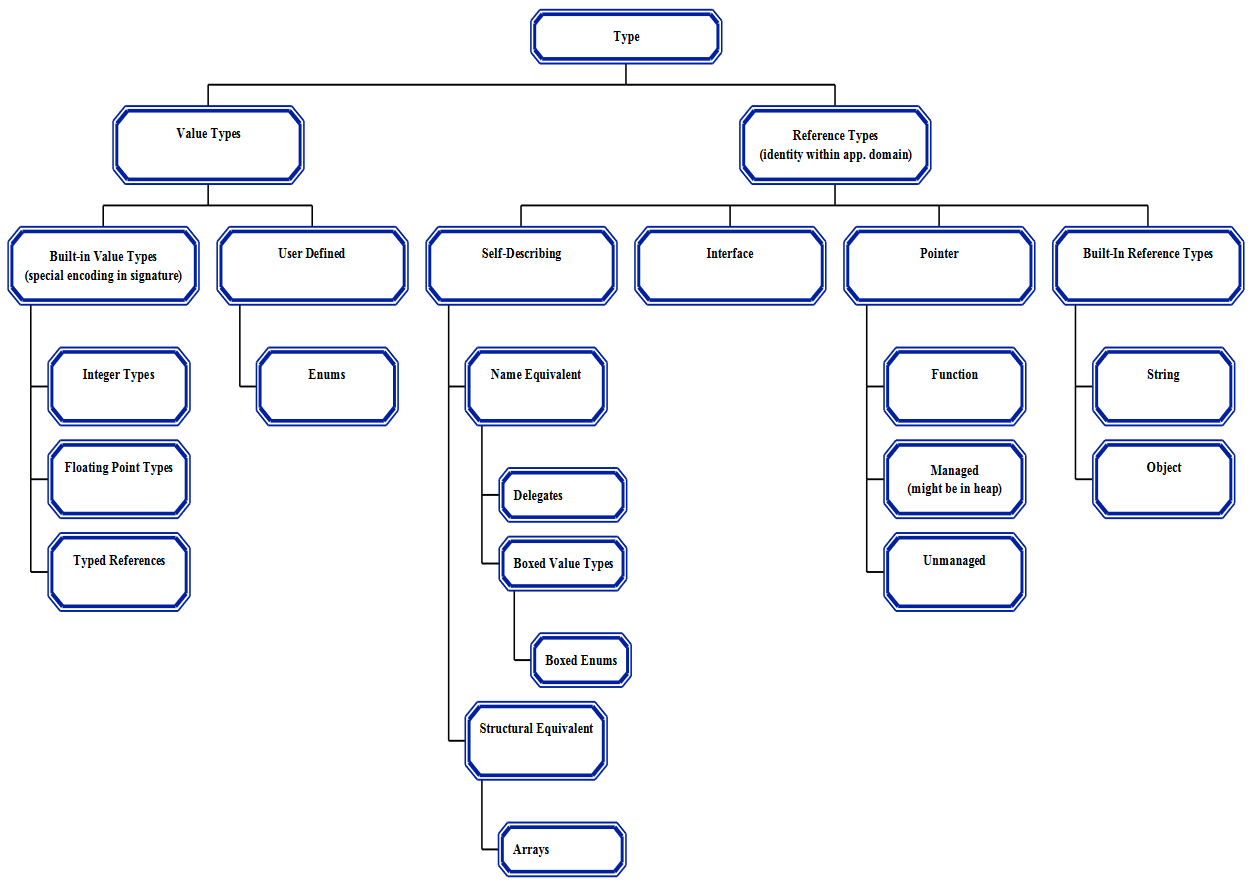
There are several kinds of objects and values, as shown in the (informative) diagram below.
The generics feature allows a whole family of types and methods to be defined using a pattern, which includes placeholders called generic parameters. These generic parameters are replaced, as required, by specific types, to instantiate whichever member of the family is actually required. The design of generics meets the following goals:
Orthogonality: Where possible, generic types can occur in any context where existing CLI types can occur.
Language independence: No assumptions about the source language are made. But CLI-generics attempts to support existing generics-like features of as many languages as possible. Furthermore, the design permits clean extensions of languages currently lacking generics.
Implementation independence: An implementation of the CLI is allowed to specialize representations and code on a case-by-case basis, or to share all representations and code, perhaps boxing and unboxing values to achieve this.
Implementation efficiency: Performance of generics is no worse than the use of Object to simulate generics; a good implementation can do much better, avoiding casts on reference type instantiations, and producing specialized code for value type instantiations.
Statically checkable at point of definition: A generic type definition can be validated and verified independently of its instantiations. Thus, a generic type is statically verifiable, and its methods are guaranteed to JIT-compile for all valid instantiations.
Uniform behavior with respect to generic parameters: In general, the behavior of parameterized types and generic methods is "the same" at all type instantiations.
In addition, CLI supports covariant and contravariant generic parameters, with the following characteristics:
It is type-safe (based on purely static checking)
Simplicity: in particular, variance is only permitted on generic interfaces and generic delegates (not classes or value-types)
Variance affects call instructions that invoke a method from a variant interface. For nonvariant interfaces, a method of the exact type specified in the call instruction must exist, and is invoked. For variant interfaces, a method of the exact type specified in the call instruction need not exist; only one that is a variant match for the type. Furthermore, if multiple matches exist, the declaration order and derivation of the methods determine which one is called, and a variant match may be invoked even if an exact match exists (II.12.2). All language systems targeting the CLI must take into account variance whether or not the source language supports the feature.
Enable implementation of more complex covariance scheme as used in some languages, e.g. Eiffel.
This figure is informative.
[Note: A managed pointer might point into the heap. end note]
End informative figure.
This subclause contains only informative text.
The term type is often used in the world of value-oriented programming to mean data representation. In the object-oriented world it usually refers to behavior rather than to representation. In the CTS, type is used to mean both of these things: two entities have compatible types if and only if they have compatible representations and compatible behaviors. Thus, in the CTS, if one type is derived from a base type, then instances of the derived type can be substituted for instances of the base type because both the representation and the behavior are compatible.
Unlike in some OOP languages, in the CTS, two objects that have fundamentally different representations have different types. Some OOP languages use a different notion of type. They consider two objects to have the same type if they respond in the same way to the same set of messages. This notion is captured in the CTS by saying that the objects implement the same interface.
Similarly, some OOP languages (e.g., Smalltalk) consider message passing to be the fundamental model of computation. In the CTS, this corresponds to calling virtual methods (see §I.8.4.4), where the signature of the virtual method plays the role of the message.
The CTS itself does not directly capture the notion of "typeless programming." That is, there is no way to call a non-static method without knowing the type of the object. Nevertheless, typeless programming can be implemented based on the facilities provided by the reflection package (see Partition IV - Reflection) if it is implemented.
End informative text.
Types describe values. Any value described by a type is called an instance of that type. Any use of a value—storing it, passing it as an argument, operating on it—requires a type. This applies in particular to all variables, arguments, evaluation stack locations, and method results. The type defines the allowable values and the allowable operations supported by the values of the type. All operators and functions have expected types for each of the values accessed or used.
Every value has an exact type that fully describes its type properties. Every value is an instance of its exact type, and can be an instance of other types as well. In particular, if a value is an instance of a type that inherits from another type, it is also an instance of that other type.
There are two kinds of types: value types and reference types.
Value types – The values described by a value type are self-contained (each can be understood without reference to other values).
Reference types – A value described by a reference type denotes the location of another value. There are four kinds of reference type:
An object type is a reference type of a self-describing value (see §I.8.2.3). Some object types (e.g., abstract classes) are only a partial description of a value.
An interface type is always a partial description of a value, potentially supported by many object types.
A pointer type is a compile-time description of a value whose representation is a machine address of a location. Pointers are divided into managed (§I.8.2.1.1, §I.12.1.1.2) and unmanaged (§I.8.9.2).
Built-in reference types.
A managed pointer (§I.12.1.1.2), or byref (§I.8.6.1.3, §I.12.4.1.5.2), can point to a local variable, parameter, field of a compound type, or element of an array. However, when a call crosses a remoting boundary (see §I.12.5) a conforming implementation can use a copy-in/copyout mechanism instead of a managed pointer. Thus programs shall not rely on the aliasing behavior of true pointers. Managed pointer types are only allowed for local variable (§I.8.6.1.3) and parameter signatures (§I.8.6.1.4); they cannot be used for field signatures (§I.8.6.1.2), as the element type of an array (§I.8.9.1), and boxing a value of managed pointer type is disallowed (§I.8.2.4). Using a managed pointer type for the return type of methods (§I.8.6.1.5) is not verifiable (§I.8.8).
[Rationale: For performance reasons items on the GC heap may not contain references to the interior of other GC objects, this motivates the restrictions on fields and boxing. Further returning a managed pointer which references a local or parameter variable may cause the reference to outlive the variable, hence it is not verifiable. end rationale]
There are three value types in the Base Class Library (see Partition
IV - BCL): System.TypedReference,
System.RuntimeArgumentHandle, and
System.ArgIterator; which are treated specially by the
CLI.
The value type System.TypedReference, or typed
reference or typedref, (§I.8.2.2, §I.8.6.1.3,
§[I.12.4.1.5.3]) contains both a managed pointer to a location and a
runtime representation of the type that can be stored at that location.
Typed references have the same restrictions as byrefs. Typed references
are created by the CIL instruction mkrefany (see Partition
III). The value types System.RuntimeArgumentHandle and
System.ArgIterator (see Partition
IV and CIL instruction arglist in Partition
III), contain pointers into the VES stack. They can be used for
local variable and parameter signatures. The use of these types for
fields, method return types, the element type of an array, or in boxing
is not verifiable (§I.8.8). These two
types are referred to as byref-like types.
The following data types are an integral part of the CTS and are supported directly by the VES. They have special encoding in the persisted metadata:
| Name in CIL assembler (see Partition II) | CLS Type? | Name in class library (see Partition IV) | Description |
|---|---|---|---|
bool1 |
Yes | System.Boolean |
True/false value |
char1 |
Yes | System.Char |
Unicode 16-bit char. |
object |
Yes | System.Object |
Object or boxed value type |
string |
Yes | System.String |
Unicode string |
float32 |
Yes | System.Single |
IEC 60559:1989 32-bit float |
float64 |
Yes | System.Double |
IEC 60559:1989 64-bit float |
int8 |
No | System.SByte |
Signed 8-bit integer |
int16 |
Yes | System.Int16 |
Signed 16-bit integer |
int32 |
Yes | System.Int32 |
Signed 32-bit integer |
int64 |
Yes | System.Int64 |
Signed 64-bit integer |
native int |
Yes | System.IntPtr |
Signed integer, native size |
native unsigned int |
No | System.UIntPtr |
Unsigned integer, native size |
typedref |
No | System.TypedReference |
Pointer plus exact type |
unsigned int8 |
Yes | System.Byte |
Unsigned 8-bit integer |
unsigned int16 |
No | System.UInt16 |
Unsigned 16-bit integer |
unsigned int32 |
No | System.UInt32 |
Unsigned 32-bit integer |
unsigned int64 |
No | System.UInt64 |
Unsigned 64-bit integer |
1 bool and char are integer
types in the categorization shown in the figure above.
A type fully describes a value if it unambiguously defines the value's representation and the operations defined on that value.
For a value type, defining the representation entails describing the sequence of bits that make up the value's representation. For a reference type, defining the representation entails describing the location and the sequence of bits that make up the value's representation.
A method describes an operation that can be performed on values of an exact type. Defining the set of operations allowed on values of an exact type entails specifying named methods for each operation.
Some types are only a partial description; for example, interface types. These types describe a subset of the operations and none of the representation, and hence, cannot be an exact type of any value. Hence, while a value has only one exact type, it can also be a value of many other types as well. Furthermore, since the exact type fully describes the value, it also fully specifies all of the other types that a value of the exact type can have.
While it is true that every value has an exact type, it is not always possible to determine the exact type by inspecting the representation of the value. In particular, it is never possible to determine the exact type of a value of a value type. Consider two of the built-in value types, 32-bit signed and unsigned integers. While each type is a full specification of their respective values (i.e., an exact type) there is no way to derive that exact type from a value's particular 32-bit sequence.
For some values, called objects, it is always
possible to determine the exact type from the value. Exact types of
objects are also called object types. Objects are
values of reference types, but not all reference types describe objects.
Consider a value that is a pointer to a 32-bit integer, a kind of
reference type. There is no way to discover the type of the value by
examining the pointer bits; hence it is not an object. Now consider the
built-in CTS reference type System.String (see Partition
IV). The exact type of a value of this type is always determinable
by examining the value, hence values of type System.String
are objects, and System.String is an object type.
For every value type, the CTS defines a corresponding reference type called the boxed type. The reverse is not true: In general, reference types do not have a corresponding value type. The representation of a value of a boxed type (a boxed value) is a location where a value of the value type can be stored. A boxed type is an object type and a boxed value is an object.
A boxed type cannot be directly referred to by name, therefore no
field or local variable can be given a boxed type. The closest named
base class to a boxed enumerated value type is System.Enum;
for all other value types it is System.ValueType. Fields
typed System.ValueType can only contain the null value or
an instance of a boxed value type. Locals typed System.Enum
can only contain the null value or an instance of a boxed enumeration
type.
All value types have an operation called box. Boxing a
value of any value type produces its boxed value; i.e., a value of the
corresponding boxed type containing a bitwise copy of the original
value. If the value type is a nullable type—defined as an instantiation
of the value type System.Nullable<T>—the result is a
null reference or bitwise copy of its Value property of
type T, depending on its HasValue property
(false and true, respectively). All boxed types have an operation called
unbox, which results in a managed pointer to the bit
representation of the value.
The box instruction can be applied to more than just
value types; such types are called boxable types. A type is
boxable if it is one of the following:
A value type (including instantiations of generic value types) excluding typed references (§I.8.2.1.1). Boxing a byref-like type is not verifiable (§I.8.2.1.1).
[Rationale: Typed references are excluded so that objects in the GC heap cannot contain references to the interior of other GC objects (§I.8.2.1.1). Byref-like types contain embedded pointers to entries in the VES stack. If byref-like types are boxed these embedded pointers could outlive the entries to which they point, so this operation is unverifiable. end rationale]
A reference type (including classes, arrays, delegates, and instantiations of generic classes) excluding managed pointers/byrefs (§I.8.2.1.1)
A generic parameter (to a generic type definition, or a generic
method definition) [Note: Boxing and unboxing of generic
arguments adds performance overhead to a CLI implementation. The
constrained. prefix can improve performance during virtual
dispatch to a method defined by a value type, by avoiding boxing the
value type. end note]
The type System.Void is never boxable.
Interfaces and inheritance are defined only on reference types. Thus,
while a value type definition (§I.8.9.7) can specify both
interfaces that shall be implemented by the value type and the class
(System.ValueType or System.Enum) from which
it inherits, these apply only to boxed values.
CLS Rule 3:
Boxed value types are not CLS-compliant.
[Note: In lieu of boxed types, use
System.Object,System.ValueType, orSystem.Enum, as appropriate.CLS (consumer): Need not import boxed value types.
CLS (extender): Need not provide syntax for defining or using boxed value types.
CLS (framework): Shall not use boxed value types in its publicly exported aspects. end note]
There are two binary operators defined on all pairs of values: identity and equality. They return a Boolean result, and are mathematical equivalence operators; that is, they are:
Reflexive – a op a is true.
Symmetric – a op b is true if and only if
b op a is true.
Transitive – if a op b is true and
b op c is true, then a op c is true.
In addition, while identity always implies equality, the reverse is
not true. To understand the difference between these operations,
consider three variables, A, B, and C, whose type is
System.String, where the arrow is intended to mean "is a
reference to":
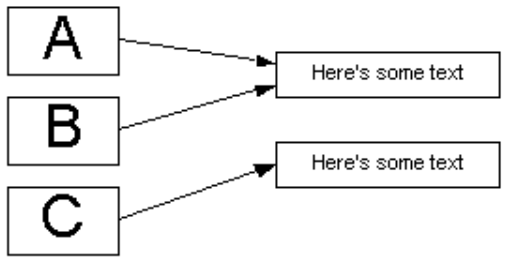
The values of the variables are identical if the locations of the sequences of characters are the same (i.e., there is, in fact, only one string in memory). The values stored in the variables are equal if the sequences of characters are the same. Thus, the values of variables A and B are identical, the values of variables A and C as well as B and C are not identical, and the values of all three of A, B, and C are equal.
The identity operator is defined by the CTS as follows.
If the values have different exact types, then they are not identical.
Otherwise, if their exact type is a value type, then they are identical if and only if the bit sequences of the values are the same, bit by bit.
Otherwise, if their exact type is a reference type, then they are identical if and only if the locations of the values are the same.
Identity is implemented on System.Object via the
ReferenceEquals method.
For value types, the equality operator is part of the definition of the exact type. Definitions of equality should obey the following rules:
Equality should be an equivalence operator, as defined above.
Identity should imply equality, as stated earlier.
If either (or both) operand is a boxed value, equality should be computed by
first unboxing any boxed operand(s), and then
applying the usual rules for equality on the resulting values.
Equality is implemented on System.Object via the
Equals method.
[Note: Although two floating point NaNs are defined by IEC
60559:1989 to always compare as unequal, the contract for
System.Object.Equals requires that overrides must satisfy
the requirements for an equivalence operator. Therefore,
System.Double.Equals and System.Single.Equals
return True when comparing two NaNs, while the equality operator returns
False in that case, as required by the IEC standard. end
note]
Values are stored in locations. A location can hold only one value at a time. All locations are typed. The type of the location embodies the requirements that shall be met by values that are stored in the location. Examples of locations are local variables and parameters.
More importantly, the type of the location specifies the restrictions on usage of any value that is loaded from that location. For example, a location can hold values of potentially many exact types as long as all of the types are assignable-to the type of the location (see below). All values loaded from a location are treated as if they are of the type of the location. Only operations valid for the type of the location can be invoked even if the exact type of the value stored in the location is capable of additional operations.
A value can be stored in a location only if one of the types of the value is assignment compatible with the type of the location. A type is always assignable-to itself. Assignment compatibility can often be determined at compile time, in which case, there is no need for testing at run time. Assignment compatibility is described in detail in §I.8.7.
Sometimes it is desirable to take a value of a type that is not assignable-to a location, and convert the value to a type that is assignable-to the type of the location. This is accomplished through coercion of the value. Coercion takes a value of a particular type and a desired type and attempts to create a value of the desired type that has equivalent meaning to the original value. Coercion can result in representation change as well as type change; hence coercion does not necessarily preserve object identity.
There are two kinds of coercion: widening, which never loses information, and narrowing, in which information might be lost. An example of a widening coercion would be coercing a value that is a 32-bit signed integer to a value that is a 64-bit signed integer. An example of a narrowing coercion is the reverse: coercing a 64-bit signed integer to a 32-bit signed integer. Programming languages often implement widening coercions as implicit conversions, whereas narrowing coercions usually require an explicit conversion.
Some coercion is built directly into the VES operations on the built-in types (see §I.12.1). All other coercion shall be explicitly requested. For the built-in types, the CTS provides operations to perform widening coercions with no runtime checks and narrowing coercions with runtime checks or truncation, according to the operation semantics.
Since a value can be of more than one type, a use of the value needs to clearly identify which of its types is being used. Since values are read from locations that are typed, the type of the value which is used is the type of the location from which the value was read. If a different type is to be used, the value is cast to one of its other types. Casting is usually a compile time operation, but if the compiler cannot statically know that the value is of the target type, a runtime cast check is done. Unlike coercion, a cast never changes the actual type of an object nor does it change the representation. Casting preserves the identity of objects.
For example, a runtime check might be needed when casting a value read from a location that is typed as holding a value of a particular interface. Since an interface is an incomplete description of the value, casting that value to be of a different interface type will usually result in a runtime cast check.
As stated above, the type defines the allowable values and the allowable operations supported by the values of the type. If the allowable values of the type have a substructure, that substructure is described via fields or array elements of the type. If there are operations that are part of the type, those operations are described via methods on the type. Fields, array elements, and methods are called members of the type. Properties and events are also members of the type.
The representation of a value (except for those of built-in types) can be subdivided into subvalues. These sub-values are either named, in which case, they are called fields, or they are accessed by an indexing expression, in which case, they are called array elements. Types that describe values composed of array elements are array types. Types that describe values composed of fields are compound types. A value cannot contain both fields and array elements, although a field of a compound type can be an array type and an array element can be a compound type.
Array elements and fields are typed, and these types never change. All of the elements in an array shall have the same type. Each field of a compound type can have a different type.
A type can associate operations with that type or with each instance of that type. Such operations are called methods. A method is named, and has a signature (see §I.8.6.1) that specifies the allowable types for all of its arguments and for its return value, if any.
A method that is associated only with the type itself (as opposed to a particular instance of the type) is called a static method (see §I.8.4.3).
A method that is associated with an instance of the type is either an instance method or a virtual method (see §I.8.4.4). When they are invoked, instance and virtual methods are passed the instance on which this invocation is to operate (known as this or a this pointer).
The fundamental difference between an instance method and a virtual method is in how the implementation is located. An instance method is invoked by specifying a class and the instance method within that class. Except in the case of instance methods of generic types, the object passed as this can be null (a special value indicating that no instance is being specified) or an instance of any type that inherits (see §I.8.9.8) from the class that defines the method. A virtual method can also be called in this manner. This occurs, for example, when an implementation of a virtual method wishes to call the implementation supplied by its base class. The CTS allows this to be null inside the body of a virtual method.
[Rationale: Allowing a virtual method to be called with a non-virtual call eliminates the need for a "call super" instruction and allows version changes between virtual and non-virtual methods. It requires CIL generators to insert explicit tests for a null pointer if they don’t want the null this pointer to propagate to called methods. end rationale]
A virtual or instance method can also be called by a different mechanism, a virtual call. Any type that inherits from a type that defines a virtual method can provide its own implementation of that method (this is known as overriding, see §I.8.10.4). It is the exact type of the object (determined at runtime) that is used to decide which of the implementations to invoke.
Types can declare locations that are associated with the type rather than any particular value of the type. Such locations are static fields of the type. As such, static fields declare a location that is shared by all values of the type. Just like non-static (instance) fields, a static field is typed and that type never changes. Static fields are always restricted to a single application domain basis (see §I.12.5), but they can also be allocated on a per-thread basis.
Similarly, types can also declare methods that are associated with the type rather than with values of the type. Such methods are static methods of the type. Since an invocation of a static method does not have an associated value on which the static method operates, there is no this pointer available within a static method.
An object type can declare any of its methods as virtual. Unlike other methods, each exact type that implements the type can provide its own implementation of a virtual method. A virtual method can be invoked through the ordinary method call mechanism that uses the static type, method name, and types of parameters to choose an implementation, in which case, the this pointer can be null. In addition, however, a virtual method can be invoked by a special mechanism (a virtual call) that chooses the implementation based on the dynamically detected type of the instance used to make the virtual call rather than the type statically known at compile time. Virtual methods can be marked final (see §I.8.10.2).
Names are given to entities of the type system so that they can be referred to by other parts of the type system or by the implementations of the types. Types, fields, methods, properties, and events have names. With respect to the type system, values, locals, and parameters do not have names. An entity of the type system is given a single name (e.g., there is only one name for a type).
All name comparisons are done on a byte-by-byte (i.e., case sensitive, locale-independent, also known as code-point comparison) basis. Where names are used to access built-in VES-supplied functionality (e.g., the class initialization method) there is always an accompanying indication on the definition so as not to build in any set of reserved names.
CLS Rule 4:
Assemblies shall follow Annex 7 of Technical Report 15 of the Unicode Standard 3.0 governing the set of characters permitted to start and be included in identifiers, available online at http://www.unicode.org/unicode/reports/tr15/tr15-18.html. Identifiers shall be in the canonical format defined by Unicode Normalization Form C. For CLS purposes, two identifiers are the same if their lowercase mappings (as specified by the Unicode locale-insensitive, one-toone lowercase mappings) are the same. That is, for two identifiers to be considered different under the CLS they shall differ in more than simply their case. However, in order to override an inherited definition the CLI requires the precise encoding of the original declaration be used. [Note:
CLS (consumer): Need not consume types that violate CLS Rule 4, but shall have a mechanism to allow access to named items that use one of its own keywords as the name.
CLS (extender): Need not create types that violate CLS Rule 4. Shall provide a mechanism for defining new names that obey these rules, but are the same as a keyword in the language.
CLS (framework): Shall not export types that violate CLS Rule 4. Should avoid the use of names that are commonly used as keywords in programming languages (see Partition VI - Annex D) end note]
Generally, names are not unique. Names are collected into groupings called scopes. Within a scope, a name can refer to multiple entities as long as they are of different kinds (methods, fields, nested types, properties, and events) or have different signatures.
CLS Rule 5:
All names introduced in a CLS-compliant scope shall be distinct independent of kind, except where the names are identical and resolved via overloading. That is, while the CTS allows a single type to use the same name for a method and a field, the CLS does not.
CLS Rule 6:
Fields and nested types shall be distinct by identifier comparison alone, even though the CTS allows distinct signatures to be distinguished. Methods, properties, and events that have the same name (by identifier comparison) shall differ by more than just the return type, except as specified in CLS Rule 39.
[Note: CLS (consumer): Need not consume types that violate these rules after ignoring any members that are marked as not CLS-compliant.
CLS (extender): Need not provide syntax for defining types that violate these rules.
CLS (framework): Shall not mark types as CLS-compliant if they violate these rules unless they mark sufficient offending items within the type as not CLS-compliant so that the remaining members do not conflict with one another. end note]
A named entity has its name in exactly one scope. Hence, to identify
a named entity, both a scope and a name need to be supplied. The scope
is said to qualify the name. Types provide a scope for
the names in the type; hence types qualify the names in the type. For
example, consider a compound type Point that has a field
named x. The name "field x" by itself does not
uniquely identify the named field, but the qualified name "field
x in type Point" does.
Since types are named, the names of types are also grouped into scopes. To fully identify a type, the type name shall be qualified by the scope that includes the type name. A type name is scoped by the assembly that contains the implementation of the type. An assembly is a configured set of loadable code modules and other resources that together implement a unit of functionality. The type name is said to be in the assembly scope of the assembly that implements the type. Assemblies themselves have names that form the basis of the CTS naming hierarchy.
The type definition:
Defines a name for the type being defined (i.e., the type name) and specifies a scope in which that name will be found.
Defines a member scope in which the names of the different kinds of members (fields, methods, events, and properties) are bound. The tuple of (member name, member kind, and member signature) is unique within a member scope of a type.
Implicitly assigns the type to the assembly scope of the assembly that contains the type definition.
The CTS supports an enum (also known as an enumeration type), an alternate name for an existing type. For the purposes of matching signatures, an enum shall not be the same as the underlying type. Instances of an enum, however, shall be assignable-to the underlying type, and vice versa. That is, no cast (see §I.8.3.3) or coercion (see §I.8.3.2) is required to convert from the enum to the underlying type, nor are they required from the underlying type to the enum. An enum is considerably more restricted than a true type, as follows:
It shall have exactly one instance field, and the type of that field defines the underlying type of the enumeration.
It shall not have any methods of its own.
It shall derive from System.Enum (see Partition
IV Library – Kernel Profile).
It shall not implement any interfaces of its own.
It shall not have any properties or events of its own.
It shall not have any static fields unless they are literal. (see §I.8.6.1.2)
The underlying type shall be a built-in integer type. Enums shall
derive from System.Enum, hence they are value types. Like
all value types, they shall be sealed (see §I.8.9.9).
CLS Rule 7:
The underlying type of an enum shall be a built-in CLS integer type, the name of the field shall be "
value__", and that field shall be markedRTSpecialName.CLS Rule 8:
There are two distinct kinds of enums, indicated by the presence or absence of the
System.FlagsAttribute(see Partition IV Library) custom attribute. One represents named integer values; the other represents named bit flags that can be combined to generate an unnamed value. The value of an enum is not limited to the specified values.CLS Rule 9:
Literal static fields (see §I.8.6.1) of an enum shall have the type of the enum itself.
[Note:
CLS (consumer): Shall accept the definition of enums that follow these rules, but need not distinguish flags from named values.
CLS (extender): Same as consumer. Extender languages are encouraged to allow the authoring of enums, but need not do so.
CLS (framework): Shall not expose enums that violate these rules, and shall not assume that enums have only the specified values (even for enums that are named values). end note]
To refer to a named entity in a scope, both the scope and the name in the scope shall be visible (see §I.8.5.3.1). Visibility is determined by the relationship between the entity that contains the reference (the referent) and the entity that contains the name being referenced. Consider the following pseudo-code:
class A
{ int32 IntInsideA;
}
class B inherits from A
{ method X(int32, int32)
  { IntInsideA := 15;
  }
}
If we consider the reference to the field IntInsideA in
class A:
We call class B the referent
because it has a method that refers to that field,
We call IntInsideA in class A the
referenced entity.
There are two fundamental questions that need to be answered in order to decide whether the referent is allowed to access the referenced entity. The first is whether the name of the referenced entity is visible to the referent. If it is visible, then there is a separate question of whether the referent is accessible (see §I.8.5.3.2).
Access to a member of a type is permitted only if all three of the following conditions are met:
The type is visible and, in the case of a nested type, accessible.
The member is accessible.
All relevant security demands (see §I.8.5.3.3) have been granted.
An instantiated generic type is visible from some assembly if and
only if the generic type itself and each of its component parts (generic
type definition and generic arguments) are visible. For example, if
List is exported from assembly A (i.e.,
declared "public") and MyClass is defined in assembly
B but not exported, then List<MyClass>
is visible only from within assembly B.
Accessibility of members of instantiated generic types is independent of instantiation.
Access to a member C<T1,…Tn>.m is therefore permitted if the following conditions are met:
C<T1,…Tn> is visible.
Member m within generic type C (i.e., C.m) is accessible.
Security permissions have been granted.
Only type names, not member names, have controlled visibility. Type names fall into one of the following three categories
Exported from the assembly in which they are defined. While a type can be marked to allow it to be exported from the assembly, it is the configuration of the assembly that decides whether the type name is made available.
Not exported outside the assembly in which they are defined.
Nested within another type. In this case, the type itself has the visibility of the type inside of which it is nested (its enclosing type). See §I.8.5.3.4.
A top-level named type is exported if and only if it has public visibility. A type generated by a type definer is exported if and only if it is made from exported types.
A type generated by a type definer is visible if all types from which it was generated are visible.
A type scopes all of its members, and it also specifies the accessibility rules for its members. Except where noted, accessibility is decided based only on the statically visible type of the member being referenced and the type and assembly that is making the reference. The CTS supports seven different rules for accessibility:
compiler-controlled – accessible only through the use of a definition, not a reference, hence only accessible from within a single compilation unit and under the control of the compiler.
private – accessible only to referents in the implementation of the exact type that defines the member.
family – accessible to referents that support the same type (i.e., an exact type and all of the types that inherit from it). For verifiable code (see §I.8.8), there is an additional requirement that can require a runtime check: the reference shall be made through an item whose exact type supports the exact type of the referent. That is, the item whose member is being accessed shall inherit from the type performing the access.
assembly – accessible only to referents in the same assembly that contains the implementation of the type.
family-and-assembly – accessible only to referents that qualify for both family and assembly access.
family-or-assembly – accessible only to referents that qualify for either family or assembly access.
public – accessible to all referents.
A member or nested type is exported if and only if it has public, family-or-assembly, or family accessibility, and its defining type (in the case of members) or its enclosing type (in the case of nested types) is exported.
The accessibility of a type definer is the same as that for the type from which it was generated.
In general, a member of a type can have any one of the accessibility rules assigned to it. There are three exceptions, however:
Members (other than nested types) defined by an interface shall be public.
When a type defines a virtual method that overrides an inherited definition, the accessibility shall either be identical in the two definitions or the overriding definition shall permit more access than the original definition. For example, it is possible to override an assembly virtual method with a new implementation that is public virtual, but not with one that is family virtual. In the case of overriding a definition derived from another assembly, it is not considered restricting access if the base definition has family-or-assembly access and the override has only family access.
A member defined by a nested type, or a nested type enclosed by a nested type, shall not have greater accessibility than the nested type that defines it (in the case of a member) or the nested type that encloses it (in the case of a nested type).
[Rationale: Languages including C++ allow this "widening" of access. Restricting access would provide an incorrect illusion of security since simply casting an object to the base class (which occurs implicitly on method call) would allow the method to be called despite the restricted accessibility. To prevent overriding a virtual method use final (see §I.8.10.2) rather than relying on limited accessibility. end rationale]
CLS Rule 10:
Accessibility shall not be changed when overriding inherited methods, except when overriding a method inherited from a different assembly with accessibility family-or-assembly. In this case, the override shall have accessibility family.
[Note:
CLS (consumer): Need not accept types that widen access to inherited virtual methods.
CLS (extender): Need not provide syntax to widen access to inherited virtual methods.
CLS (frameworks): Shall not rely on the ability to widen access to a virtual method, either in the exported portion of the framework or by users of the framework. end note]
Access to members is also controlled by security demands that can be attached to an assembly, type, method, property, or event. Security demands are not part of a type contract (see §I.8.6), and hence are not inherited. There are two kinds of demands:
An inheritance demand. When attached to a type, it requires that any type that wishes to inherit from this type shall have the specified security permission. When attached to a non-final virtual method, it requires that any type that wishes to override this method shall have the specified permission. It shall not be attached to any other member.
A *reference demand. Any attempt to resolve a reference to the marked item shall have specified security permission.
Only one demand of each kind can be attached to any item. Attaching a
security demand to an assembly implies that it is attached to all types
in the assembly unless another demand of the same kind is attached to
the type. Similarly, a demand attached to a type implies the same demand
for all members of the type unless another demand of the same kind is
attached to the member. For additional information, see Declarative
Security in Partition II,
and the classes in the System.Security namespace in Partition
IV.
A type can be a member of an enclosing type, in which case, it is a nested type. A nested type has the same visibility as the enclosing type and has an accessibility as would any other member of the enclosing type. This accessibility determines which other types can make references to the nested type. That is, for a class to define a field or array element of a nested type, have a method that takes a nested type as a parameter or returns one as value, etc., the nested type shall be both visible and accessible to the referencing type. A nested type is part of the enclosing type so its methods have access to all members of its enclosing type, as well as family access to members of the type from which it inherits (see §I.8.9.8). The names of nested types are scoped by their enclosing type, not their assembly (only top-level types are scoped by their assembly). There is no requirement that the names of nested types be unique within an assembly.
Contracts are named. They are the shared assumptions on a set of signatures (see §I.8.6.1) between all implementers and all users of the contract. The signatures are the part of the contract that can be checked and enforced.
Contracts are not types; rather they specify requirements on the implementation of types. Types state which contracts they abide by (i.e., which contracts all implementations of the type shall support). An implementation of a type can be verified to check that the enforceable parts of a contract—the named signatures—have been implemented. The kinds of contracts are:
Class contract – A class contract is specified with a class definition. Hence, a class definition defines both the class contract and the class type. The name of the class contract and the name of the class type are the same. A class contract specifies the representation of the values of the class type. Additionally, a class contract specifies the other contracts that the class type supports (e.g., which interfaces, methods, properties, and events shall be implemented). A class contract, and hence the class type, can be supported by other class types as well. A class type that supports the class contract of another class type is said to inherit from that class type.
Interface contract – An interface contract is specified with an interface definition. Hence, an interface definition defines both the interface contract and the interface type. The name of the interface contract and the name of the interface type are the same. Many types can support the same interface contract. Like class contracts, interface contracts specify which other contracts the interface supports (e.g., which interfaces, methods, properties, and events shall be implemented). [Note: An interface type can never fully describe the representation of a value. Therefore an interface type can never support a class contract, and hence can never be a class type or an exact type. end note]
Method contract – A method contract is specified with a method definition. A method contract is a named operation that specifies the contract between the implementation(s) of the method and the callers of the method. A method contract is always part of a type contract (class, value type, or interface), and describes how a particular named operation is implemented. The method contract specifies the contracts that each parameter to the method shall support and the contracts that the return value shall support, if there is a return value.
Property contract – A property contract is specified with a property definition. There is an extensible set of operations for handling a named value, which includes a standard pair for reading the value and changing the value. A property contract specifies method contracts for the subset of these operations that shall be implemented by any type that supports the property contract. A type can support many property contracts, but any given property contract can be supported by exactly one type. Hence, property definitions are a part of the type definition of the type that supports the property.
Event contract – An event contract is specified with an event definition. There is an extensible set of operations for managing a named event, which includes three standard methods (register interest in an event, revoke interest in an event, fire the event). An event contract specifies method contracts for all of the operations that shall be implemented by any type that supports the event contract. A type can support many event contracts, but any given event contract can be supported by exactly one type. Hence, event definitions are a part of the type definition of the type that supports the event.
Signatures are the part of a contract that can be checked and automatically enforced. Signatures are formed by adding constraints to types and other signatures. A constraint is a limitation on the use of or allowed operations on a value or location. Example constraints would be whether a location can be overwritten with a different value or whether a value can ever be changed. All locations have signatures, as do all values. Assignment compatibility requires that the signature of the value, including constraints, be compatible with the signature of the location, including constraints. There are four fundamental kinds of signatures: type signatures (see §I.8.6.1.1), location signatures (see §I.8.6.1.2), parameter signatures (see §I.8.6.1.4), and method signatures (see §I.8.6.1.5). (A fifth kind, a local signature (see §I.8.6.1.3) is really a version of a location signature.)
CLS Rule 11:
All types appearing in a signature shall be CLS-compliant. All types composing an instantiated generic type shall be CLS-compliant.
CLS Rule 12:
The visibility and accessibility of types and members shall be such that types in the signature of any member shall be visible and accessible whenever the member itself is visible and accessible. For example, a public method that is visible outside its assembly shall not have an argument whose type is visible only within the assembly. The visibility and accessibility of types composing an instantiated generic type used in the signature of any member shall be visible and accessible whenever the member itself is visible and accessible. For example, an instantiated generic type present in the signature of a member that is visible outside its assembly shall not have a generic argument whose type is visible only within the assembly.
[Note:
CLS (consumer): Need not accept types whose members violate these rules. CLS (extender): Need not provide syntax to violate these rules.
CLS (framework): Shall not violate this rule in its exported types and their members. end note]
The following subclauses describe the various kinds of signatures. These descriptions are cumulative: the simplest signature is a type signature; a location signature is a type signature plus (optionally) some additional attributes; and so forth.
Type signatures define the constraints on a value and its usage. A type, by itself, is a valid type signature. The type signature of a value cannot be determined by examining the value or even by knowing the class type of the value. The type signature of a value is derived from the location signature (see below) of the location from which the value is loaded or from the operation that computes it. Normally the type signature of a value is the type in the location signature from which the value is loaded.
[Rationale: The distinction between a Type Signature and a Location Signature (below) is made because certain constraints, such as "constant," are constraints on values not locations. Future versions of this standard, or non-standard extensions, can introduce type constraints, thus making the distinction meaningful. end rationale]
Assignment compatibility refers to the ability to
store a value of type T (statically described by a type
signature) into a location of type U (described by a location
signature), and is sometimes abbreviated U := T.
Because the type signature for T is described statically, the
value might not actually be of the type described by the signature, but
rather something compatible with that type. No location or value shall
have type System.Void.
The formal description of assignment compatibility is provided here, and is extended in Partition III, Verification type compatibility, with the verifier-assignable-to relation.
There are different rules for determining the compatibility of types, depending upon the context in which they are evaluated. The following relations are defined in this section:
compatible-with – this is the relation used by
castclass (§III.4.3)
and isinst (§III.4.6), and
in determining the validity of variant generic arguments.
[Note: operations based on this relation do not change the
representation of a value. When casting, the source type is the dynamic
type of the value. end note]
assignable-to – this is the relation used for general assignment; including load and store instructions (§III.3), implicit argument coercion (§III.1.6), and method return (§III.3.57). [Note: operations based on this relation may change the representation of a value. When assigning, the source type is the static type of the value. end note]
array-element-compatible-with – this is the auxiliary relation used to determine the validity of assignments to array elements
pointer-element-compatible-with – this is the auxiliary relation used to determine the compatibility of managed pointers
Informative text.
These relations are defined in terms of six type subsets:
storage types – these are the types that can occur as location (§I.8.6.1.2), local (§I.8.6.1.3) and parameter (§I.8.6.1.4) signatures. [Note: method signatures (§I.8.6.1.5) are not included here as there are no method values which can be assigned, delegate types (§I.8.9.3) are reference types (§I.8.2.1) and may occur in the above signatures. end note]
underlying types – in the CTS enumerations are alternate names for existing types (§I.8.5.2), termed their underlying type. Except for signature matching (§I.8.5.2) enumerations are treated as their underlying type. This subset is the set of storage types with the enumerations removed.
reduced types – a value of value type S can be stored into, or loaded from, an array of value type T; and an array of value type S can be assigned to an array of value type T; if and only if S and T have the same reduced type. The reduced types are a subset of the underlying types.
verification types – the verification algorithm treats certain types as interchangeable, assigning them a common verification type. The verification types are a subset of the reduced types.
intermediate types – only a subset of the built-in value types can be represented on the evaluation stack (§I.12.1). Values of other built-in value types are translated to/from their intermediate type when loaded onto/stored from the evaluation stack. The intermediate types are a subset of the verification types plus the floating-point type F (which is not a member of the above four subsets).
transient types – these are types which can only occur on the evaluation stack: boxed types, controlled-mutability managed pointer types, and the null type. Assignment compatibility for these types is defined by the verifier-assignable-to relation defined in §III.1.8.1.2.3. The precise definitions of underlying type, reduced type, verification type and intermediate type are given below.
End informative text.
Floating-point values have two types; the nominal type, and the
representation type. There are three floating-point types:
float32, float64 and F. A value
of (nominal) type float32 or float64 may be
represented by an implementation using a value of type F.
See §I.12.1.3
for complete details. Unless explicitly indicated any reference to
floating-point types refers to the nominal type, in particular when
referring to signatures (§I.8.6.1)
and assignment compatibility. Consequently when the assignment
compatibility rules indicate that a floating-point representation may
change based on the (nominal) types the representation types may already
be the same and no change is actually performed.
In the following definitions and relations:
S, T, U, V, W represent arbitrary type expressions;
N, M represent declared type names; and
X, Y represent declared (formal) type parameters.
The notation:
T is of the form N<{Xi ← Ti}>
is defined to mean:
T is a possibly-instantiated object, interface, delegate or value type of the form N<T1,…,Tn>, n ≥ 0 (for n = 0 the empty <> are omitted), and N is declared with generic parameters X1,…,Xn
The following definitions are used in defining assignment compatibility.
The underlying type of a type T is the following:
If T is an enumeration type, then its underlying type is the underlying type declared in the enumeration's definition.
Otherwise, the underlying type is itself.
The reduced type of a type T is the following:
If the underlying type of T is:
int8, or unsigned int8, then its
reduced type is int8.
int16, or unsigned int16, then its
reduced type is int16.
int32, or unsigned int32, then its
reduced type is int32.
int64, or unsigned int64, then its
reduced type is int64.
native int, or unsigned native int,
then its reduced type is native int.
Otherwise, the reduced type is itself.
[Note: in other words the reduced type ignores the semantic differences between enumerations and the signed and unsigned integer types; treating these types the same if they have the same number of bits. end note]
The verification type (§III.1.8.1.2.1) of a type T is the following:
If the reduced type of T is:
int8 or bool, then its verification
type is int8.
int16 or char, then its verification
type is int16.
int32 then its verification type is
int32.
int64 then its verification type is
int64.
native int, then its verification type is
native int.
If T is a managed pointer type
S& and the reduced type of S is:
int8 or bool, then its verification
type is int8&.
int16 or char, then its verification
type is int16&.
int32, then its verification type is
int32&.
int64, then its verification type is
int64&.
native int, then its verification type is
native int&.
Otherwise, the verification type is itself.
[Note: in other words the verification type ignores the semantic differences between enumerations, characters, booleans, the signed and unsigned integer types, and managed pointers to any of these; treating these types the same if they have the same number of bits or point to types with the same number of bits. end note]
The intermediate type of a type T is the following:
If the verification type of T is int8,
int16, or int32, then its intermediate type is
int32.
If the verification type of T is a floating-point type
then its intermediate type is F (§III.1.1.1).
Otherwise, the intermediate type is the verification type of
T.
[Note: the intermediate type is similar to the verification type in stack state according to the table in III.1.8.1.2.1, differing only for floating-point types. The intermediate type of a type T may have a different representation and meaning than T. end note]
The direct base class of a type T is the following:
If T is an array type (zero-based single-dimensional, or
general) then its direct base class is
System.Array.
If T is an interface type, then its direct base class is
System.Object.
If T is of the form N<{Xi ← Ti}>, and N is declared to extend a type U of the form M<{Yj ← Sj}>, then the direct base class of T is U with any occurrence of X1,…,Xn in S1,…,Sm replaced by the corresponding T1,…,Tn.
For any other form of type T, there is no direct base class.
[Note: as a result of this definition, only
System.Object itself, the unboxed form of a value type, and
generic parameters have no direct base class. end note]
The interfaces directly implemented by a type T are the following:
If T is of the form N<{Xi ← Ti}> and is declared to implement (or require implementation of, if N is an interface) interfaces U1,…,Um of the form Mj<{Yj,k ← Sj,k}>, then the interfaces directly implemented by T are U1,…,Um with any occurrence of Xi in Sj,k replaced by the corresponding Ti.
For any other form of type T, there are no directly implemented interfaces.
A type T is a reference type if and only if one of the following holds.
T is a possibly-instantiated object, delegate or interface of the form N<T1,…,Tn> (n ≥ 0)
T is an array type
[Note: generic parameters are not reference types. Therefore, the compatibility rules for reference types do not apply. See the definition of verification compatibility in Partition III for the special case of boxed types. end note]
For the purpose of type compatibility when determining a type from a signature:
Any byref (&) constraint (§I.8.6.1.3)
is considered part of the type;
The special signature typed reference (§I.8.6.1.3) is the type typedref;
Any modopt, modreq, or pinned modifiers are ignored; and
Any calling convention is considered part of the type.
[Note: the literal constraint is not considered as fields so marked cannot be referenced from CIL (§I.8.6.1.2). end note]
A signature type T is compatible-with a signature type U if and only if at least one of the following holds. [Formally, the compatible-with relation is the smallest relation that is closed under the following rules.]
T is identical to U. [Note: this is reflexivity. end note]
There exists some V such that T is compatible-with V and V is compatible-with U. [Note: this is transitivity. end note]
T is a reference type, and U is the direct base class of T.
T is a reference type, and U is an interface directly implemented by T.
T is a zero-based rank-1 array V[], and U is a zero-based rank-1 array W[], and V is array-element-compatible-with W.
T is an array with rank r and element type V, and U is an array with the same rank r and element type W, and V is array-element-compatible-with W.
T is a zero-based rank-1 array V[], and
U is IList<W>, and V is
array-element-compatible-with W.
T is D<T1,…,Tn> and U is D<U1,…,Un> for some interface or delegate type D with variance declarations var1 to varn, and for each i from 1 to n, one of the following holds:
vari = none (no variance), and Ti is identical to Ui
vari = + (covariance), and Ti is compatible-with Ui
vari = - (contravariance), and Ui is compatible-with Ti
T and U are method signatures and T is method-signature-compatible-with U.
A signature type T is array-element-compatible-with a signature type U if and only if T has underlying type V and U has underlying type W and either:
V is compatible-with W; or
V and W have the same reduced type.
[Note: in other words, array-element-compatible-with extends compatible-with but is agnostic with respect to enumerations and integral signed-ness. end note]
[Note: When W[] is compatible-with V[] and V and W have the same reduced type then no representation change from V to W shall be performed, rather the bits of the value shall be interpreted according to the type W rather than the type V (§III.1.1.1). end note]
[Note: Variance rules do not mirror the reduced type equivalence rules of array-element-compatible-with. Thus, for example by rule 7 above:
IList<int16> := int16[]
IList<uint16> := int16[]
But by rule 8 above:
IList<int16> :≠ IList<uint16>end note]
A method signature type T is method-signature-compatible-with a method signature type U if and only if:
For each signature, independently, if the signature is for an
instance method it carries the type of this. [Note: This is
always true for the signatures of instance method pointers produced by
the ldftn (§III.3.41) and
ldvirtftn (§III.4.18)
instructions. However, variables (as opposed to methods) whose
signatures specified in the metadata have HASTHIS set with
EXPLICITTHIS being set cannot be used in verified code and
are unsupported by method-signature-compatible-with. end
note]
The calling conventions of T and U shall match exactly, ignoring the distinction between static and instance methods (i.e., the this parameter, if any, is not treated specially).
For each parameter type of P of T, and corresponding type Q of U, P is assignable-to Q.
For the return type P of T, and return type Q of U, Q is assignable-to P.
In this section the compatible-with relation is extended to deal with managed pointer types.
A location type T is compatible-with a location type U if and only if one of the following holds.
T and U are not managed pointer types and T is compatible-with U according to the definition in §I.8.7.1.
T and U are both managed pointer types and T is pointer-element-compatible-with U.
A managed pointer type T is pointer-element-compatible-with a managed pointer type U if and only if T has verification type V and U has verification type W and V is identical to W.
In this section the relation assignable-to is defined which extends compatible-with to cover the primitive value type assignments supported by the semantics of the various load and store instructions (§III.3), implicit argument coercion (§III.1.6), and method return (§III.3.57).
A location type T is assignable-to a location type U if one of the following holds:
T is identical to U. [Note: this is reflexivity. end note]
There exists some V such that T is assignable-to V and V is assignable-to U. [Note: this is transitivity. end note]
T has intermediate type V, U has intermediate type W, and V is identical to W.
T has intermediate type native int and
U has intermediate type int32, or
vice-versa.
T is compatible-with U.
[Note: an assignment governed by assignable-to which involves an application of rules that use the intermediate type may change the representation and meaning of the assigned value as it is translated to and then from the intermediate type. end note]
Since types specify contracts, it is important to know whether a given implementation lives up to these contracts. An implementation that lives up to the enforceable part of the contract (the named signatures) is said to be type-safe. An important part of the contract deals with restrictions on the visibility and accessibility of named items as well as the mapping of names to implementations and locations in memory.
Type-safe implementations only store values described by a type signature in a location that is assignable-to (§I.8.7.3) the location signature of the location (see §I.8.6.1). Type-safe implementations never apply an operation to a value that is not defined by the exact type of the value. Type-safe implementations only access locations that are both visible and accessible to them. In a type-safe implementation, the exact type of a value cannot change.
Verification is a mechanical process of examining an implementation and asserting that it is type-safe. Verification is said to succeed if the process proves that an implementation is typesafe. Verification is said to fail if that process does not prove the type safety of an implementation. Verification is necessarily conservative: it can report failure for a type-safe implementation, but it never reports success for an implementation that is not type-safe. For example, most verification processes report implementations that do pointer-based arithmetic as failing verification, even if the implementation is, in fact, type-safe.
There are many different processes that can be the basis of verification. The simplest possible process simply says that all implementations are not type-safe. While correct and efficient this is clearly not particularly useful. By spending more resources (time and space) a process can correctly identify more type-safe implementations. It has been proven, however, that no mechanical process can, in finite time and with no errors, correctly identify all implementations as either type-safe or not type-safe. The choice of a particular verification process is thus a matter of engineering, based on the resources available to make the decision and the importance of detecting the type safety of different programming constructs.
Type definers construct a new type from existing types. Implicit types (e.g., built-in types, arrays, and pointers including function pointers) are defined when they are used. The mention of an implicit type in a signature is in and of itself a complete definition of the type. Implicit types allow the VES to manufacture instances with a standard set of members, interfaces, etc. Implicit types need not have user-supplied names.
All other types shall be explicitly defined using an explicit type definition. The explicit type definers are:
interface definitions – used to define interface types
class definitions – used to define class types, which can be either of the following:
object types (including delegates)
value types and their associated boxed types
[Note: While class definitions always define class types, not all class types require a class definition. Array types and pointer types, which are implicitly defined, are also class types. See §I.8.2.3.
Similarly, not all types defined by a class definition are object types. Array types, explicitly defined object types, and boxed types are object types. Pointer types, function pointer types, and value types are not object types. See §I.8.2.3. end note]
Class, interface, and value type definitions can be parameterized, a feature known as generic type definitions. That is, the definition of a class, interface, or value type can include generic parameters. When used, a specific instantiation of the generic class, interface, or value type is made, at which point the generic parameters are bound to specific generic arguments. The generic parameters can be constrained, so that only generic arguments that match these constraints can be used for instantiations.
An array type shall be defined by specifying the element type of the array, the rank (number of dimensions) of the array, and the upper and lower bounds of each dimension of the array. Hence, no separate definition of the array type is needed. The bounds (as well as indices into the array) shall be signed integers. While the actual bounds for each dimension are known only at runtime, the signature can specify the information that is known at compile time (e.g., no bounds, a lower bound, or both an upper and a lower bound).
Array elements shall be laid out within the array object in row-major
order (i.e., the elements associated with the rightmost array dimension
shall be laid out contiguously from lowest to highest index). The actual
storage allocated for each array element can include platform-specific
padding. (The size of this storage, in bytes, is returned by the
sizeof instruction when it is applied to the type of that
array's elements.)
Values of an array type are objects; hence an array type is a kind of object type (see §I.8.2.3). Array objects are defined by the CTS to be a repetition of locations where values of the array element type are stored. The number of repeated values is determined by the rank and bounds of the array.
Only type signatures, not location signatures, are allowed as array element types.
Exact array types are created automatically by the VES when they are required. Hence, the operations on an array type are defined by the CTS. These generally are: allocating the array based on size and lower-bound information, indexing the array to read and write a value, computing the address of an element of the array (a managed pointer), and querying for the rank, bounds, and the total number of values stored in the array.
Additionally, a created vector with element type T,
implements the interface
System.Collections.Generic.IList<U>, where
U := T. (§I.8.7)
CLS Rule 16:
Arrays shall have elements with a CLS-compliant type, and all dimensions of the array shall have lower bounds of zero. Only the fact that an item is an array and the element type of the array shall be required to distinguish between overloads. When overloading is based on two or more array types the element types shall be named types.
[Note: So-called "jagged arrays" are CLS-compliant, but when overloading multiple array types they are one-dimensional, zero-based arrays of type
System.Array.CLS (consumer): There is no need to support arrays of non-CLS types, even when dealing with instances of
System.Array.Overload resolution need not be aware of the full complexity of array types. Programmers should have access to theGet,Set, andAddressmethods on instances ofSystem.Arrayif there is no language syntax for the full range of array types.CLS (extender): There is no need to provide syntax to define non-CLS types of arrays or to extend interfaces or classes that use non-CLS array types. Shall provide access to the type
System.Array, but can assume that all instances will have a CLS-compliant type. While the full array signature must be used to override an inherited method that has an array parameter, the full complexity of array types need not be made visible to programmers. Programmers should have access to theGet,Set, andAddressmethods on instances ofSystem.Arrayif there is no language syntax for the full range of array types.CLS (framework): Non-CLS array types shall not appear in exported members. Where possible, use only one-dimensional, zero-based arrays (vectors) of simple named types, since these are supported in the widest range of programming languages. Overloading on array types should be avoided, and when used shall obey the restrictions. end note]
Array types form a hierarchy, with all array types inheriting from
the type System.Array. This is an abstract class (see §I.8.9.6.2) that represents all
arrays regardless of the type of their elements, their rank, or their
upper and lower bounds. The VES creates one array type for each
distinguishable array type. In general, array types are only
distinguished by the type of their elements and their rank. However, the
VES treats single dimensional, zero-based arrays (also known as
vectors) specially. Vectors are also distinguished by
the type of their elements, but a vector is distinct from a
single-dimensional array of the same element type that has a non-zero
lower bound. Zero-dimensional arrays are not supported. Consider the
following examples, using the syntax of CIL as described in Partition II
Metadata:
| Static specification of type | Actual type constructed | Allowed in CLS? |
|---|---|---|
int32[] |
vector of int32 |
Yes |
int32[0...5] |
vector of int32 |
Yes |
int32[1...5] |
array, rank 1, of int32 |
No |
int32[,] |
array, rank 2, of int32 |
Yes |
int32[0...3, 0...5] |
array, rank 2, of int32 |
Yes |
int32[0..., 0...] |
array, rank 2, of int32 |
Yes |
int32[1..., 0...] |
array, rank 2, of int32 |
No |
An unmanaged pointer type (also known simply as a "pointer type") is defined by specifying a location signature for the location the pointer references. Any signature of a pointer type includes this location signature. Hence, no separate definition of the pointer type is needed.
While pointer types are reference types, values of a pointer type are not objects (see §I.8.2.3), and hence it is not possible, given a value of a pointer type, to determine its exact type. The CTS provides two type-safe operations on pointer types: one to load the value from the location referenced by the pointer and the other to store a value whose type is assignable-to (§I.8.7.3) the type referenced by the pointer into that location. The CTS also provides three operations on pointer types (byte-based address arithmetic): adding to and subtracting integers from pointers, and subtracting one pointer from another. The results of the first two operations are pointers to the same type signature as the original pointer. See Partition III – Base Instructions for details.
CLS Rule 17:
Unmanaged pointer types are not CLS-compliant.
[Note:
CLS (consumer): There is no need to support unmanaged pointer types.
CLS (extender): There is no need to provide syntax to define or access unmanaged pointer types.
CLS (framework): Unmanaged pointer types shall not be externally exported. end note]
Delegates are the object-oriented equivalent of
function pointers. Unlike function pointers, delegates are
object-oriented, type-safe, and secure. Delegates are created by
defining a class that derives from the base type
System.Delegate (see Partition IV).
Each delegate type shall provide a method named Invoke with
appropriate parameters, and each instance of a delegate forwards calls
to its Invoke method to one or more static or instance
methods on particular objects that are delegate-assignable-to
(§II.14.6.1) the
signature of the delegate. The objects and methods to which it delegates
are chosen when the delegate instance is created.
In addition to an instance constructor and an Invoke
method, delegates can optionally have two additional methods:
BeginInvoke and EndInvoke. These are used for
asynchronous calls.
While, for the most part, delegates appear to be simply another kind of user-defined class, they are tightly controlled. The implementations of the methods are provided by the VES, not user code. The only additional members that can be defined on delegate types are static or instance methods.
An interface definition defines an interface type. An interface type is a named group of methods, locations, and other contracts that shall be implemented by any object type that supports the interface contract of the same name. An interface definition is always an incomplete description of a value, and, as such, can never define a class type or an exact type, nor can it be an object type.
Zero or more object types can support an interface type, and only object types can support an interface type. An interface type can require that objects that support it shall also support other (specified) interface types. An object type that supports the named interface contract shall provide a complete implementation of the methods, locations, and other contracts specified (but not implemented by) the interface type. Hence, a value of an object type is also a value of all of the interface types the object type supports. Support for an interface contract is declared, never inferred; i.e., the existence of implementations of the methods, locations, and other contracts required by the interface type does not imply support of the interface contract.
CLS Rule 18:
CLS-compliant interfaces shall not require the definition of non-CLS compliant methods in order to implement them.
[Note:
CLS (consumer): There is no need to deal with such interfaces.
CLS (extender): Need not provide a mechanism for defining such interfaces.
CLS (framework): Shall not expose any non-CLS compliant methods on interfaces it defines for external use. end note]
Interface types are necessarily incomplete since they say nothing about the representation of the values of the interface type. For this reason, an interface type definition shall not provide field definitions for values of the interface type (i.e., instance fields), although it can declare static fields (see §I.8.4.3).
Similarly, an interface type definition shall not provide implementations for any methods on the values of its type. However, an interface type definition can—and usually does—define method contracts (method name and method signature) that shall be implemented by supporting types. An interface type definition can define and implement static methods (see §I.8.4.3) since static methods are associated with the interface type itself rather than with any value of the type.
Interfaces can have static or virtual methods, but shall not have instance methods.
CLS Rule 19:
CLS-compliant interfaces shall not define static methods, nor shall they define fields.
[Note:
CLS-compliant interfaces can define properties, events, and virtual methods.
CLS (consumer): Need not accept interfaces that violate these rules.
CLS (extender): Need not provide syntax to author interfaces that violate these rules.
CLS (framework): Shall not externally expose interfaces that violate these rules. Where static methods, instance methods, or fields are required, a separate class can be defined that provides them. end note]
Interface types can also define event and property contracts that shall be implemented by object types that support the interface. Since event and property contracts reduce to sets of method contracts (§I.8.6), the above rules for method definitions apply. For more information, see §I.8.11.4 and §I.8.11.3.
Interface type definitions can specify other interface contracts that implementations of the interface type are required to support. See §I.8.9.11 for specifics.
An interface type is given a visibility attribute, as described in §I.8.5.3, that controls from where the interface type can be referenced. An interface type definition is separate from any object type definition that supports the interface type. Hence, it is possible, and often desirable, to have a different visibility for the interface type and the implementing object type. However, since accessibility attributes are relative to the implementing type rather than the interface itself, all members of an interface shall have public accessibility, and no security permissions can be attached to members or to the interface itself.
All types other than interfaces and those types for which a definition is automatically supplied by the CTS, are defined by class definitions. A class type is a complete specification of the representation of the values of the class type and all of the contracts (class, interface, method, property, and event) that are supported by the class type. Hence, a class type is an exact type. Unless it specifies that the class is an abstract object type, a class definition not only defines the class type, it also provides implementations for all of the contracts supported by the class type.
A class definition, and hence the implementation of the class type, always resides in some assembly. (An assembly is a configured set of loadable code modules and other resources that together implement a unit of functionality.)
[Note: While class definitions always define class types, not all class types require a class definition. Array types and pointer types, which are implicitly defined, are also class types. See §I.8.2.3. end note]
An explicit class definition is used to define:
An explicit class definition:
Names the class type.
Implicitly assigns the class type name to a scope, i.e., the assembly that contains the class definition, (see §I.8.5.2).
Defines the class contract of the same name (see §I.8.6).
Defines the representations and valid operations of all values of the class type using member definitions for the fields, methods, properties, and events (see §I.8.11).
Defines the static members of the class type (see §I.8.11).
Specifies any other interface and class contracts also supported by the class type.
Supplies implementations for member and interface contracts supported by the class type.
Explicitly declares a visibility for the type, either public or assembly (see §I.8.5.3).
Can optionally specify a method (called .cctor) to
be called to initialize the type.
The semantics of when and what triggers execution of such type initialization methods, is as follows:
A type can have a type-initializer method, or not.
A type can be specified as having a relaxed semantic for its type-initializer method (for convenience below, we call this relaxed semantic BeforeFieldInit).
If marked BeforeFieldInit then the type's initializer method is executed at, or sometime before, first access to any static field defined for that type.
If not marked BeforeFieldInit then that type's initializer method is executed at (i.e., is triggered by):
first access to any static field of that type, or
first invocation of any static method of that type, or
first invocation of any instance or virtual method of that type if it is a value type or
first invocation of any constructor for that type.
Execution of any type's initializer method will not trigger automatic execution of any initializer methods defined by its base type, nor of any interfaces that the type implements.
For reference types, a constructor has to be called to create a
non-null instance. Thus, for reference types, the .cctor
will be called before instance fields can be accessed and methods can be
called on non-null instances. For value types, an "all-zero" instance
can be created without a constructor (but only this value can be created
without a constructor). Thus for value types, the .cctor is
only guaranteed to be called for instances of the value type that are
not "all-zero". [Note: This changes the semantics slightly in
the reference class case from the first edition of this standard, in
that the .cctor might not be called before an instance
method is invoked if the 'this' argument is null. The added performance
of avoiding class constructors warrants this change. end
note]
[Note: BeforeFieldInit behavior is intended for initialization code with no interesting sideeffects, where exact timing does not matter. Also, under BeforeFieldInit semantics, type initializers are allowed to be executed at or before first access to any static field of that type, at the discretion of the CLI. If a language wishes to provide more rigid behavior—e.g., type initialization automatically triggers execution of base class's initializers, in a top-to-bottom order—then it can do so by either:
defining hidden static fields and code in each class constructor that touches the hidden static field of its base class and/or interfaces it implements, or
by making explicit calls to
System.Runtime.CompilerServices.RuntimeHelpers.RunClassConstructor
(see Partition
IV Library). end note]
All objects are instances of an object type. The object type of an object is set when the object is created and it is immutable. The object type describes the physical structure of the instance and the operations that are allowed on it. All instances of the same object type have the same structure and the same allowable operations. Object types are explicitly declared by a class type definition, with the exception of array types, which are intrinsically provided by the VES.
Since object type definitions are class type definitions, object type definitions implicitly specify the scope of the name of object type to be the assembly that contains the object type definition, see §I.8.5.2. Similarly, object type definitions shall also explicitly state the visibility attribute of the object type (either public or assembly); see §I.8.5.3.
An object type can be marked as abstract by the object type definition. An object type that is not marked abstract is, by definition, concrete. Only object types can be declared as abstract. Only an abstract object type is allowed to define method contracts for which the type or the VES does not also provide the implementation. Such method contracts are called abstract methods (see §I.8.11). Methods on an abstract class need not be abstract.
It is an error to attempt to create an instance of an abstract object type, whether or not the type has abstract methods. An object type that derives from an abstract object type can be concrete if it provides implementations for all abstract methods in the base object type and is not itself marked as abstract. Instances can be made of such a concrete derived class. Locations can have an abstract type, and instances of a concrete type that derives from the abstract type can be stored in them.
Object type definitions include member definitions for all of the members of the type. Briefly, members of a type include fields into which values are stored, methods that can be invoked, properties that are available, and events that can be raised. Each member of a type can have attributes as described in §I.8.4.
Fields of an object type specify the representation of values of the object type by specifying the component pieces from which it is composed (see I.8.4.1). Static fields specify fields associated with the object type itself (see §I.8.4.3). The fields of an object type are named and they are typed via location signatures. The names of the members of the type are scoped to the type (see §I.8.5.2). Fields are declared using a field definition (see §I.8.11.2).
Methods of an object type specify operations on values of the type (see §I.8.4.2). Static methods specify operations on the type itself (see §I.8.4.3). Methods are named and they have a method signature. The names of methods are scoped to the type (see §I.8.5.2). Methods are declared using a method definition (see §I.8.11.1).
Properties of an object type specify named values that are accessible via methods that read and write the value. The name of the property is the grouping of the methods; the methods themselves are also named and typed via method signatures. The names of properties are scoped to the type (see §I.8.5.2). Properties are declared using a property definition (see §I.8.11.3).
Events of an object type specify named state transitions in which subscribers can register/unregister interest via accessor methods. When the state changes, the subscribers are notified of the state transition. The name of the event is the grouping of the accessor methods; the methods themselves are also named and typed via method signatures. The names of events are scoped to the type (see §I.8.5.2). Events are declared using an event definition (see §I.8.11.4).
Object type definitions can declare that they support zero or more interface contracts. Declaring support for an interface contract places a requirement on the implementation of the object type to fully implement that interface contract. Implementing an interface contract always reduces to implementing the required set of methods, i.e., the methods required by the interface type.
The different types that the object type implements (i.e., the object
type and any implemented interface types), are each a separate logical
grouping of named members. If a class Foo implements an
interface IFoo, and IFoo declares a member
method int a(), and Foo also declares a member method
int a(), there are two members, one in the
IFoo interface type and one in the Foo class
type. An implementation of Foo will provide an
implementation for both, potentially shared. Similarly, if a class
implements two interfaces IFoo and IBar, each
of which defines a method int a(), the class will supply
two method implementations, one for each interface, although they can
share the actual code of the implementation.
CLS Rule 20:
CLS-compliant classes, value types, and interfaces shall not require the implementation of non-CLS-compliant members.
[Note:
CLS (consumer): Need not accept classes, value types or interfaces that violate this rule.
CLS (extender): Need not provide syntax to author classes, value types, or interfaces that violate this rule.
CLS (framework): Shall not externally expose classes, value types, or interfaces that violate this rule. If a CLS-compliant framework exposes a class implementing a non-CLS-compliant interface, the framework shall provide concrete implementations of all non-CLS-compliant members. This ensures that CLS extenders do not need syntax for implementing non-CLScompliant members. end note]
Object type definitions can declare support for one other class contract. Declaring support for another class contract is synonymous with object type inheritance (see §I.8.9.9).
New values of an object type are created via constructors. Constructors shall be instance methods, defined via a special form of method contract, which defines the method contract as a constructor for a particular object type. The constructors for an object type are part of the object type definition. While the CTS and VES ensure that only a properly defined constructor is used to make new values of an object type, the ultimate correctness of a newly constructed object is dependent on the implementation of the constructor itself.
Object types shall define at least one constructor method, but that method need not be public. Creating a new value of an object type by invoking a constructor involves the following steps, in order:
Space for the new value is allocated in managed memory.
VES data structures of the new value are initialized and user-visible memory is zeroed.
The specified constructor for the object type is invoked.
Inside the constructor, the object type can do any initialization it chooses (possibly none).
CLS Rule 21:
An object constructor shall call some instance constructor of its base class before any access occurs to inherited instance data. (This does not apply to value types, which need not have constructors.)
CLS Rule 22:
An object constructor shall not be called except as part of the creation of an object, and an object shall not be initialized twice.
[Note:
CLS (consumer): Shall provide syntax for choosing the constructor to be called when an object is created.
CLS (extender): Shall provide syntax for defining constructor methods with different signatures. It can issue a compiler error if the constructor does not obey these rules.
CLS (framework): Can assume that object creation includes a call to one of the constructors, and that no object is initialized twice.
System.Object.MemberwiseClone(see Partition IV Library) and deserialization (including object remoting) shall not run constructors. end note]
A class definition that creates an object type can supply an instance
method (called a finalizer) to be called when an instance of
the class is no longer reachable. The class System.GC (see
Partition
IV) provides limited control over the behavior of finalizers through
the methods SuppressFinalize and
ReRegisterForFinalize. Conforming implementations of the
CLI can specify and provide additional mechanisms that affect the
behavior of finalizers.
A conforming implementation of the CLI shall not automatically call a finalizer twice for the same object unless
there has been an intervening call to
ReRegisterForFinalize (not followed by a call to
SuppressFinalize), or
the program has invoked an implementation-specific mechanism that is clearly specified to produce an alteration to this behavior.
[Rationale: Programmers expect that finalizers are run precisely once on any given object unless they take an explicit action to cause the finalizer to be run multiple times. end rationale]
It is valid to define a finalizer for a value type. However, that finalizer will only be run for boxed instances of that value type.
[Note: Since programmers might depend on finalizers to be
called, the CLI should make every effort, before it shuts down, to
ensure that finalizers are called for all objects that have not been
exempted from finalization by a call to SuppressFinalize.
The implementation should specify any conditions under which this
behavior cannot be guaranteed. end note]
[Note: Since resources might become exhausted if finalizers are not called expeditiously, the CLI should ensure that finalizers are called soon after the instance becomes inaccessible. While relying on memory pressure to trigger finalization is acceptable, implementers should consider the use of additional metrics. end note]
Not all types defined by a class definition are object types (see §I.8.2.3); in particular, value types are not object types, but they are defined using a class definition. A class definition for a value type defines both the (unboxed) value type and the associated boxed type (see §I.8.2.4). The members of the class definition define the representation of both:
When a non-static method (i.e., an instance or virtual method) is called on the value type, its this pointer is a managed reference to the instance, whereas when the method is called on the associated boxed type, the this pointer is an object reference.
Instance methods on value types receive a this pointer that is a managed pointer to the unboxed type whereas virtual methods (including those on interfaces implemented by the value type) receive an instance of the boxed type.
Value types do not support interface contracts, but their associated boxed types do.
A value type does not inherit; rather the base type specified in the class definition defines the base type of the boxed type.
The base type of a boxed type shall not have any fields.
Unlike object types, instances of value types do not require a constructor to be called when an instance is created. Instead, the verification rules require that verifiable code initialize instances to zero (null for object fields).
Inheritance of types is another way of saying that the derived type guarantees support for all of the type contracts of the base type. In addition, the derived type usually provides additional functionality or specialized behavior. A type inherits from a base type by implementing the type contract of the base type. An interface type implements zero or more other interfaces. Value types do not inherit, although the associated boxed type is an object type and hence inherits from other types.
The derived class type shall support all of the supported interfaces contracts, class contracts, event contracts, method contracts, and property contracts of its base type. In addition, all of the locations defined by the base type are also defined in the derived type. The inheritance rules guarantee that code that was compiled to work with a value of a base type will still work when passed a value of the derived type. Because of this, a derived type also inherits the implementations of the base type. The derived type can extend, override, and/or hide these implementations.
With the sole exception of System.Object, which does not
inherit from any other object type, all object types shall either
explicitly or implicitly declare support for (i.e., inherit from)
exactly one other object type. The graph of the inherits-relation shall
form a singly rooted tree with System.Object at the base;
i.e., all object types eventually inherit from the type
System.Object. The introduction of generic types makes it
more difficult to give a precise definition; see Partition II Metadata -
Security.
An object type declares that it shall not be used as a base type (be inherited from) by declaring that it is a sealed type.
CLS Rule 23:
System.Objectis CLS-compliant. Any other CLS-compliant class shall inherit from a CLS-compliant class.
Arrays are object types and, as such, inherit from other object types. Since array object types are manufactured by the VES, the inheritance of arrays is fixed. See §I.8.9.1.
In their unboxed form value types do not inherit from any type. Boxed
value types shall inherit directly from System.ValueType
unless they are enumerations, in which case, they shall inherit from
System.Enum. Boxed value types shall be sealed.
Logically, the boxed type corresponding to a value type
Is an object type.
Will specify which object type is its base type (i.e., the object type from which it inherits).
Will have a base type that has no fields defined.
Will be sealed to avoid dealing with the complications of value slicing.
The more restrictive rules specified here allow for more efficient implementation without severely compromising functionality.
Interface types can require the implementation of one or more other interfaces. Any type that implements support for an interface type shall also implement support for any required interfaces specified by that interface. This is different from object type inheritance in two ways:
Object types form a single inheritance tree; interface types do not.
Object type inheritance specifies how implementations are inherited; required interfaces do not, since interfaces do not define implementation. Required interfaces specify additional contracts that an implementing object type shall support.
To highlight the last difference, consider an interface,
IFoo, that has a single method. An interface,
IBar, which derives from it, is requiring that any object
type that supports IBar also support IFoo. It
does not say anything about which methods IBar itself will
have.
Only object types can inherit implementations, hence only object types can inherit members (see §I.8.9.8). While interface types can be derived from other interface types, they only "inherit" the requirement to implement method contracts, never fields or method implementations.
A derived object type inherits all of the non-static fields of its base object type. This allows instances of the derived type to be used wherever instances of the base type are expected (the shapes, or layouts, of the instances will be the same). Static fields are not inherited. Just because a field exists does not mean that it can be read or written. The type visibility, field accessibility, and security attributes of the field definition (see §I.8.5.3) determine if a field is accessible to the derived object type.
A derived object type inherits all of the instance and virtual methods of its base object type. It does not inherit constructors or static methods. Just because a method exists does not mean that it can be invoked. It shall be accessible via the typed reference that is being used by the referencing code. The type visibility, method accessibility, and security attributes of the method definition (see §I.8.5.3) determine if a method is accessible to the derived object type.
A derived object type can hide a non-virtual (i.e., static or instance) method of its base type by providing a new method definition with the same name or same name and signature. Either method can still be invoked, subject to method accessibility rules, since the type that contains the method always qualifies a method reference.
Virtual methods can be marked as final, in which case, they shall not be overridden in a derived object type. This ensures that the implementation of the method is available, by a virtual call, on any object that supports the contract of the base class that supplied the final implementation. If a virtual method is not final it is possible to demand a security permission in order to override the virtual method, so that the ability to provide an implementation can be limited to classes that have particular permissions. When a derived type overrides a virtual method, it can specify a new accessibility for the virtual method, but the accessibility in the derived class shall permit at least as much access as the access granted to the method it is overriding. See §I.8.5.3.
Fundamentally, properties and events are constructs of the metadata intended for use by tools that target the CLI and are not directly supported by the VES itself. Therefore, it is the job of the source language compiler and the reflection library (see Partition IV – Kernel Package) to determine rules for name hiding, inheritance, and so forth. The source compiler shall generate CIL that directly accesses the methods named by the events and properties, not the events or properties themselves.
There are two separate issues involved in inheritance. The first is which contracts a type shall implement and hence which member names and signatures it shall provide. The second is the layout of the instance so that an instance of a derived type can be substituted for an instance of any of its base types. Only the non-static fields and the virtual methods that are part of the derived type affect the layout of an object.
The CTS provides independent control over both the names that are visible from a base type (hiding) and the sharing of layout slots in the derived class (overriding). Hiding is controlled by marking a member in the derived class as either hide by name or hide by name-and-signature. Hiding is always performed based on the kind of member, that is, derived field names can hide base field names, but not method names, property names, or event names. If a derived member is marked hide by name, then members of the same kind in the base class with the same name are not visible in the derived class; if the member is marked hide by name-and-signature then only a member of the same kind with exactly the same name and type (for fields) or method signature (for methods) is hidden from the derived class. Implementation of the distinction between these two forms of hiding is provided entirely by source language compilers and the reflection library; it has no direct impact on the VES itself.
[Example: For example:
class Base
{ field  int32         A;
  field  System.String A;
  method int32         A();
  method int32         A(int32);
}
class Derived inherits from Base
{ field  int32 A;
  hidebysig method int32 A();
}
The member names available in type Derived are:
| Kind of member | Type / Signature of member | Name of member |
|---|---|---|
| Field | int32 |
A |
| Method | () -> int32 |
A |
| Method | (int32) -> int32 |
A |
end example]
While hiding applies to all members of a type, overriding deals with object layout and is applicable only to instance fields and virtual methods. The CTS provides two forms of member overriding, new slot and expect existing slot. A member of a derived type that is marked as a new slot will always get a new slot in the object’s layout, guaranteeing that the base field or method is available in the object by using a qualified reference that combines the name of the base type with the name of the member and its type or signature. A member of a derived type that is marked as expect existing slot will re-use (i.e., share or override) a slot that corresponds to a member of the same kind (field or method), name, and type if one already exists from the base type; if no such slot exists, a new slot is allocated and used.
The general algorithm that is used for determining the names in a type and the layout of objects of the type is roughly as follows:
Flatten the inherited names (using the hide by name or hide by name-and-signature rule) ignoring accessibility rules.
For each new member that is marked "expect existing slot", look to see if an exact match on kind (i.e., field or method), name, and signature exists and use that slot if it is found, otherwise allocate a new slot.
After doing this for all new members, add these new member-kind/name/signatures to the list of members of this type
Finally, remove any inherited names that match the new members based on the hide by name or hide by name-and-signature rules.
Object type definitions, interface type definitions, and value type definitions can include member definitions. Field definitions define the representation of values of the type by specifying the substructure of the value. Method definitions define operations on values of the type and operations on the type itself (static methods). Property and event definitions shall only be defined on object types. Properties and events define named groups of accessor method definitions that implement the named event or property behavior. Nested type declarations define types whose names are scoped by the enclosing type and whose instances have full access to all members of the enclosing class.
Depending on the kind of type definition, there are restrictions on the member definitions allowed.
Method definitions are composed of a name, a method signature, and optionally an implementation of the method. The method signature defines the calling convention, type of the parameters to the method, and the return type of the method (see §I.8.6.1). The implementation is the code to execute when the method is invoked. A value type or object type shall define only one method of a given name and signature. However, a derived object type can have methods that are of the same name and signature as its base object type. See §I.8.10.2 and §I.8.10.4.
The name of the method is scoped to the type (see §I.8.5.2). Methods can be given accessibility attributes (see §I.8.5.3). Methods shall only be invoked with arguments whose types are assignable-to (§I.8.7.3) the parameter types of the method signature. The type of the return value of the method shall also be assignable-to (§I.8.7.3) the location in which it is stored.
Methods can be marked as static, indicating that the method is not an operation on values of the type but rather an operation associated with the type as a whole. Methods not marked as static define the valid operations on a value of a type. When a non-static method is invoked, a particular value of the type, referred to as this or the this pointer, is passed as the first parameter.
A method definition that does not include a method implementation shall be marked as abstract. All non-static methods of an interface definition are abstract. Abstract method definitions are only allowed in object types that are marked as abstract.
A non-static method definition in an object type can be marked as virtual, indicating that an alternate implementation can be provided in derived types. All non-static method definitions in interface definitions shall be virtual methods. Virtual method can be marked as final, indicating that derived object types are not allowed to override the method implementation.
Method definitions can be parameterized, a feature known as
generic method definitions. When used, a specific instantiation
of the generic method is made, at which point the generic parameters are
bound to specific generic arguments. Generic methods can be defined as
members of a non-generic type; or can be defined as members of a generic
type, but parameterized by different generic parameter (or parameters)
than its owner type. For example, the Stack<T> class
might include a generic method S ConvertTo<S> (),
where the S generic parameter is distinct from the
T generic parameter in Stack<T>.
Field definitions are composed of a name and a location signature. The location signature defines the type of the field and the accessing constraints, see §I.8.6.1. A value type or object type shall define only one field of a given name and type. However, a derived object type can have fields that are of the same name and type as its base object type. See §I.8.10.1 and §I.8.10.4.
The name of the field is scoped to the type (see §I.8.5.2). Fields can be given accessibility attributes, see §I.8.5.3. Fields shall only store values whose types are assignable-to (§I.8.7.3) the type of the field (see §I.8.3.1).
Fields can be marked as static, indicating that the field is not part of values of the type but rather a location associated with the type as a whole. Locations for the static fields are created when the type is loaded and initialized when the type is initialized.
Fields not marked as static define the representation of a value of a type by defining the substructure of the value (see §I.8.4.1). Locations for such fields are created within every value of the type whenever a new value is constructed. They are initialized during construction of the new value. A non-static field of a given name is always located at the same place within every value of the type.
A field that is marked serializable is to be serialized as part of the persistent state of a value of the type. This standard does not require that a conforming implementation provide support for serialization (or its counterpart, deserialization), not does it specify the mechanism by which these operations might be accomplished.
A property definition defines a named value and the methods that access the value. A property definition defines the accessing contracts on that value. Hence, the property definition specifies which accessing methods exist and their respective method contracts. An implementation of a type that declares support for a property contract shall implement the accessing methods required by the property contract. The implementation of the accessing methods defines how the value is retrieved and stored.
A property definition is always part of either an interface definition or a class definition. The name and value of a property definition is scoped to the type that includes the property definition. The CTS requires that the method contracts that comprise the property shall match the method implementations, as with any other method contract. There are no CIL instructions associated with properties, just metadata.
By convention, properties define a getter method (for accessing the current value of the property) and optionally a setter method (for modifying the current value of the property). The CTS places no restrictions on the set of methods associated with a property, their names, or their usage.
CLS Rule 24:
The methods that implement the getter and setter methods of a property shall be marked SpecialName in the metadata.
CLS Rule 25:
No longer used. [Note: In an earlier version of this standard, this rule stated "The accessibility of a property and of its accessors shall be identical." The removal of this rule allows, for example, public access to a getter while restricting access to the setter. end note]
CLS Rule 26:
A property's accessors shall all be static, all be virtual, or all be instance.
CLS Rule 27:
The type of a property shall be the return type of the getter and the type of the last argument of the setter. The types of the parameters of the property shall be the types of the parameters to the getter and the types of all but the final parameter of the setter. All of these types shall be CLS-compliant, and shall not be managed pointers (i.e., shall not be passed by reference).
CLS Rule 28:
Properties shall adhere to a specific naming pattern. See §I.10.4. The
SpecialNameattribute referred to in CLS rule 24 shall be ignored in appropriate name comparisons and shall adhere to identifier rules. A property shall have a getter method, a setter method, or both.[Note:
CLS (consumer): Shall ignore the
SpecialNamebit in appropriate name comparisons and shall adhere to identifier rules. Otherwise, no direct support other than the usual access to the methods that define the property.CLS (extender): Shall ignore the
SpecialNamebit in appropriate name comparisons and shall adhere to identifier rules. Otherwise, no direct support other than the usual access to the methods that define the property. In particular, an extender need not be able to define properties.CLS (framework): Shall design understanding that not all CLS languages will access the property using special syntax. end note]
The CTS supports events in precisely the same way that it supports properties (see §I.8.11.3). The conventional methods, however, are different and include means for subscribing and unsubscribing to events as well as for firing the event.
CLS Rule 29:
The methods that implement an event shall be marked
SpecialNamein the metadata.CLS Rule 30:
The accessibility of an event and of its accessors shall be identical.
CLS Rule 31:
The
addandremovemethods for an event shall both either be present or absent.CLS Rule 32:
The
addandremovemethods for an event shall each take one parameter whose type defines the type of the event and that shall be derived fromSystem.Delegate.CLS Rule 33:
Events shall adhere to a specific naming pattern. See §I.10.4. The
SpecialNameattribute referred to in CLS rule 29 shall be ignored in appropriate name comparisons and shall adhere to identifier rules.[Note:
CLS (consumer): Shall ignore the
SpecialNamebit in appropriate name comparisons and shall adhere to identifier rules. Otherwise, no direct support other than the usual access to the methods that define the event.CLS (extender): Shall ignore the
SpecialNamebit in appropriate name comparisons and shall adhere to identifier rules. Otherwise, no direct support other than the usual access to the methods that define the event. In particular, an extender need not be able to define events.CLS (framework): Shall design based on the understanding that not all CLS languages will access the event using special syntax. end note]
A nested type definition is identical to a top-level type definition, with one exception: a top-level type has a visibility attribute, while the visibility of a nested type is the same as the visibility of the enclosing type. See §I.8.5.3.
This clause and its subclauses contain only informative text, with the exception of the CLS rules introduced here and repeated in §I.11. The metadata format is specified in Partition II Metadata – File Format
New types—value types and reference types—are introduced into the CTS via type declarations expressed in metadata. In addition, metadata is a structured way to represent all information that the CLI uses to locate and load classes, lay out instances in memory, resolve method invocations, translate CIL to native code, enforce security, and set up runtime context boundaries. Every CLI PE/COFF module (see Partition II Metadata – File Format) carries a compact metadata binary that is emitted into the module by the CLI-enabled development tool or compiler.
Each CLI-enabled language will expose a language-appropriate syntax for declaring types and members and for annotating them with attributes that express which services they require of the infrastructure. Type imports are also handled in a language-appropriate way, and it is the development tool or compiler that consumes the metadata to expose the types that the developer sees.
Note that the typical component or application developer will not need to be aware of the rules for emitting and consuming CLI metadata. While it can help a developer to understand the structure of metadata, the rules outlined in this clause are primarily of interest to tool builders and compiler writers.
Each CLI component carries the metadata for declarations, implementations, and references specific to that component. Therefore, the component-specific metadata is referred to as component metadata, and the resulting component is said to be self-describing. In object models such as COM or CORBA, this information is represented by a combination of typelibs, IDL files, DLLRegisterServer, and a myriad of custom files in disparate formats and separate from the actual executable file. In contrast, the metadata is a fundamental part of a CLI component.
Collections of CLI components and other files are packaged together for deployment into assemblies, discussed in more detail in a later subclause. An assembly is a logical unit of functionality that serves as the primary unit of reuse in the CLI. Assemblies establish a name scope for types.
Types declared and implemented in individual components are exported for use by other implementations via the assembly in which the component participates. All references to a type are scoped by the identity of the assembly in whose context the type is being used. The CLI provides services to locate a referenced assembly and request resolution of the type reference. It is this mechanism that provides an isolation scope for applications: the assembly alone controls its composition.
Metadata is emitted into and read from a CLI module using either direct access to the file format as described in Partition II Metadata – File Format or through the Reflection library. It is possible to create a tool that verifies a CLI module, including the metadata, during development, based on the specifications supplied in Partition II and Partition III.
When a class is loaded at runtime, the CLI loader imports the metadata into its own in-memory data structures, which can be browsed via the CLI Reflection services. The Reflection services should be considered as similar to a compiler; they automatically walk the inheritance hierarchy to obtain information about inherited methods and fields, they have rules about hiding by name or name-and-signature, rules about inheritance of methods and properties, and so forth.
A metadata token is an implementation-dependent encoding mechanism. Partition II describes the manner in which metadata tokens are embedded in various sections of a CLI PE/COFF module. Metadata tokens are embedded in CIL and native code to encode method invocations and field accesses at call sites; the token is used by various infrastructure services to retrieve information from metadata about the reference and the type on which it was scoped in order to resolve the reference.
A metadata token is a typed identifier of a metadata object (such as type declaration and member declaration). Given a token, its type can be determined and it is possible to retrieve the specific metadata attributes for that metadata object. However, a metadata token is not a persistent identifier. Rather it is scoped to a specific metadata binary. A metadata token is represented as an index into a metadata data structure, so access is fast and direct.
Every location—including fields, parameters, method return values, and properties—has a type, and a specification for its type is carried in metadata.
A value type describes values that are represented as a sequence of bits. A reference type describes values that are represented as the location of a sequence of bits. The CLI provides an explicit set of built-in types, each of which has a default runtime form as either a value type or a reference type. The metadata APIs can be used to declare additional types, and part of the type specification of a variable encodes the identity of the type as well as which form (value or reference) the type is to take at runtime.
Metadata tokens representing encoded types are passed to CIL
instructions that accept a type (newobj,
newarr, ldtoken). (See the CIL instruction set
specification in Partition
III.)
These encoded type metadata tokens are also embedded in member signatures. To optimize runtime binding of field accesses and method invocations, the type and location signatures associated with fields and methods are encoded into member signatures in metadata. A member signature embodies all of the contract information that is used to decide whether a reference to a member succeeds or fails.
It is possible to pass data from CLI managed code to unmanaged code. This always involves a transition from managed to unmanaged code, which has some runtime cost, but data can often be transferred without copying. When data must be reformatted the VES provides a reasonable specification of default behavior, but it is possible to use metadata to explicitly require other forms of marshalling (i.e., reformatted copying). The metadata also allows access to unmanaged methods through implementation-specific pre-existing mechanisms.
For each method for which an implementation is supplied in the current CLI module, the tool or compiler will emit information used by the CIL-to-native code compilers, the CLI loader, and other infrastructure services. This information includes:
Whether the code is managed or unmanaged.
Whether the implementation is in native code or CIL (note that all CIL code is managed).
The location of the method body in the current module, as an address relative to the start of the module file in which it is located (a Relative Virtual Address, or RVA). Or, alternatively, the RVA is encoded as 0 and other metadata is used to tell the infrastructure where the method implementation will be found, including:
A method implementation to be located by implementation-specific means described outside this Standard.
Forwarding calls through an imported global static method.
In the general case, the CLI loader is free to lay out the instances of a class in any way it chooses, consistent with the rules of the CTS. However, there are times when a tool or compiler needs more control over the layout. In the metadata, a class is marked with an attribute indicating whether its layout rule is:
autolayout: A class marked
autolayout indicates that the loader is free to lay out the
class in any way it sees fit; any layout information that might have
been specified is ignored. This is the default.
sequentiallayout: A class marked
sequentiallayout guides the loader to preserve field order
as emitted, but otherwise the specific offsets are calculated based on
the CLI type of the field; these can be shifted by explicit offset,
padding, and/or alignment information.
explicitlayout: A class marked
explicitlayout causes the loader to ignore field sequence
and to use the explicit layout rules provided, in the form of field
offsets and/or overall class size or alignment. There are restrictions
on valid layouts, specified in Partition
II.
It is also possible to specify an overall size for a class. This enables a tool or compiler to emit a value type specification where only the size of the type is supplied. This is useful in declaring CLI built-in types (such as 32-bit integer). It is also useful in situations where the data type of a member of a structured value type does not have a representation in CLI metadata (e.g., C++ bit fields). In the latter case, as long as the tool or compiler controls the layout, and CLI doesn't need to know the details or play a role in the layout, this is sufficient. Note that this means that the VES can move bits around but can't marshal across machines – the emitting tool or compiler will need to handle the marshaling.
Optionally, a developer can specify a packing size for a class. This
is layout information that is not often used, but it allows a developer
to control the alignment of the fields. It is not an alignment
specification, per se, but rather serves as a modifier that places a
ceiling on all alignments. Typical values are 1, 2, 4, 8, or 16. Generic
types shall not be marked explicitlayout.
For the full specification of class layout attributes, see the
classes in System.Runtime.InteropServices in Partition
IV.
An assembly is a collection of resources that are built to work together to deliver a cohesive set of functionality. An assembly carries all of the rules necessary to ensure that cohesion. It is the unit of access to resources in the CLI.
Externally, an assembly is a collection of exported resources, including types. Resources are exported by name. Internally, an assembly is a collection of public (exported) and private (internal to the assembly) resources. It is the assembly that determines which resources are to be exported outside of the assembly and which resources are accessible only within the current assembly scope. It is the assembly that controls how a reference to a resource, public or private, is mapped onto the bits that implement the resource. For types in particular, the assembly can also supply runtime configuration information. A CLI module can be thought of as a packaging of type declarations and implementations, where the packaging decisions can change under the covers without affecting clients of the assembly.
The identity of a type is its assembly scope and its declared name. A type defined identically in two different assemblies is considered two different types.
Assembly Dependencies: An assembly can depend on other assemblies. This happens when implementations in the scope of one assembly reference resources that are scoped in or owned by another assembly.
All references to other assemblies are resolved under the control of the current assembly scope. This gives an assembly an opportunity to control how a reference to another assembly is mapped onto a particular version (or other characteristic) of that referenced assembly (although that target assembly has sole control over how the referenced resource is resolved to an implementation).
It is always possible to determine which assembly scope a particular implementation is running in. All requests originating from that assembly scope are resolved relative to that scope.
From a deployment perspective, an assembly can be deployed by itself, with the assumption that any other referenced assemblies will be available in the deployed environment. Or, it can be deployed with its dependent assemblies.
Manifests: Every assembly has a manifest that declares which files make up the assembly, what types are exported, and what other assemblies are required to resolve type references within the assembly. Just as CLI components are self-describing via metadata in the CLI component, so are assemblies self-describing via their manifests. When a single file makes up an assembly it contains both the metadata describing the types defined in the assembly and the metadata describing the assembly itself. When an assembly contains more than one file with metadata, each of the files describes the types defined in the file, if any, and one of these files also contains the metadata describing the assembly (including the names of the other files, their cryptographic hashes, and the types they export outside of the assembly).
Applications: Assemblies introduce isolation semantics for applications. An application is simply an assembly that has an external entry point that triggers (or causes a hosting environment such as a browser to trigger) the creation of a new application domain. This entry point is effectively the root of a tree of request invocations and resolutions. Some applications are a single, self-contained assembly. Others require the availability of other assemblies to provide needed resources. In either case, when a request is resolved to a module to load, the module is loaded into the same application domain from which the request originated. It is possible to monitor or stop an application via the application domain.
References: A reference to a type always qualifies a type name with the assembly scope within which the reference is to be resolved; that is, an assembly establishes the name scope of available resources. However, rather than establishing relationships between individual modules and referenced assemblies, every reference is resolved through the current assembly. This allows each assembly to have absolute control over how references are resolved. See Partition II.
CLI metadata is extensible. There are three reasons this is important:
The CLS is a specification for conventions that languages and tools agree to support in a uniform way for better language integration. The CLS constrains parts of the CTS model, and the CLS introduces higher-level abstractions that are layered over the CTS. It is important that the metadata be able to capture these sorts of developmenttime abstractions that are used by tools even though they are not recognized or supported explicitly by the CLI.
It should be possible to represent language-specific abstractions in metadata that are neither CLI nor CLS language abstractions. For example, it should be possible, over time, to enable languages like C++ to not require separate headers or IDL files in order to use types, methods, and data members exported by compiled modules.
It should be possible, in member signatures, to encode types and
type modifiers that are used in language-specific overloading. For
example, to allow C++ to distinguish int from
long even on 32-bit machines where both map to the
underlying type int32.
This extensibility comes in the following forms:
Every metadata object can carry custom attributes, and the metadata APIs provide a way to declare, enumerate, and retrieve custom attributes. Custom attributes can be identified by a simple name, where the value encoding is opaque and known only to the specific tool, language, or service that defined it. Or, custom attributes can be identified by a type reference, where the structure of the attribute is self-describing (via data members declared on the type) and any tool including the CLI reflection services can browse the value encoding.
CLS Rule 34:
The CLS only allows a subset of the encodings of custom attributes. The only types that shall appear in these encodings are (see Partition IV):
System.Type,System.String,System.Char,System.Boolean,System.Byte,System.Int16,System.Int32,System.Int64,System.Single,System.Double, and any enumeration type based on a CLS-compliant base integer type.[Note:
CLS (consumer): Shall be able to read attributes encoded using the restricted scheme.
CLS (extender): Must meet all requirements for CLS consumer and be able to author new classes and new attributes. Shall be able to attach attributes based on existing attribute classes to any metadata that is emitted. Shall implement the rules for the
System.AttributeUsageAttribute(see Partition IV).CLS (framework): Shall externally expose only attributes that are encoded within the CLS rules and following the conventions specified for
System.AttributeUsageAttributeend note]
In addition to CTS type extensibility, it is possible to emit custom modifiers into member signatures (see Types in Partition II). The CLI will honor these modifiers for purposes of method overloading and hiding, as well as for binding, but will not enforce any of the language-specific semantics. These modifiers can reference the return type or any parameter of a method, or the type of a field. They come in two kinds: required modifiers that anyone using the member must understand in order to correctly use it, and optional modifiers that can be ignored if the modifier is not understood.
CLS Rule 35:
The CLS does not allow publicly visible required modifiers (modreq, see Partition II), but does allow optional modifiers (modopt, see Partition II) it does not understand.
[Note:
CLS (consumer): Shall be able to read metadata containing optional modifiers and correctly copy signatures that include them. Can ignore these modifiers in type matching and overload resolution. Can ignore types that become ambiguous when the optional modifiers are ignored, or that use required modifiers.
CLS (extender): Shall be able to author overrides for inherited methods with signatures that include optional modifiers. Consequently, an extender must be able to copy such modifiers from metadata that it imports. There is no requirement to support required modifiers, nor to author new methods that have any kind of modifier in their signature.
CLS (framework): Shall not use required modifiers in externally visible signatures unless they are marked as not CLS-compliant. Shall not expose two members on a class that differ only by the use of optional modifiers in their signature, unless only one is marked CLS-compliant. end note]
The CTS does not have the notion of global statics: all statics are associated with a particular class. Nonetheless, the metadata is designed to support languages that rely on static data that is stored directly in a PE/COFF file and accessed by its relative virtual address. In addition, while access to managed data and managed functions is mediated entirely through the metadata itself, the metadata provides a mechanism for accessing unmanaged data and unmanaged code.
CLS Rule 36:
Global static fields and methods are not CLS-compliant.
[Note:
CLS (consumer): Need not support global static fields or methods.
CLS (extender): Need not author global static fields or methods.
CLS (framework): Shall not define global static fields or methods. end note]
The CTS does not include a model for file- or function-scoped static functions or data members. However, there are times when a compiler needs a metadata token to emit into CIL for a scoped function or data member. The metadata allows members to be marked so that they are never visible or accessible outside of the PE/COFF file in which they are declared and for which the compiler guarantees to enforce all access rules.
End informative text.
Languages that are either case-sensitive or case-insensitive can support the CLS. Since its rules apply only to items exported to other languages, private members or types that aren’t exported from an assembly can use any names they choose. For interoperation, however, there are some restrictions.
In order to make tools work well with a case-sensitive language it is important that the exact case of identifiers be maintained. At the same time, when dealing with non-English languages encoded in Unicode, there might be more than one way to represent precisely the same identifier that includes combining characters. The CLS requires that identifiers obey the restrictions of the appropriate Unicode standard and they are persisted in Canonical form C, which preserves case but forces combining characters into a standard representation. See CLS Rule 4, in §I.8.5.1.
At the same time, it is important that externally visible names not conflict with one another when used from a case-insensitive programming language. As a result, all identifier comparisons shall be done internally to CLS-compliant tools using the Canonical form KC, which first transforms characters to their case-canonical representation. See CLS Rule 4, in §I.8.5.1.
When a compiler for a CLS-compliant language supports interoperability with a non-CLScompliant language it must be aware that the CTS and VES perform all comparisons using codepoint (i.e., byte-by-byte) comparison. Thus, even though the CLS requires that persisted identifiers be in Canonical form C, references to non-CLS identifiers will have to be persisted using whatever encoding the non-CLS language chose to use. It is a language design issue, not covered by the CTS or the CLS, precisely how this should be handled.
[Note: Although the CTS describes inheritance, object layout, name hiding, and overriding of virtual methods, it does not discuss overloading at all. While this is surprising, it arises from the fact that overloading is entirely handled by compilers that target the CTS and not the type system itself. In the metadata, all references to types and type members are fully resolved and include the precise signature that is intended. This choice was made since every programming language has its own set of rules for coercing types and the VES does not provide a means for expressing those rules. end note]
Following the rules of the CTS, it is possible for duplicate names to be defined in the same scope as long as they differ in either kind (field, method, etc.) or signature. The CLS imposes a stronger restriction for overloading methods. Within a single scope, a given name can refer to any number of methods provided they differ in any of the following:
Number of parameters
Type of any parameter
Notice that the signature includes more information, but CLS-compliant languages need not produce or consume classes that differ only by that additional information (see Partition II for the complete list of information carried in a signature):
Calling convention
Custom modifiers
Return type
Whether a parameter is passed by value or by reference
There is one exception to this rule. For the special names
op_Implicit and op_Explicit, described in §I.10.3.3, methods can be
provided that differ only by their return type. These are marked
specially and can be ignored by compilers that don’t support operator
overloading.
Properties shall not be overloaded by type (that is, by the return type of their getter method), but they can be overloaded with different number or types of indices (that is, by the number and types of the parameters of their getter methods). The overloading rules for properties are identical to the method overloading rules.
CLS Rule 37:
Only properties and methods can be overloaded.
CLS Rule 38:
Properties and methods can be overloaded based only on the number and types of their parameters, except the conversion operators named
op_Implicitandop_Explicit, which can also be overloaded based on their return type.[Note:
CLS (consumer): Can assume that only properties and methods are overloaded, and need not support overloading based on return type unless providing special syntax for operator overloading. If return type overloading isn’t supported, then the
op_Implicitandop_Explicitcan be ignored since the functionality shall be provided in some other way by a CLS-compliant framework. Consumers must first apply the hide-by-name and hide-by-signature-and-name rules (§I.8.10.4) to avoid any ambiguity.CLS (extender): Should not permit the authoring of overloads other than those specified here. It is not necessary to support operator overloading at all, hence it is possible to entirely avoid support for overloading on return type.
CLS (framework): Shall not publicly expose overloading except as specified here. Frameworks authors should bear in mind that many programming languages, including object-oriented languages, do not support overloading and will expose overloaded methods or properties through mangled names. Most languages support neither operator overloading nor overloading based on return type, so
op_Implicitandop_Explicitshall always be augmented with some alternative way to gain the same functionality. end note]
[Note: The names visible on any class C, are
the names visible in that class and its base classes. As a consequence,
the names of methods on interfaces implemented by C that
are only implemented via MethodImpls (see Partition II) are not
visible on class C. The names visible on an interface
I, consist only of the names directly defined on this
interface. As a consequence, the names of methods from other interfaces
(which I requires be implemented) are not visible on
I itself. end note]
CLS-compliant consumer and extender tools are under no obligation to allow defining of operator overloading. CLS-compliant consumer and extender tools do not have to provide a special mechanism to call these methods.
[Note: This topic is addressed by the CLS so that
languages that do provide operator overloading can describe their rules in a way that other languages can understand, and
languages that do not provide operator overloading can still access the underlying functionality without the addition of special syntax.
end note]
Operator overloading is described by using the names specified below,
and by setting a special bit in the metadata (SpecialName)
so that they do not collide with the user's name space. A CLS-compliant
producer tool shall provide some means for setting this bit. If these
names are used, they shall have precisely the semantics described
here.
Unary operators take one operand, perform some operation on it, and return the result. They are represented as static methods on the class that defines the type of their one operand. Table I.4: Unary Operator Names shows the names that are defined.
| Name | ISO/IEC 14882:2003 C++ Operator Symbol (This column is informative.) |
|---|---|
op_Decrement |
Similar to -- 1 |
op_Increment |
Similar to ++ 1 |
op_UnaryNegation |
- (unary) |
op_UnaryPlus |
+ (unary) |
op_LogicalNot |
! |
op_True 2 |
Not defined |
op_False 2 |
Not defined |
op_AddressOf |
& (unary) |
op_OnesComplement |
~ |
op_PointerDereference |
* (unary) |
1 From a pure C++ point of view, the way one must write
these functions for the CLI differs in one very important aspect. In
C++, these methods must increment or decrement their operand directly,
whereas, in CLI, they must not; instead, they simply return the value of
their operand +/- 1, as appropriate, without modifying their operand.
The operand must be incremented or decremented by the compiler that
generates the code for the ++/-- operator,
separate from the call to these methods.
2 The op_True and op_False
operators do not exist in C++. They are provided to support tristate
Boolean types, such as those used in database languages.
Binary operators take two operands, perform some operation on them, and return a value. They are represented as static methods on the class that defines the type of one of their two operands. Table I.5: Binary Operator Names shows the names that are defined.
| Name | ISO/IEC 14882:2003 C++ Operator Symbol (This column is informative.) |
|---|---|
op_Addition |
+ (binary) |
op_Subtraction |
- (binary) |
op_Multiply |
* (binary) |
op_Division |
/ |
op_Modulus |
% |
op_ExclusiveOr |
^ |
op_BitwiseAnd |
& (binary) |
op_BitwiseOr |
| |
op_LogicalAnd |
&& |
op_LogicalOr |
|| |
op_Assign |
Not defined (= is not the same) |
op_LeftShift |
<< |
op_RightShift |
>> |
op_SignedRightShift |
Not defined |
op_UnsignedRightShift |
Not defined |
op_Equality |
== |
op_GreaterThan |
> |
op_LessThan |
< |
op_Inequality |
!= |
op_GreaterThanOrEqual |
>= |
op_LessThanOrEqual |
<= |
op_UnsignedRightShiftAssignment |
Not defined |
op_MemberSelection |
-> |
op_RightShiftAssignment |
>>= |
op_MultiplicationAssignment |
*= |
op_PointerToMemberSelection |
->* |
op_SubtractionAssignment |
-= |
op_ExclusiveOrAssignment |
^= |
op_LeftShiftAssignment |
<<= |
op_ModulusAssignment |
%= |
op_AdditionAssignment |
+= |
op_BitwiseAndAssignment |
&= |
op_BitwiseOrAssignment |
|= |
op_Comma |
, |
op_DivisionAssignment |
/= |
Conversion operators are unary operations that allow conversion from one type to another. The operator method shall be defined as a static method on either the operand or return type. There are two types of conversions:
An implicit (widening) coercion shall not lose
any magnitude or precision. These should be provided using a method
named op_Implicit.
An explicit (narrowing) coercion can lose
magnitude or precision. These should be provided using a method named
op_Explicit.
[Note: Conversions provide functionality that can’t be
generated in other ways, and many languages do not support the use of
the conversion operators through special syntax. Therefore, CLS rules
require that the same functionality be made available through an
alternate mechanism. It is recommended that the more common
ToXxx (where Xxx is the target type) and
FromYyy (where Yyy is the name of the source
type) naming pattern be used. end note]
Because these operations can exist on the class of their operand type (so-called "from" conversions) and would therefore differ on their return type only, the CLS specifically allows that these two operators be overloaded based on their return type. The CLS, however, also requires that if this form of overloading is used then the language shall provide an alternate means for providing the same functionality since not all CLS languages will implement operators with special syntax.
CLS Rule 39:
If either
op_Implicitorop_Explicitis provided, an alternate means of providing the coercion shall be provided.[Note:
CLS (consumer): Where appropriate to the language design, use the existence of
op_Implicitand/orop_Explicitin choosing method overloads and generating automatic coercions.CLS (extender): Where appropriate to the language design, implement user-defined implicit or explicit coercion operators using the corresponding
op_Implicit,op_Explicit,ToXxx, and/orFromXxxmethods.CLS (framework): If coercion operations are supported, they shall be provided as
FromXxxandToXxx, and optionallyop_Implicitandop_Explicitas well. CLS frameworks are encouraged to provide such coercion operations. end note]
See also Partition VI.
While the CTS does not dictate the naming of properties or events, the CLS does specify a pattern to be observed.
For Events:
An individual event is created by choosing or defining a delegate
type that is used to indicate the event. Then, three methods are created
with names based on the name of the event and with a fixed signature.
For the examples below we define an event named Click that
uses a delegate type named EventHandler.
EventAdd, used to add a handler for an event
        Pattern: void add_<EventName> (<DelegateType> handler)
        Example: void add_Click (EventHandler handler);

EventRemove, used to remove a handler for an event
        Pattern: void remove_<EventName> (<DelegateType> handler)
        Example: void remove_Click (EventHandler handler);

EventRaise, used to indicate that an event has occurred
        Pattern: void family raise_<EventName> (Event e)
For Properties:
An individual property is created by deciding on the type returned by
its getter method and the types of the getter’s parameters (if any).
Then, two methods are created with names based on the name of the
property and these types. For the examples below we define two
properties: Name takes no parameters and returns a
System.String, while Item takes a
System.Object parameter and returns a
System.Object. Item is referred to as an
indexed property, meaning that it takes parameters and thus can appear
to the user as through it were an array with indices.
PropertyGet, used to read the value of the property
        Pattern: <PropType> get_<PropName> (<Indices>)
        Example: System.String get_Name ();
        Example: System.Object get_Item (System.Object key);

PropertySet, used to modify the value of the property
        Pattern: void set_<PropName> (<Indices>, <PropType>)
        Example: void set_Name (System.String name);
Example: void set_Item (System.Object key, System.Object value);The CLI supports an exception handling model, which is introduced in §I.12.4.2. CLS-compliant frameworks can define and throw externally visible exceptions, but there are restrictions on the type of objects thrown:
CLS Rule 40:
Objects that are thrown shall be of type
System.Exceptionor a type inheriting from it. Nonetheless, CLS-compliant methods are not required to block the propagation of other types of exceptions.[Note:
CLS (consumer): Need not support throwing or catching of objects that are not of the specified type.
CLS (extender): Must support throwing of objects of type
System.Exceptionor a type inheriting from it. Need not support the throwing of objects having other types.CLS (framework): Shall not publicly expose thrown objects that are not of type
System.Exceptionor a type inheriting from it. end note]
In order to allow languages to provide a consistent view of custom attributes across language boundaries, the Base Class Library provides support for the following rule defined by the CLS:
CLS Rule 41:
Attributes shall be of type
System.Attribute, or a type inheriting from it.[Note:
CLS (consumer): Need not support attributes that are not of the specified type.
CLS (extender): Must support the authoring of custom attributes.
CLS (framework): Shall not publicly expose attributes that are not of type
System.Attributeor a type inheriting from it. end note]
The use of a particular attribute class can be restricted in various
ways by placing an attribute on the attribute class. The
System.AttributeUsageAttribute is used to specify these
restrictions. The restrictions supported by the
System.AttributeUsageAttribute are:
What kinds of constructs (types, methods, assemblies, etc.) can
have the attribute applied to them. By default, instances of an
attribute class can be applied to any construct. This is specified by
setting the value of the ValidOn property of
System.AttributeUsageAttribute. Several constructs can be
combined.
Multiple instances of the attribute class can be applied to a
given piece of metadata. By default, only one instance of any given
attribute class can be applied to a single metadata item. The
AllowMultiple property of the attribute is used to specify
the desired value.
Do not inherit the attribute when applied to a type. By default,
any attribute attached to a type should be inherited to types that
derive from it. If multiple instances of the attribute class are
allowed, the inheritance performs a union of the attributes inherited
from the base class and those explicitly applied to the derived class
type. If multiple instances are not allowed, then an attribute of that
type applied directly to the derived class overrides the attribute
supplied by the base class. This is specified by setting the
Inherited property of
System.AttributeUsageAttribute to the desired
value.
[Note: Since these are CLS rules and not part of the CTS
itself, tools are required to specify explicitly the custom attributes
they intend to apply to any given metadata item. That is, compilers or
other tools that generate metadata must implement the
AllowMultiple and Inherit rules. The CLI does
not supply attributes automatically. The usage of attributes in the CLI
is further described in Partition II. end
note]
The following subclauses describe the CLS rules for generic types and methods.
Any type exported by a CLS-compliant framework, that is nested in a generic type, itself declares, by position, all the generic parameters of that enclosing type. (The nested type can also introduce new generic parameters.) As such, any CLS-compliant type nested inside a generic type is itself generic. Such redeclared generic parameters shall precede any newly introduced generic parameters. [Example: Consider the following C# source code:
public class A<T> {
  public class B {}
  public class C<U,V> {
    public class D<W> {}
  }
}
public class X {
  public class Y<T> {}
}
The relevant corresponding ILAsm code is:
.class … A`1<T> … {                       // T is introduced
  .class … nested … B<T> … { }            // T is redeclared
  .class … nested … C`2<T,U,V> … {        // T is redeclared; U and V are introduced
    .class … nested … D`1<T,U,V,W> … { }  // T, U, and V are redeclared; W is introduced
  }
}
.class … X … {
  .class … nested Y`1<T> … { }            // Nothing is redeclared; T is introduced
}
As generic parameter re-declaration is based on parameter position matching, not on parameter name matching, the name of a redeclared generic parameter need not be the same as the one it redeclares. For example:
.class … A`1<T> … {                          // T is introduced
  .class … nested … B<Q> … { }               // T is redeclared (as Q)
  .class … nested … C`2<T1,U,V> … {          // T is redeclared (as T1); U and V are introduced
    .class … nested … D`1<R1,R2,R3,W> … { }  // T1, U, and V are redeclared (as R1, R2, and R3); W is introduced
  }
}
A CLS-compliant Framework should therefore expose the following types:
| Lexical Name | Total Generic Parameters | Redeclared Generic Parameters | Introduced Generic Parameters |
|---|---|---|---|
A<T> |
1 (T) |
0 | 1 T |
A<T>.B |
1 (T) |
1 T |
0 |
A<T>.C<U,V> |
3 (T,U,V) |
1 T |
2 U,V |
A<T>.C<U,V>.D<W> |
4 (T,U,V,W) |
3 T,U,V |
1 W |
X |
0 | 0 | 0 |
X.Y<T> |
1 (T) |
0 | 1 T |
end example]
CLS Rule 42:
Nested types shall have at least as many generic parameters as the enclosing type. Generic parameters in a nested type correspond by position to the generic parameters in its enclosing type.
[Note:
CLS (consumer): Need not consume types that violate this rule.
CLS (extender): Same as consumers. Extenders choosing to support definition of types nested in generic types shall follow this rule for externally visible types.
CLS (framework): Shall not expose types that violate this rule. end note]
CLS-compliant generic type names are encoded using the format
"name[`arity]" , where […] indicates that
the grave accent character "`" and arity together
are optional. The encoded name shall follow these rules:
name shall be an ID (see Partition II) that does not
contain the "`" character.
arity is specified as an unsigned decimal number without leading zeros or spaces.
For a normal generic type, arity is the number of type parameters declared on the type.
For a nested generic type, arity is the number of newly introduced type parameters.
[Example: Consider the following C# source code:
public class A<T> {
  public class B {}
  public class C<U,V> {
    public class D<W> {}
  }
}
public class X {
  public class Y<T> {}
}
The relevant corresponding ILAsm code is:
.class … A`1<T> … {                      // T is introduced
  .class … nested … B<T> … { }           // T is redeclared
  .class … nested … C`2<T,U,V> … {       // T is redeclared; U and V are introduced
    .class … nested … D`1<T,U,V,W> … { } // T, U, and V are redeclared; W is introduced
  }
}
.class … X … {
  .class … nested Y`1<T> … { }           // Nothing is redeclared; T is introduced
}
A CLS-compliant Framework should expose the following types:
| Lexical Name | Total Generic Parameters | Redeclared Generic Parameters | Introduced Generic Parameters | Metadata Encoding |
|---|---|---|---|---|
A<T> |
1 (T) |
0 | 1 T |
A`1 |
A<T>.B |
1 (T) |
1 T |
0 | B |
A<T>.C<U,V> |
3 (T,U,V) |
1 T |
2 U,V |
C`2 |
A<T>.C<U,V>.D<W> |
4 (T,U,V,W) |
3 T,U,V |
1 W |
D`1 |
X |
0 | 0 | 0 | X |
X.Y<T> |
1 (T) |
0 | 1 T |
Y`1 |
While a type name encoded in metadata does not explicitly mention its enclosing type, the CIL and Reflection type name grammars do include this detail:
| Lexical | Name | Metadata Encoding | CIL Reflection | ||
|---|---|---|---|---|---|
A<T> |
A`1 | A`1 |
A`1[T] |
||
A<T>.B |
B |
A`1/B | A`1+B[T] |
||
A<T>.C<U,V> |
C`2 | A`1/C`2 |
A`1+C`2[T,U,V] |
||
A<T>.C<U,V>.D<W> |
D`1 | A`1/C`2/D`1 |
A`1+C`2+D`1[T,U,V,W] |
||
X |
X |
X |
X |
||
X.Y<T> |
Y`1 | X/Y`1 |
X+Y`1[T] |
end example]
CLS Rule 43:
The name of a generic type shall encode the number of type parameters declared on the non-nested type, or newly introduced to the type if nested, according to the rules defined above.
[Note:
CLS (consumer): Need not consume types that violate this rule.
CLS (extender): Same as consumers. Extenders choosing to support definition of generic types shall follow this rule for externally visible types.
CLS (framework): Shall not expose types that violate this rule. end note]
CLS Frameworks shall ensure that a generic type explicitly re-declares any constraints present on generic parameters in its base class and all implemented interfaces. Put another way, CLS Extenders and Consumers should be able to examine just the specific type in question, to determine the set of constraints that need to be satisfied.
CLS Rule 44:
A generic type shall redeclare sufficient constraints to guarantee that any constraints on the base type, or interfaces would be satisfied by the generic type constraints.
[Note:
CLS (consumer): Need not consume types that violate this rule. Consumers who check constraints need only look at the type being instantiated to determine the applicable constraints.
CLS (extender): Same as consumers. Extenders choosing to support definition of generic types shall follow this rule.
CLS (framework): Shall not expose types that violate this rule. end note]
CLS Rule 45:
Types used as constraints on generic parameters shall themselves be CLS-compliant.
[Note:
CLS (consumer): Need not consume types that violate this rule.
CLS (extender): Same as consumers. Extenders choosing to support definition of generic types shall follow this rule when checking for CLS compliance, and need not provide syntax to violate this rule.
CLS (framework): Shall not expose types that violate this rule. end note]
CLI generics treat the generic type declaration and all instantiations of that generic type as having the same accessibility scope. However, language accessibility rules may differ in this regard, with some choosing to follow the CLI accessibility model, while others use a more restrictive, per-instantiation model. To enable consumption by all CLS languages, CLS frameworks shall be designed with a conservative per-instantiation model of accessibility in mind, and not expose nested types or require access to protected members based on specific, alternate instantiations of a generic type.
This has implications for signatures containing nested types with family accessibility. Open generic types shall not expose fields or members with signatures containing a specific instantiation of a nested generic type with family accessibility. Non-generic types extending a specific instantiation of a generic base class or interface, shall not expose fields or members with signatures containing a different instantiation of a nested generic type with family accessibility.
[Example: Consider the following C# source code:
public class C<T> {
  protected class N {…}
  protected void M1(C<int>.N n) {…}  // Not CLS-compliant - C<int>.N not
                                     // accessible from within C<T> in all languages
  protected void M2(C<T>.N n) {…}    // CLS-compliant – C<T>.N accessible inside C<T>
}
public class D : C<long> {
  protected void M3(C<int>.N n) {…}  // Not CLS-compliant – C<int>.N is not
                                     // accessible in D (extends C<long>)
  protected void M4(C<long>.N n) {…} // CLS-compliant, C<long>.N is
                                     // accessible in D (extends C<long>)
}
The relevant corresponding ILASM code is:
.class public … C`1<T> … {
  .class … nested … N<T> … {}
  .method family hidebysig instance void  M1(class C`1/N<int32> n) … {}
  // Not CLS-compliant - C<int>.N is not accessible from within C<T> in all languages

  .method family hidebysig instance void  M2(class C`1/N<!0> n) … {}
  // CLS-compliant – C<T>.N is accessible inside C<T>
}
.class public … D extends class C`1<int64> {
  .method family hidebysig instance void  M3(class C`1/N<int32> n) … {}
  // Not CLS-compliant – C<int>.N is not accessible in D (extends C<long>)

  .method family hidebysig instance void  M4(class C`1/N<int64> n) … {}
  // CLS-compliant, C<long>.N is accessible in D (extends C<long>)
}
end example]
CLS Rule 46:
The visibility and accessibility of members (including nested types) in an instantiated generic type shall be considered to be scoped to the specific instantiation rather than the generic type declaration as a whole. Assuming this, the visibility and accessibility rules of CLS rule 12 still apply.
[Note:
CLS (consumer): Need not consume types that violate this rule.
CLS (extender): Shall use this more restrictive notion of accessibility when determining CLS compliance.
CLS (framework): Shall not expose members that violate this rule. end note]
CLS Frameworks shall not expose libraries that require CLS Extenders to override or implement generic methods to use the framework. This does not imply that virtual or abstract generic methods are non-compliant; rather, the framework shall also provide concrete implementations with appropriate default behavior.
CLS Rule 47:
For each abstract or virtual generic method, there shall be a default concrete (nonabstract) implementation.
[Note:
CLS (consumer): No impact.
CLS (extender): Need not provide syntax for overriding generic methods.
CLS (framework): Shall not expose generic methods that violate this rule without also providing appropriate concrete implementations. end note]
The complete set of CLS rules are collected here for reference.
Recall that these rules apply only to "externally visible" items—types
that are visible outside of their own assembly and members of those
types that have public, family, or
family-or-assembly accessibility. Furthermore, items can be
explicitly marked as CLS-compliant or not using the
System.CLSCompliantAttribute. The CLS rules apply only to
items that are marked as CLS-compliant.
CLS Rule 1: CLS rules apply only to those parts of a type that are accessible or visible outside of the defining assembly. (§I.7.3)
CLS Rule 2: Members of non-CLS compliant types shall not be marked CLS-compliant. (§I.7.3.1)
CLS Rule 3: Boxed value types are not CLS-compliant. (§I.8.2.4.)
CLS Rule 4: Assemblies shall follow Annex 7 of Technical Report 15 of the Unicode Standard 3.0 governing the set of characters permitted to start and be included in identifiers, available on-line at http://www.unicode.org/unicode/reports/tr15/tr15-18.html. Identifiers shall be in the canonical format defined by Unicode Normalization Form C. For CLS purposes, two identifiers are the same if their lowercase mappings (as specified by the Unicode locale-insensitive, one-to-one lowercase mappings) are the same. That is, for two identifiers to be considered different under the CLS they shall differ in more than simply their case. However, in order to override an inherited definition the CLI requires the precise encoding of the original declaration be used. (§I.8.5.1)
CLS Rule 5: All names introduced in a CLS-compliant scope shall be distinct independent of kind, except where the names are identical and resolved via overloading. That is, while the CTS allows a single type to use the same name for a method and a field, the CLS does not. (§I.8.5.2)
CLS Rule 6: Fields and nested types shall be distinct by identifier comparison alone, even though the CTS allows distinct signatures to be distinguished. Methods, properties, and events that have the same name (by identifier comparison) shall differ by more than just the return type, except as specified in CLS Rule 39. (§I.8.5.2)
CLS Rule 7: The underlying type of an enum shall be a built-in CLS integer type, the name of the field shall be "value__", and that field shall be marked RTSpecialName. (§I.8.5.2)
CLS Rule 8: There are two distinct kinds of enums,
indicated by the presence or absence of the
System.FlagsAttribute (see Partition
IV Library) custom attribute. One represents named integer values;
the other represents named bit flags that can be combined to generate an
unnamed value. The value of an enum is not limited to the specified
values. (§I.8.5.2)
CLS Rule 9: Literal static fields (see §I.8.6.1) of an enum shall have the type of the enum itself. (§I.8.5.2)
CLS Rule 10: Accessibility shall not be changed when overriding inherited methods, except when overriding a method inherited from a different assembly with accessibility family-or-assembly. In this case, the override shall have accessibility family. (§I.8.5.3.2)
CLS Rule 11: All types appearing in a signature shall be CLS-compliant. All types composing an instantiated generic type shall be CLS-compliant. (§I.8.6.1)
CLS Rule 12: The visibility and accessibility of types and members shall be such that types in the signature of any member shall be visible and accessible whenever the member itself is visible and accessible. For example, a public method that is visible outside its assembly shall not have an argument whose type is visible only within the assembly. The visibility and accessibility of types composing an instantiated generic type used in the signature of any member shall be visible and accessible whenever the member itself is visible and accessible. For example, an instantiated generic type present in the signature of a member that is visible outside its assembly shall not have a generic argument whose type is visible only within the assembly. (§I.8.6.1)
CLS Rule 13: The value of a literal static is specified through the use of field initialization metadata (see Partition II Metadata). A CLS-compliant literal must have a value specified in field initialization metadata that is of exactly the same type as the literal (or of the underlying type, if that literal is an enum). (§I.8.6.1.2)
CLS Rule 14: Typed references are not CLS-compliant. (§I.8.6.1.3)
CLS Rule 15: The vararg constraint is not part of the CLS, and the only calling convention supported by the CLS is the standard managed calling convention. (§I.8.6.1.5)
CLS Rule 16: Arrays shall have elements with a CLS-compliant type, and all dimensions of the array shall have lower bounds of zero. Only the fact that an item is an array and the element type of the array shall be required to distinguish between overloads. When overloading is based on two or more array types the element types shall be named types. (§I.8.9.1)
CLS Rule 17: Unmanaged pointer types are not CLS-compliant. (§I.8.9.2)
CLS Rule 18: CLS-compliant interfaces shall not require the definition of non-CLS compliant methods in order to implement them. (§I.8.9.4)
CLS Rule 19: CLS-compliant interfaces shall not define static methods, nor shall they define fields. (§I.8.9.4)
CLS Rule 20: CLS-compliant classes, value types, and interfaces shall not require the implementation of non-CLS-compliant members. (§[I.8.9.6.4]](#todo-missing-hyperlink))
CLS Rule 21: An object constructor shall call some instance constructor of its base class before any access occurs to inherited instance data. (This does not apply to value types, which need not have constructors.) (§[I.8.9.6.6]](#todo-missing-hyperlink))
CLS Rule 22: An object constructor shall not be called except as part of the creation of an object, and an object shall not be initialized twice. (§[I.8.9.6.6]](#todo-missing-hyperlink))
CLS Rule 23: System.Object is
CLS-compliant. Any other CLS-compliant class shall inherit from a
CLS-compliant class. (§[I.8.9.9]](#todo-missing-hyperlink))
CLS Rule 24: The methods that implement the getter and setter methods of a property shall be marked SpecialName in the metadata. (§[I.8.11.3]](#todo-missing-hyperlink))
CLS Rule 25: No longer used. [Note: In an earlier version of this standard, this rule stated "The accessibility of a property and of its accessors shall be identical." The removal of this rule allows, for example, public access to a getter while restricting access to the setter. end note] (§I.8.11.3)
CLS Rule 26: A property’s accessors shall all be static, all be virtual, or all be instance. (§I.8.11.3)
CLS Rule 27: The type of a property shall be the return type of the getter and the type of the last argument of the setter. The types of the parameters of the property shall be the types of the parameters to the getter and the types of all but the final parameter of the setter. All of these types shall be CLS-compliant, and shall not be managed pointers (i.e., shall not be passed by reference). (§I.8.11.3)
CLS Rule 28: Properties shall adhere to a specific naming pattern. See §I.10.4. The SpecialName attribute referred to in CLS rule 24 shall be ignored in appropriate name comparisons and shall adhere to identifier rules. A property shall have a getter method, a setter method, or both. (§I.8.11.3)
CLS Rule 29: The methods that implement an event shall be marked SpecialName in the metadata. (§I.8.11.4)
CLS Rule 30: The accessibility of an event and of its accessors shall be identical. (§I.8.11.4)
CLS Rule 31: The add and remove methods for an event shall both either be present or absent. (§I.8.11.4)
CLS Rule 32: The add and remove methods for an event
shall each take one parameter whose type defines the type of the event
and that shall be derived from System.Delegate. (§I.8.11.4)
CLS Rule 33: Events shall adhere to a specific naming pattern. See §I.10.4. The SpecialName attribute referred to in CLS rule 29 shall be ignored in appropriate name comparisons and shall adhere to identifier rules. (§I.8.11.4)
CLS Rule 34: The CLS only allows a subset of the
encodings of custom attributes. The only types that shall appear in
these encodings are (see Partition IV): System.Type,
System.String, System.Char,
System.Boolean, System.Byte,
System.Int16, System.Int32,
System.Int64, System.Single,
System.Double, and any enumeration type based on a
CLS-compliant base integer type. (§I.9.7)
CLS Rule 35: The CLS does not allow publicly visible required modifiers (modreq, see Partition II), but does allow optional modifiers (modopt, see Partition II) it does not understand. (§I.9.7)
CLS Rule 36: Global static fields and methods are not CLS-compliant. (§I.9.8)
CLS Rule 37: Only properties and methods can be overloaded. (§I.10.2)
CLS Rule 38: Properties and methods can be
overloaded based only on the number and types of their parameters,
except the conversion operators named op_Implicit and
op_Explicit, which can also be overloaded based on their
return type. (§I.10.2)
CLS Rule 39: If either op_Implicit or
op_Explicit is provided, an alternate means of providing
the coercion shall be provided. (§I.10.3.3)
CLS Rule 40: Objects that are thrown shall be of
type System.Exception or a type inheriting from it.
Nonetheless, CLS-compliant methods are not required to block the
propagation of other types of exceptions. (§I.10.5)
CLS Rule 41: Attributes shall be of type
System.Attribute, or a type inheriting from it. (§I.10.6)
CLS Rule 42: Nested types shall have at least as many generic parameters as the enclosing type. Generic parameters in a nested type correspond by position to the generic parameters in its enclosing type. (§I.10.7.1)
CLS Rule 43: The name of a generic type shall encode the number of type parameters declared on the non-nested type, or newly introduced to the type if nested, according to the rules defined above. (§I.10.7.2)
CLS Rule 44: A generic type shall redeclare sufficient constraints to guarantee that any constraints on the base type, or interfaces would be satisfied by the generic type constraints. (§I.10.7.3)
CLS Rule 45: Types used as constraints on generic parameters shall themselves be CLS-compliant. (§I.10.7.4)
CLS Rule 46: The visibility and accessibility of members (including nested types) in an instantiated generic type shall be considered to be scoped to the specific instantiation rather than the generic type declaration as a whole. Assuming this, the visibility and accessibility rules of CLS rule 12 still apply. (§I.10.7.5)
CLS Rule 47: For each abstract or virtual generic method, there shall be a default concrete (non-abstract) implementation. (§I.10.7.6)
CLS Rule 48: If two or more CLS-compliant methods declared in a type have the same name and, for a specific set of type instantiations, they have the same parameter and return types, then all these methods shall be semantically equivalent at those type instantiations. (§I.7.2.1)
The Virtual Execution System (VES) provides an environment for executing managed code. It provides direct support for a set of built-in data types, defines a hypothetical machine with an associated machine model and state, a set of control flow constructs, and an exception handling model. To a large extent, the purpose of the VES is to provide the support required to execute the CIL instruction set (see Partition III).
The CLI directly supports the data types shown in Table I.6: Data Types Directly Supported by the CLI. That is, these data types can be manipulated using the CIL instruction set (see Partition III).
| Data Type | Description |
|---|---|
int8 |
8-bit two’s-complement signed value |
unsigned int8 |
8-bit unsigned binary value |
int16 |
16-bit two’s-complement signed value |
unsigned int16 |
16-bit unsigned binary value |
int32 |
32-bit two’s-complement signed value |
unsigned int32 |
32-bit unsigned binary value |
int64 |
64-bit two’s-complement signed value |
unsigned int64 |
64-bit unsigned binary value |
float32 |
32-bit IEC 60559:1989 floating-point value |
float64 |
64-bit IEC 60559:1989 floating-point value |
native int |
native size two’s-complement signed value |
native unsigned int |
native size unsigned binary value, also unmanaged pointer |
F |
native size floating-point number (internal to VES, not user visible) |
O |
native size object reference to managed memory |
& |
native size managed pointer (can point into managed memory) |
The CLI model uses an evaluation stack. Instructions that copy values
from memory to the evaluation stack are "loads"; instructions that copy
values from the stack back to memory are "stores". The full set of data
types in Table
I.6: Data Types Directly Supported by the CLI can be represented in
memory. However, the CLI supports only a subset of these types in its
operations upon values stored on its evaluation
stack—int32, int64, and
native int. In addition, the CLI supports an internal data
type to represent floating-point values on the internal evaluation
stack. The size of the internal data type is implementation-dependent.
For further information on the treatment of floating-point values on the
evaluation stack, see §I.12.1.3
and Partition
III. Short numeric values (int8, int16,
unsigned int8, and unsigned int16) are widened
when loaded and narrowed when stored. This reflects a computer model
that assumes, for numeric and object references, memory cells are 1, 2,
4, or 8 bytes wide, but stack locations are either 4 or 8 bytes wide.
User-defined value types can appear in memory locations or on the stack
and have no size limitation; the only built-in operations on them are
those that compute their address and copy them between the stack and
memory.
The only CIL instructions with special support for short numeric values (rather than support for simply the 4- or 8-byte integral values) are:
Load and store instructions to/from memory: ldelem,
ldind, stelem, stind
Data conversion: conv,
conv.ovf
Array creation: newarr
The signed integer types (int8, int16,
int32, int64, and native int) and
their corresponding unsigned integer types (unsigned int8,
unsigned int16, unsigned int32,
unsigned int64, and native unsigned int)
differ only in how the bits of the integer are interpreted. For those
operations in which an unsigned integer is treated differently from a
signed integer (e.g., in comparisons or arithmetic with overflow) there
are separate instructions for treating an integer as unsigned (e.g.,
cgt.un and add.ovf.un).
This instruction set design simplifies CIL-to-native code (e.g., JIT) compilers and interpreters of CIL by allowing them to internally track a smaller number of data types. See §I.12.3.2.1.
As described below, CIL instructions do not specify their operand types. Instead, the CLI keeps track of operand types based on data flow and aided by a stack consistency requirement described below. For example, the single add instruction will add two integers or two floats from the stack.
The native-size types (native int,
native unsigned int, O, and
&) are a mechanism in the CLI for deferring the choice
of a value’s size. These data types exist as CIL types; however, the CLI
maps each to the native size for a specific processor. (For example,
data type I would map to int32 on a Pentium processor, but
to int64 on an IA64 processor.) So, the choice of size is
deferred until JIT compilation or runtime, when the CLI has been
initialized and the architecture is known. This implies that field and
stack frame offsets are also not known at compile time. For languages
like Visual Basic, where field offsets are not computed early anyway,
this is not a hardship. In languages like C or C++, where sizes must be
known when source code is compiled, a conservative assumption that they
occupy 8 bytes is sometimes acceptable (for example, when laying out
compile-time storage).
[Rationale: For languages like C, when compiling all the way
to native code, where the size of a pointer is known at compile time and
there are no managed objects, the fixed-size unsigned integer types
(unsigned int32 or unsigned int64) can serve
as pointers. However choosing pointer size at compile time has its
disadvantages. If pointers were chosen to be 32- bit quantities at
compile time, the code would be restricted to 4 gigabytes of address
space, even if it were run on a 64-bit machine. Moreover, a 64-bit CLI
would need to take special care so those pointers passed back to 32-bit
code would always fit in 32 bits. If pointers were chosen at compile
time to be 64 bits, the code would run on a 32-bit machine, but pointers
in every data structure would be twice as large as necessary on that
CLI.
For other languages, where the size of a data type need not be known at compile time, it is desirable to defer the choice of pointer size from compile time to CLI initialization time. In that way, the same CIL code can handle large address spaces for those applications that need them, while also being able to reap the size benefit of 32-bit pointers for those applications that do not need a large address space. end rationale]
The native unsigned int type is used to represent
unmanaged pointers with the VES. The metadata allows unmanaged pointers
to be represented in a strongly typed manner, but these types are
translated into type native unsigned int for use by the
VES.
The O data type represents an object reference that is
managed by the CLI. As such, the number of specified operations is
severely limited. In particular, references shall only be used on
operations that indicate that they operate on reference types (e.g.,
ceq and ldind.ref), or on operations whose
metadata indicates that references are allowed (e.g., call,
ldsfld, and stfld).
The & data type (managed pointer) is similar to the
O type, but points to the interior of an object. That is, a
managed pointer is allowed to point to a field within an object or an
element within an array, rather than to point to the 'start' of object
or array.
Object references (O) and managed pointers
(&) can be changed during garbage collection, since the
data to which they refer might be moved.
[Note: In summary, object references, or O
types, refer to the 'outside' of an object, or to an object as-a-whole.
But managed pointers, or & types, refer to the interior
of an object. The & types are sometimes called "byref
types" in source languages, since passing a field of an object by
reference is represented in the VES by using an & type
to represent the type of the parameter. end note]
In order to allow managed pointers to be used more flexibly, they are
also permitted to point to areas that aren't under the control of the
CLI garbage collector, such as the evaluation stack, static variables,
and unmanaged memory. This allows them to be used in many of the same
ways that unmanaged pointers (U) are used. Verification
restrictions guarantee that, if all code is verifiable, a managed
pointer to a value on the evaluation stack doesn't outlast the life of
the location to which it points.
Several instructions, including calli,
cpblk, initblk, ldind.*, and
stind.*, expect an address on the top of the stack. If this
address is derived from a pointer stored in memory, there is an
important portability consideration.
Code that stores pointers in a native-sized integer or pointer
location (types native int, O,
native unsigned int, or &) is always fully
portable.
Code that stores pointers in an 8-byte integer (type
int64 or unsigned int64) can be portable. But
this requires that a conv.ovf.un instruction be used to
convert the pointer from its memory format before its use as a pointer.
This might cause a runtime exception if run on a 32-bit
machine.
Code that uses any smaller integer type to store a pointer in
memory (int8, unsigned int8,
int16, unsigned int16, int32,
unsigned int32) is never portable, even though the use of
an unsigned int32 or int32 will work correctly
on a 32-bit machine.
The CLI defines an evaluation stack that contains either 4-byte or 8-byte integers; however, it also has a memory model that encompasses 1- and 2-byte integers. To be more precise, the following rules are part of the CLI model:
Loading from 1- or 2-byte locations (arguments, locals, fields,
statics, pointers) expands to 4-byte values. For locations with a known
type (e.g., local variables) the type being accessed determines whether
the load sign-extends (signed locations) or zero-extends (unsigned
locations). For pointer dereference (ldind.*), the
instruction itself identifies the type of the location (e.g.,
ldind.u1 indicates an unsigned location, while
ldind.i1 indicates a signed location).
Storing into a 1- or 2-byte location truncates to fit and will
not generate an overflow error. Specific instructions
(conv.ovf.*) can be used to test for overflow before
storing.
Calling a method assigns values from the evaluation stack to the arguments for the method, hence it truncates just as any other store would when the argument is larger than the parameter.
Returning from a method assigns a value to an invisible return variable, so it also truncates as a store would when the type of the value returned is larger than the return type of the method. Since the value of this return variable is then placed on the evaluation stack, it is then sign-extended or zero-extended as would any other load. Note that this truncation followed by extending is not identical to simply leaving the computed value unchanged.
It is the responsibility of any translator from CIL to native machine instructions to make sure that these rules are faithfully modeled through the native conventions of the target machine. The CLI does not specify, for example, whether truncation of short integer arguments occurs at the call site or in the target method.
Floating-point calculations shall be handled as described in IEC 60559:1989. This standard describes encoding of floating-point numbers, definitions of the basic operations and conversion, rounding control, and exception handling.
The standard defines special values, NaN (not a number), +infinity, and –infinity. These values are returned on overflow conditions. A general principle is that operations that have a value in the limit return an appropriate infinity while those that have no limiting value return NaN (see the standard for details).
[Note: The following examples show the most commonly encountered cases.
X rem 0 = NaN
0 *  +infinity = 0 * -infinity = NaN
(X / 0) =    +infinity, if X > 0
             NaN, if X = 0
             -infinity, if X < 0
NaN op X = X op NaN = NaN for all operations
(+infinity) + (+infinity) = (+infinity)
X / (+infinity) = 0
X mod (-infinity) = -X
(+infinity) - (+infinity) = NaN
This standard does not specify the behavior of arithmetic operations on denormalized floatingpoint numbers, nor does it specify when or whether such representations should be created. This is in keeping with IEC 60559:1989. In addition, this standard does not specify how to access the exact bit pattern of NaNs that are created, nor the behavior when converting a NaN between 32-bit and 64-bit representation. All of this behavior is deliberately left implementation-specific. end note]
For purposes of comparison, infinite values act like a number of the
correct sign, but with a very large magnitude when compared with finite
values. For comparison purposes, NaN is 'unordered'
(see clt, clt.un).
While the IEC 60559:1989 standard also allows for exceptions to be
thrown under unusual conditions (such as overflow and invalid operand),
the CLI does not generate these exceptions. Instead, the CLI uses the
NaN, +infinity, and
–infinity return values and provides the instruction
ckfinite to allow users to generate an exception if a
result is NaN, +infinity, or
–infinity.
The rounding mode defined in IEC 60559:1989 shall be set by the CLI to "round to the nearest number," and neither the CIL nor the class library provide a mechanism for modifying this setting. Conforming implementations of the CLI need not be resilient to external interference with this setting. That is, they need not restore the mode prior to performing floating-point operations, but rather, can rely on it having been set as part of their initialization.
For conversion to integers, the default operation supplied by the CIL is "truncate towards zero". Class libraries are supplied to allow floating-point numbers to be converted to integers using any of the other three traditional operations (round to nearest integer, floor (truncate towards –infinity), ceiling (truncate towards +infinity)).
Storage locations for floating-point numbers (statics, array
elements, and fields of classes) are of fixed size. The supported
storage sizes are float32 and float64.
Everywhere else (on the evaluation stack, as arguments, as return types,
and as local variables) floating-point numbers are represented using an
internal floating-point type. In each such instance, the nominal type of
the variable or expression is either float32 or
float64, but its value can be represented internally with
additional range and/or precision. The size of the internal
floating-point representation is implementation-dependent, can vary, and
shall have precision at least as great as that of the variable or
expression being represented. An implicit widening conversion to the
internal representation from float32 or
float64 is performed when those types are loaded from
storage. The internal representation is typically the native size for
the hardware, or as required for efficient implementation of an
operation. The internal representation shall have the following
characteristics:
The internal representation shall have precision and range greater than or equal to the nominal type.
Conversions to and from the internal representation shall preserve value.
[Note: This implies that an implicit widening conversion
from float32 (or float64) to the internal
representation, followed by an explicit conversion from the internal
representation to float32 (or float64), will
result in a value that is identical to the original float32
(or float64) value. end note]
[Rationale: This design allows the CLI to choose a platform-specific high-performance representation for floating-point numbers until they are placed in storage locations. For example, it might be able to leave floating-point variables in hardware registers that provide more precision than a user has requested. At the same time, CIL generators can force operations to respect language-specific rules for representations through the use of conversion instructions. end rationale]
When a floating-point value whose internal representation has greater
range and/or precision than its nominal type is put in a storage
location, it is automatically coerced to the type of the storage
location. This can involve a loss of precision or the creation of an
out-of-range value (NaN, +infinity, or
-infinity). However, the value might be retained in the
internal representation for future use, if it is reloaded from the
storage location without having been modified. It is the responsibility
of the compiler to ensure that the retained value is still valid at the
time of a subsequent load, taking into account the effects of aliasing
and other execution threads (see memory model (§I.12.6)). This
freedom to carry extra precision is not permitted, however, following
the execution of an explicit conversion (conv.r4 or
conv.r8), at which time the internal representation must be
exactly representable in the associated type.
[Note: To detect values that cannot be converted to a
particular storage type, a conversion instruction (conv.r4,
or conv.r8) can be used, followed by a check for a
non-finite value using ckfinite. Underflow can be detected by converting
to a particular storage type, comparing to zero before and after the
conversion. end note]
[Note: The use of an internal representation that is wider
than float32 or float64 can cause differences
in computational results when a developer makes seemingly unrelated
modifications to their code, the result of which can be that a value is
spilled from the internal representation (e.g., in a register) to a
location on the stack. end note]
This subclause contains only informative text.
Most CIL instructions that deal with numbers take their operands from
the evaluation stack (see §I.12.3.2.1), and these
inputs have an associated type that is known to the VES. As a result, a
single operation like add can have inputs of any numeric
data type, although not all instructions can deal with all combinations
of operand types. Binary operations other than addition and subtraction
require that both operands be of the same type. Addition and subtraction
allow an integer to be added to or subtracted from a managed pointer
(types & and O). Details are specified in
Partition II.
Instructions fall into the following categories:
Numeric: These instructions deal with both integers and floating point numbers, and consider integers to be signed. Simple arithmetic, conditional branch, and comparison instructions fit in this category.
Integer: These instructions deal only with integers. Bit operations and unsigned integer division/remainder fit in this category.
Floating-point: These instructions deal only with floating-point numbers.
Specific: These instructions deal with integer and/or floating-point numbers, but have variants that deal specially with different sizes and unsigned integers. Integer operations with overflow detection, data conversion instructions, and operations that transfer data between the evaluation stack and other parts of memory (see §I.12.3.2) fit into this category.
Unsigned/unordered: There are special comparison and branch instructions that treat integers as unsigned and consider unordered floating-point numbers specially (as in "branch if greater than or unordered"):
Load constant: The load constant
(ldc.*) instructions are used to load constants of type
int32, int64, float32, or
float64. Native size constants (type
native int) shall be created by conversion from
int32 (conversion from int64 would not be
portable) using conv.i or conv.u. Table
I.7: CIL Instructions by Numeric Category shows the CIL instructions
that deal with numeric values, along with the category to which they
belong. Instructions that end in ".*" indicate all variants of the
instruction (based on size of data and whether the data is treated as
signed or unsigned). The notation "[.s]" means both the long and short
forms of these instructions.
| Instruction | Category |
|---|---|
add |
Numeric |
add.ovf.* |
Specific |
and |
Integer |
beq[.s] |
Numeric |
bge[.s] |
Numeric |
bge.un[.s] |
Unsigned/unordered |
bgt[.s] |
Numeric |
bgt.un[.s] |
Unsigned/unordered |
ble[.s] |
Numeric |
ble.un[.s] |
Unsigned/unordered |
blt[.s] |
Numeric |
blt.un[.s] |
Unsigned/unordered |
bne.un[.s] |
Unsigned/unordered |
ceq |
Numeric |
cgt |
Numeric |
cgt.un |
Unsigned/unordered |
ckfinite |
Floating point |
clt |
Numeric |
clt.un |
Unsigned/unordered |
conv.* |
Specific |
conv.ovf.* |
Specific |
div |
Numeric |
div.un |
Integer |
ldc.* |
Load constant |
ldelem.* |
Specific |
ldind.* |
Specific |
mul |
Numeric |
mul.ovf.* |
Specific |
neg |
Integer |
newarr.* |
Specific |
not |
Integer |
or |
Integer |
rem |
Numeric |
rem.un |
Integer |
shl |
Integer |
shr |
Integer |
shr.un |
Specific |
stelem.* |
Specific |
stind.* |
Specific |
sub |
Numeric |
sub.ovf.* |
Specific |
xor |
Integer |
End informative text.
This subclause contains only informative text.
[Rationale: Some implementations of the CLI will require the
ability to track pointers to objects and to collect objects that are no
longer reachable (thus providing memory management by "garbage
collection"). This process moves objects in order to reduce the working
set and thus will modify all pointers to those objects as they move. For
this to work correctly, pointers to objects can only be used in certain
ways. The O (object reference) and &
(managed pointer) data types are the formalization of these
restrictions. end rationale]
The use of object references is tightly restricted in the CIL. They are used almost exclusively with the "virtual object system" instructions, which are specifically designed to deal with objects. In addition, a few of the base instructions of the CIL handle object references. In particular, object references can be:
Loaded onto the evaluation stack to be passed as arguments to
methods (ldloc, ldarg), and stored from the
stack to their home locations (stloc,
starg)
Duplicated or popped off the evaluation stack (dup,
pop)
Tested for equality with one another, but not other data types
(beq, beq.s, bne,
bne.s, ceq)
Loaded-from / stored-into unmanaged memory, in type unmanaged
code only (ldind.ref, stind.ref)
Created as a null reference (ldnull)
Returned as a value (ret)
Managed pointers have several additional base operations.
Addition and subtraction of integers, in units of bytes,
returning a managed pointer (add, add.ovf.u,
sub, sub.ovf.u)
Subtraction of two managed pointers to elements of the same
array, returning the number of bytes between them (sub,
sub.ovf.u)
Unsigned comparison and conditional branches based on two managed
pointers (bge.un, bge.un.s,
bgt.un, bgt.un.s, ble.un,
ble.un.s, blt.un, blt.un.s,
cgt.un, clt.un)
Arithmetic operations upon managed pointers are intended only for use on pointers to elements of the same array. If other uses of arithmetic on managed pointers are made, the behavior is unspecified.
[Rationale: Since the memory manager runs asynchronously with respect to programs and updates managed pointers, both the distance between distinct objects and their relative position can change. end rationale]
End informative text.
This subclause contains only informative text.
The CLI supports aggregate data, that is, data items that have sub-components (arrays, structures, or object instances) but are passed by copying the value. The sub-components can include references to managed memory. Aggregate data is represented using a value type, which can be instantiated in two different ways:
Boxed: as an object, carrying full type information at runtime, and typically allocated on the heap by the CLI memory manager.
Unboxed: as a "value type instance" that does not carry type information at runtime and that is never allocated directly on the heap. It can be part of a larger structure on the heap—a field of a class, a field of a boxed value type, or an element of an array. Or it can be in the local variables or incoming arguments array (see §I.12.3.2). Or it can be allocated as a static variable or static member of a class or a static member of another value type.
Because value type instances, specified as method arguments, are copied on method call, they do not have "identity" in the sense that objects (boxed instances of classes) have.
The home of a data value is where it is stored for possible reuse. The CLI directly supports the following home locations:
An incoming argument
A local variable of a method
An instance field of an object or value type
A static field of a class, interface, or module
An array element
For each home location, there is a means to compute (at runtime) the address of the home location and a means to determine (at JIT compile time) the type of a home location. These are summarized in Table I.8: Address and Type of Home Locations.
| Type of Home | Runtime Address Computation | JIT compile time Type Determination |
|---|---|---|
| Argument | ldarga for by-value arguments or ldarg for
by-reference (byref) arguments |
Method signature |
| Local Variable | ldloca for by-value locals or ldloc for
byreference (byref) byref locals |
Locals signature in method header |
| Field | ldflda |
Type of field in the class, interface, or module |
| Static | ldsflda |
Type of field in the class, interface, or module |
| Array Element | ldelema for single-dimensional zero-based arrays or
call the instance method Address |
Element type of array |
In addition to homes, built-in values can exist in two additional ways (i.e., without homes):
as constant values (typically embedded in the CIL instruction
stream using ldc.* instructions)
as an intermediate value on the evaluation stack, when returned by a method or CIL instruction.
Value type instances can be created,
passed
as arguments, returned
as values, and stored into and extracted from locals, fields, and
elements of arrays (i.e., copied).
Like classes, value types can have both static and non-static members
(methods and fields). But, because they carry no type information at
runtime, value type instances are not substitutable for items of type
System.Object; in this respect, they act like the built-in
types int32, int64, and so forth. There are
two operations, box
and unbox,
that convert between value type instances and objects.
There are three options for initializing the home of a value type
instance. You can zero it by loading the address of the home (see Table
I.8: Address and Type of Home Locations) and using the
initobj instruction (for local variables this is also
accomplished by setting the localsinit bit in the
method's header). You can call a user-defined constructor by loading the
address of the home (see Table
I.8: Address and Type of Home Locations) and then calling the
constructor directly. Or you can copy an existing instance into the
home, as described in §I.12.1.6.2.2.
There are two ways to load a value type onto the evaluation stack:
Directly load the value from a home that has the appropriate
type, using an ldarg, ldloc,
ldfld, or ldsfld instruction.
Compute the address of the value type, then use an
ldobj instruction.
Similarly, there are two ways to store a value type from the evaluation stack:
Directly store the value into a home of the appropriate type,
using a starg, stloc, stfld, or
stsfld instruction.
Compute the address of the value type, then use a
stobj instruction.
Value types are treated just as any other value would be treated:
To pass a value type by value, simply load it
onto the stack as you would any other argument: use ldloc,
ldarg, etc., or call a method that returns a value type. To
access a value type parameter that has been passed by value use the
ldarga instruction to compute its address or the
ldarg instruction to load the value onto the evaluation
stack.
To pass a value type by reference, load the
address of the value type as you normally would (see Table
I.8: Address and Type of Home Locations). To access a value type
parameter that has been passed by reference use the ldarg
instruction to load the address of the value type and then the
ldobj instruction to load the value type onto the
evaluation stack.
To return a value type, just load the value onto
an otherwise empty evaluation stack and then issue a ret
instruction.
Static methods on value types are handled no differently from static
methods on an ordinary class: use a call instruction with a
metadata token specifying the value type as the class of the method.
Non-static methods (i.e., instance and virtual methods) are supported on
value types, but they are given special treatment. A non-static method
on a reference type (rather than a value type) expects a
this pointer that is an instance of that class. This
makes sense for reference types, since they have identity and the
this pointer represents that identity. Value types,
however, have identity only when boxed. To address this issue, the
this pointer on a non-static method of a value type is
a byref parameter of the value type rather than an ordinary by-value
parameter.
A non-static method on a value type can be called in the following ways:
For unboxed instances of a value type, the exact type is known
statically. The call instruction can be used to invoke the
function, passing as the first parameter (the this
pointer) the address of the instance. The metadata token used with the
call instruction shall specify the value type itself as the
class of the method.
Given a boxed instance of a value type, there are three cases to consider:
Instance or virtual methods introduced on the value type itself: unbox the instance and call the method directly using the value type as the class of the method.
Virtual methods inherited from a base class: use the
callvirt instruction and specify the method on the
System.Object, System.ValueType or
System.Enum class as appropriate.
Virtual methods on interfaces implemented by the value type: use
the callvirt instruction and specify the method on the
interface type.
Boxing and unboxing are
conceptually equivalent to (and can be seen in higher-level languages
as) casting between a value type instance and
System.Object. Because they change data representations,
however, boxing and unboxing are like the widening and narrowing of
various sizes of integers (the conv and
conv.ovf instructions) rather than the casting of reference
types (the isinst and castclass instructions).
The box instruction is a widening (always type-safe)
operation that converts a value type instance to
System.Object by making a copy of the instance and
embedding it in a newly allocated object. unbox is a
narrowing (runtime exception can be generated) operation that converts a
System.Object (whose exact type is a value type) to a value
type instance. This is done by computing the address of the embedded
value type instance without making a copy of the instance.
Casting to and from value type instances isn't permitted (the
equivalent operations are box and unbox). When
boxed, however, it is possible to use the isinst
instruction to see whether a value of type System.Object is
the boxed representation of a particular class.
Some languages provide multi-byte data structures whose contents are
manipulated directly by address arithmetic and indirection operations.
To support this feature, the CLI allows value types to be created with a
specified size but no information about their data members. Instances of
these "opaque classes" are handled in precisely the same way as
instances of any other class, but the ldfld,
stfld, ldflda, ldsfld, and
stsfld instructions shall not be used to access their
contents.
End informative text.
Partition II provides details of the CLI PE file format. The CLI relies on the following information about each method defined in a PE file:
The instructions composing the method body, including all exception handlers.
The signature of the method, which specifies the return type and the number, order, parameter passing convention, and built-in data type of each of the arguments. It also specifies the native calling convention (this does not affect the CIL virtual calling convention, just the native code).
The exception handling array. This array holds information delineating the ranges over which exceptions are filtered and caught. See Partition II and §I.12.4.2.
The size of the evaluation stack that the method will require.
The size of the locals array that the method will require.
A "localsinit flag" that indicates whether the local variables
and memory pool (§I.12.3.2.4) should be
initialized by the CLI (see also localloc §III.3.47).
Type of each local variable in the form of a signature of the local variable array (called the "locals signature").
In addition, the file format is capable of indicating the degree of portability of the file. There is one kind of restriction that can be described:
By stating which restrictions are placed on executing the code, the CLI class loader can prevent non-portable code from running on an architecture that it cannot support.
One of the design goals of the CLI is to hide the details of a method call frame from the CIL code generator. This allows the CLI (and not the CIL code generator) to choose the most efficient calling convention and stack layout. To achieve this abstraction, the call frame is integrated into the CLI. The machine state definitions below reflect these design choices, where machine state consists primarily of global state and method state.
The CLI manages multiple concurrent threads of control (not necessarily the same as the threads provided by a host operating system), multiple managed heaps, and a shared memory address space.
[Note: A thread of control can be thought of, somewhat
simplistically, as a singly linked list of method states, where
a new state is created and linked back to the current state by a method
call instruction—the traditional model of a stack-based calling
sequence. Notice that this model of the thread of control doesn’t
correctly explain the operation of tail., jmp,
or throw instructions. end note]
Figure 2: Machine State Model illustrates the machine state model, which includes threads of control, method states, and multiple heaps in a shared address space. Method state, shown separately in Figure 3: Method State, is an abstraction of the stack frame. Arguments and local variables are part of the method state, but they can contain Object References that refer to data stored in any of the managed heaps. In general, arguments and local variables are only visible to the executing thread, while instance and static fields and array elements can be visible to multiple threads, and modification of such values is considered a side-effect.
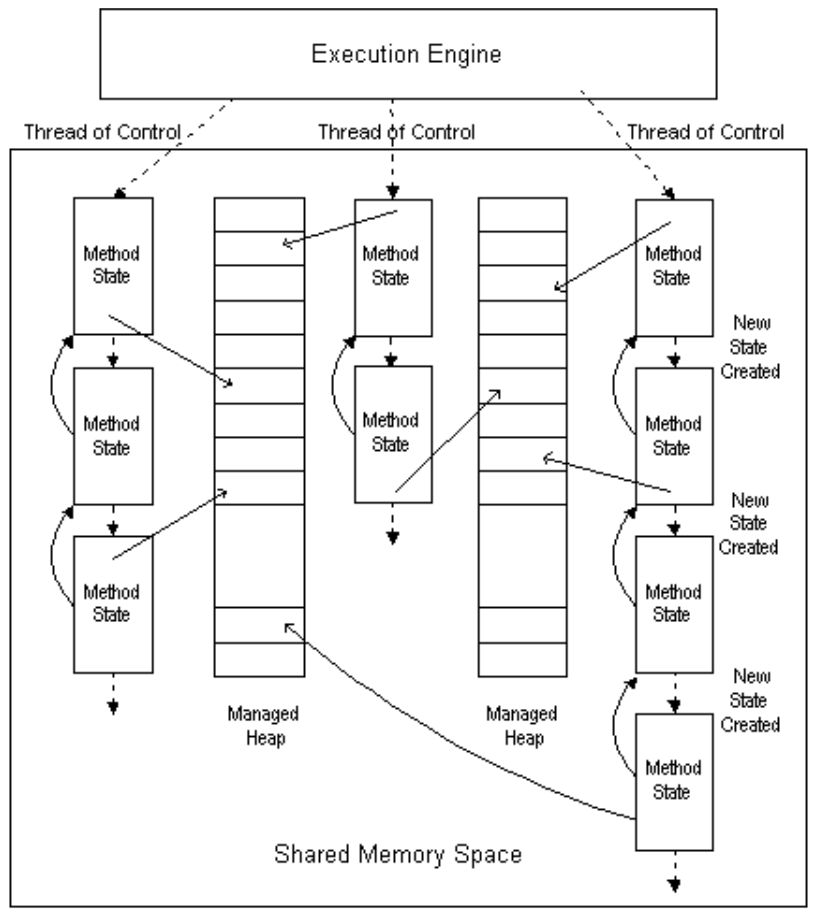
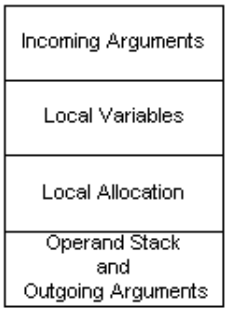
Method state describes the environment within which a method executes. (In conventional compiler terminology, it corresponds to a superset of the information captured in the "invocation stack frame"). The CLI method state consists of the following items:
An instruction pointer (IP) — This points to the next CIL instruction to be executed by the CLI in the present method.
An evaluation stack — The stack is empty upon method entry. Its contents are entirely local to the method and are preserved across call instructions (that's to say, if this method calls another, once that other method returns, our evaluation stack contents are "still there"). The evaluation stack is not addressable. At all times it is possible to deduce which one of a reduced set of types is stored in any stack location at a specific point in the CIL instruction stream (see §I.12.3.2.1).
A local variable array (starting at index 0) — Values of
local variables are preserved across calls (in the same sense as for the
evaluation stack). A local variable can hold any data type. However, a
particular slot shall be used in a type consistent way (where the type
system is the one described in §I.12.3.2.1). Local
variables are initialized to 0 before entry if the
localsinit flag for the method is set (see §I.12.2). The address of an
individual local variable can be taken using the ldloca
instruction.
An argument array — The values of the current method's
incoming arguments (starting at index 0). These can be read and written
by logical index. The address of an argument can be taken using the
ldarga instruction. The address of an argument is also
implicitly taken by the arglist instruction for use in
conjunction with type-safe iteration through variable-length argument
lists.
A methodInfo handle — This contains read-only information about the method. In particular it holds the signature of the method, the types of its local variables, and data about its exception handlers.
A local memory pool — The CLI includes instructions for
dynamic allocation of objects from the local memory pool
(localloc). Memory allocated in the local memory pool is
addressable. The memory allocated in the local memory pool is reclaimed
upon method context termination.
A return state handle — This handle is used to restore the method state on return from the current method. Typically, this would be the state of the method's caller. This corresponds to what in conventional compiler terminology would be the dynamic link.
A security descriptor — This descriptor is not directly accessible to managed code but is used by the CLI security system to record security overrides (assert, permit-only, and deny).
The four areas of the method state—incoming arguments array, local variables array, local memory pool and evaluation stack—are specified as if logically distinct areas. A conforming implementation of the CLI can map these areas into one contiguous array of memory, held as a conventional stack frame on the underlying target architecture, or use any other equivalent representation technique.
Associated with each method state is an evaluation stack. Most CLI instructions retrieve their arguments from the evaluation stack and place their return values on the stack. Arguments to other methods and their return values are also placed on the evaluation stack. When a procedure call is made the arguments to the called methods become the incoming arguments array (see §I.12.3.2.2) to the method. This can require a memory copy, or simply a sharing of these two areas by the two methods.
The evaluation stack is made up of slots that can hold any data type, including an unboxed instance of a value type. The type state of the stack (the stack depth and types of each element on the stack) at any given point in a program shall be identical for all possible control flow paths. For example, a program that loops an unknown number of times and pushes a new element on the stack at each iteration would be prohibited.
While the CLI, in general, supports the full set of types described in §I.12.1, the CLI treats the evaluation stack in a special way. While some JIT compilers might track the types on the stack in more detail, the CLI only requires that values be one of:
int64, an 8-byte signed integer
int32, a 4-byte signed integer
native int, a signed integer of either 4 or 8 bytes,
whichever is more convenient for the target architecture
F, a floating point value (float32,
float64, or other representation supported by the
underlying hardware)
&, a managed pointer
O, an object reference
*, a "transient pointer," which can be used only
within the body of a single method, that points to a value known to be
in unmanaged memory (see the CIL Instruction Set specification for more
details. * types are generated internally within the CLI;
they are not created by the user).
A user-defined value type
The other types are synthesized through a combination of techniques:
Shorter integer types in other memory locations are zero-extended or sign-extended when loaded onto the evaluation stack; these values are truncated when stored back to their home location.
Special instructions perform numeric conversions, with or without overflow detection, between different sizes and between signed and unsigned integers.
Special instructions treat an integer on the stack as though it were unsigned.
Instructions that create pointers which are guaranteed not to
point into the memory manager’s heaps (e.g., ldloca,
ldarga, and ldsflda) produce transient
pointers (type *) that can be used wherever a managed
pointer (type &) or unmanaged pointer (type
native unsigned int) is expected.
When a method is called, an unmanaged pointer (type
native unsigned int or *) is permitted to
match a parameter that requires a managed pointer (type
&). The reverse, however, is not permitted since it
would allow a managed pointer to be "lost" by the memory
manager.
A managed pointer (type &) can be explicitly
converted to an unmanaged pointer (type
native unsigned int), although this is not verifiable and
might produce a runtime exception.
Part of each method state is an array that holds local variables and
an array that holds arguments. Like the evaluation stack, each element
of these arrays can hold any single data type or an instance of a value
type. Both arrays start at 0 (that is, the first argument or local
variable is numbered 0). The address of a local variable can be computed
using the ldloca instruction, and the address of an
argument using the ldarga instruction. Associated with each
method is metadata that specifies:
whether the local variables and memory pool memory will be initialized when the method is entered.
the type of each argument and the length of the argument array (but see below for variable argument lists).
the type of each local variable and the length of the local variable array.
The CLI inserts padding as appropriate for the target architecture. That is, on some 64-bit architectures all local variables can be 64-bit aligned, while on others they can be 8-, 16-, or 32-bit aligned. The CIL generator shall make no assumptions about the offsets of local variables within the array. In fact, the CLI is free to reorder the elements in the local variable array, and different implementations might choose to order them in different ways.
The CLI works in conjunction with the class library to implement
methods that accept argument lists of unknown length and type ("vararg
methods"). Access to these arguments is through a type-safe iterator in
the library, called System.ArgIterator (see Partition
IV).
The CIL includes one instruction provided specifically to support the
argument iterator, arglist. This instruction shall only be
used within a method that is declared to take a variable number of
arguments. It returns a value that is needed by the constructor for a
System.ArgIterator object. Basically, the value created by
arglist provides access both to the address of the argument
list that was passed to the method and a runtime data structure that
specifies the number and type of the arguments that were provided. This
is sufficient for the class library to implement the user visible
iteration mechanism. From the CLI point of view, vararg methods have an
array of arguments like other methods. But only the initial portion of
the array has a fixed set of types and only these can be accessed
directly using the ldarg, starg, and
ldarga instructions. The argument iterator allows access to
both this initial segment and the remaining entries in the array.
Part of each method state is a local memory pool. Memory can be
explicitly allocated from the local memory pool using the
localloc instruction. All memory in the local memory pool
is reclaimed on method exit, and that is the only way local memory pool
memory is reclaimed (there is no instruction provided to free
local memory that was allocated during this method invocation). The
local memory pool is used to allocate objects whose type or size is not
known at compile time and which the programmer does not wish to allocate
in the managed heap.
Because the local memory pool cannot be shrunk during the lifetime of the method, a language implementation cannot use the local memory pool for general-purpose memory allocation.
The CIL instruction set provides a rich set of instructions to alter the normal flow of control from one CIL instruction to the next.
Conditional and Unconditional Branch instructions for use within a method, provided the transfer doesn't cross a protected region boundary (see §I.12.4.2).
Method call instructions to compute new arguments, transfer them and control to a known or computed destination method (see §I.12.4.1).
Tail call prefix to indicate that a method should relinquish its stack frame before executing a method call (see §I.12.4.1).
Return from a method, returning a value if necessary.
Method jump instructions to transfer the current method's arguments to a known or computed destination method (see §I.12.4.1).
Exception-related instructions (see §I.12.4.2). These include instructions to initiate an exception, transfer control out of a protected region, and end a filter, catch clause, or finally clause.
While the CLI supports control transfers within a method, there are several restrictions that shall be observed:
Control transfer is never permitted to enter a catch handler or finally clause (see §I.12.4.2) except through the exception handling mechanism.
Control transfer out of a protected region is covered in §I.12.4.2.3.
The evaluation stack shall be empty after the return value is
popped by a ret instruction.
Regardless of the control flow that allows execution to arrive there, each slot on the stack shall have the same data type at any given point within the method body.
In order for the JIT compilers to efficiently track the data
types stored on the stack, the stack shall normally be empty at the
instruction following an unconditional control transfer instruction
(br, br.s, ret, jmp,
throw, endfilter, endfault, or
endfinally). The stack shall be non-empty at such an
instruction only if at some earlier location within the method there has
been a forward branch to that instruction.
Control is not permitted to simply "fall through" the end of a
method. All paths shall terminate with one of these instructions:
ret, throw, jmp, or
(tail. followed by call, calli,
or callvirt).
Instructions emitted by the CIL code generator contain sufficient information for different implementations of the CLI to use different native calling conventions. All method calls initialize the method state areas (see §I.12.3.2) as follows:
The incoming arguments array is set by the caller to the desired values.
The local variables array always has null for object types and for fields within value types that hold objects. In addition, if the localsinit flag is set in the method header, then the local variables array is initialized to 0 for all integer types and to 0.0 for all floating-point types. Value types are not initialized by the CLI, but verified code will supply a call to an initializer as part of the method’s entry point code.
The evaluation stack is empty.
Call sites specify additional information that enables an interpreter
or JIT compiler to synthesize any native calling convention. All CIL
calling instructions (call, calli, and
callvirt) include a description of the call site. This
description can take one of two forms. The simpler form, used with the
calli instruction, is a "call site description"
(represented as a metadata token for a standalone call signature) that
provides:
The number of arguments being passed.
The data type of each argument.
The order in which they have been placed on the call stack.
The native calling convention to be used
The more complicated form, used for the call and
callvirt instructions, is a "method reference" (a metadata
methodref token) that augments the call site
description with an identifier for the target of the call
instruction.
The CIL has three call instructions that are used to transfer argument values to a destination method. Under normal circumstances, the called method will terminate and return control to the calling method.
call is designed to be used when the destination
address is fixed at the time the CIL is linked. In this case, a method
reference is placed directly in the instruction. This is comparable to a
direct call to a static function in C. It can be used to call static or
instance methods or the (statically known) base class method within an
instance method body.
calli is designed for use when the destination
address is calculated at run time. A method pointer is passed on the
stack and the instruction contains only the call site
description.
callvirt, part of the CIL common type system
instruction set, uses the class of an object (known only at runtime) to
determine the method to be called. The instruction includes a method
reference, but the particular method isn’t computed until the call
actually occurs. This allows an instance of a derived class to be
supplied and the method appropriate for that derived class to be
invoked. The callvirt instruction is used both for instance
methods and methods on interfaces. For further details, see the CTS
specification and the CIL instruction set specification in Partition
III.
In addition, each of these instructions can be immediately preceded
by a tail. instruction prefix. This specifies that the
calling method terminates with this method call (and returns whatever
value is returned by the called method). The tail. prefix
instructs the JIT compiler to discard the caller's method state prior to
making the call (if the call is from untrusted code to trusted code the
frame cannot be fully discarded for security reasons). When the called
method executes a ret instruction, control returns not to
the calling method but rather to wherever that method would itself have
returned (typically, return to caller's caller). Notice that the
tail. instruction shortens the lifetime of the caller's
frame so it is unsafe to pass managed pointers (type &)
as arguments.
Finally, there are two instructions that indicate an optimization of
the tail. case:
jmp is followed by a methodref or
methoddef token and indicates that the current method's
state should be discarded, its arguments should be transferred intact to
the destination method, and control should be transferred to the
destination. The signature of the calling method shall exactly match the
signature of the destination method.The destination of a method call can be either encoded directly in
the CIL instruction stream (the call and jmp
instructions) or computed (the callvirt, and
calli instructions). The destination address for a
callvirt instruction is automatically computed by the CLI
based on the method token and the value of the first argument (the
this pointer). The method token shall refer to a
virtual method on a class that is a direct ancestor of the class of the
first argument. The CLI computes the correct destination by locating the
nearest ancestor of the first argument's class that supplies an
implementation of the desired method.
[Note: The implementation can be assumed to be more efficient than the linear search implied here. end note]
For the calli instruction the CIL code is responsible
for computing a destination address and pushing it on the stack. This is
typically done through the use of an ldftn or
ldvirtfn instruction at some earlier time. The
ldftn instruction includes a metadata token in the CIL
stream that specifies a method, and the instruction pushes the address
of that method. The ldvirtfn instruction takes a metadata
token for a virtual method in the CIL stream and an object on the stack.
It performs the same computation described above for the
callvirt instruction but pushes the resulting destination
on the stack rather than calling the method.
The calli instruction includes a call site description
that includes information about the native calling convention that
should be used to invoke the method. Correct CIL code shall specify a
calling convention in the calli instruction that matches
the calling convention for the method that is being called.
The CIL provides a "virtual calling convention" that is converted by the JIT compiler into a native calling convention. The JIT compiler determines the optimal native calling convention for the target architecture. This allows the native calling convention to differ from machine to machine, including details of register usage, local variable homes, copying conventions for large call-by-value objects (as well as deciding, based on the target machine, what is considered "large"). This also allows the JIT compiler to reorder the values placed on the CIL virtual stack to match the location and order of arguments passed in the native calling convention.
The CLI uses a single uniform calling convention for all method
calls. It is the responsibility of the implementation to convert this
into the appropriate native calling convention. The contents of the
stack at the time of a call instruction (call,
calli, or callvirt any of which can be
preceded by tail.) are as follows:
If the method being called is an instance method (class or
interface) or a virtual method, the this pointer is the
first object on the stack at the time of the call instruction. For
methods on objects (including boxed value types), the
this pointer is of type O (object
reference). For methods on value types, the this pointer is provided as
a byref parameter; that is, the value is a pointer (managed,
&, or unmanaged, * or
native int) to the instance.
The remaining arguments appear on the stack in left-to-right order (that is, the lexically leftmost argument is the lowest on the stack, immediately following the this pointer, if any). §I.12.4.1.5 describes how each of the three parameter passing conventions (by-value, byref, and typed reference) should be implemented.
The CLI supports three kinds of parameter passing, all indicated in metadata as part of the signature of the method. Each parameter to a method has its own passing convention (e.g., the first parameter can be passed by-value while all others are passed byref). Parameters shall be passed in one of the following ways (see detailed descriptions below):
By-value — where the value of an object is passed from the caller to the callee.
By-reference — where the address of the data is passed from the caller to the callee, and the type of the parameter is therefore a managed or unmanaged pointer.
Typed reference — where a runtime representation of the data type is passed along with the address of the data, and the type of the parameter is therefore one specially supplied for this purpose. It is the responsibility of the CIL generator to follow these conventions. Verification checks that the types of parameters match the types of values passed, but is otherwise unaware of the details of the calling convention.
For built-in types (integers, floats, etc.) the caller copies the
value onto the stack before the call. For objects the object reference
(type O) is pushed on the stack. For managed pointers (type
&) or unmanaged pointers (type
native unsigned int), the address is passed from the caller
to the callee. For value types, see the protocol in §I.12.1.6.2.
By-reference parameters (identified by the presence of a byref
constraint) are the equivalent of C++ reference parameters or PASCAL
var parameters: instead of passing as an argument the value
of a variable, field, or array element, its address is passed instead;
and any assignment to the corresponding parameter actually modifies the
corresponding caller's variable, field, or array element. Much of this
work is done by the higher-level language, which hides from the user the
need to compute addresses to pass a value and the use of indirection to
reference or update values.
Passing a value by reference requires that the value have a home (see §I.12.1.6.1) and it is the address of this home that is passed. Constants, and intermediate values on the evaluation stack, cannot be passed as byref parameters because they have no home.
The CLI provides instructions to support byref parameters:
calculate addresses of home locations (see Table I.8: Address and Type of Home Locations)
load and store built-in data types through these address pointers
(ldind.*, stind.*, ldfld,
etc.)
copy value types (ldobj and
cpobj).
Some addresses (e.g., local variables and arguments) have lifetimes
tied to that method invocation. These shall not be referenced outside
their lifetimes, and so they should not be stored in locations that last
beyond their lifetime. The CIL does not (and cannot) enforce this
restriction, so the CIL generator shall enforce this restriction or the
resulting CIL will not work correctly. For code to be verifiable (see
§I.8.8) byref
parameters shall only be passed to other methods or referenced via the
appropriate stind or ldind instructions.
By-reference parameters and value types are sufficient to support statically typed languages (C++, Pascal, etc.). They also support dynamically typed languages that pay a performance penalty to box value types before passing them to polymorphic methods (Lisp, Scheme, Smalltalk, etc.). Unfortunately, they are not sufficient to support languages like Visual Basic that require byref passing of unboxed data to methods that are not statically restricted as to the type of data they accept. These languages require a way of passing both the address of the home of the data and the static type of the home. This is exactly the information that would be provided if the data were boxed, but without the heap allocation required of a box operation.
Typed reference parameters address this requirement. A typed reference parameter is very similar to a standard byref parameter but the static data type is passed as well as the address of the data. Like byref parameters, the argument corresponding to a typed reference parameter will have a home.
[Note: If it were not for the fact that verification and the memory manager need to be aware of the data type and the corresponding address, a byref parameter could be implemented as a standard value type with two fields: the address of the data and the type of the data. end note]
Like a regular byref parameter, a typed reference parameter can refer to a home that is on the stack, and that home will have a lifetime limited by the call stack. Thus, the CIL generator shall apply appropriate checks on the lifetime of byref parameters; and verification imposes the same restrictions on the use of typed reference parameters as it does on byref parameters (see §I.12.4.1.5.2).
A typed reference is passed by either creating a new typed reference
(using the mkrefany instruction) or by copying an existing
typed reference. Given a typed reference argument, the address to which
it refers can be extracted using the refanyval instruction;
the type to which it refers can be extracted using the
refanytype instruction.
A given parameter can be passed using any one of the parameter passing conventions: by-value, by-reference, or typed reference. No combination of these is allowed for a single parameter, although a method can have different parameters with different calling mechanisms.
A parameter that has been passed in as typed reference shall not be passed on as by-reference or by-value without a runtime type check and (in the case of by-value) a copy.
A byref parameter can be passed on as a typed reference by attaching the static type.
Table I.9: Parameter Passing Conventions illustrates the parameter passing convention used for each data type.
| Type of data | Pass By | How data is sent |
|---|---|---|
| Built-in value type (int, float, etc.) | Value | Copied to called method, type statically known at both sides |
| Reference | Address sent to called method, type statically known at both sides | |
| Typed reference | Address sent along with type information to called method | |
| User-defined value type | Value | Called method receives a copy; type statically known at both sides |
| Reference | Address sent to called method, type statically known at both sides | |
| Typed reference | Address sent along with type information to called method | |
| Object | Value | Reference to data sent to called method, type statically known and class available from reference |
| Reference | Address of reference sent to called method, type statically known and class available from reference | |
| Typed reference | Address of reference sent to called method along with static type information, class (i.e., dynamic type) available from reference |
Exception handling is supported in the CLI through exception objects
and protected blocks of code. When an exception occurs, an object is
created to represent the exception. All exception objects are instances
of some class (i.e., they can be boxed value types, but not pointers,
unboxed value types, etc.). Users can create their own exception
classes, typically by deriving from System.Exception (see
Partition
IV).
There are four kinds of handlers for protected blocks. A single protected block shall have exactly one handler associated with it:
A finally handler that shall be executed whenever the block exits, regardless of whether that occurs by normal control flow or by an unhandled exception.
A fault handler that shall be executed if an exception occurs, but not on completion of normal control flow.
A catch handler that handles any exception of a specified class or any of its subclasses.
A filter handler that runs a user-specified set of CIL instructions to determine if the exception should be handled by the associated handler, or passed on to the next protected block.
Protected regions, the type of the associated handler, and the location of the associated handler and (if needed) user-supplied filter code are described through an Exception Handler Table associated with each method. The exact format of the Exception Handler Table is specified in detail in Partition II. Details of the exception handling mechanism are also specified in Partition II.
CLI instructions can throw the following exceptions as part of
executing individual instructions. The documentation for each
instruction lists all the exceptions the instruction can throw (except
for the general purpose System.ExecutionEngineException
described below that can be generated by all instructions).
Base Instructions (see Partition III)
System.ArithmeticException
System.DivideByZeroException
System.ExecutionEngineException
System.InvalidAddressException
System.OverflowException
System.SecurityException
System.StackOverflowException
Object Model Instructions (see Partition III)
System.TypeLoadException
System.IndexOutOfRangeException
System.InvalidAddressException
System.InvalidCastException
System.MissingFieldException
System.MissingMethodException
System.NullReferenceException
System.OutOfMemoryException
System.SecurityException
System.StackOverflowException
The System.ExecutionEngineException is special. It can
be thrown by any instruction and indicates an unexpected inconsistency
in the CLI. Running exclusively verified code can never cause this
exception to be thrown by a conforming implementation of the CLI.
However, unverified code (even though that code is conforming CIL) can
cause this exception to be thrown if it might corrupt memory. Any
attempt to execute non-conforming CIL or non-conforming file formats can
result in unspecified behavior: a conforming implementation of the CLI
need not make any provision for these cases.
There are no exceptions for things like 'MetaDataTokenNotFound.' CIL
verification (see Partition
III) will detect this inconsistency before the instruction is
executed, leading to a verification violation. If the CIL is not
verified this type of inconsistency shall raise
System.ExecutionEngineException.
Exceptions can also be thrown by the CLI, as well as by user code,
using the throw instruction. The handling of an exception
is identical, regardless of the source.
Certain types of exceptions thrown by the CLI can be derived from to provide more information to the user. The specification of CIL instructions in Partition III describes what types of exceptions should be thrown by the runtime environment when an abnormal situation occurs. Each of these descriptions allows a conforming implementation to throw an object of the type described or an object of a derived class of that type.
[Note: For instance, the specification of the ckfinite
instruction requires that an exception of type
System.ArithmeticException or a derived class of
ArithmeticException be thrown by the CLI. A conforming
implementation might simply throw an exception of type
ArithmeticException, but it might also choose to provide
more information to the programmer by throwing an exception of type
NotFiniteNumberException with the offending number. end
note]
CIL allows types to reference, among other things, interfaces, classes, methods, and fields. Resolution errors occur when references are not found or are mismatched. Resolution exceptions can be generated by references from CIL instructions, references to base classes, to implemented interfaces, and by references from signatures of fields, methods and other class members.
To allow scalability with respect to optimization, detection of resolution exceptions is given latitude such that it might occur as early as install time and as late as execution time.
The latest opportunity to check for resolution exceptions from all references except CIL instructions is as part of initialization of the type that is doing the referencing (see Partition II). If such a resolution exception is detected the static initializer for that type, if present, shall not be executed.
The latest opportunity to check for resolution exceptions in CIL instructions is as part of the first execution of the associated CIL instruction. When an implementation chooses to perform resolution exception checking in CIL instructions as late as possible, these exceptions, if they occur, shall be thrown prior to any other non-resolution exception that the VES might throw for that CIL instruction. Once a CIL instruction has passed the point of throwing resolution errors (it has completed without exception, or has completed by throwing a non-resolution exception), subsequent executions of that instruction shall no longer throw resolution exceptions.
If an implementation chooses to detect some resolution errors, from any references, earlier than the latest opportunity for that kind of reference, it is not required to detect all resolution exceptions early.
An implementation that detects resolution errors early is allowed to prevent a class from being installed, loaded or initialized as a result of resolution exceptions detected in the class itself or in the transitive closure of types from following references of any kind.
For example, each of the following represents a permitted scenario. An installation program can throw resolution exceptions (thus failing the installation) as a result of checking CIL instructions for resolution errors in the set of items being installed. An implementation is allowed to fail to load a class as a result of checking CIL instructions in a referenced class for resolution errors. An implementation is permitted to load and initialize a class that has resolution errors in its CIL instructions.
The following exceptions are among those considered resolution exceptions:
BadImageFormatException
EntryPointNotFoundException
MissingFieldException
MissingMemberException
MissingMethodException
NotSupportedException
TypeLoadException
TypeUnloadedException
For example, when a referenced class cannot be found, a
TypeLoadException is thrown. When a referenced method
(whose class is found) cannot be found, a
MissingMethodException is thrown. If a matching method
being used consistently is accessible, but violates declared security
policy, a SecurityException is thrown.
A remoting boundary exists if it is not possible to share the identity of an object directly across the boundary. For example, if two objects exist on physically separate machines that do not share a common address space, then a remoting boundary will exist between them. There are other administrative mechanisms for creating remoting boundaries.
The VES provides a mechanism, called the application domain, to isolate applications running in the same operating system process from one another. Types loaded into one application domain are distinct from the same type loaded into another application domain, and instances of objects shall not be directly shared from one application domain to another. Hence, the application domain itself forms a remoting boundary.
The VES implements remoting boundaries based on the concept of a proxy. A proxy is an object that exists on one side of the boundary and represents an object on the other side. The proxy forwards references to instance fields and methods to the actual object for interpretation. Proxies do not forward references to static fields or calls to static methods.
The implementation of proxies is provided automatically for instances
of types that derive from System.MarshalByRefObject (see Partition
IV).
By "memory store" we mean the regular process memory that the CLI
operates within. Conceptually, this store is simply an array of bytes.
The index into this array is the address of a data object. The CLI
accesses data objects in the memory store via the ldind.*
and stind.* instructions.
Built-in data types shall be properly aligned, which is defined as follows:
1-byte, 2-byte, and 4-byte data is properly aligned when it is stored at a 1-byte, 2-byte, or 4-byte boundary, respectively.
8-byte data is properly aligned when it is stored on the same
boundary required by the underlying hardware for atomic access to a
native int.
Thus, int16 and unsigned int16 start on
even address; int32, unsigned int32, and
float32 start on an address divisible by 4; and
int64, unsigned int64, and
float64 start on an address divisible by 4 or 8, depending
upon the target architecture. The native size types
(native int, native unsigned int, and
&) are always naturally aligned (4 bytes or 8 bytes,
depending on the architecture). When generated externally, these should
also be aligned to their natural size, although portable code can use
8-byte alignment to guarantee architecture independence. It is strongly
recommended that float64 be aligned on an 8-byte boundary,
even when the size of native int is 32 bits.
There is a special prefix instruction, unaligned., that
can immediately precede an ldind, stind,
initblk, or cpblk instruction. This prefix
indicates that the data can have arbitrary alignment; the JIT compiler
is required to generate code that correctly performs the effect of the
instructions regardless of the actual alignment. Otherwise, if the data
is not properly aligned, and no unaligned. prefix has been
specified, executing the instruction can generate unaligned memory
faults or incorrect data.
For data types larger than 1 byte, the byte ordering is dependent on the target CPU. Code that depends on byte ordering might not run on all platforms. The PE file format (see §I.12.2) allows the file to be marked to indicate that it depends on a particular type ordering.
Conforming implementations of the CLI are free to execute programs
using any technology that guarantees, within a single thread of
execution, that side-effects and exceptions generated by a thread are
visible in the order specified by the CIL. For this purpose only
volatile operations (including volatile reads) constitute visible
side-effects. (Note that while only volatile operations constitute
visible side-effects, volatile operations also affect the visibility of
non-volatile references.) Volatile operations are specified in §I.12.6.7. There are no
ordering guarantees relative to exceptions injected into a thread by
another thread (such exceptions are sometimes called "asynchronous
exceptions" (e.g.,
System.Threading.ThreadAbortException).
[Rationale: An optimizing compiler is free to reorder side-effects and synchronous exceptions to the extent that this reordering does not change any observable program behavior. end rationale]
[Note: An implementation of the CLI is permitted to use an optimizing compiler, for example, to convert CIL to native machine code provided the compiler maintains (within each single thread of execution) the same order of side-effects and synchronous exceptions.
This is a stronger condition than ISO C++ (which permits reordering between a pair of sequence points) or ISO Scheme (which permits reordering of arguments to functions). end note]
Optimizers are granted additional latitude for relaxed exceptions in
methods. A method is E-relaxed for a kind of exception if the
innermost custom attribute
System.Runtime.CompilerServices. CompilationRelaxationsAttribute
pertaining to exceptions of kind E is present and specifies to
relax exceptions of kind E. (Here, "innermost" means inspecting
the method, its class, and its assembly, in that order.)
A E-relaxed sequence is a sequence of instructions executed by a thread, where
Each instruction causing visible side effects or exceptions is in an E-relaxed method.
The sequence does not cross the boundary of a non-trivial protected or handler region. A region is trivial if it can be optimized away under the rules for non-relaxed methods.
Below, an E-check is defined as a test performed by a CIL instruction that upon failure causes an exception of kind E to be thrown. Furthermore, the type and range tests performed by the methods that set or get an array element's value, or that get an array element's address are considered checks here.
A conforming implementation of the CLI is free to change the timing of relaxed E-checks in an E-relaxed sequence, with respect to other checks and instructions as long as the observable behavior of the program is changed only in the case that a relaxed E-check fails. If an E-check fails in an E-relaxed sequence:
The rest of the associated instruction must be suppressed, in order to preserve verifiability. If the instruction was expected to push a value on the VES stack, no subsequent instruction that uses that value should visibly execute.
It is unspecified whether or not any or all of the side effects in the E-relaxed sequence are made visible by the VES.
The check's exception is thrown some time in the sequence, unless the sequence throws another exception. When multiple relaxed checks fail, it is unspecified as to which exception is thrown by the VES.
[Note: Relaxed checks preserve verifiability, but not necessarily security. Because a relaxed check’s exception might be deferred and subsequent code allowed to execute, programmers should never rely on implicit checks to preserve security, but instead use explicit checks and throws when security is an issue. end note]
[Rationale: Different programmers have different goals. For some, trading away precise exception behavior is unacceptable. For others, optimization is more important. The programmer must specify their preference. Different kinds of exceptions may be relaxed or not relaxed separately because different programmers have different notions of which kinds of exceptions must be timed precisely. end rationale]
[Note: For background and implementation information for relaxed exception handling, plus examples, see Annex F of Partition VI. end note]
The logical abstraction of a thread of control is captured by an
instance of the System.Threading.Thread object in the class
library. Classes beginning with the prefix
"System.Threading" (see Partition
IV) provide much of the user visible support for this abstraction.
To create consistency across threads of execution, the CLI provides the
following mechanisms:
Synchronized methods. A lock that is visible
across threads controls entry to the body of a synchronized method. For
instance and virtual methods the lock is associated with the this
pointer. For static methods the lock is associated with the type to
which the method belongs. The lock is taken by the logical thread (see
System.Threading.Thread in Partition
IV) and can be entered any number of times by the same thread; entry
by other threads is prohibited while the first thread is still holding
the lock. The CLI shall release the lock when control exits (by any
means) the method invocation that first acquired the lock.
Explicit locks and monitors. These are provided
in the class library, see System.Threading.Monitor. Many of
the methods in the System.Threading.Monitor class accept an
Object as argument, allowing direct access to the same lock
that is used by synchronized methods. While the CLI is responsible for
ensuring correct protocol when this lock is only used by synchronized
methods, the user must accept this responsibility when using explicit
monitors on these same objects.
Volatile reads and writes. The CIL includes a
prefix, volatile., that specifies that the subsequent
operation is to be performed with the cross-thread visibility
constraints described in §[I.12.6.7]](#todo-missing-hyperlink). In
addition, the class library provides methods to perform explicit
volatile reads (System.Thread.VolatileRead) and writes
(System.Thread.VolatileWrite), as well as barrier
synchronization (System.Thread.MemoryBarrier).
Built-in atomic reads and writes. All reads and writes of certain properly aligned data types are guaranteed to occur atomically. See §[I.12.6.6]](#todo-missing-hyperlink).
Explicit atomic operations. The class library
provides a variety of atomic operations in the
System.Threading.Interlocked class. These operations (e.g.,
Increment, Decrement, Exchange,
and CompareExchange) perform implicit acquire/release
operations.
Acquiring a lock (System.Threading.Monitor.Enter or
entering a synchronized method) shall implicitly perform a volatile read
operation, and releasing a lock
(System.Threading.Monitor.Exit or leaving a synchronized
method) shall implicitly perform a volatile write operation. See §I.12.6.7.
A conforming CLI shall guarantee that read and write access to
properly aligned memory locations no larger than the native
word size (the size of type native int) is atomic (see §I.12.6.2) when all the write accesses
to a location are the same size. Atomic writes shall alter no bits other
than those written. Unless explicit layout control (see Partition II (Controlling
Instance Layout)) is used to alter the default behavior, data
elements no larger than the natural word size (the size of a
native int) shall be properly aligned. Object references
shall be treated as though they are stored in the native word size.
[Note: There is no guarantee about atomic update (read-modify-write) of memory, except for methods provided for that purpose as part of the class library (see Partition IV). An atomic write of a "small data item" (an item no larger than the native word size) is required to do an atomic read/modify/write on hardware that does not support direct writes to small data items. end note]
[Note: There is no guaranteed atomic access to 8-byte data
when the size of a native int is 32 bits even though some
implementations might perform atomic operations when the data is aligned
on an 8-byte boundary. end note]
The volatile. prefix on certain instructions shall
guarantee cross-thread memory ordering rules. They do not provide
atomicity, other than that guaranteed by the specification of §I.12.6.6.
A volatile read has "acquire semantics" meaning that the read is guaranteed to occur prior to any references to memory that occur after the read instruction in the CIL instruction sequence. A volatile write has "release semantics" meaning that the write is guaranteed to happen after any memory references prior to the write instruction in the CIL instruction sequence.
A conforming implementation of the CLI shall guarantee this semantics of volatile operations. This ensures that all threads will observe volatile writes performed by any other thread in the order they were performed. But a conforming implementation is not required to provide a single total ordering of volatile writes as seen from all threads of execution.
An optimizing compiler that converts CIL to native code shall not remove any volatile operation, nor shall it coalesce multiple volatile operations into a single operation.
[Rationale: One traditional use of volatile operations is to model hardware registers that are visible through direct memory access. In these cases, removing or coalescing the operations might change the behavior of the program. end rationale]
[Note: An optimizing compiler from CIL to native code is permitted to reorder code, provided that it guarantees both the single-thread semantics described in §I.12.6 and the cross-thread semantics of volatile operations. end note]
All memory allocated for static variables (other than those assigned RVAs within a PE file, see Partition II) and objects shall be zeroed before they are made visible to any user code.
A conforming implementation of the CLI shall ensure that, even in a multi-threaded environment and without proper user synchronization, objects are allocated in a manner that prevents unauthorized memory access and prevents invalid operations from occurring. In particular, on multiprocessor memory systems where explicit synchronization is required to ensure that all relevant data structures are visible (for example, vtable pointers) the Execution Engine shall be responsible for either enforcing this synchronization automatically or for converting errors due to lack of synchronization into non-fatal, non-corrupting, user-visible exceptions.
It is explicitly not a requirement that a conforming implementation of the CLI guarantee that all state updates performed within a constructor be uniformly visible before the constructor completes. CIL generators can ensure this requirement themselves by inserting appropriate calls to the memory barrier or volatile write instructions.
This specification provides the normative description of the metadata: its physical layout (as a file format), its logical contents (as a set of tables and their relationships), and its semantics (as seen from a hypothetical assembler, ilasm).
This partition focuses on the semantics and the structure of metadata. The semantics of metadata, which dictate much of the operation of the VES, are described using the syntax of ILAsm, an assembly language for CIL. The ILAsm syntax itself (contained in clauses §II.5 through §II.21) is considered a normative part of this International Standard. (An implementation of an assembler for ILAsm is described in Partition VI.) The structure (both logical and physical) is covered in clauses §II.22 through §II.25.
[Rationale: An assembly language is really just syntax for specifying the metadata in a file, and the CIL instructions in that file. Specifying ILAsm provides a means of interchanging programs written directly for the CLI without the use of a higher-level language; it also provides a convenient way to express examples. The semantics of the metadata can also be described independently of the actual format in which the metadata is stored. This point is important because the storage format as specified in clauses §II.22 through §II.25 is engineered to be efficient for both storage space and access time, but this comes at the cost of the simplicity desirable for describing its semantics. end rationale]
Validation refers to the application of a set of tests on any file to check that the file’s format, metadata, and CIL are self-consistent. These tests are intended to ensure that the file conforms to the normative requirements of this specification. When a conforming implementation of the CLI is presented with a non-conforming file, the behavior is unspecified.
Verification refers to the checking of both CIL and its related metadata to ensure that the CIL code sequences do not permit any access to memory outside the program's logical address space. In conjunction with the validation tests, verification ensures that the program cannot access memory or other resources to which it is not granted access.
Partition III specifies the rules for both correct and verifiable use of CIL instructions. Partition III also provides an informative description of rules for validating the internal consistency of metadata (the rules follow, albeit indirectly, from the specification in this Partition); it also contains a normative description of the verification algorithm. A mathematical proof of soundness of the underlying type system is possible, and provides the basis for the verification requirements. Aside from these rules, this standard leaves as unspecified:
The time at which (if ever) such an algorithm should be performed.
What a conforming implementation should do in the event of a verification failure.
The following figure makes this relationship clearer (see next paragraph for a description):
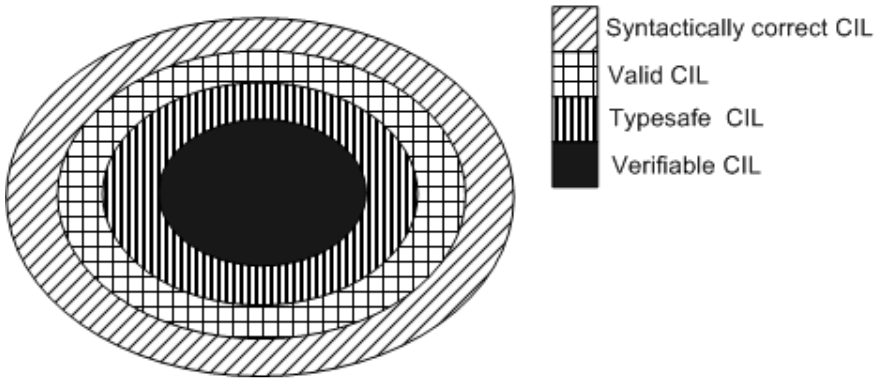
In the above figure, the outer circle contains all code permitted by the ILAsm syntax. The next inner circle represents all code that is correct CIL. The striped inner circle represents all type-safe code. Finally, the black innermost circle contains all code that is verifiable. (The difference between type-safe code and verifiable code is one of provability: code which passes the VES verification algorithm is, by-definition, verifiable; but that simple algorithm rejects certain code, even though a deeper analysis would reveal it as genuinely type-safe). Note that even if a program follows the syntax described in Partition VI, the code might still not be valid, because valid code shall adhere to restrictions presented in this Partition and in Partition III.
The verification process is very stringent. There are many programs that will pass validation, but will fail verification. The VES cannot guarantee that these programs do not access memory or resources to which they are not granted access. Nonetheless, they might have been correctly constructed so that they do not access these resources. It is thus a matter of trust, rather than mathematical proof, whether it is safe to run these programs. Ordinarily, a conforming implementation of the CLI can allow unverifiable code (valid code that does not pass verification) to be executed, although this can be subject to administrative trust controls that are not part of this standard. A conforming implementation of the CLI shall allow the execution of verifiable code, although this can be subject to additional implementation-specified trust controls.
This clause and its subclauses contain only informative text.
To get the general feel of ILAsm, consider the following simple
example, which prints the well known "Hello world!" salutation. The
salutation is written by calling WriteLine, a static method
found in the class System.Console that is part of the
standard assembly mscorlib (see Partition
IV).
[Example:
.assembly extern mscorlib {}
.assembly hello {}
.method static public void main() cil managed
{ .entrypoint
  .maxstack 1
  ldstr "Hello world!"
  call void [mscorlib]System.Console::WriteLine(class System.String)
  ret
}
end example]
The .assembly extern declaration references an
external assembly, mscorlib, which contains the definition
of System.Console. The .assembly
declaration in the second line declares the name of the assembly for
this program. (Assemblies are the deployment unit for executable content
for the CLI.) The .method declaration defines the
global method main, the body of which follows, enclosed in
braces. The first line in the body indicates that this method is the
entry point for the assembly (.entrypoint), and the
second line in the body specifies that it requires at most one stack
slot (.maxstack).
Method main contains only three instructions:
ldstr, call, and ret. The
ldstr instruction pushes the string constant
"Hello world!" onto the stack and the call
instruction invokes System.Console::WriteLine, passing the
string as its only argument. (Note that string literals in CIL are
instances of the standard class System.String.) As shown,
call instructions shall include the full signature of the
called method. Finally, the last instruction, ret, returns
from main.
This Partition contains integrated examples for most features of the CLI metadata. Many subclauses conclude with an example showing a typical use of some feature. All these examples are written using the ILAsm assembly language. In addition, Partition VI contains a longer example of a program written in the ILAsm assembly language. All examples are, of course, informative only.
End informative text.
This clause describes aspects of the ILAsm syntax that are common to many parts of the grammar.
This partition uses a modified form of the BNF syntax notation. The following is a brief summary of this notation.
Terminals are written in a constant-width font (e.g.,
.assembly, extern, and
float64); however, terminals consisting solely of
punctuation characters are enclosed in single quotes (e.g.,
':', '[', and '('). The names of
syntax categories are capitalized and italicized (e.g.
ClassDecl) and shall be replaced by actual instances of the
category. Items placed in [ ] brackets (e.g., [ Filename ] and
[ Float ]), are optional, and any item followed by * (e.g.,
HexByte* and [ '.' Id ]*) can appear zero
or more times. The character "|" means that the items on either side of
it are acceptable (e.g., true | false). The
options are sorted in alphabetical order (to be more specific: in ASCII
order, and case-insensitive). If a rule starts with an optional term,
the optional term is not considered for sorting purposes.
ILAsm is a case-sensitive language. All terminals shall be used with the same case as specified in this clause.
[Example: A grammar such as
Top ::= Int32 | float Float |
floats [ Float [ ',' Float
]* ] | else QSTRING
would consider all of the following to be valid:
12
float 3
float –4.3e7
floats
floats 2.4
floats 2.4, 3.7
else "Something \t weird"
but all of the following to be invalid:
else 3
3, 4
float 4.3, 2.4
float else
stuff
end example]
These categories are used to describe syntactic constraints on the input intended to convey logical restrictions on the information encoded in the metadata.
Int32 is either a decimal number or "0x"
followed by a hexadecimal number, and shall be represented in 32 bits.
[Note: ILAsm has no concept of 8- or 16-bit integer constants.
Instead, situations requiring such a constant (such as
int8(...) and int16(...) in §II.16.2) accept an
Int32 instead, and use only the least-significant bytes.
end note]
Int64 is either a decimal number or "0x"
followed by a hexadecimal number, and shall be represented in 64
bits.
HexByte is a hexadecimal number that is a pair of characters
from the set 0–9,
a–f, and A–F.
RealNumber is any syntactic representation for a
floating-point number that is distinct from that for all other syntax
categories. In this partition, a period (.) is used to
separate the integer and fractional parts, and "e" or
"E" separates the mantissa from the exponent. Either of the
period or the mantissa separator (but not both) can be omitted.
[Note: A complete assembler might also provide syntax for infinities and NaNs. end note]
QSTRING is a string surrounded by double quote
(") marks. Within the quoted string the character
"\" can be used as an escape character, with
"\t" representing a tab character, "\n"
representing a newline character, and "\" followed by three
octal digits representing a byte with that value. The "+"
operator can be used to concatenate string literals. This way, a long
string can be broken across multiple lines by using "+" and
a new string on each line. An alternative is to use "\" as
the last character in a line, in which case, that character and the line
break following it are not entered into the generated string. Any white
space characters (space, line-feed, carriage-return, and tab) between
the "\" and the first non-white space character on the next
line are ignored. [Note: To include a double quote character in
a QSTRING, use an octal escape sequence. end note]
[Example: The following result in strings that are
equivalent to "Hello World from CIL!":
ldstr "Hello " + "World " +
"from CIL!"
and
ldstr "Hello World\
      \040from CIL!"
end example]
[Note: A complete assembler will need to deal with the full set of issues required to support Unicode encodings, see Partition I (especially CLS Rule 4). end note]
SQSTRING is just like QSTRING except that the
former uses single quote (') marks instead of double quote.
[Note: To include a single quote character in an
SQSTRING, use an octal escape sequence. end note]
ID is a contiguous string of characters which starts with
either an alphabetic character (A–Z,
a–z) or one of "_",
"$", "@", "`" (grave accent), or
"?", and is followed by any number of alphanumeric
characters (A–Z,
a–z, 0–9) or the
characters "_", "$", "@",
"`" (grave accent), and "?". An ID is
used in only two ways:
Identifiers are used to name entities. Simple identifiers are equivalent to an ID. However, the ILAsm syntax allows the use of any identifier that can be formed using the Unicode character set (see Partition I). To achieve this, an identifier shall be placed within single quotation marks. This is summarized in the following grammar.
| Id ::= |
|---|
| ID |
| | SQSTRING |
A keyword shall only be used as an identifier if that keyword appears
in single quotes (see Partition VI
for a list of all keywords). Several Ids can be combined to
form a larger Id, by separating adjacent pairs with a dot
(.). An Id formed in this way is called a
DottedName.
| DottedName ::= |
|---|
Id [ '.' Id
]* |
[Rationale: DottedName is provided for convenience,
since "." can be included in an Id using the
SQSTRING syntax. DottedName is used in the grammar
where '.' is considered a common character (e.g., in fully
qualified type names) end rationale]
[Example: The following are simple identifiers:
A Test $Test @Foo? ?_X_ MyType`1The following are identifiers in single quotes:
'Weird Identifier' 'Odd\102Char' 'Embedded\nReturn'The following are dotted names:
System.Console 'My Project'.'My Component'.'My Name' System.IComparable`1end example]
Labels are provided as a programming convenience; they represent a number that is encoded in the metadata. The value represented by a label is typically an offset in bytes from the beginning of the current method, although the precise encoding differs depending on where in the logical metadata structure or CIL stream the label occurs. For details of how labels are encoded in the metadata, see clauses §II.22 through §II.25; for their encoding in CIL instructions see Partition III.
A simple label is a special name that represents an address. Syntactically, a label is equivalent to an Id. Thus, labels can be single quoted and can contain Unicode characters.
A list of labels is comma separated, and can be any combination of simple labels.
| LabelOrOffset ::= |
|---|
| Id |
| Labels ::= |
|---|
LabelOrOffset [ ',' LabelOrOffset
]* |
[Note: In a real assembler the syntax for LabelOrOffset might allow the direct specification of a number rather than requiring symbolic labels. end note]
ILAsm distinguishes between two kinds of labels: code labels and data
labels. Code labels are followed by a colon (":") and
represent the address of an instruction to be executed. Code labels
appear before an instruction and they represent the address of the
instruction that immediately follows the label. A particular code label
name shall not be declared more than once in a method.
In contrast to code labels, data labels specify the location of a piece of data and do not include the colon character. A data label shall not be used as a code label, and a code label shall not be used as a data label. A particular data label name shall not be declared more than once in a module.
| CodeLabel ::= |
|---|
Id ':' |
| DataLabel ::= |
|---|
| Id |
[Example: The following defines a code label,
ldstr_label, that represents the address of the
ldstr instruction:
ldstr_label: ldstr "A label"end example]
A list of bytes consists simply of one or more hexbytes.
| Bytes ::= |
|---|
| HexByte [ HexByte* ] |
There are two different ways to specify a floating-point number:
As a RealNumber.
By using the keyword float32 or
float64, followed by an integer in parentheses, where
the integer value is the binary representation of the desired
floating-point number. For example, float32(1) results in
the 4-byte value 1.401298E-45, while float64(1)results in
the 8-byte value 4.94065645841247E-324.
| Float32 ::= |
|---|
| RealNumber |
| float32 '(' Int32
')' |
| Float64 ::= |
|---|
| RealNumber |
| float64 '(' Int64
')' |
[Example:
5.5
1.1e10
float64(128) // note: this results in an 8-byte value whose bits are the same
             // as those for the integer value 128.
end example]
The metadata does not encode information about the lexical scope of variables or the mapping from source line numbers to CIL instructions. Nonetheless, it is useful to specify an assembler syntax for providing this information for use in creating alternate encodings of the information.
.line takes a line number, optionally followed by a column number (preceded by a colon), optionally followed by a single-quoted string that specifies the name of the file to which the line number is referring:
| ExternSourceDecl ::= |
|---|
.line Int32 [ ':' Int32
] [ SQSTRING ] |
Some grammar elements require that a file name be supplied. A file
name is like any other name where "." is considered a
normal constituent character. The specific syntax for file names follows
the specifications of the underlying operating system.
| Filename ::= | Clause |
|---|---|
| DottedName | §II.5.3 |
Attributes of types and their members attach descriptive information to their definition. The most common attributes are predefined and have a specific encoding in the metadata associated with them (§II.23). In addition, the metadata provides a way of attaching user-defined attributes to metadata, using several different encodings.
From a syntactic point of view, there are several ways for specifying attributes in ILAsm:
Using special syntax built into ILAsm. For example, the keyword private in a ClassAttr specifies that the visibility attribute on a type shall be set to allow access only within the defining assembly.
Using a general-purpose syntax in ILAsm. The non-terminal CustomDecl describes this grammar (§II.21). For some attributes, called pseudo-custom attributes, this grammar actually results in setting special encodings within the metadata (§II.21.2.1).
Security attributes are treated specially. There is special
syntax in ILAsm that allows the XML representing security attributes to
be described directly (§II.20). While all other
attributes defined either in the standard library or by user-provided
extension are encoded in the metadata using one common mechanism
described in §II.22.10,
security attributes (distinguished by the fact that they inherit,
directly or indirectly from
System.Security.Permissions.SecurityAttribute, see Partition
IV) shall be encoded as described in §II.22.11.
An input to ilasm is a sequence of top-level declarations, defined as follows:
| ILFile ::= | Reference |
|---|---|
| Decl* | §II.5.10 |
The complete grammar for a top-level declaration is shown below. The
reference subclauses contain details of the corresponding productions of
this grammar. These productions begin with a name having a
'.' prefix. Such a name is referred to as a directive.
| Decl ::= | Reference |
|---|---|
.assembly DottedName '{'
AsmDecl* '}' |
§II.6.2 |
| .assembly extern DottedName '{'
AsmRefDecl* '}' |
§II.6.3 |
| .class ClassHeader '{'
ClassMember* '}' |
§II.10 |
| .class extern ExportAttr DottedName
'{' ExternClassDecl* '}' |
§II.6.7 |
| .corflags Int32 |
§II.6.2 |
| .custom CustomDecl |
§II.21 |
| .data DataDecl |
§II.16.3.1 |
| .field FieldDecl |
§II.16 |
| .file [ nometadata ] Filename
.hash '=' '(' Bytes
')' [ .entrypoint ] |
§II.6.2.3 |
| .method MethodHeader '{'
MethodBodyItem* '}' |
§II.15 |
| .module [ Filename ] |
§II.6.4 |
| .module extern Filename |
§II.6.5 |
| .mresource [ public |
private ] DottedName '{'
ManResDecl* '}' |
§II.6.2.2 |
| .subsystem Int32 |
§II.6.2 |
| .vtfixup VTFixupDecl |
§II.15.5.1 |
| | ExternSourceDecl | §II.5.7 |
| | SecurityDecl | §II.20 |
Assemblies and modules are grouping constructs, each playing a different role in the CLI.
An assembly is a set of one or more files deployed as a unit. An assembly always contains a manifest that specifies (§II.6.1):
Version, name, culture, and security requirements for the assembly.
Which other files, if any, belong to the assembly, along with a cryptographic hash of each file. The manifest itself resides in the metadata part of a file, and that file is always part of the assembly.
The types defined in other files of the assembly that are to be exported from the assembly. Types defined in the same file as the manifest are exported based on attributes of the type itself.
Optionally, a digital signature for the manifest itself, and the public key used to compute it.
A module is a single file containing executable content in the format specified here. If the module contains a manifest then it also specifies the modules (including itself) that constitute the assembly. An assembly shall contain only one manifest amongst all its constituent files. For an assembly that is to be executed (rather than simply being dynamically loaded) the manifest shall reside in the module that contains the entry point.
While some programming languages introduce the concept of a namespace, the only support in the CLI for this concept is as a metadata encoding technique. Type names are always specified by their full name relative to the assembly in which they are defined.
This subclause contains informative text only.
Consider the following figure:
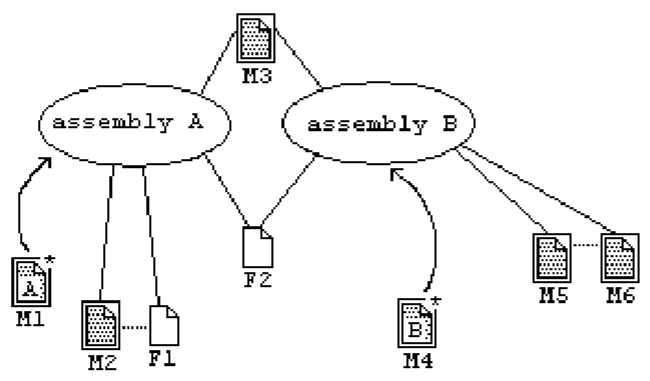
Eight files are shown, each with its name written below it. The six files that each declare a module have an additional border around them, and their names begin with M. The other two files have a name beginning with F. These files can be resource files (such as bitmaps) or other files that do not contain CIL code.
Files M1 and M4 declare an assembly in addition to the module declaration, namely assemblies A and B, respectively. The assembly declaration in M1 and M4 references other modules, shown with straight lines. For example, assembly A references M2 and M3, and assembly B references M3 and M5. Thus, both assemblies reference M3.
Usually, a module belongs only to one assembly, but it is possible to share it across assemblies. When assembly A is loaded at runtime, an instance of M3 will be loaded for it. When assembly B is loaded into the same application domain, possibly simultaneously with assembly A, M3 will be shared for both assemblies. Both assemblies also reference F2, for which similar rules apply.
The module M2 references F1, shown by dotted lines. As a consequence, F1 will be loaded as part of assembly A, when A is executed. Thus, the file reference shall also appear with the assembly declaration. Similarly, M5 references another module, M6, which becomes part of B when B is executed. It follows that assembly B shall also have a module reference to M6.
End informative text.
An assembly is specified as a module that contains a manifest in the metadata; see §II.22.2. The information for the manifest is created from the following portions of the grammar:
| Decl ::= | Clause |
|---|---|
.assembly DottedName '{'
AsmDecl* '}' |
§II.6.2 |
| .assembly extern DottedName '{'
AsmRefDecl* '}' |
§II.6.3 |
| .corflags Int32 |
§II.6.2 |
| .file [ nometadata ] Filename
.hash '=' '(' Bytes
')' [ .entrypoint ] |
§II.6.2.3 |
| .module extern Filename |
§II.6.5 |
| .mresource [ public |
private ] DottedName '{'
ManResDecl* '}' |
§II.6.2.2 |
| .subsystem Int32 |
§II.6.2 |
| | … |
The .assembly directive declares the manifest and specifies to which assembly the current module belongs. A module shall contain at most one .assembly directive. The DottedName specifies the name of the assembly.
[Note: The standard library assemblies are described in Partition IV. end note])
[Note: Since some platforms treat names in a case-insensitive manner, two assemblies that have names that differ only in case should not be declared. end note]
The .corflags directive sets a field in the CLI header of the output PE file (see §II.25.3.3.1). A conforming implementation of the CLI shall expect this field's value to be 1. For backwards compatibility, the three least-significant bits are reserved. Future versions of this standard might provide definitions for values between 8 and 65,535. Experimental and non-standard uses should thus use values greater than 65,535.
The .subsystem directive is used only when the assembly is executed directly (as opposed to its being used as a library for another program). This directive specifies the kind of application environment required for the program, by storing the specified value in the PE file header (see §II.25.2.2). While any 32-bit integer value can be supplied, a conforming implementation of the CLI need only respect the following two values:
If the value is 2, the program should be run using whatever conventions are appropriate for an application that has a graphical user interface.
If the value is 3, the program should be run using whatever conventions are appropriate for an application that has a direct console attached.
[Example:
.assembly CountDown
{ .hash algorithm 32772
  .ver 1:0:0:0
}
.file Counter.dll .hash = (BA D9 7D 77 31 1C 85 4C 26 9C 49 E7  02 BE E7 52 3A CB 17 AF)
end example]
The following grammar shows the information that can be specified about an assembly:
| AsmDecl ::= | Description | Clause |
|---|---|---|
.custom CustomDecl |
Custom attributes | §II.21 |
| .hash algorithm Int32 |
Hash algorithm used in the .file directive | §II.6.2.1.1 |
| .culture QSTRING |
Culture for which this assembly is built | §II.6.2.1.2 |
| .publickey '=' '('
Bytes ')' |
The originator's public key. | §II.6.2.1.3 |
| .ver Int32 ':' Int32
':' Int32 ':' Int32 |
Major version, minor version, build, and revision | §II.6.2.1.4 |
| | SecurityDecl | Permissions needed, desired, or prohibited | §II.20 |
| AsmDecl ::= |
|---|
.hash algorithm Int32 |
| | … |
When an assembly consists of more than one file (see §II.6.2.3), the manifest for the assembly specifies both the name and cryptographic hash of the contents of each file other than its own. The algorithm used to compute the hash can be specified, and shall be the same for all files included in the assembly. All values are reserved for future use, and conforming implementations of the CLI shall use the SHA-1 (see FIPS 180-1 in Partition I, 3) hash function and shall specify this algorithm by using a value of 32772 (0x8004).
[Rationale: SHA-1 was chosen as the best widely available technology at the time of standardization (see Partition I). A single algorithm was chosen since all conforming implementations of the CLI would be required to implement all algorithms to ensure portability of executable images. end rationale]
| AsmDecl ::= |
|---|
.culture QSTRING |
| | … |
When present, this indicates that the assembly has been customized
for a specific culture. The strings that shall be used here are those
specified in Partition IV
as acceptable with the class
System.Globalization.CultureInfo. When used for comparison
between an assembly reference and an assembly definition these strings
shall be compared in a case-insensitive manner. (See §II.23.1.3.)
[Note: The culture names follow the IETF RFC1766 names. The format is "<language><country/region>", where <language> is a lowercase two-letter code in ISO 639-1. <country/region> is an uppercase two-letter code in ISO 3166. end note]
| AsmDecl ::= |
|---|
.publickey '=' '('
Bytes ')' |
| | … |
The CLI metadata allows the producer of an assembly to compute a cryptographic hash of that assembly (using the SHA-1 hash function) and then to encrypt it using the RSA algorithm (see Partition I) and a public/private key pair of the producer's choosing. The results of this (an "SHA1/RSA digital signature") can then be stored in the metadata (§II.25.3.3) along with the public part of the key pair required by the RSA algorithm. The .publickey directive is used to specify the public key that was used to compute the signature. To calculate the hash, the signature is zeroed, the hash calculated, and then the result is stored into the signature.
All of the assemblies in the Standard Library (see Partition IV) use the public key
00 00 00 00 00 00 00 00 04 00 00 00 00 00 00 00. This key is known as the Standard Public Key in this standard.
A reference to an assembly (§II.6.3) captures some of this information at compile time. At runtime, the information contained in the assembly reference can be combined with the information from the manifest of the assembly located at runtime to ensure that the same private key was used to create both the assembly seen when the reference was created (compile time) and when it is resolved (runtime).
The Strong Name (SN) signing process uses standard hash and cipher algorithms for Strong name signing. An SHA-1 hash over most of the PE file is generated. That hash value is RSA-signed with the SN private key. For verification purposes the public key is stored into the PE file as well as the signed hash value.
Except for the following, all portions of the PE File are hashed:
The Authenticode Signature entry: PE files can be authenticode signed. The authenticode signature is contained in the 8-byte entry at offset 128 of the PE Header Data Directory ("Certificate Table" in §II.25.2.3.3) and the contents of the PE File in the range specified by this directory entry. [Note: In a PE File conforming to this specification, this entry shall be zero. end note]
The Strong Name Blob: The 8-byte entry at offset 32 of the CLI Header ("StrongNameSignature" in §II.25.3.3) and the contents of the hash data contained at this RVA in the PE File. If the 8-byte entry is 0, there is no associated strong name signature.
The PE Header Checksum: The 4-byte entry at offset 64 of the PE Header Windows NT-Specific Fields ("File Checksum" in §II.25.2.3.2). [Note: In a PE File conforming to this specification, this entry shall be zero. end note]
| AsmDecl ::= |
|---|
.ver Int32 ':' Int32
':' Int32 ':' Int32 |
| | … |
The version number of an assembly is specified as four 32-bit integers. This version number shall be captured at compile time and used as part of all references to the assembly within the compiled module.
All standardized assemblies shall have the last two 32-bit integers set to 0. This standard places no other requirement on the use of the version numbers, although individual implementers are urged to avoid setting both of the last two 32-bit integers to 0 to avoid a possible collision with future versions of this standard.
Future versions of this standard shall change one or both of the first two 32-bit integers specified for a standardized assembly if any additional functionality is added or any additional features of the VES are required to implement it. Furthermore, future versions of this standard shall change one or both of the first two 32-bit integers specified for the mscorlib assembly so that its version number can be used (if desired) to distinguish between different versions of the Execution Engine required to run programs.
[Note: A conforming implementation can ignore version numbers entirely, or it can require that they match precisely when binding a reference, or it can exhibit any other behavior deemed appropriate. By convention:
The first of these 32-bit integers is considered to be the major version number, and assemblies with the same name, but different major versions, are not interchangeable. This would be appropriate, for example, for a major rewrite of a product where backwards compatibility cannot be assumed.
The second of these 32-bit integers is considered to be the minor version number, and assemblies with the same name and major version, but different minor versions, indicate significant enhancements, but with the intention of being backwards compatible. This would be appropriate, for example, on a "point release" of a product or a fully backward compatible new version of a product.
The third of these 32-bit integers is considered to be the build number, and assemblies that differ only by build number are intended to represent a recompilation from the same source. This would be appropriate, for example, because of processor, platform, or compiler changes.
The fourth of these 32-bit integers is considered to be the revision number, and assemblies with the same name, major and minor version number, but different revisions, are intended to be fully interchangeable. This would be appropriate, for example, to fix a security hole in a previously released assembly.
end note]
A manifest resource is simply a named item of data associated with an assembly. A manifest resource is introduced using the .mresource directive, which adds the manifest resource to the assembly manifest begun by a preceding .assembly declaration.
| Decl ::= | Clause | .mresource [
public | private ] DottedName
'{' ManResDecl* '}' | | … | §II.5.10
If the manifest resource is declared public, it is exported from the assembly. If it is declared private, it is not exported, in which case, it is only available from within the assembly. The DottedName is the name of the resource.
| ManResDecl ::= | Description | Clause |
|---|---|---|
.assembly extern DottedName |
Manifest resource is in external assembly with name DottedName. | §II.6.3 |
| .custom CustomDecl |
Custom attribute. | §II.21 |
| .file DottedName at
Int32 |
Manifest resource is in file DottedName at byte offset Int32. |
For a resource stored in a file that is not a module (for example, an attached text file), the file shall be declared in the manifest using a separate (top-level) .file declaration (see §II.6.2.3) and the byte offset shall be zero. A resource that is defined in another assembly is referenced using .assembly extern, which requires that the assembly has been defined in a separate (top-level) .assembly extern directive (§II.6.3).
Assemblies can be associated with other files (such as documentation and other files that are used during execution). The declaration .file is used to add a reference to such a file to the manifest of the assembly: (See §II.22.19)
| Decl ::= | Clause |
|---|---|
.file [ nometadata ] Filename
.hash '=' '(' Bytes
')' [ .entrypoint ] |
|
| | … | §II.5.10 |
The attribute nometadata is specified if the file is not a module according to this specification. Files that are marked as nometadata can have any format; they are considered pure data files.
The Bytes after the .hash specify a hash value computed for the file. The VES shall recompute this hash value prior to accessing this file and if the two do not match, the behavior is unspecified. The algorithm used to calculate this hash value is specified with .hash algorithm (§II.6.2.1.1). If specified, the .entrypoint directive indicates that the entrypoint of a multi-module assembly is contained in this file.
| Decl ::= | Clause |
|---|---|
| .assembly extern DottedName [
as DottedName ] '{'
AsmRefDecl* '}' |
|
| | … | §II.5.10 |
An assembly mediates all accesses to other assemblies from the files that it contains. This is done through the metadata by requiring that the manifest for the executing assembly contain a declaration for any assembly referenced by the executing code. A top-level .assembly extern declaration is used for this purpose. The optional as clause provides an alias, which allows ILAsm to address external assemblies that have the same name, but differing in version, culture, etc.
The dotted name used in .assembly extern shall exactly match the name of the assembly as declared with an .assembly directive, in a case-sensitive manner. (So, even though an assembly might be stored within a file, within a file system that is case-insensitive, the names stored internally within metadata are case-sensitive, and shall match exactly.)
| AsmRefDecl ::= | Description | Clause |
|---|---|---|
.hash '=' '(' Bytes
')' |
Hash of referenced assembly | §II.6.2.3 |
| .custom CustomDecl |
Custom attributes | §II.21 |
| .culture QSTRING |
Culture of the referenced assembly | §II.6.2.1.2 |
| .publickeytoken '=' '('
Bytes ')' |
The low 8 bytes of the SHA-1 hash of the originator's public key. | §II.6.3 |
| .publickey '=' '('
Bytes ')' |
The originator's full public key | §II.6.2.1.3 |
| .ver Int32 ':' Int32
':' Int32 ':' Int32 |
Major version, minor version, build, and revision | §II.6.2.1.4 |
These declarations are the same as those for .assembly declarations (§II.6.2.1), except for the addition of .publickeytoken. This declaration is used to store the low 8 bytes of the SHA-1 hash of the originator's public key in the assembly reference, rather than the full public key.
An assembly reference can store either a full public key or an 8-byte "public key token." Either can be used to validate that the same private key used to sign the assembly at compile time also signed the assembly used at runtime. Neither is required to be present, and while both can be stored, this is not useful.
A conforming implementation of the CLI need not perform this validation, but it is permitted to do so, and it can refuse to load an assembly for which the validation fails. A conforming implementation of the CLI can also refuse to permit access to an assembly unless the assembly reference contains either the public key or the public key token. A conforming implementation of the CLI shall make the same access decision independent of whether a public key or a token is used.
[Rationale: The public key or public key token stored in an assembly reference is used to ensure that the assembly being referenced and the assembly actually used at runtime were produced by an entity in possession of the same private key, and can therefore be assumed to have been intended for the same purpose. While the full public key is cryptographically safer, it requires more storage in the reference. The use of the public key token reduces the space required to store the reference while only weakening the validation process slightly. end rationale]
[Note: To validate that an assembly's contents have not been tampered with since it was created, the full public key in the assembly's own identity is used, not the public key or public key token stored in a reference to the assembly. end note]
[Example:
.assembly extern MyComponents
{ .publickeytoken = (BB AA BB EE 11 22 33 00)
  .hash = (2A 71 E9 47 F5 15 E6 07 35 E4 CB E3 B4 A1 D3 7F 7F A0 9C 24)
  .ver 2:10:2002:0
}
end example]
All CIL files are modules and are referenced by a logical name carried in the metadata rather than by their file name. See §II.22.30.
| Decl ::= | Clause |
|---|---|
| .module Filename |
|
| | … | §II.5.10 |
[Example:
.module CountDown.exeend example]
When an item is in the current assembly, but is part of a module other than the one containing the manifest, the defining module shall be declared in the manifest of the assembly using the .module extern directive. The name used in the .module extern directive of the referencing assembly shall exactly match the name used in the .module directive (§II.6.4) of the defining module. See §II.22.31.
| Decl ::= | Clause |
|---|---|
| .module extern Filename |
|
| | … | §II.5.10 |
[Example:
.module extern Counter.dllend example]
Declarations inside a module or assembly are specified by the following grammar. More information on each option can be found in the corresponding clause or subclause.
| Decl ::= | Clause |
|---|---|
| .class ClassHeader '{'
ClassMember* '}' |
§II.10 |
| .custom CustomDecl |
§II.21 |
| .data DataDecl |
§II.16.3.1 |
| .field FieldDecl |
§II.16 |
| .method MethodHeader '{'
MethodBodyItem* '}' |
§II.15 |
| | ExternSourceDecl | §II.5.7 |
| | SecurityDecl | §II.20 |
| | … |
The manifest module, of which there can only be one per assembly, includes the .assembly directive. To export a type defined in any other module of an assembly requires an entry in the assembly's manifest. The following grammar is used to construct such an entry in the manifest:
| Decl ::= | Clause |
|---|---|
.class extern ExportAttr DottedName
'{' ExternClassDecl* '}' |
|
| | … |
| ExternClassDecl ::= | Clause |
|---|---|
.file DottedName |
| ExternClassDecl ::= | Clause |
|---|---|
| .class extern DottedName |
|
| .custom CustomDecl |
§II.21 |
The ExportAttr value shall be either public or nested public and shall match the visibility of the type.
For example, suppose an assembly consists of two modules,
A.EXE and B.DLL. A.EXE contains
the manifest. A public class Foo is defined in
B.DLL. In order to export it—that is, to make it visible
by, and usable from, other assemblies—a .class extern
directive shall be included in A.EXE. Conversely, a public
class Bar defined in A.EXE does not need any
.class extern directive.
[Rationale: Tools should be able to retrieve a single module, the manifest module, to determine the complete set of types defined by the assembly. Therefore, information from other modules within the assembly is replicated in the manifest module. By convention, the manifest module is also known as the assembly. end rationale]
A type forwarder indicates that a type originally in this assembly is now located in a different assembly, the VES shall resolve references for the type to the other assembly. The type forwarding information is stored in the ExportedType table (§II.22.14). The following grammar is used to construct the entry in the ExportedType table:
| Decl ::= | Clause |
|---|---|
.class extern forwarder DottedName
'{' .assembly extern DottedName
'}' |
|
| | … |
[Rationale: Type forwarders allow assemblies which reference the original assembly for the type to function correctly without recompilation if the type is moved to another assembly. end rationale]
The metadata provides mechanisms to both define and reference types. §II.10 describes the metadata associated with a type definition, regardless of whether the type is an interface, class, or value type. The mechanism used to reference types is divided into two parts:
A logical description of user-defined types that are referenced, but (typically) not defined in the current module. This is stored in a table in the metadata (§II.22.38).
A signature that encodes one or more type references, along with a variety of modifiers. The grammar non-terminal Type describes an individual entry in a signature. The encoding of a signature is specified in §II.23.1.16.
The following grammar completely specifies all built-in types (including pointer types) of the CLI system. It also shows the syntax for user defined types that can be defined in the CLI system:
| Type ::= | Description | Clause |
|---|---|---|
'!' Int32 |
Generic parameter in a type definition, accessed by index from 0 | §II.9.1 |
| '!!' Int32 |
Generic parameter in a method definition, accessed by index from 0 | §II.9.2 |
| bool |
Boolean | §II.7.2 |
| char |
16-bit Unicode code point | §II.7.2 |
| class TypeReference |
User defined reference type | §II.7.3 |
| float32 |
32-bit floating-point number | §II.7.2 |
| float64 |
64-bit floating-point number | §II.7.2 |
| int8 |
Signed 8-bit integer | §II.7.2 |
| int16 |
Signed 16-bit integer | §II.7.2 |
| int32 |
Signed 32-bit integer | §II.7.2 |
| int64 |
Signed 64-bit integer | §II.7.2 |
| method CallConv Type
'*' '(' Parameters
')' |
Method pointer | §II.14.5 |
| native int |
32- or 64-bit signed integer whose size is platform-specific | §II.7.2 |
| native unsigned int |
32- or 64-bit unsigned integer whose size is platform-specific | §II.7.2 |
| object |
See System.Object in Partition IV |
|
| string |
See System.String in Partition IV |
|
| Type '&' |
Managed pointer to Type. Type shall not be a managed pointer type or typedref | §II.14.4 |
| Type '*' |
Unmanaged pointer to Type | §II.14.4 |
| Type '<' GenArgs
'>' |
Instantiation of generic type | §II.9.4 |
| Type '[' [ Bound [ ','
Bound ]*] ']' |
Array of Type with optional rank (number of dimensions) and bounds. | §II.14.1 and §II.14.2 |
| Type modopt '('
TypeReference ')' |
Custom modifier that can be ignored by the caller. | §II.7.1.1 |
| Type modreq '('
TypeReference ')' |
Custom modifier that the caller shall understand. | §II.7.1.1 |
| Type pinned |
For local variables only. The garbage collector shall not move the referenced value. | §II.7.1.2 |
| typedref |
Typed reference (i.e., a value of type
System.TypedReference), created by mkrefany
and used by refanytype or refanyval. |
§II.7.2 |
| valuetype TypeReference |
(Unboxed) user defined value type | §II.13 |
| unsigned int8 |
Unsigned 8-bit integer | §II.7.2 |
| unsigned int16 |
Unsigned 16-bit integer | §II.7.2 |
| unsigned int32 |
Unsigned 32-bit integer | §II.7.2 |
| unsigned int64 |
Unsigned 64-bit integer | §II.7.2 |
| void |
No type. Only allowed as a return type or as part of
void * |
§II.7.2 |
In several situations the grammar permits the use of a slightly
simpler representation for specifying types; e.g.,
"System.GC" can be used instead of
"class System.GC". Such representations are called type
specifications:
| TypeSpec ::= | Clause |
|---|---|
'[' [ .module ] DottedName
']' |
§II.7.3 |
| | TypeReference | §II.7.2 |
| | Type | §II.7.1 |
Custom modifiers, defined using modreq ("required modifier") and modopt ("optional modifier"), are similar to custom attributes (§II.21) except that modifiers are part of a signature rather than being attached to a declaration. Each modifer associates a type reference with an item in the signature.
The CLI itself shall treat required and optional modifiers in the same manner. Two signatures that differ only by the addition of a custom modifier (required or optional) shall not be considered to match. Custom modifiers have no other effect on the operation of the VES.
[Rationale: The distinction between required and optional
modifiers is important to tools other than the CLI that deal with the
metadata, typically compilers and program analysers. A required modifier
indicates that there is a special semantics to the modified item that
should not be ignored, while an optional modifier can simply be ignored.
For example, the const qualifier in the C programming
language can be modelled with an optional modifier since the caller of a
method that has a const-qualified parameter need not treat
it in any special way. On the other hand, a parameter that shall be
copy-constructed in C++ shall be marked with a required custom attribute
since it is the caller who makes the copy. end rationale]
The signature encoding for pinned shall appear only in signatures that describe local variables (§II.15.4.1.3). While a method with a pinned local variable is executing, the VES shall not relocate the object to which the local refers. That is, if the implementation of the CLI uses a garbage collector that moves objects, the collector shall not move objects that are referenced by an active pinned local variable.
[Rationale: If unmanaged pointers are used to dereference managed objects, these objects shall be pinned. This happens, for example, when a managed object is passed to a method designed to operate with unmanaged data. end rationale]
The CLI built-in types have corresponding value types defined in the Base Class Library. They shall be referenced in signatures only using their special encodings (i.e., not using the general purpose valuetype TypeReference syntax). Partition I specifies the built-in types.
User-defined types are referenced either using their full name and a resolution scope or, if one is available in the same module, a type definition (§II.10). A TypeReference is used to capture the full name and resolution scope:
| TypeReference ::= |
|---|
[ ResolutionScope ] DottedName [ '/'
DottedName ]* |
| ResolutionScope ::= |
|---|
'[' .module Filename
']' |
| AssemblyRefName ::= | Clause |
|---|---|
| DottedName | §II.5.1 |
The following resolution scopes are specified for un-nested types:
[Note: A type reference that refers to a type in the same module and assembly is better represented using a type definition. Where this is not possible (e.g., when referencing a nested type that has compilercontrolled accessibility) or convenient (e.g., in some one-pass compilers) a type reference is equivalent and can be used. end note]
Different module, current assembly. The resolution scope shall be a module reference syntactically represented using the notation [ .module Filename ]. The type shall be resolved to a definition only if the referenced module (§II.6.4) and type (§II.6.7) have been declared by the current assembly and hence have entries in the assembly's manifest. Note that in this case the manifest is not physically stored with the referencing module.
Different assembly. The resolution scope shall be an assembly reference syntactically represented using the notation [ AssemblyRefName ]. The referenced assembly shall be declared in the manifest for the current assembly (§II.6.3), the type shall be declared in the referenced assembly's manifest, and the type shall be marked as exported from that assembly (§II.6.7 and §II.10.1.1).
For nested types, the resolution scope is always the enclosing
type. (See §II.10.6). This is
indicated syntactically by using a slash ("/") to separate
the enclosing type name from the nested type's name.
[Example: The type System.Console defined in
the base class library (found in the assembly named
mscorlib):
.assembly extern mscorlib { }
.class [mscorlib]System.Console
A reference to the type named C.D in the module named
x in the current assembly:
.module extern x
.class [.module x]C.D
A reference to the type named C nested inside of the
type named Foo.Bar in another assembly, named
MyAssembly:
.assembly extern MyAssembly { }
.class [MyAssembly]Foo.Bar/C
end example]
Some implementations of the CLI will be hosted on top of existing operating systems or runtime platforms that specify data types required to perform certain functions. The metadata allows interaction with these native data types by specifying how the built-in and user-defined types of the CLI are to be marshalled to and from native data types. This marshalling information can be specified (using the keyword marshal) for
the return type of a method, indicating that a native data type is actually returned and shall be marshalled back into the specified CLI data type
a parameter to a method, indicating that the CLI data type provided by the caller shall be marshalled into the specified native data type. (If the parameter is passed by reference, the updated value shall be marshalled back from the native data type into the CLI data type when the call is completed.)
a field of a user-defined type, indicating that any attempt to pass the object in which it occurs, to platform methods shall make a copy of the object, replacing the field by the specified native data type. (If the object is passed by reference, then the updated value shall be marshalled back when the call is completed.)
The following table lists all native types supported by the CLI, and
provides a description for each of them. (A more complete description
can be found in Partition
IV in the definition of the enum
System.Runtime.Interopservices.UnmanagedType, which
provides the actual values used to encode these types.) All encoding
values in the range 0–63, inclusive, are reserved for backward
compatibility with existing implementations of the CLI. Values in the
range 64–127 are reserved for future use in this and related
Standards.
| NativeType ::= | Description | Name in the class library enum type UnmanagedType |
|---|---|---|
'[' ']' |
Native array. Type and size are determined at runtime from the actual marshaled array. | LPArray |
| bool |
Boolean. 4-byte integer value where any nonzero value represents TRUE, and 0 represents FALSE. | Bool |
| float32 |
32-bit floating-point number. | R4 |
| float64 |
64-bit floating-point number. | R8 |
| [ unsigned ] int |
Signed or unsigned integer, sized to hold a pointer on the platform | SysUInt or SysInt |
| [ unsigned ] int8 |
Signed or unsigned 8-bit integer | U1 or I1 |
| [ unsigned ] int16 |
Signed or unsigned 16-bit integer | U2 or I2 |
| [ unsigned ] int32 |
Signed or unsigned 32-bit integer | U4 or I4 |
| [ unsigned ] int64 |
Signed or unsigned 64-bit integer | U8 or I8 |
| lpstr |
A pointer to a null-terminated array of ANSI characters. The code page is implementation-specific. | LPStr |
| lpwstr |
A pointer to a null-terminated array of Unicode characters. The character encoding is implementation-specific. | LPWStr |
| method |
A function pointer. | FunctionPtr |
| NativeType '[' ']' |
Array of NativeType. The length is determined at runtime by the size of the actual marshaled array. | LPArray |
| NativeType '[' Int32
']' |
Array of NativeType of length Int32. | LPArray |
| NativeType '[' '+'
Int32 ']' |
Array of NativeType with runtime supplied element size. The Int32 specifies a parameter to the current method (counting from parameter number 0) that, at runtime, will contain the size of an element of the array in bytes. Can only be applied to methods, not fields. | LPArray |
| NativeType '[' Int32
'+' Int32 ']' |
Array of NativeType with runtime supplied element size. The first Int32 specifies the number of elements in the array. The second Int32 specifies which parameter to the current method (counting from parameter number 0) will specify the additional number of elements in the array. Can only be applied to methods, not fields. | LPArray |
[Example:
.method int32 M1( int32 marshal(int32), bool[] marshal(bool[5]) )Method M1 takes two arguments: an int32,
and an array of 5 bools.
.method int32 M2( int32 marshal(int32), bool[] marshal(bool[+1]) )Method M2 takes two arguments: an int32,
and an array of bools: the number of elements in that array
is given by the value of the first parameter.
.method int32 M3( int32 marshal(int32), bool[] marshal(bool[7+1]) )Method M3 takes two arguments: an int32,
and an array of bools: the number of elements in that array
is given as 7 plus the value of the first parameter. end
example]
Partition I specifies visibility and accessibility. In addition to these attributes, the metadata stores information about method name hiding. Hiding controls which method names inherited from a base type are available for compile-time name binding.
Visibility is attached only to top-level types, and there are only two possibilities: visible to types within the same assembly, or visible to types regardless of assembly. For nested types (i.e., types that are members of another type) the nested type has an accessibility that further refines the set of methods that can reference the type. A nested type can have any of the seven accessibility modes (see Partition I), but has no direct visibility attribute of its own, using the visibility of its enclosing type instead.
Because the visibility of a top-level type controls the visibility of the names of all of its members, a nested type cannot be more visible than the type in which it is nested. That is, if the enclosing type is visible only within an assembly then a nested type with public accessibility is still only available within that assembly. By contrast, a nested type that has assembly accessibility is restricted to use within the assembly even if the enclosing type is visible outside the assembly.
To make the encoding of all types consistent and compact, the visibility of a top-level type and the accessibility of a nested type are encoded using the same mechanism in the logical model of §II.23.1.15.
Accessibility is encoded directly in the metadata (see §II.22.26 for an example).
Hiding is a compile-time concept that applies to individual methods of a type. The CTS specifies two mechanisms for hiding, specified by a single bit:
hide-by-name, meaning that the introduction of a name in a given type hides all inherited members of the same kind with the same name.
hide-by-name-and-sig, meaning that the introduction of a name in a given type hides any inherited member of the same kind, but with precisely the same type (in the case of nested types and fields) or signature (in the case of methods, properties, and events).
There is no runtime support for hiding. A conforming implementation of the CLI treats all references as though the names were marked hide-by-name-and-sig. Compilers that desire the effect of hide-by-name can do so by marking method definitions with the newslot attribute (§II.15.4.2.3) and correctly choosing the type used to resolve a method reference (§II.15.1.3).
As mentioned in Partition I,
generics allows a whole family of types and methods to be defined using
a pattern, which includes placeholders called generic parameters. These
generic parameters are replaced, as required, by specific types, to
instantiate whichever member of the family is actually required. For
example, class List<T>{}, represents a whole family
of possible Lists; List<string>,
List<int> and List<Button> are
three possible instantiations; however, as we'll see below, the
CLS-compliant names of these types are really class
List`1<T>, List`1<string>,
List`1<int>, and
List`1<Button>.
A generic type consists of a name followed by a
<…>-delimited list of generic parameters, as in
C<T>. Two or more generic types shall not be defined
with the same name, but different numbers of generic parameters, in the
same scope. However, to allow such overloading on generic arity at the
source language level, CLS Rule 43 is defined to map generic type names
to unique CIL names. That Rule states that the CLS-compliant name of a
type C having one or more generic parameters, shall have a
suffix of the form `n, where n is a
decimal integer constant (without leading zeros) representing the number
of generic parameters that C has. For example: the types
C, C<T>, and C<K,V>
have CLS-compliant names of C, C`1<T>,
and C`2<K,V>, respectively. [Note: The names
of all standard library types are CLS-compliant; e.g.,
System.Collections.Generic.IEnumerable`1<T>. end
note]
Before generics is discussed in detail, here are the definitions of some new terms:
public class List`1<T> {} is a generic
type definition.
<T> is a generic parameter list, and
T is a generic parameter.
List`1<T> is a generic type; it is
sometimes termed a generic type, or open generic type
because it has at least one generic parameter. This partition will use
the term open type.
List`1<int> is a closed generic type
because it has no unbound generic parameters. (It is sometimes called an
instantiated generic type or a generic type
instantiation). This partition will use the term closed
type.
Note that generics includes generic types which are neither
strictly open nor strictly closed; e.g., the base class B,
in:
.public class D`1<V> extends B`2<!0,int32> {},
given .public class B`2<T,U> {}.
If a distinction need be made between generic types and ordinary types, the latter are referred to as non-generic types.
<int> is a generic argument list, and
int is a generic argument.
This standard maintains the distinction between generic
parameters and generic arguments. If at all possible, use the phrase
"int is the type used for generic parameter T"
when speaking of List`1<int>. (In Reflection, this is
sometimes referred to as "T is bound to
int")
"(C1, …, Cn) T" is a generic parameter
constraint on the generic parameter T.
[Note: Conside the following definition:
class C`2<(I1,I2) S, (Base,I3) T> { … }This denotes a class called C, with two generic
parameters, S and T. S is
constrained to implement two interfaces, I1 and
I2. T is constrained to derive from the class
Base, and also to implement the interface I3.
end note]
Within a generic type definition, its generic parameters are referred
to by their index. Generic parameter zero is referred to as
!0, generic parameter one as !1, and so on.
Similarly, within the body of a generic method definition, its generic
parameters are referred to by their index; generic parameter zero is
referred to as !!0, generic parameter one as
!!1, and so on.
A generic type definition is one that includes generic parameters.
Each such generic parameter can have a name and an optional set of
constraints—types which generic arguments shall be
assignable-to (§I.8.7.3).
Optional variance notation is also permitted (§II.10.1.7). (For an
explanation of the ! and !! notation used
below, see §II.9.4)
The generic parameter is in scope in the declarations of:
its constraints (e.g.,
.class … C`1<(class IComparable`1<!0>) T>)
any base class from which the type-under-definition derives
(e.g.,
.class … MultiSet`1<T> extends class Set`1<!0[]>)
any interfaces that the type-under-definition implements (e.g.,
.class … Hashtable`2<K,D> implements class IDictionary`2<!0,!1>)
all members (instance and static fields, methods, constructors, properties and events) except nested classes. [Note: C# allows generic parameters from an enclosing class to be used in a nested class, but adds any required extra generic parameters to the nested class definition in metadata. end note]
A generic type definition can include static, instance, and virtual methods.
Generic type definitions are subject to the following restrictions:
A generic parameter, on its own, cannot be used to specify the
base class, or any implemented interfaces. So, for example,
.class … G`1<T> extends !0 is invalid. However, it is
valid for the base class, or interfaces, to use that generic parameter
when nested within another generic type. For example,
.class … G`1<T> extends class H`1<!0> and
.class … G`1<T> extends class B`2<!0,int32> are
valid.
[Rationale: This permits checking that generic types are
valid at definition time rather than at instantiation time. e.g., in
.class … G`1<T> extends !0, we do not know what
methods would override what others because no information is available
about the base class; indeed, we do not even know whether T
is a class: it might be an array or an interface. Similarly, for
.class … C`2<(!1)T,U> where we are in the same
situation of knowing nothing about the base class/interface definition.
end rationale]
Varargs methods cannot be members of generic types
[Rationale: Implementing this feature would take considerable effort. Since varargs has very limited use among languages targetting the CLI, it was decided to exclude varargs methods from generic types. end rationale]
When generic parameters are ignored, there shall be no cycles in the inheritance/interface hierarchy. To be precise, define a graph whose nodes are possibly-generic (but open) classes and interfaces, and whose edges are the following:
If a (possibly-generic) class or interface D extends or implements a class or interface B, then add an edge from D to B.
If a (possibly-generic) class or interface D extends or implements an instantiated class or interface B<type-1, …, type-n>, then add an edge from D to B.
The graph is valid if it contains no cycles.
[Note: This algorithm is a natural generalization of the rules for non-generic types. See Partition I, §8.9.9 end note]
[Rationale: Although inheritance graphs cannot be directly
cyclic, instantiations given in parent classes or interfaces may
introduce either direct or indirect cyclic dependencies, some of which
are allowed (e.g., C : IComparable<C>), and some of
which are disallowed (e.g.,
class A<T> : B<A<A<T>>> given
class B<U>). end rationale]
Each type definition shall generate a finite instantiation closure. An instantiation closure is defined as follows:
Create a set containing a single generic type definition.
Form the closure of this set by adding all generic types
referenced in the type signatures of base classes and implemented
interfaces of all types in the set. Include nested instantiations in
this set, so a referenced type Stack<List<T>>
actually counts as both List<T> and
Stack<List<T>>.
Construct a graph:
Whose nodes are the formal type parameters of types in the set. Use alpha-renaming as needed to avoid name clashes.
If T appears as the actual type argument to be substituted for U in some referenced type D<…, U, …> add a non-expanding (→) edge from T to U.
If T appears somewhere inside (but not as) the actual type argument to be substituted for U in referenced type D<…, U, …> add an expanding (⇒) edge from T to U.
An expanding-cycle is a cycle in the instantiation closure that contains at least one expanding-edge (⇒). The instantiation-closure of the system is finite if and only if the graph as constructed above contains no expanding-cycles.
[Example:
class B<U>
class A<T> : B<A<A<T>>>
generates the edges (using ⇒ for expanding-edges and → for non-expanding-edges)
T → T (generated by referenced type
A<T>)T ⇒ T (generated by referenced type
A<A<T>>)T ⇒ U (generated by referenced type
B<A<A<T>>>)This graph does contain an expanding-cycle, so the instantiation closure is infinite. end example]
[Example:
class B<U>
class A<T> : B<A<T>>
generates the edges
T → T (generated by referenced type
A<T>)T ⇒ U (generated by referenced type
B<A<T>>)This graph does not contain an expanding-cycle, so the instantiation closure is finite. end example]
[Example:
class P<T>
class C<U,V> : P<D<V,U>>
class D<W,X> : P<C<W,X>>
generates the edges
U → X, V → W,
U ⇒ T, V ⇒ T
(generated by referenced type D<V,U> and
P<D<V,U>>)W → U, X → V,
W ⇒ T, X => T
(generated by referenced type C<W,X> and
P<C<W,X>>)This graph contains non-expanding-cycles (e.g. U →
X → V → W → U), but
no expanding-cycle, so the instantiation closure is finite. end
example]
A generic method definition is one that includes a generic parameter list. A generic method can be defined within a non-generic type; or within a generic type, in which case the method's generic parameter(s) shall be additional to the generic parameter(s) of the owner. As with generic type definitions, each generic parameter on a generic method definition has a name and an optional set of constraints.
Generic methods can be static, instance, or virtual. Class or
instance constructors (.cctor, or .ctor,
respectively) shall not be generic.
The method generic parameters are in scope in the signature and body of the method, and in the generic parameter constraints. _[Note: The signature includes the method return type. So, in the example:
.method … !!0 M`1<T>() { … }the !!0 is in scope—it's the generic parameter of
M`1<T> even though it preceeds that parameter in the
declaration. end note]
Generic instance (virtual and non-virtual) methods can be defined as members of generic types, in which case the generic parameters of both the generic type and the generic method are in scope in the method signature and body, and in constraints on method generic parameters.
GenArgs is used to represent a generic argument list:
| GenArgs ::= |
|---|
Type [ ',' Type ]* |
We say that a type is closed if it contains no generic parameters; otherwise, it is open.
A given generic type definition can be instantiated with generic arguments to produce an instantiated type.
[Example: Given suitable definitions for the generic class
MyList and value type Pair, we could
instantiate them as follows:
newobj instance void class MyList`1<int32>::.ctor()
initobj valuetype Pair`2<int32, valuetype Pair<string,int32>>
end example]
[Example:
ldtoken !0                   // !0 = generic parameter 0 in generic type definition
castclass class List`1<!1>   // !1 = generic parameter 1 in generic type definition
box !!1                      // !!1 = generic parameter 1 in generic method definition
end example]
The number of generic arguments in an instantiation shall match the number of generic parameters specified in the type or method definition.
The CLI does not support partial instantiation of generic types. And generic types shall not appear uninstantiated anywhere in metadata signature blobs.
The following kinds of type cannot be used as arguments in instantiations (of generic types or methods):
Byref types (e.g.,
System.Generic.Collection.List`1<string&> is
invalid)
Byref-like types, i.e. value types that contain fields that can
point into the CIL evaluation stack (e.g.,
List<System.RuntimeArgumentHandle> is
invalid)
Typed references (e.g.
List<System.TypedReference> is invalid)
Unmanaged pointers (e.g. List<int32*> is
invalid)
void (e.g., List<System.Void> is
invalid)
[Rationale: Byrefs types cannot be used as generic arguments
because some, indeed most, instantiations would be invalid. For example,
since byrefs are not allowed as field types or as method return types,
in the definition of List`1<string&>, one could
not declare a field of type !0, nor a method that returned
a type of !0. end rationale]
[Rationale: Unmanaged pointers are disallowed because as
currently specified unmanaged pointers are not technically subclasses of
System.Object. This restriction can be lifted, but
currently the runtime enforces this restriction and this spec reflects
that.]
Objects of instantiated types shall carry sufficient information to
recover at runtime their exact type (including the types and number of
their generic arguments). [Rationale: This is required to
correctly implement casting and instance-of testing, as well as in
reflection capabilities (System.Object::GetType). end
rationale]
The CLI supports covariance and contravariance of generic parameters,
but only in the signatures of interfaces and delegate classes. The
symbol "+" is used in the syntax of §II.10.1.7 to denote
a covariant generic parameter, while "-" is used to denote
a contravariant generic parameter
This block contains only informative text.
Suppose we have a generic interface, which is covariant in its one
generic parameter; e.g., IA`1<+T>. Then all
instantiations satisfy IA`1<GenArgB> :=
IA`1<GenArgA>, so long as GenArgB :=
GenArgA using the notion from assignment compatibility. So,
for example, an instance of type IA`1<string> can be
assigned to a local of type type IA`1<object>.
Generic contravariance operates in the opposite sense: supposing that
we have a contravariant interface IB`1<-T>, then
IB`1<GenArgB> := IB`1<GenArgA>, so
long as GenArgA := GenArgB.
[Example: (The syntax used is illustrative of a high-level language.)
// Covariant parameters can be used as result types
interface IEnumerator<+T> {
  T Current { get; }
  bool MoveNext();
}

// Covariant parameters can be used in covariant result types
interface IEnumerable<+T> {
  IEnumerator<T> GetEnumerator();
}

// Contravariant parameters can be used as argument types
interface IComparer<-T> {
  bool Compare(T x, T y);
}

// Contravariant parameters can be used in contravariant interface types
interface IKeyComparer<-T> : IComparer<T> {
 bool Equals(T x, T y);
 int GetHashCode(T obj);
}

// A contravariant delegate type
delegate void EventHandler<-T>(T arg);

// No annotation indicates non-variance. Non-variant parameters can be used anywhere.
// The following type shall be non-variant because T appears in as a method argument as
// well as in a covariant interface type
interface ICollection<T> : IEnumerable<T> {
 void CopyTo(T[] array, int index);
  int Count { get; }
}
end example]
End informative text.
[Example:
Assuming Employee := Manager,
IEnumerable<Manager> eManager = ...
IEnumerable<Employee> eEmployee = eManager;               // Covariance

IComparer<object> objComp = ...
IComparer<string> strComp = objComp;                      // Contravariance

EventHandler<Employee> employeeHandler = ...
EventHandler<Manager> managerHandler = employeeHandler;   // Contravariance
end example]
[Example:
Given the following:
interface IConverter<-T,+U> {
  U Convert(T x);
}

IConverter<string, object> := IConverter<object, string>
Given the following:
delegate U Function<-T,+U>(T arg);
Function<string, object> := Function<object, string>.
end example]
[Example:
IComparer<object> objComp = ...
// Contravariance and interface inheritance
IKeyComparer<string> strKeyComp = objComp;

IEnumerable<string[]> strArrEnum = …
// Covariance on IEnumerable and covariance on arrays
IEnumerable<object[]> objArrEnum = strArrEnum;

IEnumerable<string>[] strEnumArr = ...
// Covariance on IEnumerable and covariance on arrays
IEnumerable<object>[] objEnumArr = strEnumArr;

IComparer<object[]> objArrComp = ...
// Contravariance on IComparer and covariance on arrays
IComparer<string[]> strArrComp = objArrComp;

IComparer<object>[] objCompArr = ...
// Contravariance on IComparer and covariance on arrays
IComparer<string>[] strCompArr = objCompArr;
end example]
To achieve type safety, it is necessary to impose additional requirements on the well-formedness of signatures of members of covariant and contravariant generic types.
This block contains only informative text.
Covariant parameters can only appear in "producer," "reader," or "getter" positions in the type definition; i.e., in
result types of methods
inherited interfaces
Contravariant parameters can only appear in "consumer," "writer," or "setter" positions in the type definition; i.e., in
NonVariant parameters can appear anywhere.
End informative text.
We now define formally what it means for a co/contravariant generic type definition to be valid.
Generic type definition: A generic type definition
G<var1 T1, …,
varn Tn> is
valid if G is an interface or delegate type, and each of the
following holds, given S = <var1
T1, …, varn
Tn>, where
varn is +, -, or
nothing:
Every instance method and virtual method declaration is valid with respect to S
Every inherited interface declaration is valid with respect to S
There are no restrictions on static members, instance constructors, or on the type's own generic parameter constraints.
Given the annotated generic parameters S = <var1 T1, …, varn Tn>, we define what it means for various components of the type definition to be valid with respect to S. We define a negation operation on annotations, written -S, to mean "flip negatives to positives, and positives to negatives". Think of
"valid with respect to S" as "behaves covariantly"
"valid with respect to ¬S" as "behaves contravariantly"
"valid with respect to S and to ¬S" as "behaves non-variantly".
Note that the last of these has the effect of prohibiting covariant and contravariant parameters from a type; i.e., all generic parameters appearing shall be non-variant.
Methods. A method signature t meth(t1, …, tn) is valid with respect to S if
its result type signature t is valid with respect to S; and
each argument type signature ti is valid with respect to ¬S.
each method generic parameter constraint type tj is valid with respect to ¬S.
[Note: In other words, the result behaves covariantly and the arguments behave contravariantly. Constraints on generic parameters also behave contravariantly. end note]
Type signatures. A type signature t is valid with respect to S if it is
a non-generic type (e.g., an ordinary class or value type)
a generic parameter Ti for which
vari is + or none (i.e., it is
a generic parameter that is marked covariant or non-variant)
an array type u[] and u is valid with respect to S; i.e., array types behave covariantly
a closed generic type G<t1,…,tn> for which each
ti is valid with respect to S, if the i'th parameter of G is declared covariant
ti is valid with respect to ¬S, if the i'th parameter of G is declared contravariant
ti is valid with respect to S and with respect to ¬S, if the i'th parameter of G is declared non-variant.
Members (fields and methods) of a generic type are referenced in CIL instructions using a metadata token, which specifies an entry in the MemberRef table (§II.22.25). Abstractly, the reference consists of two parts:
The type in which the member is declared, in this case, an
instantiation of the generic type definition. For example:
IComparer`1<String>.
The name and generic (uninstantiated) signature of the member.
For example: int32 Compare(!0,!0).
It is possible for distinct members to have identical types when instantiated, but which can be distinguished by MemberRef.
[Example:
.class public C`2<S,T> {
  .field string f
  .field !0 f
  .method instance void m(!0 x) {...}
  .method instance void m(!1 x) {...}
  .method instance void m(string x) {...}
}
The closed type C`2<string,string> is valid: it
has three methods called m, all with the same parameter
type; and two fields called f with the same type. They are
all distinguished through the MemberRef encoding described
above:
string C`2<string, string>::f
!0  C<string, string>::f
void C`2<string, string>::m(!0)
void C`2<string, string>::m(!1)
void C`2<string, string>::m(string)
The way in which a source language might resolve this kind of overloading is left to each individual language. For example, many might disallow such overloads. end example]
Member inheritance is defined in Partition I, in "Member Inheritance". (Overriding and hiding are also defined in that partition, in "Hiding, overriding, and layout".) This definition is extended, in an obvious manner, in the presence of generics. Specifically, in order to determine whether a member hides (for static or instance members) or overrides (for virtual methods) a member from a base class or interface, simply substitute each generic parameter with its generic argument, and compare the resulting member signatures.
[Example: The following illustrates this point:
Suppose the following definitions of a base class B, and
a derived class D.
.class B
{ .method public virtual void V(int32 i) { … } }

.class D extends B
{ .method public virtual void V(int32 i) { … } }
In class D, D.V overrides the inherited
method B.V, because their names and signatures match.
How does this simple example extend in the presence of generics,
where class D derives from a generic instantiation?
Consider this example:
.class B`1<T>
{ .method public virtual void V(!0) { … } }

.class D extends B`1<int32>
{ .method public virtual void V(int32) { … } }

.class E extends B`1<string>
{ .method public virtual void V(int32) { … } }
Class D derives from B<int32>. And
class B<int32> defines the method:
public virtual void V(int32 t) { … }where we have simply substituted B's generic parameter
T, with the specific generic argument int32.
This matches the method D.V (same name and signature).
Thus, for the same reasons as in the nongeneric example above, it's
clear that D.V overrides the inherited method
B.V.
Contrast this with class E, which derives from
B<string>. In this case, substituting
B's T with string, we see that
B.V has this signature:
public virtual void V(string t) { … }This signature differs from method E.V, which therefore
does not override the base class's B.V method.
end example]
Type definitions are invalid if, after substituting base class generic arguments, two methods result in the same name and signature (including return type). The following illustrates this point:
[Example:
.class B`1<T>
{ .method public virtual void V(!0 t)     { … }
  .method public virtual void V(string x) { … }
}

.class D extends B`1<string> { } // Invalid
Class D is invalid, because it will inherit from
B<string> two methods with identical signatures:
void V(string)However, the following version of D is valid:
.class D extends B`1<string>
{ .method public virtual void  V(string t)  { … }
  .method public virtual void  W(string t)
  { …
    .override  method instance void class B`1<string>::V(!0)
    …
  }
}
end example]
When overriding generic methods (that is, methods with their own generic parameters) the number of generic parameters shall match exactly those of the overridden method. If an overridden generic method has one or more constraints on its generic arguments then:
The overriding method can have constraints only on the same generic arguments;
Any such constraint on a generic argument specified by the overriding method shall be no more restrictive than the constraint specified by the overridden method for the same generic argument;
[Note: Within the body of an overriding method, only
constraints directly specified in its signature apply. When a method is
invoked, it's the constraints associated with the metadata token in the
call or callvirt instruction that are
enforced. end note]
Explicit method overrides A type, be it generic or non-generic, can implement particular virtual methods (whether the method was introduced in an interface or base class) using an explicit override. (See §II.10.3.2 and §II.15.1.4.)
The rules governing overrides are extended, in the presence of generics, as follows:
If the implementing method is part of a non-generic type or a closed generic type, then the declaring method shall be part of a base class of that type or an interface implemented by that type. [Example:
.class interface I`1<T>
{ .method public abstract virtual void M(!0) {}
}

.class C implements class I`1<string>
{ .override method instance void class I`1<string>::M(!0) with
            method instance void class C::MInC(string)
  .method virtual void MInC(string s)
  { ldstr "I.M"
    call void [mscorlib]System.Console::WriteLine(string)
    ret
  }
}
end example]
If the implementing method is generic, then the declared method shall also be generic and shall have the same number of method generic parameters.
Neither the implementing method nor the declared method shall be an instantiated generic method. This means that an instantiated generic method cannot be used to implement an interface method, and that it is not possible to provide a special method for instantiating a generic method with specific generic parameters.
[Example: Given the following
.class interface I
{ .method public abstract virtual void M<T>(!!0) {}
  .method public abstract virtual void N() {}
}
neither of the following .override statements is allowed
.class C implements class I`1<string>
{ .override class I::M<string> with instance void class C::MInC(string)
  .override class I::N with instance void class C::MyFn<string>
  .method virtual void MInC(string s) { … }
  .method virtual void MyFn<T>() { … }
}
end example]
A generic parameter declared on a generic class or generic method can be constrained by one or more types (for encoding, see GenericParamConstraint table in §II.22.21) and by one or more special constraints (§II.10.1.7). Generic parameters can be instantiated only with generic arguments that are assignable-to (§I.8.7.3) (when boxed) each of the declared constraints and that satisfy all specified special constraints.
Generic parameter constraints shall have at least the same visibility as the generic type definition or generic method definition itself.
[Note: There are no other restrictions on generic parameter constraints. In particular, the following uses are valid:
Constraints on generic parameters of generic classes can make recursive reference to the generic parameters, and even to the class itself.
.class public Set`1<(class IComparable`1<!0>) T> { … }

// can only be instantiated by a derived class!
.class public C`1<(class C<!0>) T> {}
.class public D extends C`1<class D> { … }
Constraints on generic parameters of generic methods can make recursive reference to the generic parameters of both the generic method and its enclosing class (if generic). The constraints can also reference the enclosing class itself.
.class public A`1<T> {
  .method public void M<(class IDictionary<!0,!!0>) U>() {}
}
Generic parameter constraints can be generic parameters or non-generic types such as arrays.
.class public List`1<T> {
  // The constraint on U is T itself
  .method public void AddRange<(!0) U>(class IEnumerable`1<!!0> items) { … }
}
end note]
Generic parameters can have multiple constraints: to inherit from at
most one base class (if none is specified, the CLI defaults to
inheriting from System.Object); and to implement zero or
more interfaces. (The syntax for using constraints with a class or
method is defined in §II.10.1.7.)
[Example:
The following declaration shows a generic class
OrderedSet<T>, in which the generic parameter
T is constrained to inherit both from the class
Employee, and to implement the interface
IComparable<T>:
.class OrderedSet`1<(Employee, class [mscorlib]System.IComparable`1<!0>) T> { … }end example]
[Note: Constraints on a generic parameter only restrict the
types that the generic parameter may be instantiated with. Verification
(see Partition
III) requires that a field, property or method that a generic
parameter is known to provide through meeting a constraint, cannot be
directly accessed/called via the generic parameter unless it is first
boxed (see Partition
III) or the callvirt instruction is prefixed with the
constrained. prefix instruction (see Partition
III). end note]
This block contains only informative text.
CIL instructions that reference type members are generalized to permit reference to members of instantiated types.
The number of generic arguments specified in the reference shall match the number specified in the definition of the type.
CIL instructions that reference methods are generalized to permit reference to instantiated generic methods.
End informative text.
Types (i.e., classes, value types, and interfaces) can be defined at the top-level of a module:
| Decl ::= |
|---|
.class ClassHeader '{'
ClassMember* '}' |
| | … |
The logical metadata table created by this declaration is specified in §II.22.37.
[Rationale: For historical reasons, many of the syntactic categories used for defining types incorrectly use “class" instead of "type" in their name. All classes are types, but "types" is a broader term encompassing value types, and interfaces as well. end rationale]
A type header consists of
any number of type attributes,
optional generic parameters
a name (an Id),
a base type (or base class type), which defaults to
[mscorlib]System.Object, and
an optional list of interfaces whose contract this type and all its descendent types shall satisfy.
| ClassHeader ::= |
|---|
ClassAttr* Id [ '<'
GenPars '>' ] [ extends
TypeSpec [ implements TypeSpec ] [
',' TypeSpec ]* ] |
The optional generic parameters are used when defining a generic type (§II.10.1.7).
The extends keyword specifies the base type
of a type. A type shall extend from exactly one other type. If no type
is specified, ilasm will add an extends clause
to make the type inherit from System.Object.
The implements keyword specifies the interfaces of a type. By listing an interface here, a type declares that all of its concrete implementations will support the contract of that interface, including providing implementations of any virtual methods the interface declares. See also §II.11 and §II.12.
The left-to-right order of the TypeSpec after the implements keyword is preserved as a top-to-bottom ordering in the InterfaceImpl table (§22.23). This is required to support variance resolution in interface dispatch (§12.2).
[Example: This code declares the class
CounterTextBox, which extends the class
System.Windows.Forms.TextBox in the assembly
System.Windows.Forms, and implements the interface
CountDisplay in the module Counter of the
current assembly. The attributes private,
auto and autochar are described in the
following subclauses.
.class private auto autochar CounterTextBox
   extends [System.Windows.Forms]System.Windows.Forms.TextBox
   implements [.module Counter]CountDisplay
{ // body of the class }
end example]
A type can have any number of custom attributes attached. Custom attributes are attached as described in §II.21. The other (predefined) attributes of a type can be grouped into attributes that specify visibility, type layout information, type semantics information, inheritance rules, interoperation information, and information on special handling. The following subclauses provide additional information on each group of predefined attributes.
| ClassAttr ::= | Description | Clause |
|---|---|---|
abstract |
Type is abstract. | §II.10.1.4 |
| ansi |
Marshal strings to platform as ANSI. | §II.10.1.5 |
| auto |
Layout of fields is provided automatically. | §II.10.1.2 |
| autochar |
Marshal strings to platform as ANSI or Unicode (platform-specific). | §II.10.1.5 |
| beforefieldinit |
Need not initialize the type before a static method is called. | §II.10.1.6 |
| explicit |
Layout of fields is provided explicitly. | §II.10.1.2 |
| interface |
Declares an interface. | §II.10.1.3 |
| nested assembly |
Assembly accessibility for nested type. | §II.10.1.1 |
| nested famandassem |
Family and assembly accessibility for nested type. | §II.10.1.1 |
| nested family |
Family accessibility for nested type. | §II.10.1.1 |
| nested famorassem |
Family or assembly accessibility for nested type. | §II.10.1.1 |
| nested private |
Private accessibility for nested type. | §II.10.1.1 |
| nested public |
Public accessibility for nested type. | §II.10.1.1 |
| private |
Private visibility of top-level type. | §II.10.1.1 |
| public |
Public visibility of top-level type. | §II.10.1.1 |
| rtspecialname |
Special treatment by runtime. | §II.10.1.6 |
| sealed |
The type cannot be derived from. | §II.10.1.4 |
| sequential |
Layout of fields is sequential. | §II.10.1.2 |
| serializable |
Reserved (to indicate this type can be serialized). | §II.10.1.6 |
| specialname |
Might get special treatment by tools. | §II.10.1.6 |
| unicode |
Marshal strings to platform as Unicode. | §II.10.1.5 |
| ClassAttr ::= … |
|---|
| nested assembly |
| nested famandassem |
| nested family |
| nested famorassem |
| nested private |
| nested public |
| private |
| public |
See Partition I. A type that is not nested inside another type shall have exactly one visibility (private or public) and shall not have an accessiblity. Nested types shall have no visibility, but instead shall have exactly one of the accessibility attributes nested assembly, nested famandassem, nested family, nested famorassem, nested private, or nested public. The default visibility for top-level types is private. The default accessibility for nested types is nested private.
| ClassAttr ::= … |
|---|
| auto |
| explicit |
| sequential |
The type layout specifies how the fields of an instance of a type are arranged. A given type shall have only one layout attribute specified. By convention, ilasm supplies auto if no layout attribute is specified. The layout attributes are:
auto: The layout shall be done by the CLI, with no user-supplied constraints.
explicit: The layout of the fields is explicitly provided (§II.10.7). However, a generic type shall not have explicit layout.
sequential: The CLI shall lay out the fields in sequential order, based on the order of the fields in the logical metadata table (§II.22.15).
[Rationale: The default auto layout should provide the best layout for the platform on which the code is executing. sequential layout is intended to instruct the CLI to match layout rules commonly followed by languages like C and C++ on an individual platform, where this is possible while still guaranteeing verifiable layout. explicit layout allows the CIL generator to specify the precise layout semantics. end rationale]
| ClassAttr ::= … |
|---|
| interface |
The type semantic attributes specify whether an interface, class, or
value type shall be defined. The interface attribute specifies an
interface. If this attribute is not present and the definition extends
(directly or indirectly) System.ValueType, and the
definition is not for System.Enum, a value type shall be
defined (§II.13).
Otherwise, a class shall be defined (§II.11).
[Example:
.class interface public abstract auto ansi 'System.IComparable' { … }System.IComparable is an interface because the interface
attribute is present.
.class public sequential ansi serializable sealed beforefieldinit
    'System.Double' extends System.ValueType implements System.IComparable,
     … { … }
System.Double directly extends
System.ValueType; System.Double is not the
type System.Enum; so System.Double is a value
type.
.class public abstract auto ansi serializable beforefieldinit 'System.Enum'
    extends System.ValueType implements System.IComparable, … { … }
Although System.Enum directly extends
System.ValueType, System.Enum is not a value
type, so it is a class.
.class public auto ansi serializable beforefieldinit 'System.Random'
    extends System.Object { … }
System.Random is a class because it is not an interface
or a value type. end example]
Note that the runtime size of a value type shall not exceed 1 MByte (0x100000 bytes).
| ClassAttr ::= … |
|---|
| abstract |
| sealed |
Attributes that specify special semantics are abstract and sealed. These attributes can be used together.
abstract specifies that this type shall not be instantiated. If a type contains abstract methods, that type shall be declared as an abstract type.
sealed specifies that a type shall not have derived classes. All value types shall be sealed.
[Rationale: Virtual methods of sealed types are effectively instance methods, since they cannot be overridden. Framework authors should use sealed classes sparingly since they do not provide a convenient building block for user extensibility. Sealed classes can be necessary when the implementation of a set of virtual methods for a single class (typically multiple interfaces) becomes interdependent or depends critically on implementation details not visible to potential derived classes.
A type that is both abstract and sealed should have only static members, and serves as what some languages call a "namespace" or "static class". end rationale]
| ClassAttr ::= … |
|---|
| ansi |
| autochar |
| unicode |
These attributes are for interoperation with unmanaged code. They
specify the default behavior to be used when calling a method (static,
instance, or virtual) on the class, that has an argument or return type
of System.String and does not itself specify marshalling
behavior. Only one value shall be specified for any type, and the
default value is ansi. The interoperation attributes
are:
ansi specifies that marshalling shall be to and from ANSI strings.
autochar specifies marshalling behavior (either ANSI or Unicode), depending on the platform on which the CLI is running.
unicode specifies that marshalling shall be to and from Unicode strings.
In addition to these three attributes, §II.23.1.15
specifies an additional set of bit patterns
(CustomFormatClass and
CustomStringFormatMask), which have no standardized
meaning. If these bits are set, but an implementation has no support for
them, a System.NotSupportedException is thrown.
| ClassAttr ::= … |
|---|
| beforefieldinit |
| rtspecialname |
| serializable |
| specialname |
These attributes can be combined in any way.
beforefieldinit instructs the CLI that it need not initialize the type before a static method is called. See §II.10.5.3.
rtspecialname indicates that the name of this item has special significance to the CLI. There are no currently defined special type names; this is for future use. Any item marked rtspecialname shall also be marked specialname.
serializable Reserved for future use, to indicate that the fields of the type are to be serialized into a data stream (should such support be provided by the implementation).
specialname indicates that the name of this item can have special significance to tools other than the CLI. See, for example, Partition I.
[Rationale: If an item is treated specially by the CLI, then tools should also be made aware of that. The converse is not true. end rationale]
Generic parameters are included when defining a generic type.
| GenPars ::= |
|---|
GenPar [ ',' GenPars ] |
The GenPar non-terminal has the following production:
| GenPar ::= |
|---|
[ GenParAttribs ]* [ '(' [
GenConstraints ] ')' ] Id |
| GenParAttribs ::= |
|---|
'+' | '-' | class |
valuetype | .ctor |
+ denotes a covariant generic parameter
(§II.9.5).
- denotes a contravariant generic
parameter (§II.9.5).
class is a special-purpose constraint that constrains Id to being a reference type. [Note: This includes type parameters which are themselves constrained to be reference types through a class or base type constraint. end note]
valuetype is a special-purpose constraint that
constrains Id to being a value type, except that that type
shall not be System.Nullable<T> or any concrete
closed type of System.Nullable<T>. [Note:
This includes type parameters which are themselves constrained to be
value types. end note]
.ctor is a special-purpose constraint that constrains Id to being a concrete reference type (i.e., not abstract) that has a public constructor taking no arguments (the default constructor), or to being a value type. [Note: This includes type parameters which are, themselves, constrained either to be concrete reference types, or to being a value type. end note]
class and valuetype shall not both be specified for the same Id.
[Example:
.class C< + class .ctor (class System.IComparable`1<!0>) T > { … }This declares a generic class C<T>, which has a
covariant generic parameter named T. T is
constrained such that it must implement
System.IComparable`1<T>, and must be a concrete class
with a public default constructor. end example]
Finally, the GenConstraints non-terminal has the following production:
| GenConstraints ::= |
|---|
Type [ ',' GenConstraints ] |
There shall be no duplicates of Id in the GenPars production.
[Example: Given appropriate definitions for interfaces
I1 and I2, and for class Base,
the following code defines a class Dict that has two
generic parameters, K and V, where
K is constrained to implement both interfaces
I1 and I2, and V is constrained
to derive from class Base:
.class Dict`2<(I1,I2)K, (Base)V> { … }end example]
The following table shows the valid combinations of type and special
constraints for a representative set of types. The first set of rows
(Type Constraint System.Object) applies either when no base
class constraint is specified or when the base class constraint is
System.Object. The symbol ✓ means "set", the symbol ✗ means
"not set", and the symbol * means "either set or not set" or "don't
care".
| Type Constraint | Special Constraint | Meaning | ||
|---|---|---|---|---|
| class | valuetype | .ctor | ||
(System.Object) |
✗ | ✗ | ✗ | Any type |
| ✓ | ✗ | ✗ | Any reference type | |
| ✓ | ✗ | ✓ | Any reference type having a default constructor | |
| ✗ | ✓ | * | Any value type except System.Nullable<T> |
|
| ✗ | ✗ | ✓ | Any type with a public default constructor | |
| ✓ | ✓ | * | Invalid | |
System.ValueType |
✗ | ✗ | ✓ | Any value type including System.Nullable<T> |
| ✗ | ✓ | * | Any value type except System.Nullable<T> |
|
| ✗ | ✗ | ✗ | Any value type and System.ValueType, and
System.Enum |
|
| ✓ | ✗ | ✗ | System.ValueType and System.Enum only |
|
| ✓ | ✗ | ✓ | Not meaningful: Cannot be instantiated (no instantiable reference
type can be derived from System.ValueType) |
|
| ✓ | ✓ | * | Invalid | |
System.Enum |
✗ | ✗ | ✓ | Any enum type |
| ✗ | ✓ | * | ||
| ✗ | ✗ | ✗ | Any enum type and System.Enum |
|
| ✓ | ✗ | ✗ | System.Enum only |
|
| ✓ | ✗ | ✓ | Not meaningful: Cannot be instantiated (no instantiable reference
type can be derived from System.Enum) |
|
| ✓ | ✓ | * | Invalid | |
System.Exception (an example of any non-special
reference Type) |
✗ | ✗ | ✗ | System.Exception, or any class derived from
System.Exception |
| ✗ | ✗ | ✓ | Any System.Exception with a public default
constructor |
|
| ✓ | ✗ | ✗ | System.Exception, or any class derived from
System.Exception. This is exactly the same result as if the
class constraint was not specified |
|
| ✓ | ✗ | ✓ | Any Exception with a public default constructor. |
|
| ✗ | ✓ | * | Not meaningful: Cannot be instantiated (a value type cannot be derived from a reference type) | |
| ✓ | ✓ | * | Invalid | |
System.Delegate |
✗ | ✗ | ✗ | System.Delegate, or any class derived from
System.Delegate |
| ✗ | ✗ | ✓ | Not meaningful: Cannot be instantiated (there is no default constructor) | |
| ✓ | ✗ | ✗ | System.Delegate, or any class derived from
System.Delegate |
|
| ✓ | ✗ | ✓ | Any Delegate with a public .ctor. Invalid for known
delegates (System.Delegate) |
|
| ✗ | ✓ | * | Not meaningful: Cannot be instantiated (a value type cannot be derived from a reference type) | |
| ✓ | ✓ | * | Invalid | |
System.Array |
✗ | ✗ | ✗ | Any array |
| * | ✗ | ✓ | Not meaningful: Cannot be instantiated (no default constructor) | |
| ✓ | ✗ | ✗ | Any array | |
| ✗ | ✓ | * | Not meaningful: Cannot be instantiated (a value type cannot be derived from a reference type) | |
| ✓ | ✓ | * | Invalid |
[Example: The following instantiations are allowed or disallowed, based on the constraint. In all of these instances, the declaration itself is allowed. Items marked Invalid indicate where the attempt to instantiate the specified type fails verification, while those marked Valid do not.
.class public auto ansi beforefieldinit Bar`1<valuetype T>| Valid | ldtoken class Bar`1<int32> |
| Invalid | ldtoken class Bar`1<class [mscorlib]System.Exception> |
| Invalid | ldtoken class Bar`1<Nullable`1<int32>> |
| Invalid | ldtoken class Bar`1<class [mscorlib]System.ValueType> |
.class public auto ansi beforefieldinit 'Bar`1'<class T>| Invalid | ldtoken class Bar`1<int32> |
| Valid | ldtoken class Bar`1<class [mscorlib]System.Exception> |
| Invalid | ldtoken class Bar`1<valuetype [mscorlib]System.Nullable`1<int32>> |
| Valid | ldtoken class Bar`1<class [mscorlib]System.ValueType> |
.class public auto ansi beforefieldinit Bar`1<(class [mscorlib]System.ValueType) T>| Valid | ldtoken class Bar`1<int32> |
| Invalid | ldtoken class Bar`1<class [mscorlib]System.Exception> |
| Valid | ldtoken class Bar`1<valuetype [mscorlib]System.Nullable`1<int32>> |
| Valid | ldtoken class Bar`1<class [mscorlib]System.ValueType> |
.class public auto ansi beforefieldinit Bar`1<class (int32)> T>| Invalid | ldtoken class Bar`1<int32> |
| Invalid | ldtoken class Bar`1<class [mscorlib]System.Exception> |
| Invalid | ldtoken class Bar`1<valuetype [mscorlib]System.Nullable`1<int32>> |
| Invalid | ldtoken class Bar`1<class [mscorlib]System.ValueType> |
Note: This type cannot be instantiated as no reference type can
extend int32
.class public auto ansi beforefieldinit Bar`1<valuetype (class [mscorlib]System.Exception)> T>| Invalid | ldtoken class Bar`1<int32> |
| Invalid | ldtoken class Bar`1<class [mscorlib]System.Exception> |
| Invalid | ldtoken class Bar`1<valuetype [mscorlib]System.Nullable`1<int32>> |
| Invalid | ldtoken class Bar`1<class [mscorlib]System.ValueType> |
Note: This type cannot be instantiated as no value type can extend
System.Exception
.class public auto ansi beforefieldinit Bar`1<.ctor (class Foo) T>where Foo has no public .ctor, but FooBar, which derives
from Foo, has a public .ctor:
| Invalid | ldtoken class Bar`1<class Foo> |
| Valid | ldtoken class Bar`1<class FooBar> |
end example]
A type can contain any number of further declarations. The directives .event, .field, .method, and .property are used to declare members of a type. The directive .class inside a type declaration is used to create a nested type, which is discussed in further detail in §II.10.6.
| ClassMember ::= | Description | Clause |
|---|---|---|
.class ClassHeader '{'
ClassMember* '}' |
Defines a nested type. | §II.10.6 |
| .custom CustomDecl |
Custom attribute. | §II.21 |
| .data DataDecl |
Defines static data associated with the type. | §II.16.3 |
| .event EventHeader '{'
EventMember* '}' |
Declares an event. | §II.18 |
| .field FieldDecl |
Declares a field belonging to the type. | §II.16 |
| .method MethodHeader '{'
MethodBodyItem* '}' |
Declares a method of the type. | §II.15 |
| .override TypeSpec '::'
MethodName with CallConv Type
TypeSpec '::' MethodName '('
Parameters ')' |
Specifies that the first method is overridden by the definition of the second method. | §II.10.3.2 |
| .pack Int32 |
Used for explicit layout of fields. | §II.10.7 |
| .param type '[' Int32
']' |
Specifies a type parameter for a generic type; for use in associating a custom attribute with that type parameter. | §II.15.4.1.5 |
| .property PropHeader '{'
PropMember* '}' |
Declares a property of the type. | §II.17 |
| .size Int32 |
Used for explicit layout of fields. | §II.10.7 |
| | ExternSourceDecl | Source line information. | §II.5.7 |
| | SecurityDecl | Declarative security permissions. | §II.20 |
The top-to-bottom order of the .method definitions within a .class declaration (§II.10) is preserved in the MethodDef table (§22.26). This is required to support variance resolution in interface dispatch (§12.2).
A virtual method of a base type is overridden by providing a direct implementation of the method (using a method definition, see §II.15.4) and not specifying it to be newslot (§II.15.4.2.3). An existing method body can also be used to implement a given virtual declaration using the .override directive (§II.10.3.2).
A virtual method is introduced in the inheritance hierarchy by defining a virtual method (§II.15.4). The definition can be marked newslot to always create a new virtual method for the defining class and any classes derived from it:
If the definition is marked newslot, the definition always creates a new virtual method, even if a base class provides a matching virtual method. A reference to the virtual method via the class containing the method definition, or via a class derived from that class, refers to the new definition (unless hidden by a newslot definition in a derived class). Any reference to the virtual method not via the class containing the method definition, nor via its derived classes, refers to the original definition.
If the definition is not marked newslot, the definition creates a new virtual method only if there is not virtual method of the same name and signature inherited from a base class. It follows that when a virtual method is marked newslot, its introduction will not affect any existing references to matching virtual methods in its base classes.
The .override directive specifies that a virtual method shall be implemented (overridden), in this type, by a virtual method with a different name, but with the same signature. This directive can be used to provide an implementation for a virtual method inherited from a base class, or a virtual method specified in an interface implemented by this type. The .override directive specifies a Method Implementation (MethodImpl) in the metadata (§II.15.1.4).
| ClassMember ::= | Clause |
|---|---|
.override TypeSpec '::'
MethodName with CallConv Type
TypeSpec '::' MethodName '('
Parameters ')' |
|
.override method CallConv Type
TypeSpec '::' MethodName
GenArity '(' Parameters ')'
with method CallConv Type
TypeSpec '::' MethodName
GenArity '(' Parameters
')' |
|
| | … | §II.10.2 |
| GenArity ::= |
|---|
[ '<' '[' Int32
']' '>' ] |
Int32 is the number of generic parameters. The first TypeSpec::MethodName pair specifies the virtual method that is being overridden, and shall be either an inherited virtual method or a virtual method on an interface that the current type implements. The remaining information specifies the virtual method that provides the implementation.
While the syntax specified here (as well as the actual metadata format (§II.22.27)) allows any virtual method to be used to provide an implementation, a conforming program shall provide a virtual method actually implemented directly on the type containing the .override directive.
[Rationale: The metadata is designed to be more expressive than can be expected of all implementations of the VES. end rationale]
[Example: The following shows a typical use of the .override directive. A method implementation is provided for a method declared in an interface (see §II.12).
.class interface I
{ .method public virtual abstract void M() cil managed {}
}
.class C implements I
{ .method virtual public void M2()
  { // body of M2
  }
  .override I::M with instance void C::M2()
}
The .override directive specifies that the
C::M2 body shall provide the implementation of be used to
implement I::M on objects of class C. end
example]
If the strict flag (§II.23.1.10) is specified then only accessible virtual methods can be overridden.
If a type overrides an inherited method through means other than a MethodImpl, it can widen, but it shall not narrow, the accessibility of that method. As a principle, if a client of a type is allowed to access a method of that type, then it should also be able to access that method (identified by name and signature) in any derived type. Table 7.1 specifies narrow and widen in this context—a "Yes" denotes that the derived class can apply that accessibility, a "No" denotes it is invalid.
If a type overrides an inherited method via a MethodImpl, it can widen or narrow the accessibility of that method.
| Derived class\Base type Accessibility | Compiler-controlled | private | family | assembly | famandassem | famorassem | public |
|---|---|---|---|---|---|---|---|
| Compiler-controlled | See note 3 | No | No | No | No | No | No |
| private | See note 3 | Yes | No | No | No | No | No |
| family | See note 3 | Yes | Yes | No | Yes | See note 1 | No |
| assembly | See note 3 | Yes | No | See note 2 | See note 2 | No | No |
| famandassem | See note 3 | Yes | No | No | See note 2 | No | No |
| famorassem | See note 3 | Yes | Yes | See note 2 | Yes | Yes | No |
| public | See note 3 | Yes | Yes | Yes | Yes | Yes | Yes |
Yes, provided both are in different assemblies; otherwise, No.
Yes, provided both are in the same assembly; otherwise, No.
Yes, provided both are in the same module; otherwise, No.
[Note: A method can be overridden even if it might not be accessed by the derived class.
If a method has assembly accessibility, then it shall have public accessibility if it is being overridden by a method in a different assembly. A similar rule applies to famandassem, where also famorassem is allowed outside the assembly. In both cases assembly or famandassem, respectively, can be used inside the same assembly. end note]
A special rule applies to famorassem, as shown in the table. This is the only case where the accessibility is apparently narrowed by the derived class. A famorassem method can be overridden with family accessibility by a type in another assembly.
[Rationale: Because there is no way to specify "family or specific other assembly" it is not possible to specify that the accessibility should be unchanged. To avoid narrowing access, it would be necessary to specify an accessibility of public, which would force widening of access even when it is not desired. As a compromise, the minor narrowing of "family" alone is permitted. end rationale]
When a method is overridden in a parent type, the override shall apply to the derived class according to the following:
If the derived class provides an implementation of a virtual method, then that method is not affected by any overrides of that method in the parent type
Otherwise, if the method is overridden in the parent type, the override is inherited, subject to any overrides in the derived class. [Note: This means that if the parent type overrides method A with method B, and the derived class does not provide an implementation or override of method A, but provides an overriding implementation of method B, then it is the derived class' implementation of B that will override method A in the derived class. It may be useful to think of this as virtual slot overriding. end Note.]
[Example: Consider the following (excerpted for clarity; all methods are declared public hidebysig virtual instance):
.class interface I
{
  .method newslot abstract void foo() {...}
}
.class A implements I
{
  .method newslot void foo() {...}
}
.class B extends A
{
 .method newslot void foo1() {.override I::foo ... }
}
.class C extends B
{
  .method void foo1() {...}
  .method void foo2() {.override A::foo ... }
}
.class D extends C
{
  .method newslot void foo() {...}
  .method void foo1(){...}
  .method void foo2(){...}
}
For this example, a sampling of the behavior of calls on objects of various types is presented in the following table:
| Type of object | Method invocation (callvirt) |
Method called | Notes |
|---|---|---|---|
B |
I::foo() |
B::foo1 |
Explicit override |
C |
I::foo() |
C::foo1 |
Override of I::foo to virtual function
foo1 is inherited from B |
C |
A::foo() |
C::foo2 |
Explicit override |
C |
B::foo1() |
C::foo1 |
Virtual override |
D |
I::foo() |
D::foo1 |
Override of I::foo to virtual function
foo1 is inherited |
D |
A::foo() |
D::foo2 |
Explicit override of A::foo with virtual
C::foo2 (D::foo doesn't override this because
it is newslot) |
D |
B::foo1() |
D::foo1 |
Virtual override |
D |
C::foo1() |
D::foo1 |
Virtual override |
end example]
A type (concrete or abstract) can provide
implementations for instance, static, and virtual methods that it introduces
implementations for methods declared in interfaces that it has specified it will implement, or that its base type has specified it will implement
alternative implementations for virtual methods inherited from its base class
implementations for virtual methods inherited from an abstract base type that did not provide an implementation
A concrete (i.e., non-abstract) type shall provide, either directly or by inheritance, an implementation for
all methods declared by the type itself
all virtual methods of interfaces implemented by the type
all virtual methods that the type inherits from its base type
There are three special members, all of which are methods that can be defined as part of a type: instance constructors, instance finalizers, and type initializers.
An instance constructor initializes an instance of a type,
and is called when an instance of a type is created by the
newobj instruction (see Partition
III). An instance constructor shall be an instance (not static or
virtual) method, it shall be named .ctor, and marked
instance, rtspecialname, and
specialname (§II.15.4.2.6). An
instance constructor can have parameters, but shall not return a value.
An instance constructor cannot take generic type parameters. An instance
constructor can be overloaded (i.e., a type can have several instance
constructors). Each instance constructor for a type shall have a unique
signature. Unlike other methods, instance constructors can write into
fields of the type that are marked with the initonly
attribute (§II.16.1.2).
[Example: The following shows the definition of an instance constructor that does not take any parameters:
.class X {
  .method public rtspecialname specialname instance void .ctor() cil managed
  { .maxstack 1
    // call super constructor
    ldarg.0  // load this pointer
    call instance void [mscorlib]System.Object::.ctor()
    // do other initialization work
    ret
  }
}
end example]
The behavior of finalizers is specified in Partition
I. The finalize method for a particular type is specified by
overriding the virtual method Finalize in
System.Object.
A type (class, interface, or value type) can contain a special method
called a type initializer, which is used to initialize the type
itself. This method shall be static, take no parameters, return no
value, be marked with rtspecialname and
specialname (§II.15.4.2.6), and
be named .cctor.
Like instance constructors, type initializers can write into static fields of their type that are marked with the initonly attribute (§II.16.1.2).
[Example: The following shows the definition of a type initializer:
.class public EngineeringData extends [mscorlib]System.Object
{
.field private static initonly float64[] coefficient
.method private specialname rtspecialname static void .cctor() cil managed
  {
  .maxstack 1

 // allocate array of 4 Double
  ldc.i4.4
  newarr     [mscorlib]System.Double
  // point initonly field to new array
  stsfld     float64[] EngineeringData::coefficient
  // code to initialize array elements goes here
  ret
  }
}
end example]
[Note: Type initializers are often simple methods that initialize the type's static fields from stored constants or via simple computations. There are, however, no limitations on what code is permitted in a type initializer. end note]
The CLI shall provide the following guarantees regarding type initialization (but see also §II.10.5.3.2 and §II.10.5.3.3):
A type can be marked with the attribute beforefieldinit (§II.10.1.6) to indicate that the guarantees specified in §II.10.5.3.1 are not necessarily required. In particular, the final requirement above need not be provided: the type initializer need not be executed before a static method is called or referenced.
[Rationale: When code can be executed in multiple application domains it becomes particularly expensive to ensure this final guarantee. At the same time, examination of large bodies of managed code have shown that this final guarantee is rarely required, since type initializers are almost always simple methods for initializing static fields. Leaving it up to the CIL generator (and hence, possibly, to the programmer) to decide whether this guarantee is required therefore provides efficiency when it is desired at the cost of consistency guarantees. end rationale]
In addition to the type initialization guarantees specified in §II.10.5.3.1, the CLI shall ensure two further guarantees for code that is called from a type initializer:
[Rationale: Consider the following two class definitions:
.class public A extends [mscorlib]System.Object
{ .field static public class A a
  .field static public class B b
  .method public static rtspecialname specialname void .cctor ()
  { ldnull   // b=null
    stsfld class B A::b
    ldsfld class A B::a // a=B.a
    stsfld class A A::a
    ret
  }
}

.class public B extends [mscorlib]System.Object
{ .field static public class A a
  .field static public class B b
  .method public static rtspecialname specialname void .cctor ()
  { ldnull   // a=null
    stsfld class A B::a
    ldsfld class B A::b // b=A.b
    stsfld class B B::b
    ret
  }
}
After loading these two classes, an attempt to reference any of the
static fields causes a problem, since the type initializer for each of
A and B requires that the type initializer of
the other be invoked first. Requiring that no access to a type be
permitted until its initializer has completed would create a deadlock
situation. Instead, the CLI provides a weaker guarantee: the initializer
will have started to run, but it need not have completed. But this alone
would allow the full uninitialized state of a type to be visible, which
would make it difficult to guarantee repeatable results.
There are similar, but more complex, problems when type initialization takes place in a multi-threaded system. In these cases, for example, two separate threads might start attempting to access static variables of separate types (A and B) and then each would have to wait for the other to complete initialization.
A rough outline of an algorithm to ensure points 1 and 2 above is as follows:
At class load-time (hence prior to initialization time) store zero or null into all static fields of the type.
If the type is initialized, you are done.
If the type is not yet initialized, try to take an initialization lock.
If successful, record this thread as responsible for initializing the type and proceed to step 3.
If not successful, see whether this thread or any thread waiting for this thread to complete already holds the lock.
If so, return since blocking would create a deadlock. This thread will now see an incompletely initialized state for the type, but no deadlock will arise.
If not, block until the type is initialized then return.
Initialize the base class type and then all interfaces implemented by this type.
Execute the type initialization code for this type.
Mark the type as initialized, release the initialization lock, awaken any threads waiting for this type to be initialized, and return.
end rationale]
Nested types are specified in Partition I. For information about the logical tables associated with nested types, see §II.22.32.
[Note: A nested type is not associated with an instance of its enclosing type. The nested type has its own base type, and can be instantiated independently of its enclosing type. This means that the instance members of the enclosing type are not accessible using the this pointer of the nested type.
A nested type can access any members of its enclosing type, including private members, as long as those members are static or the nested type has a reference to an instance of the enclosing type. Thus, by using nested types, a type can give access to its private members to another type.
On the other hand, the enclosing type cannot access any private or family members of the nested type. Only members with assembly, famorassem, or public accessibility can be accessed by the enclosing type. end note]
[Example: The following shows a class declared inside
another class. Each class declares a field. The nested class can access
both fields, while the enclosing class does not have access to the
enclosed class's field b.
.class public auto ansi X
{ .field static private int32 a
  .class auto ansi nested public Y
   { .field static private int32 b
    // ...
  }
}
end example]
The CLI supports both sequential and explicit layout control, see §II.10.1.2. For explicit layout it is also necessary to specify the precise layout of an instance; see also §II.22.18 and §II.22.16.
| FieldDecl ::= |
|---|
[ '[' Int32 ']' ]
FieldAttr* Type Id |
The optional int32 specified in brackets at the
beginning of the declaration specifies the byte offset from the
beginning of the instance of the type. (For a given type t,
this beginning refers to the start of the set of members explicitly
defined in type t, excluding all members defined in any types
from which type t directly or indirectly inherits.) This form
of explicit layout control shall not be used with global fields
specified using the at notation §II.16.3.2).
Offset values shall be non-negative. It is possible to overlap fields in this way, though offsets occupied by an object reference shall not overlap with offsets occupied by a built-in value type or a part of another object reference. While one object reference can completely overlap another, this is unverifiable.
Fields can be accessed using pointer arithmetic and
ldind to load the field indirectly or stind to
store the field indirectly (see Partition
III). See §II.22.16 and
§II.22.18 for encoding of this
information. For explicit layout, every field shall be assigned an
offset.
The .pack directive specifies that fields should be placed within the runtime object at byte addresses which are a multiple of the specified number, or at natural alignment for that field type, whichever is smaller. For example, .pack 2 would allow 32-bit-wide fields to be started on even addresses, whereas without any .pack directive, they would be naturally aligned; that is, placed on addresses that are a multiple of 4. The integer following .pack shall be one of the following: 0, 1, 2, 4, 8, 16, 32, 64, or 128. (A value of zero indicates that the pack size used should match the default for the current platform.) The .pack directive shall not be supplied for any type with explicit layout control.
The .size directive indicates a minimum size, and is intended to allow for padding. Therefore, the amount of memory allocated is the maximum of the size calculated from the layout and the .size directive. Note that if this directive applies to a value type, then the size shall be less than 1 MByte.
[Note: Metadata that controls instance layout is not a "hint," it is an integral part of the VES that shall be supported by all conforming implementations of the CLI. end note]
[Example: The following class uses sequential layout of its fields:
.class sequential public SequentialClass
{ .field public int32 a  // store at offset 0 bytes
  .field public int32 b  // store at offset 4 bytes
}
The following class uses explicit layout of its fields:
.class explicit public ExplicitClass
{ .field [0] public int32 a // store at offset 0 bytes
  .field [6] public int32 b // store at offset 6 bytes
}
The following value type uses .pack to pack its fields together:
.class value sealed public MyClass extends [mscorlib]System.ValueType
{ .pack 2
  .field  public int8  a  // store at offset 0 bytes
  .field  public int32 b // store at offset 2 bytes (not 4)
}
The following class specifies a contiguous block of 16 bytes:
.class public BlobClass
{ .size 16
}
end example]
In addition to types with static members, many languages have the notion of data and methods that are not part of a type at all. These are referred to as global fields and methods.
The simplest way to understand global fields and methods in the CLI
is to imagine that they are simply members of an invisible
abstract public class. In fact, the CLI defines such a
special class, named <Module>, that does not have a
base type and does not implement any interfaces. (This class is a
top-level class; i.e., it is not nested.) The only noticeable difference
is in how definitions of this special class are treated when multiple
modules are combined together, as is done by a class loader. This
process is known as metadata merging.
For an ordinary type, if the metadata merges two definitions of the same type, it simply discards one definition on the assumption they are equivalent, and that any anomaly will be discovered when the type is used. For the special class that holds global members, however, members are unioned across all modules at merge time. If the same name appears to be defined for cross-module use in multiple modules then there is an error.
In detail:
If no member of the same kind (field or method), name, and signature exists, then add this member to the output class.
If there are duplicates and no more than one has an accessibility other than compilercontrolled, then add them all to the output class.
If there are duplicates and two or more have an accessibility other than compilercontrolled, an error has occurred.
[Note: Strictly speaking, the CLI does not support global
statics, even though global fields and methods might be thought of as
such. All global fields and methods in a module are owned by the
manufactured class "<Module>". However, each module
has its own "<Module>" class. There's no way to even
refer, early-bound, to such a global field or method in another module.
(You can, however, "reach" them, late-bound, via Reflection.) end
note]
Classes, as specified in Partition
I, define types in an inheritance hierarchy. A class (except for the
built-in class System.Object and the special class
<Module>) shall declare exactly one base class. A
class shall declare zero or more interfaces that it implements (§II.12). A concrete class
can be instantiated to create an object, but an
abstract class (§II.10.1.4) shall not be
instantiated. A class can define fields (static or instance), methods
(static, instance, or virtual), events, properties, and nested types
(classes, value types, or interfaces).
Instances of a class (i.e., objects) are created only by explicitly
using the newobj instruction (see Partition
III). When a variable or field that has a class as its type is
created (for example, by calling a method that has a local variable of a
class type), the value shall initially be null, a special value that :=
with all class types even though it is not an instance of any particular
class.
Interfaces, as specified in Partition I, each define a contract that other types can implement. Interfaces can have static fields and methods, but they shall not have instance fields or methods. Interfaces can define virtual methods, but only if those methods are abstract (see Partition I and §II.15.4.2.4).
[Rationale: Interfaces cannot define instance fields for the same reason that the CLI does not support multiple inheritance of base types: in the presence of dynamic loading of data types there is no known implementation technique that is both efficient when used and has no cost when not used. By contrast, providing static fields and methods need not affect the layout of instances and therefore does not raise these issues. end rationale]
Interfaces can be nested inside any type (interface, class, or value type).
Classes and value types shall implement zero or more interfaces. Implementing an interface implies that all concrete instances of the class or value type shall provide an implementation for each abstract virtual method declared in the interface. In order to implement an interface, a class or value type shall either explicitly declare that it does so (using the implements attribute in its type definition, see §II.10.1) or shall be derived from a base class that implements the interface.
[Note: An abstract class (since it cannot be instantiated) need not provide implementations of the virtual methods of interfaces it implements, but any concrete class derived from it shall provide the implementation.
Merely providing implementations for all of the abstract methods of an interface is not sufficient to have a type implement that interface. Conceptually, this represents the fact that an interface represents a contract that can have more requirements than are captured in the set of abstract methods. From an implementation point of view, this allows the layout of types to be constrained only by those interfaces that are explicitly declared. end note]
Interfaces shall declare that they require the implementation of zero or more other interfaces. If one interface, A, declares that it requires the implementation of another interface, B, then A implicitly declares that it requires the implementation of all interfaces required by B. If a class or value type declares that it implements A, then all concrete instances shall provide implementations of the virtual methods declared in A and all of the interfaces A requires.
[Note: The class need not explicitly declare that it implements the interfaces required by A. end note]
[Example: The following class implements the interface
IStartStopEventSource defined in the module
Counter.
.class private auto autochar StartStopButton
       extends [System.Windows.Forms]System.Windows.Forms.Button
       implements [.module Counter]IstartStopEventSource
{ // body of class
}
end example]
Classes that implement an interface (§II.12.1) are required to provide implementations for the abstract virtual methods defined by that interface. There are three mechanisms for providing this implementation:
Directly specifying an implementation, using the same name and signature as appears in the interface.
Inheritance of an existing implementation from the base type.
Use of an explicit MethodImpl (§II.15.1.4).
Where there are multiple implementations for a given interface method due to differences in type parameters, the declaration order of the interfaces on the class determines which method is invoked, as well as the order in which the methods are declared. The following terms are used in the specification for interface method invocation (see Example in §12.2.1):
For the type T implements I1,…,In, n ≥ 0 the Ix are termed the explicit interfaces of the type and form an ordered list; the Ix are the interfaces listed in the InterfaceImpl (§22.23) table entries for T, ordered by row top-to-bottom.
The inheritance/implements tree for a type T is the n-ary tree formed as follows:
The root of the tree is T
If T derives from S; i.e. its Extends field references S (§22.37); then the first child of the root node is the inheritance/implements tree of the type S.
If T has one or more explicit interfaces, Ix, then the inheritance/implements tree for each Ix is a child of the root node, in order.
The type declaration order of the interfaces and super classes of a type T is the postorder depth-first traversal of the inheritance/implements tree of type T with any second and subsequent duplicates of any type omitted. Occurrences of the same interface with different type parameters are not considered duplicates. [Note: a class may provide multiple implementations of the same interface, by specifying different generic arguments. This may result in a list of methods for the same interface method. end note]
The method declaration order of methods for a type T is the method declaration order of its base type, if any, followed by the non-overriding methods of T, in top-to-bottom order as they are listed in the MethodDef table (§22.26) of T.
The VES shall use the following algorithm to determine the appropriate implementation of an interface's virtual abstract methods on the open form of the class:
Create an interface table that has an empty list for each virtual method defined by the interface.
If the interface is an explicit interface of this class:
If the class defines any public virtual methods whose name and signature match a virtual method on the interface, then add these to the list for that method, in type declaration order (see above). [Note: For an example where the order is relevant, see Case 6 in §12.2.1. end note]
If there are any public virtual methods available on this class (directly or inherited) having the same name and signature as the interface method, and whose generic type parameters do not exactly match any methods in the existing list for that interface method for this class or any class in its inheritance chain, then add them (in type declaration order) to the list for the corresponding methods on the interface.
If there are multiple methods with the same name, signature and generic type parameters, only the last such method in method declaration order is added to the list. [Note: For an example of duplicate methods, see Case 4 in §12.2.1. end note]
Apply all MethodImpls that are specified for this class, placing explicitly specified virtual methods into the interface list for this method, in place of those inherited or chosen by name matching that have identical generic type parameters. If there are multiple methods for the same interface method (i.e. with different generic type parameters), place them in the list in type declaration order of the associated interfaces.
If the current class is not abstract and there are any interface methods that still have empty slots (i.e. slots with empty lists) for this class and all classes in its inheritance chain, then the program is invalid.
When an interface method is invoked, the VES shall use the following algorithm to determine the appropriate method to call:
Beginning with the runtime class of the instance through which the interface method is invoked, using its interface table as constructed above, and substituting generic arguments, if any, specified on the invoking class:
For each method in the list associated with the interface method, if there exists a method whose generic type arguments match exactly for this instantiation (or there are no generic type parameters), then call the first method. [Note: there may be duplicates in the list, once the generic arguments are substituted, in which case the first matching method is invoked. end note]
Otherwise, if there exists a method in the list whose generic type parameters have the correct variance relationship, then call the first such method in the list.
If no method is found in this class, return to step 1 with the next class in the inheritance chain (i.e. the Extends field of the current class)
If no method is found, then raise
System.InvalidCastException
[Note: In the presence of generic type parameters, it is possible for a method on a class which implicitly implements an interface to take precedence over a base type which explicitly implements the interface, in the case where the generic type arguments match only upon full instantiation. For an example, see Case 3 in §12.2.1. end note]
[Note: In the presence of variant interfaces, it is possible for a method on a class which matches by variance to take precedence over a method in a base type which matches exactly. For an example, see Case 5 in §12.2.1. end note]
[Note: It is possible for a type to provide multiple implementations of the same interface, with the same generic parameters. In this case, it is the order of declaration that determines which implementation is used for the invocation of an interface method. This means that changing declaration order can change the behavior. For an example, see Case 6 in §12.2.1. end note].
This subclause contains only informative text.
These examples illustrate the application of the rules for resolving
interface calls. The examples use an abbreviated form of the ilasm
syntax (e.g. I<T> instead of
I`1<T> and ':' as an abbreviation for
extends or implements), and the inheritance/implements
tree diagrams omit System.Object.
Here are the interfaces used:
IExp<T> { void M() {} }       // Interface which declares method M
IImp<T> : IExp<T> {}          // Interface requiring IExp<T>
IVar<-T> { void P(T) {} }     // Contravariant interface with method P
IVarImp : IVar<A> {}          // Implicit variant interface
The following simple types are used as generic type arguments (and
for conciseness, an instantiation such as I<class A>
is abbreviated as I<A>, so the reader should note
that A, B and C are actual types,
not type parameters):
A {}
B : A {}
C : B {}
The following types are used to illustrate the implementation of interfaces:
abstract S1<T,U> : IExp<!0> {
  void MImpl() {.override IExp<!0>::M()...}
  void P(!0){...}
  void P(!1){...}
}
S2 : S1<C,C>, IImp<C>, IVar<C> {
  void M(){...}
}
S3 : S2, IExp<C>, IVar<A> {
  void M(){...}
  newslot void P(A){...}
}
S4<V> : S1<A,B>, IVarImp, IVar<B>, IImp<!0> {
  newslot void M(){...}
}
Explicit interfaces: The explicit interfaces of a
type are those directly listed in its implements list (e.g. for
S2 it is only IImp<A> and
IVar<C>, not IExp<A>, although it
is required by IImp<A>, and implicitly implemented
through parent type S1<C,C>).
Inherits/implements trees: Here are the
inherits/implements trees for S3 and S4 (as it
happens, in this example the tree for S2 is a proper subset
of the tree for S3):

Type declaration order: The type declaration order
for types S2, S3 and S4 is as
follows:
S2    : IExp<C>, S1<C,C>, IImp<C>, IVar<C>, S2
S3    : IExp<C>, S1<C,C>, IImp<C>, IVar<C>, S2, IVar<A>, S3
S4<V> : IExp<A>, S1<A,B>, IVar<A>, IVarImp, IVar<B>, IExp<!0>, IImp<!0>, S4<!0>
IExp<C> appears only once in the type declaration
order for S3, even though it appears in the tree below
IImp<C>. This is because the second occurrence is a
duplicate. However, IExp<!0> appears in the
S4<V> inherits/implements tree because it is not a
duplicate of IExp<A>.
Method declaration order: The method declaration order for these types is as follows:
S1<T,U>: S1<!0,!1>::MImpl(), S1<!0,!1>::P(!0), S1<!0,!1>::P(!1)
S2     : S1<C,C>::MImpl(), S1<C,C>::P(!0:C), S1<C,C>::P(!1:C), S2::M()
S3     : S1<C,C>::MImpl(), S1<C,C>::P(!0:C), S1<C,C>::P(!1:C), S3::M(),S3::P(A)
S4<V>  : S1<A,B>::MImpl(), S1<A,B>::P(A), S1<A,B>::P(B), S4<!0>::M()
Note that the newslot methods appear separately in the lists, while
overrides replace the overridden method in the list. The lists above are
shown with the generic parameter substitution as declared by the
extending or implementing type, but using the !n notation
to identify the original type parameter from the defining type where it
is ambiguous (e.g. S1<C,C>::P(!0:C) refers to the
first P method in S1, in which the first type
parameter is bound to type C).
The interface tables are as follows:
| Class | Interface Method | Implementation List |
|---|---|---|
S1<T,U> |
IExp<T>::M() |
(IExp<!0>)S1<!0,!1>::MImpl() |
S2 |
IVar<T>::P(T) |
(IVar<C>)S1<C,C>::P(!1:C) |
S3 |
IExp<T>::M() |
(IExp<C>)S3::M() |
IVar<T>::P(T) |
(IVar<A>)S3::P(A) |
|
S4<V> |
IExp<T>::M() |
(IExp<!0>)S4<!0>::M() |
IVar<T>::P(T) |
(IVar<A>)S1<A,B>::P(!0:A)(IVar<B>)S1<A,B>::P(!1:B) |
Following are several code sequences illustrating different
interesting cases. These sequences assume that a,
c, s2, s3 and s4 are
indices of local variables of type A, C,
S2, S3 and S4<A>,
respectively.
ldloc      s2
callvirt   IExp<C>::M()  // 1: Calls S1<!0,!1>::MImpl()
Although S2 provides a matching method for
IExp<C>::M(), it is not added to the implementation
list because IExp<C> is not an explicit interface of
S2, and there is already a match provided by the parent
type, S1<C,C>.
ldloc      s3
callvirt   IExp<C>::M()  // 2: Calls S3::M()
The situation is different for S3 because
IExp<C> is an explicit interface of S3,
so its matching M() method is added to the implementation
list.
ldloc      s4
callvirt   IExp<A>::M()  // 3: Calls S4<A>::M()
S4<V> is a slightly different case. While it
implements IExp<!0> only implicitly, it differs in
type parameters from the IExp<A> implemented by its
parent (i.e., the parent instantiation is fixed as
IExp<A>, while the implicit implementation is unbound
as IExp<!0>). So its matching M() is
added to the list, and is invoked even when S4 is
instantiated with the matching type parameter of the explicit parent
implementation, since the interface table is constructed from the open
type.
ldloc      s2
ldloc      c
callvirt   IVar<C>::P(C) // 4: Calls S1<C,C>::P(!1:C)
The two P methods on S1<C,C> both
match IVar<C>::P(C). The last matching method is kept
(bullet 4 of the table building algorithm).
ldloc      s3
ldloc      c
callvirt   IVar<C>::P(C) // 5: Calls S3::P(A)
Although S3::P(A) is a match through variance for
IVar<C>::P(C),
S2<A,B::IVar<A>::P(A) on its parent is an exact
match. However, the variant match is found before searching the parent
type.
ldloc      s4
ldloc      c
callvirt   IVar<C>::P(C) // 6: Calls S1<A,B>::P(!0:A)
Although IVar<A> is not an explicit interface of
S4<A>, it is placed ahead of
IVar<B> in the interface order. This is why the call
resolves to S1<A,B>::P(!0:A), instead of
S1<A,B>::P(!1:B). (Note that this is independent of
the type parameter of S4<V>, which only affects the
IImp<!0> interface implementation).
End informative text.
In contrast to reference types, value types (see Partition I) are not accessed by using a reference, but are stored directly in the location of that type.
[Rationale: Value types are used to describe the type of small data items. They can be compared to struct (as opposed to pointers to struct) types in C++. Compared to reference types, value types are accessed faster since there is no additional indirection involved. As elements of arrays they do not require allocating memory for the pointers as well as for the data itself. Typical value types are complex numbers, geometric points, and dates. end rationale]
Like other types, value types can have fields (static or instance),
methods (static, instance, or virtual), properties, events, and nested
types. A value of some value type can be converted into an instance of a
corresponding reference type (its boxed form, a class
automatically created for this purpose by the VES when a value type is
defined) by a process called boxing. A boxed value type can be
converted back into its value type representation, the unboxed
form, by a process called unboxing. Value types shall be
sealed, and they shall have a base type of either
System.ValueType or System.Enum (see Partition
IV). Value types shall implement zero or more interfaces, but this
has meaning only in their boxed form (§II.13.3).
Unboxed value types are not considered subtypes of another type and
it is not valid to use the isinst instruction (see Partition
III) on unboxed value types. The isinst instruction can
be used for boxed value types, however. Unboxed value types shall not be
assigned the value null and they shall not be compared to
null.
Value types support layout control in the same way as do reference types (§II.10.7). This is especially important when values are imported from native code.
Since ValueTypes represent direct layout of data, recursive struct
definitions such as (in C#) struct S {S x; S y;} are not
permitted. A struct shall have an acyclic finite flattening
graph:
For a value type S, define the flattening graph G of S to be the smallest directed graph such that:
S is in G.
Whenever T is in G and T has an instance field of value type X then X is in G and there is an edge from T to X.
Whenever T is in G and T has a static field of value type Y then Y is in G.
[Example:
class C<U> { }
struct S1<V> {
  S1<V> x;
}
struct S2<V> {
  static S2<V> x;
}
struct S3<V> {
  static S3<C<V>> x;
}
struct S4<V> {
  S4<C<V>>[] x;
}
Struct type S1 has a finite but cyclic flattening graph
and is invalid; S2 has a finite acyclic flattening graph
and is valid; S3 has an infinite acyclic flattening graph
and is invalid; S4 has a finite acyclic flattening graph
and is valid because field S4<C<V>>.x has
reference type, not value type.
The C<U> type is not strictly necessary for the
examples, but if it were not used, it might be unclear whether something
like the following
struct S3<V> {
  static S3<S3<V>> x;
}
is problematic due to the inner or the outer occurrence of
S3<...> in the field type. end example]
The unboxed form of a value type shall be referred to by using the valuetype keyword followed by a type reference. The boxed form of a value type shall be referred to by using the boxed keyword followed by a type reference.
| ValueTypeReference ::= |
|---|
boxed TypeReference |
| valuetype TypeReference |
Like classes, value types can have both instance constructors (§II.10.5.1) and type initializers (§II.10.5.3). Unlike classes, whose fields are automatically initialized to null, the following rules constitute the only guarantee about the initilization of (unboxed) value types:
Static variables shall be initialized to zero when a type is loaded (§II.10.5.3.3), hence statics whose type is a value type are zero-initialized when the type is loaded.
Local variables shall be initialized to zero if the localsinit bit in the method header (§II.25.4.4) is set.
Arrays shall be zero-initialized.
Instances of classes (i.e., objects) shall be zero-initialized prior to calling their instance constructor.
[Rationale: Guaranteeing automatic initialization of unboxed value types is both difficult and expensive, especially on platforms that support thread-local storage and that allow threads to be created outside of the CLI and then passed to the CLI for management. end rationale]
[Note: Boxed value types are classes and follow the rules for classes. end note]
The instruction initobj (see Partition
III) performs zero-initialization under program control. If a value
type has a constructor, an instance of its unboxed type can be created
as is done with classes. The newobj instruction (see Partition
III) is used along with the initializer and its parameters to
allocate and initialize the instance. The instance of the value type
will be allocated on the stack. The Base Class Library provides the
method System.Array.Initialize (see Partition
IV) to zero all instances in an array of unboxed value types.
[Example: The following code declares and initializes three value type variables. The first variable is zero-initialized, the second is initialized by calling an instance constructor, and the third by creating the object on the stack and storing it into the local.
.assembly Test { }
.assembly extern System.Drawing {
  .ver 1:0:3102:0
  .publickeytoken = (b03f5f7f11d50a3a)
}

.method public static void Start()
{ .maxstack 3
  .entrypoint
  .locals init (valuetype [System.Drawing]System.Drawing.Size Zero,
          valuetype [System.Drawing]System.Drawing.Size Init,
          valuetype [System.Drawing]System.Drawing.Size Store)

  // Zero initialize the local named Zero
  ldloca Zero           // load address of local variable
  initobj valuetype [System.Drawing]System.Drawing.Size

  // Call the initializer on the local named Init
  ldloca Init           // load address of local variable
  ldc.i4 425            // load argument 1 (width)
  ldc.i4 300            // load argument 2 (height)
  call instance void [System.Drawing]System.Drawing.Size::.ctor(int32, int32)

  // Create a new instance on the stack and store into Store. Note that
  // stobj is used here - but one could equally well use stloc, stfld, etc.
  ldloca Store
  ldc.i4 425            // load argument 1 (width)
  ldc.i4 300            // load argument 2 (height)
  newobj instance void [System.Drawing]System.Drawing.Size::.ctor(int32, int32)
  stobj valuetype [System.Drawing]System.Drawing.Size
  ret
}
end example]
Value types can have static, instance and virtual methods. Static
methods of value types are defined and called the same way as static
methods of class types. As with classes, both instance and virtual
methods of a boxed or unboxed value type can be called using the
call instruction. The callvirt instruction
shall not be used with unboxed value types (see Partition
I), but it can be used on boxed value types.
Instance and virtual methods of classes shall be coded to expect a reference to an instance of the class as the this pointer. By contrast, instance and virtual methods of value types shall be coded to expect a managed pointer (see Partition I) to an unboxed instance of the value type. The CLI shall convert a boxed value type into a managed pointer to the unboxed value type when a boxed value type is passed as the this pointer to a virtual method whose implementation is provided by the unboxed value type.
[Note: This operation is the same as unboxing the instance,
since the unbox instruction (see Partition
III) is defined to return a managed pointer to the value type that
shares memory with the original boxed instance. The following diagrams
are intended to help the reader understand the relationship between the
boxed and unboxed representations of a value type.
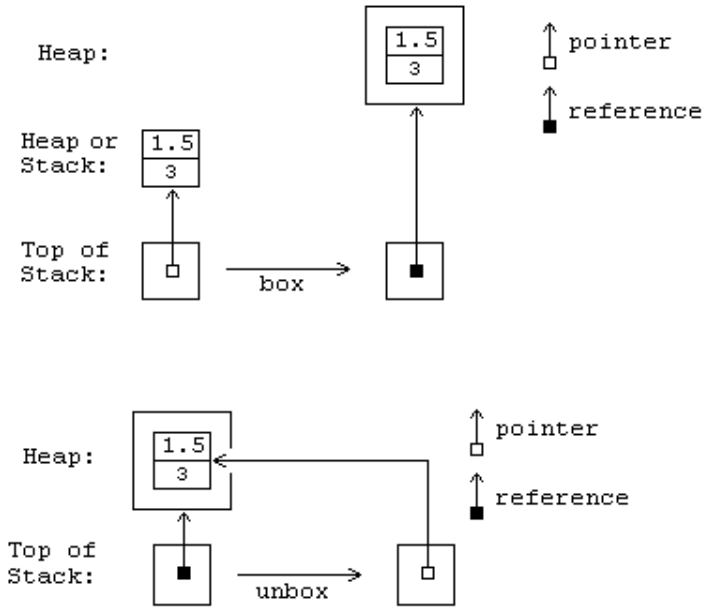
end note]
[Rationale: An important use of instance methods on value
types is to change internal state of the instance. This cannot be done
if an instance of the unboxed value type is used for the this pointer,
since it would be operating on a copy of the value, not the original
value: unboxed value types are copied when they are passed as arguments.
Virtual methods are used to allow multiple types to share implementation
code, and this requires that all classes that implement the virtual
method share a common representation defined by the class that first
introduces the method. Since value types can (and in the Base Class
Library do) implement interfaces and virtual methods defined on
System.Object, it is important that the virtual method be
callable using a boxed value type so it can be manipulated as would any
other type that implements the interface. This leads to the requirement
that the EE automatically unbox value types on virtual calls. end
rationale]
| Value Type (Boxed or Unboxed) | Interface | Object Type | |
|---|---|---|---|
call |
managed pointer to value type | invalid | object reference |
callvirt |
managed pointer to value type | object reference | object reference |
[Example:
The following converts an integer of the value type
int32 into a string. Recall that int32
corresponds to the unboxed value type System.Int32 defined
in the Base Class Library. Suppose the integer is declared as:
.locals init (int32 x)Then the call is made as shown below:
ldloca x  // load managed pointer to local variable
call instance string valuetype [mscorlib]System.Int32::ToString()
However, if System.Object (a class) is used as the type
reference rather than System.Int32 (a value type), the
value of x shall be boxed before the call is made and the
code becomes:
ldloc x
box valuetype [mscorlib]System.Int32
callvirt instance string [mscorlib]System.Object::ToString()
end example]
Special types are those that are referenced from CIL, but for which no definition is supplied: the VES supplies the definitions automatically based on information available from the reference.
| Type ::= |
|---|
| … |
| Type '[' ']' |
Vectors are single-dimension arrays with a zero lower bound. They
have direct support in CIL instructions (newarr,
ldelem, stelem, and ldelema, see
Partition
III). The CIL Framework also provides methods that deal with
multidimensional arrays and single-dimension arrays with a non-zero
lower bound (§II.14.2). Two vectors
have the same type if their element types are the same, regardless of
their actual upper bounds.
Vectors have a fixed size and element type, determined when they are created. All CIL instructions shall respect these values. That is, they shall reliably detect attempts to do the following: index beyond the end of the vector, store the incorrect type of data into an element of a vector, and take the address of elements of a vector with an incorrect data type. See Partition III.
[Example: Declare a vector of Strings:
.field string[] errorStringsDeclare a vector of function pointers:
.field method instance void*(int32) [] myVecCreate a vector of 4 strings, and store it into the field
errorStrings. The 4 strings lie at
errorStrings[0] through errorStrings[3]:
ldc.i4.4
newarr string
stfld string[] CountDownForm::errorStrings
Store the string "First" into
errorStrings[0]:
ldfld string[] CountDownForm::errorStrings
ldc.i4.0
ldstr "First"
stelem
end example]
Vectors are subtypes of System.Array, an abstract class
pre-defined by the CLI. It provides several methods that can be applied
to all vectors. See Partition IV.
While vectors (§II.14.1) have
direct support through CIL instructions, all other arrays are supported
by the VES by creating subtypes of the abstract class
System.Array (see Partition IV)
| Type ::= |
|---|
| … |
| Type '[' [ Bound [ ','
Bound ]*] ']' |
The rank of an array is the number of dimensions. The CLI does not support arrays with rank 0. The type of an array (other than a vector) shall be determined by the type of its elements and the number of dimensions.
| Bound ::= | Description |
|---|---|
'...' |
Lower and upper bounds unspecified. In the case of multi-dimensional arrays, the ellipsis can be omitted |
| | Int32 | Zero lower bound, Int32 upper bound |
| Int32 '...' |
Lower bound only specified |
| Int32 '...' Int32 |
Both bounds specified |
The class that the VES creates for arrays contains several methods whose implementation is supplied by the VES:
A constructor that takes a sequence of int32
arguments, one for each dimension of the array, that specify the number
of elements in each dimension beginning with the first dimension. A
lower bound of zero is assumed.
A constructor that takes twice as many int32
arguments as there are dimensions of the array. These arguments occur in
pairs—one pair per dimension—with the first argument of each pair
specifying the lower bound for that dimension, and the second argument
specifying the total number of elements in that dimension. Note that
vectors are not created with this constructor, since a zero lower bound
is assumed for vectors.
A Get method that takes a sequence of
int32 arguments, one for each dimension of the array, and
returns a value whose type is the element type of the array. This method
is used to access a specific element of the array where the arguments
specify the index into each dimension, beginning with the first, of the
element to be returned.
A Set method that takes a sequence of
int32 arguments, one for each dimension of the array,
followed by a value whose type is the element type of the array. The
return type of Set is void. This method is
used to set a specific element of the array where the arguments specify
the index into each dimension, beginning with the first, of the element
to be set and the final argument specifies the value to be stored into
the target element.
An Address method that takes a sequence of
int32 arguments, one for each dimension of the array, and
has a return type that is a managed pointer to the array's element type.
This method is used to return a managed pointer to a specific element of
the array where the arguments specify the index into each dimension,
beginning with the first, of the element whose address is to be
returned.
[Example: The following creates an array,
MyArray, of strings with two dimensions, with indexes 5…10
and 3…7. It then stores the string "One" into
MyArray[5, 3], retrieves it and prints it out. Then it
computes the address of MyArray[5, 4], stores
"Test" into it, retrieves it, and prints it out.
.assembly Test { }
.assembly extern mscorlib { }

.method public static void Start()
{ .maxstack 5
  .entrypoint
  .locals (class [mscorlib]System.String[,] myArray)

  ldc.i4.5 // load lower bound for dim 1
  ldc.i4.6 // load (upper bound - lower bound + 1) for dim 1
  ldc.i4.3 // load lower bound for dim 2
  ldc.i4.5 // load (upper bound - lower bound + 1) for dim 2
  newobj instance void string[,]::.ctor(int32, int32, int32, int32)
  stloc  myArray

  ldloc myArray
  ldc.i4.5
  ldc.i4.3
  ldstr "One"
  call instance void string[,]::Set(int32, int32, string)

  ldloc myArray
  ldc.i4.5
  ldc.i4.3
  call instance string string[,]::Get(int32, int32)
  call void [mscorlib]System.Console::WriteLine(string)

  ldloc myArray
  ldc.i4.5
  ldc.i4.4
  call instance string & string[,]::Address(int32, int32)
  ldstr "Test"
  stind.ref

  ldloc myArray
  ldc.i4.5
  ldc.i4.4
  call instance string string[,]::Get(int32, int32)
  call void [mscorlib]System.Console::WriteLine(string)

  ret
}
end example]
The following text is informative.
Whilst the elements of multi-dimensional arrays can be thought of as laid out in contiguous memory, arrays of arrays are different – each dimension (except the last) holds an array reference. The following picture illustrates the difference:
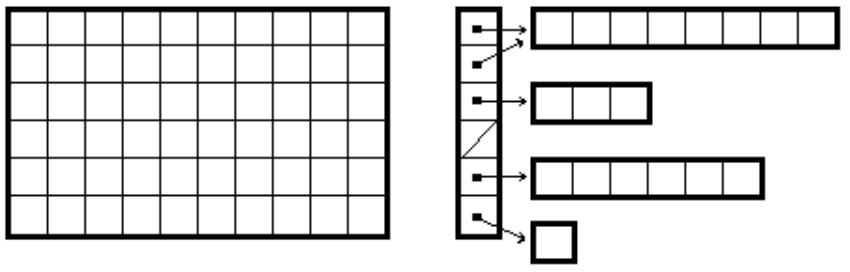
On the left is a [6, 10] rectangular array. On the right is not one, but a total of five arrays. The vertical array is an array of arrays, and references the four horizontal arrays. Note how the first and second elements of the vertical array both reference the same horizontal array.
Note that all dimensions of a multi-dimensional array shall have the same size. But in an array of arrays, it is possible to reference arrays of different sizes. For example, the figure on the right shows the vertical array referencing arrays of lengths 8, 8, 3, null (i.e., no array), 6 and 1, respectively.
There is no special support for these so-called jagged arrays in either the CIL instruction set or the VES. They are simply vectors whose elements reference other (recursively) jagged arrays.
End of informative text.
An enum (short for enumeration) defines a set of
symbols that all have the same type. A type shall be an enum if and only
if it has an immediate base type of System.Enum. Since
System.Enum itself has an immediate base type of
System.ValueType, (see Partition IV) enums
are value types (§II.13) The symbols of an
enum are represented by an underlying integer type: one of {
bool, char, int8,
unsigned int8, int16,
unsigned int16, int32,
unsigned int32, int64,
unsigned int64, native int,
unsigned native int }
[Note: Unlike Pascal, the CLI does not provide a guarantee that values of the enum type are integers corresponding to one of the symbols. In fact, the CLS (see Partition I, CLS) defines a convention for using enums to represent bit flags which can be combined to form integral value that are not named by the enum type itself. end note]
Enums obey additional restrictions beyond those on other value types.
Enums shall contain only fields as members (they shall not even define
type initializers or instance constructors); they shall not implement
any interfaces; they shall have auto field layout (§II.10.1.2); they shall
have exactly one instance field and it shall be of the underlying type
of the enum; all other fields shall be static and literal (§II.16.1); and they shall not
be initialized with the initobj instruction.
[Rationale: These restrictions allow a very efficient implementation of enums. end rationale]
The single, required, instance field stores the value of an instance of the enum. The static literal fields of an enum declare the mapping of the symbols of the enum to the underlying values. All of these fields shall have the type of the enum and shall have field init metadata that assigns them a value (§II.16.2).
For binding purposes (e.g., for locating a method definition from the method reference used to call it) enums shall be distinct from their underlying type. For all other purposes, including verification and execution of code, an unboxed enum freely interconverts with its underlying type. Enums can be boxed (§II.13) to a corresponding boxed instance type, but this type is not the same as the boxed type of the underlying type, so boxing does not lose the original type of the enum.
[Example: Declare an enum type and then create a local variable of that type. Store a constant of the underlying type into the enum (showing automatic coersion from the underlying type to the enum type). Load the enum back and print it as the underlying type (showing automatic coersion back). Finally, load the address of the enum and extract the contents of the instance field and print that out as well.
assembly Test { }
.assembly extern mscorlib { }

.class sealed public ErrorCodes extends [mscorlib]System.Enum
{ .field public unsigned int8 MyValue
  .field public static literal valuetype ErrorCodes no_error = int8(0)
  .field public static literal valuetype ErrorCodes format_error = int8(1)
  .field public static literal valuetype ErrorCodes overflow_error = int8(2)
  .field public static literal valuetype ErrorCodes nonpositive_error = int8(3)
}

.method public static void Start()
{ .maxstack 5
  .entrypoint
  .locals init (valuetype ErrorCodes errorCode)

  ldc.i4.1           // load 1 (= format_error)
  stloc errorCode    // store in local, note conversion to enum
  ldloc errorCode
  call void [mscorlib]System.Console::WriteLine(int32)
  ldloca errorCode   // address of enum
  ldfld unsigned int8 valuetype ErrorCodes::MyValue
  call void [mscorlib]System.Console::WriteLine(int32)
  ret
}
end example]
| Type ::= | Clause |
|---|---|
| … | |
| Type '&' |
II.14.4.2 |
| Type '*' |
II.14.4.1 |
A pointer type shall be defined by specifying a signature
that includes the type of the location at which it points. A
pointer can be managed (reported to the CLI garbage
collector, denoted by &, see §II.14.4.2) or
unmanaged (not reported, denoted by *, see §II.14.4.1)
Pointers can contain the address of a field (of an object or value type) or of an element of an array. Pointers differ from object references in that they do not point to an entire type instance, but, rather, to the interior of an instance. The CLI provides two type-safe operations on pointers:
Loading the value from the location referenced by the pointer.
Storing a value V into the location referenced by a pointer P, where the type of V is assignable-to (§I.8.7.3) the type referenced by P.
For pointers into the same array or object (see Partition I) the following arithmetic operations are supported:
Adding an integer value to a pointer (where that value is interpreted as a number of bytes), which results in a pointer of the same kind
Subtracting an integer value from a pointer (where that value is interpreted as a number of bytes), which results in a pointer of the same kind. Note that subtracting a pointer from an integer value is not permitted.
Two pointers, regardless of kind, can be subtracted from one another, producing an integer value that specifies the number of bytes between the addresses they reference.
The following is informative text.
Pointers are compatible with unsigned int32 on 32-bit
architectures, and with unsigned int64 on 64-bit
architectures. They are best considered as unsigned int,
whose size varies depending upon the runtime machine architecture.
The CIL instruction set (see Partition III) contains instructions to compute addresses of fields, local variables, arguments, and elements of vectors:
| Instruction | Description |
|---|---|
ldarga |
Load address of argument |
ldelema |
Load address of vector element |
ldflda |
Load address of field |
ldloca |
Load address of local variable |
ldsflda |
Load address of static field |
Once a pointer is loaded onto the stack, the ldind class
of instructions can be used to load the data item to which it points.
Similarly, the stind family of instructions can be used to
store data into the location.
Note that the CLI will throw an
InvalidOperationException for an ldflda
instruction if the address is not within the current application domain.
This situation arises typically only from the use of objects with a base
type of System.MarshalByRefObject (see Partition
IV).
Unmanaged pointers (*) are the traditional pointers used
in languages like C and C++. There are no restrictions on their use,
although, for the most part, they result in code that cannot be
verified. While it is perfectly valid to mark locations that contain
unmanaged pointers as though they were unsigned integers (and this is,
in fact, how they are treated by the VES), it is often better to mark
them as unmanaged pointers to a specific type of data. This is done by
using * in a signature for a return value, local variable,
or an argument, or by using a pointer type for a field or array
element.
Unmanaged pointers are not reported to the garbage collector and can be used in any way that an integer can be used.
Verifiable code cannot dereference unmanaged pointers.
Unverified code can pass an unmanaged pointer to a method that expects a managed pointer. This is safe only if one of the following is true:
The unmanaged pointer refers to memory that is not in memory used by the CLI for storing instances of objects ("garbage-collected memory" or "managed memory").
The unmanaged pointer contains the address of a field within an object.
The unmanaged pointer contains the address of an element within an array.
The unmanaged pointer contains the address where the element following the last element in an array would be located.
Managed pointers (&) can point to an instance of a
value type, a field of an object, a field of a value type, an element of
an array, or the address where an element just past the end of an array
would be stored (for pointer indexes into managed arrays). Managed
pointers cannot be null, and they shall be reported to the
garbage collector even if they do not point to managed memory.
Managed pointers are specified by using & in a
signature for a return value, local variable or an argument, or by using
a byref type for a field or array element.
Managed pointers can be passed as arguments, stored in local variables, and returned as values.
If a parameter is passed by reference, the corresponding argument is a managed pointer.
Managed pointers cannot be stored in static variables, array elements, or fields of objects or value types.
Managed pointers are not interchangeable with object references.
A managed pointer cannot point to another managed pointer, but it can point to an object reference or a value type.
A managed pointer can point to a local variable, or a method argument
Managed pointers that do not point to managed memory can be
converted (using conv.u or conv.ovf.u) into
unmanaged pointers, but this is not verifiable.
Unverified code that erroneously converts a managed pointer into an unmanaged pointer can seriously compromise the integrity of the CLI. See Partition III (Managed Pointers) for more details.
End informative text.
| Type ::= |
|---|
| … |
| method CallConv Type
'*' '(' Parameters
')' |
Variables of type method pointer shall store the address of the entry
point to a method whose signature is
method-signature-compatible-with (§I.8.7.1)
the type of the method pointer. A pointer to a static or instance method
is obtained with the ldftn instruction, while a pointer to
a virtual method is obtained with the ldvirtftn
instruction. A method can be called by using a method pointer with the
calli instruction. See Partition
III for the specification of these instructions.
[Note: Like other pointers, method pointers are compatible
with unsigned int64 on 64-bit architectures, and with
unsigned int32 on 32-bit architectures. The preferred
usage, however, is unsigned native int, which works on both
32- and 64-bit architectures. end note]
[Example: Call a method using a pointer. The method
MakeDecision::Decide returns a method pointer to either
AddOne or Negate, alternating on each call.
The main program calls MakeDecision::Decide three times,
and after each call uses a calli instruction to call the
method specified. The output printed is "-1 2 -1"
indicating successful alternating calls.
.assembly Test { }
.assembly extern mscorlib { }

.method public static int32 AddOne(int32 Input)
{ .maxstack 5
  ldarg Input
  ldc.i4.1
  add
  ret
}

.method public static int32 Negate(int32 Input)
{ .maxstack 5
  ldarg Input
  neg
  ret
}

.class value sealed public MakeDecision extends
       [mscorlib]System.ValueType
{ .field static bool Oscillate
  .method public static method int32 *(int32) Decide()
  { ldsfld bool valuetype MakeDecision::Oscillate
    dup
    not
    stsfld bool valuetype MakeDecision::Oscillate
    brfalse NegateIt
    ldftn int32 AddOne(int32)
    ret

NegateIt:
    ldftn int32 Negate(int32)
    ret
  }
}

.method public static void Start()
{ .maxstack 2
  .entrypoint

  ldc.i4.1
  call method int32 *(int32) valuetype MakeDecision::Decide()
  calli int32(int32)
  call  void [mscorlib]System.Console::WriteLine(int32)

  ldc.i4.1
  call method int32 *(int32) valuetype MakeDecision::Decide()
  calli int32(int32)
  call  void [mscorlib]System.Console::WriteLine(int32)

  ldc.i4.1
  call method int32 *(int32) valuetype MakeDecision::Decide()
  calli int32(int32)
  call  void [mscorlib]System.Console::WriteLine(int32)

  ret
}
end example]
Delegates (see Partition I)
are the object-oriented equivalent of function pointers. Unlike function
pointers, delegates are object-oriented, type-safe, and secure.
Delegates are reference types, and are declared in the form of classes.
Delegates shall have a base type of System.Delegate (see Partition
IV).
Delegates shall be declared sealed, and the only
members a delegate shall have are either the first two or all four
methods as specified here. These methods shall be declared
runtime and managed (§II.15.4.3).
They shall not have a body, since that body shall be created
automatically by the VES. Other methods available on delegates are
inherited from the class System.Delegate in the Base Class
Library (see Partition IV).
The delegate methods are:
The instance constructor (named .ctor and marked
specialname and rtspecialname, see §II.10.5.1) shall take
exactly two parameters, the first having type
System.Object, and the second having type
System.IntPtr. When actually called (via a
newobj instruction, see Partition III),
the first argument shall be an instance of the class (or one of its
derived classes) that defines the target method, and the second argument
shall be a method pointer to the method to be called.
The Invoke method shall be virtual
and its signature constrains the target method to which it can be bound;
see §II.14.6.1. The
verifier treats calls to the Invoke method on a delegate
just like it treats calls to any other method.
The BeginInvoke method (§II.14.6.3.1), if
present, shall be virtual and have a signature related to, but not the
same as, that of the Invoke method. There are two
differences in the signature. First, the return type shall be
System.IAsyncResult (see Partition IV).
Second, there shall be two additional parameters that follow those of
Invoke: the first of type System.AsyncCallback
and the second of type System.Object.
The EndInvoke method (§II.14.6.3)
shall be virtual and have the same return type as the
Invoke method. It shall take as parameters exactly those
parameters of Invoke that are managed pointers, in the same
order they occur in the signature for Invoke. In addition,
there shall be an additional parameter of type
System.IAsyncResult.
Unless stated otherwise, a standard delegate type shall provide the
two optional asynchronous methods, BeginInvoke and
EndInvoke.
[Example: The following declares a Delegate used to call
functions that take a single integer and return nothing. It provides all
four methods so it can be called either synchronously or asynchronously.
Because no parameters are passed by reference (i.e., as managed
pointers) there are no additional arguments to
EndInvoke.
.assembly Test { }
.assembly extern mscorlib { }

.class private sealed StartStopEventHandler extends [mscorlib]System.Delegate
{ .method public specialname rtspecialname instance void .ctor(object Instance,
         native int Method) runtime managed {}
  .method public virtual void Invoke(int32 action) runtime managed {}
  .method public virtual class [mscorlib]System.IAsyncResult
       BeginInvoke(int32 action, class [mscorlib]System.AsyncCallback callback,
          object Instance) runtime managed {}
  .method public virtual void EndInvoke(class
       [mscorlib]System.IAsyncResult result) runtime managed {}
}
end example]
As with any class, an instance is created using the
newobj instruction in conjunction with the instance
constructor. The first argument to the constructor shall be the object
on which the method is to be called, or it shall be null if the method
is a static method. The second argument shall be a method pointer to a
method on the corresponding class and with a signature that matches that
of the delegate class being instantiated.
This clause defines the relation delegate-assignable-to, which is a variant of method-signature-compatible-with (§I.8.7.1) and covers delegate construction.
Delegates are bound to target methods through the newobj
IL instruction (§III.4.21) passing a
method pointer for the target method and an object reference, if the
target is an instance method, or null, if the target is a static method.
The target method is loaded onto the evaluation stack through the
ldftn, ldvirtftn, or one of the load IL
instructions, at which time the signature of the method is
available.
The signature of a delegate is the signature of the
Invoke method on the delegate type. [Note: the
signature does not include the type of the this
pointer, if any, bound at delegate creation time. end note]
Delegates can only be verifiably bound to target methods where:
the signatures of the target method is delegate-assignable-to the signature of the delegate;
The object reference's verification type is
verifier-assignable-to (§III.1.8.1.2.3)
the this signature of the target method, if the target is an instance
method, or null, if the target method is a static method. The special
verification rules for delegate construction are captured by the
newobj (§III.4.21)
instruction.
The delegate-assignable-to relation is defined in terms of the parameter types, ignoring the this parameter, if any, the return type and calling convention. (Custom modifiers are not considered significant and do not impact compatibility.)
A target method or delegate of type T is delegate-assignable-to a delegate of type D if and only if all of the following apply:
The calling conventions of T and D shall match exactly, ignoring the distinction between static and instance methods (i.e., the this parameter, if any, is not treated specially). [Note: delegate-assignable-to does not consider the type of this, if any, that is covered by the additional verification rules above. end note]
T and D have the same number of parameters, ignoring any this parameter if T is a method.
For each parameter type U of T, ignoring any this parameter if T is a method, and corresponding type V of D, U is assignable-to (§I.8.7.3) V.
The return type U of T and return type V of D, V is assignable-to U.
The synchronous mode of calling delegates corresponds to regular
method calls and is performed by calling the virtual method named
Invoke on the delegate. The delegate itself is the first
argument to this call (it serves as the this pointer),
followed by the other arguments as specified in the signature. When this
call is made, the caller shall block until the called method returns.
The called method shall be executed on the same thread as the
caller.
[Example: Continuing the previous example, define a class
Test that declares a method, onStartStop,
appropriate for use as the target for the delegate.
.class public Test
{ .field public int32 MyData
  .method public void onStartStop(int32 action)
  { ret        // put your code here
  }
  .method public specialname rtspecialname
          instance void .ctor(int32 Data)
  { ret        // call base class constructor, store state, etc.
  }
}
Then define a main program. This one constructs an instance of
Test and then a delegate that targets the
onStartStop method of that instance. Finally, call the
delegate.
.method public static void Start()
{ .maxstack 3
  .entrypoint
  .locals (class StartStopEventHandler DelegateOne,
           class Test InstanceOne)
  // Create instance of Test class
  ldc.i4.1
  newobj instance void Test::.ctor(int32)
  stloc InstanceOne

 // Create delegate to onStartStop method of that class
 ldloc InstanceOne
  ldftn instance void Test::onStartStop(int32)
  newobj void StartStopEventHandler::.ctor(object, native int)
  stloc DelegateOne

  // Invoke the delegate, passing 100 as an argument
  ldloc DelegateOne
  ldc.i4 100
  callvirt instance void StartStopEventHandler::Invoke(int32)
  ret
}
Note that the example above creates a delegate to a non-virtual
function. If onStartStop had been a virtual function, use
the following code sequence instead:
ldloc InstanceOne
dup
ldvirtftn instance void Test::onStartStop(int32)
newobj void StartStopEventHandler::.ctor(object, native int)
stloc DelegateOne

// Invoke the delegate, passing 100 as an argument
ldloc DelegateOne
end example]
[Note: The code sequence above shall use dup –
not ldloc InstanceOne twice. The dup code
sequence is easily recognized as type-safe, whereas alternatives would
require more complex analysis. Verifiability of code is discussed in Partition
III end note]
In the asynchronous mode, the call is dispatched, and the caller shall continue execution without waiting for the method to return. The called method shall be executed on a separate thread.
To call delegates asynchronously, the BeginInvoke and
EndInvoke methods are used.
Note: if the caller thread terminates before the callee completes, the callee thread is unaffected. The callee thread continues execution and terminates silently
Note: the callee can throw exceptions. Any unhandled
exception propagates to the caller via the EndInvoke
method.
An asynchronous call to a delegate shall begin by making a virtual
call to the BeginInvoke method. BeginInvoke is
similar to the Invoke method (§II.14.6.1),
but has two differences:
It has two additional parameters, appended to the list, of type
System.AsyncCallback, and
System.Object.
The return type of the method is
System.IAsyncResult.
Although the BeginInvoke method therefore includes
parameters that represent return values, these values are not updated by
this method. The results instead are obtained from the
EndInvoke method (see below). Unlike a synchronous call, an
asynchronous call shall provide a way for the caller to determine when
the call has been completed. The CLI provides two such mechanisms. The
first is through the result returned from the call. This object, an
instance of the interface System.IAsyncResult, can be used
to wait for the result to be computed, it can be queried for the current
status of the method call, and it contains the
System.Object value that was passed to the call to
BeginInvoke. See Partition
IV.
The second mechanism is through the System.AsyncCallback
delegate passed to BeginInvoke. The VES shall call this
delegate when the value is computed or an exception has been raised
indicating that the result will not be available. The value passed to
this callback is the same value passed to the call to
BeginInvoke. A value of null can be passed for
System.AsyncCallback to indicate that the VES need not
provide the callback.
[Rationale: This model supports both a polling approach (by
checking the status of the returned System.IAsyncResult)
and an event-driven approach (by supplying a
System.AsyncCallback) to asynchronous calls. end
rationale]
A synchronous call returns information both through its return value
and through output parameters. Output parameters are represented in the
CLI as parameters with managed pointer type. Both the returned value and
the values of the output parameters are not available until the VES
signals that the asynchronous call has completed successfully. They are
retrieved by calling the EndInvoke method on the delegate
that began the asynchronous call.
The EndInvoke method can be called at any time after
BeginInvoke. It shall suspend the thread that calls it
until the asynchronous call completes. If the call completes
successfully, EndInvoke will return the value that would
have been returned had the call been made synchronously, and its managed
pointer arguments will point to values that would have been returned to
the out parameters of the synchronous call.
EndInvoke requires as parameters the value returned by
the originating call to BeginInvoke (so that different
calls to the same delegate can be distinguished, since they can execute
concurrently) as well as any managed pointers that were passed as
arguments (so their return values can be provided).
Methods can be defined at the global level (outside of any type):
| Decl ::= … |
|---|
| .method MethodHeader '{'
MethodBodyItem* '}' |
as well as inside a type:
| ClassMember ::= … |
|---|
| .method MethodHeader '{'
MethodBodyItem* '}' |
There are four constructs in ILAsm connected with methods. These correspond with different metadata constructs, as described in §II.23.
A MethodDecl, or method declaration, supplies the method
name and signature (parameter and return types), but not its body. That
is, a method declaration provides a MethodHeader but no
MethodBodyItems. These are used at call sites to specify the
call target (call or callvirt instructions,
see Partition
III) or to declare an abstract method. A MethodDecl has no
direct logical couterpart in the metadata; it can be either a
Method or a MethodRef.
A Method, or method definition, supplies the method name, attributes, signature, and body. That is, a method definition provides a MethodHeader as well as one or more MethodBodyItems. The body includes the method's CIL instructions, exception handlers, local variable information, and additional runtime or custom metadata about the method. See §II.22.26.
A MethodRef, or method reference, is a reference to a
method. It is used when a method is called and that method's definition
lies in another module or assembly. A MethodRef shall be
resolved by the VES into a Method before the method is called
at runtime. If a matching Method cannot be found, the VES shall
throw a System.MissingMethodException. See §II.22.25.
A MethodImpl, or method implementation, supplies the executable body for an existing virtual method. It associates a Method (representing the body) with a MethodDecl or Method (representing the virtual method). A MethodImpl is used to provide an implementation for an inherited virtual method or a virtual method from an interface when the default mechanism (matching by name and signature) would not provide the correct result. See §II.22.27.
Static methods are methods that are associated with a type, not with its instances.
Instance methods are associated with an instance of a type: within the body of an instance method it is possible to reference the particular instance on which the method is operating (via the this pointer). It follows that instance methods shall only be defined in classes or value types, but not in interfaces or outside of a type (i.e., globally). However, notice
Instance methods on classes (including boxed value types), have a this pointer that is by default an object reference to the class on which the method is defined.
Instance methods on (unboxed) value types, have a this pointer that is by default a managed pointer to an instance of the type on which the method is defined.
There is a special encoding (denoted by the syntactic item explicit in the calling convention, see §II.15.3) to specify the type of the this pointer, overriding the default values specified here.
The this pointer can be null.
Virtual methods are associated with an instance of a type in much the
same way as for instance methods. However, unlike instance methods, it
is possible to call a virtual method in such a way that the
implementation of the method shall be chosen at runtime by the VES
depending upon the type of object used for the this pointer.
The particular Method that implements a virtual method is
determined dynamically at runtime (a virtual call) when invoked via the
callvirt instruction; whilst the binding is decided at
compile time when invoked via the call instruction (see Partition
III).
With virtual calls (only), the notion of inheritance becomes important. A derived class can override a virtual method inherited from its base classes, providing a new implementation of the method. The method attribute newslot specifies that the CLI shall not override the virtual method definition of the base type, but shall treat the new definition as an independent virtual method definition.
Abstract virtual methods (which shall only be defined in abstract
classes or interfaces) shall be called only with a callvirt
instruction. Similarly, the address of an abstract virtual method shall
be computed with the ldvirtftn instruction, and the
ldftn instruction shall not be used.
[Rationale: With a concrete virtual method there is always an implementation available from the class that contains the definition, thus there is no need at runtime to have an instance of a class available. Abstract virtual methods, however, receive their implementation only from a subtype or a class that implements the appropriate interface, hence an instance of a class that actually implements the method is required. end rationale]
| CallConv ::= |
|---|
[ instance [ explicit ]] [
CallKind ] |
A calling convention specifies how a method expects its arguments to be passed from the caller to the called method. It consists of two parts: the first deals with the existence and type of the this pointer, while the second relates to the mechanism for transporting the arguments.
If the attribute instance is present, it indicates that a this pointer shall be passed to the method. This attribute shall be used for both instance and virtual methods.
Normally, a parameter list (which always follows the calling convention) does not provide information about the type of the this pointer, since this can be deduced from other information. When the combination instance explicit is specified, however, the first type in the subsequent parameter list specifies the type of the this pointer and subsequent entries specify the types of the parameters themselves.
| CallKind ::= |
|---|
default |
| unmanaged cdecl |
| unmanaged fastcall |
| unmanaged stdcall |
| unmanaged thiscall |
| vararg |
Managed code shall have only the default or vararg calling kind. default shall be used in all cases except when a method accepts an arbitrary number of arguments, in which case vararg shall be used. When dealing with methods implemented outside the CLI it is important to be able to specify the calling convention required. For this reason there are 16 possible encodings of the calling kind. Two are used for the managed calling kinds. Four are reserved with defined meaning across many platforms, as follows:
unmanaged cdecl is the calling convention used by Standard C
unmanaged stdcall specifies a standard C++ call
unmanaged fastcall is a special optimized C++ calling convention
unmanaged thiscall is a C++ call that passes a this pointer to the method
Four more are reserved for existing calling conventions, but their use is not maximally portable. Four more are reserved for future standardization, and two are available for non-standard experimental use. (In this context, "portable" means a feature that is available on all conforming implementations of the CLI.)
| MethodHeader ::= |
|---|
MethAttr* [ CallConv ] Type [
marshal '(' [ NativeType ]
')' ] MethodName [ '<'
GenPars '>' ] '('
Parameters ')' ImplAttr* |
The method head (see also §II.10) consists of
the calling convention (CallConv, see §II.15.3)
any number of predefined method attributes (MethAttr, see §II.15.4.1.5)
a return type with optional attributes
optional marshalling information (§II.7.4)
a method name
optional generic parameters (when defining generic methods, see §II.10.1.7)
a signature
and any number of implementation attributes (ImplAttr, see §II.15.4.3)
Methods that do not have a return value shall use void as the return type.
| MethodName ::= |
|---|
.cctor |
| .ctor |
| | DottedName |
Method names are either simple names or the special names used for instance constructors and type initializers.
| Parameters ::= |
|---|
[ Param [ ',' Param ]* ] |
| Param ::= | ... | | [ ParamAttr* ]
Type [ marshal '(' [
NativeType ] ')' ] [ Id ]
The Id, if present, is the name of the parameter. A parameter can be referenced either by using its name or the zero-based index of the parameter. In CIL instructions it is always encoded using the zero-based index (the name is for ease of use in ILAsm).
Note that, in contrast to calling a vararg method,
the definition of a vararg method does not include any
ellipsis ("…")
| ParamAttr ::= |
|---|
'[' in ']' |
| '[' opt ']' |
| '[' out ']' |
The parameter attributes shall be attached to the parameters (§II.22.33) and hence are not part of a method signature.
[Note: Unlike parameter attributes, custom modifiers (modopt and modreq) are part of the signature. Thus, modifiers form part of the method's contract while parameter attributes do not. end note]
in and out shall only be attached to parameters of pointer (managed or unmanaged) type. They specify whether the parameter is intended to supply input to the method, return a value from the method, or both. If neither is specified in is assumed. The CLI itself does not enforce the semantics of these bits, although they can be used to optimize performance, especially in scenarios where the call site and the method are in different application domains, processes, or computers.
opt specifies that this parameter is intended to be optional from an end-user point of view. The value to be supplied is stored using the .param syntax (§II.15.4.1.4).
The method body shall contain the instructions of a program. However, it can also contain labels, additional syntactic forms and many directives that provide additional information to ilasm and are helpful in the compilation of methods of some languages.
| MethodBodyItem ::= | Description | Clause |
|---|---|---|
.custom CustomDecl |
Definition of custom attributes. | §II.21 |
| .data DataDecl |
Emits data to the data section | §II.16.3 |
| .emitbyte Int32 |
Emits an unsigned byte to the code section of the method. | §II.15.4.1.1 |
| .entrypoint |
Specifies that this method is the entry point to the application (only one such method is allowed). | §II.15.4.1.2 |
| .locals [ init ] '('
LocalsSignature ')' |
Defines a set of local variables for this method. | §II.15.4.1.3 |
| .maxstack Int32 |
The int32 specifies the maximum number of elements on
the evaluation stack during the execution of the method. |
§II.15.4.1 |
| .override TypeSpec '::'
MethodName |
Use current method as the implementation for the method specified. | §II.10.3.2 |
| .override method CallConv Type
TypeSpec '::' MethodName
GenArity '(' Parameters
')' |
Use current method as the implementation for the method specified. | §II.10.3.2 |
| .param '[' Int32
']' [ '=' FieldInit ] |
Store a constant FieldInit value for parameter Int32 | §II.15.4.1.4 |
| .param type '[' Int32
']' |
Specifies a type parameter for a generic method | §II.15.4.1.5 |
| | ExternSourceDecl | .line or #line |
§II.5.7 |
| | Instr | An instruction | Partition VI |
| Id ':' |
A label | §II.5.4 |
| | ScopeBlock | Lexical scope of local variables | §II.15.4.4 |
| | SecurityDecl | .permission or .permissionset |
§II.20 |
| | SEHBlock | An exception block | §II.19 |
| MethodBodyItem ::= … | | .emitbyte
Int32
This directive causes an unsigned 8-bit value to be emitted directly into the CIL stream of the method, at the point at which the directive appears.
[Note: The .emitbyte directive is used for generating tests. It is not required in generating regular programs. end note]
| MethodBodyItem ::= … | | .entrypoint
The .entrypoint directive marks the current method, which shall be static, as the entry point to an application. The VES shall call this method to start the application. An executable shall have exactly one entry point method; entry point methods in a library are not handled specially by the VES. This entry point method can be a global method or it can appear inside a type. (The effect of the directive is to place the metadata token for this method into the CLI header of the PE file)
The entry point method shall either accept no arguments or a vector of strings. If it accepts a vector of strings, the strings shall represent the arguments to the executable, with index 0 containing the first argument. The mechanism for specifying these arguments is platform-specific and is not specified here.
The return type of the entry point method shall be void, int32, or unsigned int32. If an int32 or unsigned int32 is returned, the executable can return an exit code to the host environment. A value of 0 shall indicate that the application terminated ordinarily.
The accessibility of the entry point method shall not prevent its use in starting execution. Once started the VES shall treat the entry point as it would any other method. The entry point method cannot be defined in a generic class.
[Example: The following prints the first argument and returns successfully to the operating system:
.method public static int32 MyEntry(string[] s) cil managed
{ .entrypoint
  .maxstack 2
  ldarg.0                  // load and print the first argument
  ldc.i4.0
  ldelem.ref
  call void [mscorlib]System.Console::WriteLine(string)
  ldc.i4.0                 // return success
  ret
}
end example]
The .locals statement declares one or more local variables (see Partition I) for the current method.
| MethodBodyItem ::= … |
|---|
| .locals [ init ] '('
LocalsSignature ')' |
| LocalsSignature ::= |
|---|
Local [ ',' Local ]* |
| Local ::= |
|---|
| Type [ Id ] |
If present, the Id is the name of the corresponding local variable. If init is specified, the variables are initialized to their default values according to their type: reference types are initialized to null and value types are zeroed out.
[Note: Verifiable methods shall include the init keyword. See Partition III. end note]
[Example: The following declares 4 local variables, each of which is to be initialized to its default value:
.locals init ( int32 i, int32 j, float32 f, int64[] vect)end example]
| MethodBodyItem ::= … |
|---|
| .param '[' Int32
']' [ '=' FieldInit ] |
This directive stores in the metadata a constant value associated with method parameter number Int32, see §II.22.9. While the CLI requires that a value be supplied for the parameter, some tools can use the presence of this attribute to indicate that the tool rather than the user is intended to supply the value of the parameter. Unlike CIL instructions, .param uses index 0 to specify the return value of the method, index 1 to specify the first parameter of the method, index 2 to specify the second parameter of the method, and so on.
[Note: The CLI attaches no semantic whatsoever to these values—it is entirely up to compilers to implement any semantic they wish (e.g., so-called default argument values). end note]
| MethodBodyItem ::= … |
|---|
| .param type '[' Int32
']' |
This directive allows type parameters for a generic type or method to be specified. Int32 is the 1-based ordinal of the type or method parameter to which the directive applies. [Note: This directive is used in conjunction with a .custom directive to associate a custom attribute with a type parameter. end note]
When a .param type directive is used within class scope, it refers to a type parameter of that class. When the directive is used within method scope inside a class definition, it refers to a type parameter of that method. Otherwise, the program is ill-formed.
[Example:
.class public G<T,U> {
  .param type [1]  // refers to T
  .custom instance void TypeParamAttribute::.ctor() = (01 00 ... )
  .method public void Foo<M>(!!0 m) {
     .param type [1] // refers to M
     .custom instance void AnotherTypeParamAttribute::.ctor() = (01 00 ... )
      …
  }
  …
}
end example]
| MethAttr ::= | Description | Clause |
|---|---|---|
abstract |
The method is abstract (shall also be virtual). | §II.15.4.2.4 |
| assembly |
Assembly accessibility | §II.15.4.2.1 |
| compilercontrolled |
Compiler-controlled accessibility. | §II.15.4.2.1 |
| famandassem |
Family and Assembly accessibility | §II.15.4.2.1 |
| family |
Family accessibility | §II.15.4.2.1 |
| famorassem |
Family or Assembly accessibility | §II.15.4.2.1 |
| final |
This virtual method cannot be overridden by derived classes. | §II.15.4.2.2 |
| hidebysig |
Hide by signature. Ignored by the runtime. | §II.15.4.2.2 |
| newslot |
Specifies that this method shall get a new slot in the virtual method table. | §II.15.4.2.3 |
| pinvokeimpl '(' QSTRING [
as QSTRING ] PinvAttr*
')' |
Method is actually implemented in native code on the underlying platform | §II.15.4.2.5 |
| private |
Private accessibility | §II.15.4.2.1 |
| public |
Public accessibility. | §II.15.4.2.1 |
| rtspecialname |
The method name needs to be treated in a special way by the runtime. | §II.15.4.2.6 |
| specialname |
The method name needs to be treated in a special way by some tool. | §II.15.4.2.6 |
| static |
Method is static. | §II.15.4.2.2 |
| virtual |
Method is virtual. | §II.15.4.2.2 |
| strict |
Check accessibility on override | §II.15.4.2.2 |
The following combinations of predefined attributes are invalid:
static combined with any of final, newslot, or virtual
abstract combined with any of final or pinvokeimpl
compilercontrolled combined with any of final, rtspecialname, specialname, or virtual
| MethAttr ::= … |
|---|
| assembly |
| compilercontrolled |
| famandassem |
| family |
| famorassem |
| private |
| public |
Only one of these attributes shall be applied to a given method. See Partition I.
| MethAttr ::= … |
|---|
| final |
| hidebysig |
| static |
| virtual |
| strict |
These attributes can be combined, except a method shall not be both static and virtual; only virtual methods shall be final or strict; and abstract methods shall not be final.
final methods shall not be overridden by derived classes of this type.
hidebysig is supplied for the use of tools and is ignored by the VES. It specifies that the declared method hides all methods of the base class types that have a matching method signature; when omitted, the method should hide all methods of the same name, regardless of the signature.
[Rationale: Some languages (such as C++) use a hide-by-name semantics while others (such as C#, Java™) use a hide-by-name-and-signature semantics. end rationale]
static and virtual are described in §II.15.2.
strict virtual methods can only be overridden if they are also accessible. See §II.23.1.10.
| MethAttr ::= … |
|---|
| newslot |
newslot shall only be used with virtual methods. See II.10.3.
| MethAttr ::= … |
|---|
| abstract |
abstract shall only be used with virtual methods that are not final. It specifies that an implementation of the method is not provided but shall be provided by a derived class. abstract methods shall only appear in abstract types (§II.10.1.4).
| MethAttr ::= … |
|---|
| pinvokeimpl '(' QSTRING [
as QSTRING ] PinvAttr*
')' |
| MethAttr ::= … |
|---|
| rtspecialname |
| specialname |
The attribute rtspecialname specifies that the
method name shall be treated in a special way by the runtime. Examples
of special names are .ctor (object constructor) and
.cctor (type initializer).
specialname indicates that the name of this method has special meaning to some tools.
| ImplAttr ::= | Description | Clause |
|---|---|---|
cil |
The method contains standard CIL code. | §II.15.4.3.1 |
| forwardref |
The body of this method is not specified with this declaration. | §II.15.4.3.3 |
| internalcall |
Denotes the method body is provided by the CLI itself | §II.15.4.3.3 |
| managed |
The method is a managed method. | §II.15.4.3.2 |
| native |
The method contains native code. | §II.15.4.3.1 |
| noinlining |
The runtime shall not expand the method inline. | §II.15.4.3.3 |
| nooptimization |
The runtime shall not optimize the method when generating native code. | §II.15.4.3.3 |
| runtime |
The body of the method is not defined, but is produced by the runtime. | §II.15.4.3.1 |
| synchronized |
The method shall be executed in a single threaded fashion. | §II.15.4.3.3 |
| unmanaged |
Specifies that the method is unmanaged. | §II.15.4.3.2 |
| ImplAttr ::= … |
|---|
| cil |
| native |
| runtime |
These attributes are mutually exclusive; they specify the type of code the method contains.
cil specifies that the method body consists of cil code. Unless the method is declared abstract, the body of the method shall be provided if cil is used.
native specifies that a method was implemented using native code, tied to a specific processor for which it was generated. native methods shall not have a body but instead refer to a native method that declares the body. Typically, the PInvoke functionality (§II.15.5.2) of the CLI is used to refer to a native method.
runtime specifies that the implementation of the method is automatically provided by the runtime and is primarily used for the methods of delegates (§II.14.6).
| ImplAttr ::= … |
|---|
| managed |
| unmanaged |
These shall not be combined. Methods implemented using CIL are managed. unmanaged is used primarily with PInvoke (§II.15.5.2).
| ImplAttr ::= … |
|---|
| forwardref |
| internalcall |
| noinlining |
| nooptimization |
| synchronized |
These attributes can be combined.
forwardref specifies that the body of the method is provided elsewhere. This attribute shall not be present when an assembly is loaded by the VES. It is used for tools (like a static linker) that will combine separately compiled modules and resolve the forward reference.
internalcall specifies that the method body is provided by this CLI (and is typically used by low-level methods in a system library). It shall not be applied to methods that are intended for use across implementations of the CLI.
noinlining specifies that the body of this method should not be included into the code of any caller methods, by a CIL-to-native-code compiler; it shall be kept as a separate routine.
nooptimization specifies that a CIL-to-native-code compiler should not perform code optimizations.
[Rationale: specifying that a method not be inlined ensures that it remains 'visible' for debugging (e.g., displaying stack traces) and profiling. It also provides a mechanism for the programmer to override the default heuristics a CIL-to-native-code compiler uses for inlining. end rationale]
synchronized specifies that the whole body of the
method shall be single-threaded. If this method is an instance or
virtual method, a lock on the object shall be obtained before the method
is entered. If this method is a static method, a lock on the closed type
shall be obtained before the method is entered. If a lock cannot be
obtained, the requesting thread shall not proceed until it is granted
the lock. This can cause deadlocks. The lock is released when the method
exits, either through a normal return or an exception. Exiting a
synchronized method using a tail. call shall be implemented
as though the tail. had not been specified.
noinlining specifies that the runtime shall not inline this method. Inlining refers to the process of replacing the call instruction with the body of the called method. This can be done by the runtime for optimization purposes.
| ScopeBlock ::= |
|---|
'{' MethodBodyItem* '}' |
A ScopeBlock is used to group elements of a method body together. For example, it is used to designate the code sequence that constitutes the body of an exception handler.
vararg methods accept a variable number of arguments. They shall use the vararg calling convention (§[II.15.3(#todo-missing-hyperlink)).
At each call site, a method reference shall be used to describe the types of the fixed and variable arguments that are passed. The fixed part of the argument list shall be separated from the additional arguments with an ellipsis (see Partition I).
[Note: The method reference is represented by either a MethodRef (§II.22.25) or MethodDef (§II.22.26). A MethodRef might be needed even if the method is defined in the same assembly, because the MethodDef only describes the fixed part of the argument list. If the call site does not pass any additional arguments, then it can use the MethodDef for vararg methods defined in the same assembly. end note]
The vararg arguments shall be accessed by obtaining
a handle to the argument list using the CIL instruction
arglist (see Partition
III). The handle can be used to create an instance of the value type
System.ArgIterator which provides a type-safe mechanism for
accessing the arguments (see Partition
IV).
[Example: The following example shows how a vararg method is declared and how the first vararg argument is accessed, assuming that at least one additional argument was passed to the method:
.method public static vararg void MyMethod(int32 required) {
  .maxstack 3
  .locals init (valuetype [mscorlib]System.ArgIterator it, int32 x)

  ldloca it    // initialize the iterator
  initobj  valuetype [mscorlib]System.ArgIterator
  ldloca it
  arglist     // obtain the argument handle
  call instance void [mscorlib]System.ArgIterator::.ctor(valuetype
      [mscorlib]System.RuntimeArgumentHandle)   // call constructor of iterator

  /* argument value will be stored in x when retrieved, so load address of x */
  ldloca x
  ldloca it
  // retrieve the argument, the argument for required does not matter
  call instance typedref [mscorlib]System.ArgIterator::GetNextArg()
  call object [mscorlib]System.TypedReference::ToObject(typedref)  /* retrieve the object */
  castclass [mscorlib]System.Int32  // cast and unbox
  unbox int32
  cpobj int32                       // copy the value into x
  // first vararg argument is stored in x
  ret
}
end example]
In addition to supporting managed code and managed data, the CLI provides facilities for accessing pre-existing native code from the underlying platform, known as unmanaged code. These facilities are, by necessity, platform-specific and hence are only partially specified here.
This Standard specifies:
A mechanism in the file format for providing function pointers to managed code that can be called from unmanaged code (§II.15.5.1).
A mechanism for marking certain method definitions as being implemented in unmanaged code (called platform invoke, see §II.15.5.2).
A mechanism for marking call sites used with method pointers to indicate that the call is to an unmanaged method (§II.15.5.3).
A small set of pre-defined data types that can be passed (marshaled) using these mechanisms on all implementations of the CLI (§II.15.5.4). The set of types is extensible through the use of custom attributes and modifiers, but these extensions are platform-specific.
[Note: As this mechanism is not part of the Kernel Profile, it might not be present in all conforming implementations of the CLI. See Partition IV. end note]
In order to call managed code from unmanaged code, some platforms require a specific transition sequence to be performed. In addition, some platforms require that the representation of data types be converted (data marshaling). Both of these problems are solved by the .vtfixup directive. This directive can appear several times, but only at the top level of a CIL assembly file, as shown by the following grammar:
| Decl ::= | Clause |
|---|---|
.vtfixup VTFixupDecl |
|
| | … | §II.5.10 |
The .vtfixup directive declares that at a certain memory location there is a table that contains metadata tokens referring to methods that shall be converted into method pointers. The CLI will do this conversion automatically when the file containing the .vtfixup directive is loaded into memory for execution. The declaration specifies the number of entries in the table, the kind of method pointer that is required, the width of an entry in the table, and the location of the table:
| VTFixupDecl ::= |
|---|
[ Int32 ] VTFixupAttr* at
DataLabel |
| VTFixupAttr ::= |
|---|
fromunmanaged |
| int32 |
| int64 |
The attributes int32 and int64 are mutually exclusive, with int32 being the default. These attributes specify the width of each slot in the table. Each slot contains a 32-bit metadata token (zero-padded if the table has 64-bit slots), and the CLI converts it into a method pointer of the same width as the slot.
If fromunmanaged is specified, the CLI will generate a thunk that will convert the unmanaged method call to a managed call, call the method, and return the result to the unmanaged environment. The thunk will also perform data marshalling in the platform-specific manner described for platform invoke.
The ILAsm syntax does not specify a mechanism for creating the table of tokens, but a compiler can simply emit the tokens as byte literals into a block specified using the .data directive.
Methods defined in native code can be invoked using the platform invoke (also know as PInvoke or p/invoke) functionality of the CLI. Platform invoke will switch from managed to unmanaged state and back, and also handle necessary data marshalling. Methods that need to be called using PInvoke are marked as pinvokeimpl. In addition, the methods shall have the implementation attributes native and unmanaged (§II.15.4.2.4).
| MethAttr ::= | Description | Clause |
|---|---|---|
pinvokeimpl '(' QSTRING [
as QSTRING ] PinvAttr*
')' |
Implemented in native code | |
| | … | §II.15.4.1.5 |
The first quoted string is a platform-specific description indicating where the implementation of the method is located (for example, on Microsoft Windows™ this would be the name of the DLL that implements the method). The second (optional) string is the name of the method as it exists on that platform, since the platform can use name-mangling rules that force the name as it appears to a managed program to differ from the name as seen in the native implementation (this is common, for example, when the native code is generated by a C++ compiler).
Only static methods, defined at global scope (i.e., outside of any type), can be marked pinvokeimpl. A method declared with pinvokeimpl shall not have a body specified as part of the definition.
| PinvAttr ::= | Description (platform-specific, suggestion only) |
|---|---|
ansi |
ANSI character set. |
| autochar |
Determine character set automatically. |
| cdecl |
Standard C style call |
| fastcall |
C style fastcall. |
| stdcall |
Standard C++ style call. |
| thiscall |
The method accepts an implicit this pointer. |
| unicode |
Unicode character set. |
| platformapi |
Use call convention appropriate to target platform. |
The attributes ansi, autochar, and unicode are mutually exclusive. They govern how strings will be marshaled for calls to this method: ansi indicates that the native code will receive (and possibly return) a platform-specific representation that corresponds to a string encoded in the ANSI character set (typically this would match the representation of a C or C++ string constant); autochar indicates a platform-specific representation that is "natural" for the underlying platform; and unicode indicates a platform-specific representation that corresponds to a string encoded for use with Unicode methods on that platform.
The attributes cdecl, fastcall, stdcall, thiscall, and platformapi are mutually exclusive. They are platform-specific and specify the calling conventions for native code.
[Example: The following shows the declaration of the method
MessageBeep located in the Microsoft Windows™ DLL
user32.dll:
.method public static pinvokeimpl("user32.dll" stdcall) int8
      MessageBeep(unsigned int32) native unmanaged {}
end example]
Unmanaged methods can also be called via function pointers. There is no difference between calling managed or unmanaged methods with pointers. However, the unmanaged method needs to be declared with pinvokeimpl as described in §II.15.5.2. Calling managed methods with function pointers is described in §II.14.5.
While data type marshaling is necessarily platform-specific, this Standard specifies a minimum set of data types that shall be supported by all conforming implementations of the CLI. Additional data types can be supported in a platform-specific manner, using custom attributes and/or custom modifiers to specify any special handling required on the particular implementation.
The following data types shall be marshaled by all conforming implementations of the CLI; the native data type to which they conform is implementation-specific:
All integer data types (int8, int16, unsigned int8, bool, char, etc.) including the native integer types.
Enumerations, as their underlying data type.
All floating-point data types (float32 and float64), if they are supported by the CLI implementation for managed code.
The type string.
Unmanaged pointers to any of the above types.
In addition, the following types shall be supported for marshaling from managed code to unmanaged code, but need not be supported in the reverse direction (i.e., as return types when calling unmanaged methods or as parameters when calling from unmanaged methods into managed methods):
One-dimensional zero-based arrays of any of the above
Delegates (the mechanism for calling from unmanaged code into a delegate is platform-specific; it should not be assumed that marshaling a delegate will produce a function pointer that can be used directly from unmanaged code).
Finally, the type
System.Runtime.InteropServices.GCHandle can be used to
marshal an object to unmanaged code. The unmanaged code receives a
platform-specific data type that can be used as an "opaque handle" to a
specific object. See Partition
IV.
Fields are typed memory locations that store the data of a program. The CLI allows the declaration of both instance and static fields. While static fields are associated with a type, and are shared across all instances of that type, instance fields are associated with a particular instance of that type. Once instantiated, an instance has its own copy of each instance field. The CLI also supports global fields, which are fields declared outside of any type definition. Global fields shall be static.
A field is defined by the .field directive: (§II.22.15)
| Field ::= |
|---|
.field FieldDecl |
| FieldDecl ::= |
|---|
[ '[' Int32 ']' ]
FieldAttr* Type Id [ '='
FieldInit |
The FieldDecl has the following parts:
An optional integer specifying the byte offset of the field within an instance (§II.10.7). If present, the type containing this field shall have the explicit layout attribute. An offset shall not be supplied for global or static fields.
Any number of field attributes (§II.16.2).
Type.
Name.
Optionally, either a FieldInit clause (§II.16.2) or a DataLabel (§II.5.4) clause.
Global fields shall have a data label associated with them. This specifies where, in the PE file, the data for that field is located. Static fields of a type can, but need not, be assigned a data label.
[Example:
.field private class [.module Counter.dll]Counter counter
.field public static initonly int32 pointCount
.field private int32 xOrigin
.field public static int32 count at D_0001B040
end example]
Attributes of a field specify information about accessibility, contract information, interoperation attributes, as well as information on special handling.
The following subclauses contain additional information on each group of predefined attributes of a field.
| FieldAttr ::= | Description | Clause |
|---|---|---|
assembly |
Assembly accessibility. | §II.16.1.1 |
| famandassem |
Family and Assembly accessibility. | §II.16.1.1 |
| family |
Family accessibility. | §II.16.1.1 |
| famorassem |
Family or Assembly accessibility. | §II.16.1.1 |
| initonly |
Marks a constant field. | §II.16.1.2 |
| literal |
Specifies metadata field. No memory is allocated at runtime for this field. | §II.16.1.2 |
| marshal '(' NativeType
')' |
Marshaling information. | §II.16.1.3 |
| notserialized |
Reserved (indicates this field is not to be serialized). | §II.16.1.2 |
| private |
Private accessibility. | §II.16.1.1 |
| compilercontrolled |
Compiler controlled accessibility. | §II.16.1.1 |
| public |
Public accessibility. | §II.16.1.1 |
| rtspecialname |
Special treatment by runtime. | §II.16.1.4 |
| specialname |
Special name for other tools. | §II.16.1.4 |
| static |
Static field. | §II.16.1.2 |
The accessibility attributes are assembly, famandassem, family, famorassem, private, compilercontrolled, and public. These attributes are mutually exclusive. Accessibility attributes are described in §II.8.2.
Field contract attributes are initonly, literal, static and notserialized. These attributes can be combined; however, only static fields shall be literal. The default is an instance field that can be serialized.
static specifies that the field is associated with the type itself rather than with an instance of the type. Static fields can be accessed without having an instance of a type, e.g., by static methods. As a consequence, within an application domain, a static field is shared between all instances of a type, and any modification of this field will affect all instances. If static is not specified, an instance field is created.
initonly marks fields which are constant after they are initialized. These fields shall only be mutated inside a constructor. If the field is a static field, then it shall be mutated only inside the type initializer of the type in which it was declared. If it is an instance field, then it shall be mutated only in one of the instance constructors of the type in which it was defined. It shall not be mutated in any other method or in any other constructor, including constructors of derived classes.
[Note: The use of ldflda or
ldsflda on an initonly field makes code
unverifiable. In unverifiable code, the VES need not check whether
initonly fields are mutated outside the constructors. The VES need not
report any errors if a method changes the value of a constant. However,
such code is not valid. end note]
literal specifies that this field represents a constant value; such fields shall be assigned a value. In contrast to initonly fields, literal fields do not exist at runtime. There is no memory allocated for them. literal fields become part of the metadata, but cannot be accessed by the code. literal fields are assigned a value by using the FieldInit syntax (§II.16.2).
[Note: It is the responsibility of tools generating CIL to replace source code references to the literal with its actual value. Hence changing the value of a literal requires recompilation of any code that references the literal. Literal values are, thus, not version-resilient. end note]
There is one attribute for interoperation with pre-existing native applications; it is platform-specific and shall not be used in code intended to run on multiple implementations of the CLI. The attribute is marshal and specifies that the field's contents should be converted to and from a specified native data type when passed to unmanaged code. Every conforming implementation of the CLI will have default marshaling rules as well as restrictions on what automatic conversions can be specified using the marshal attribute. See also §II.15.5.4.
[Note: Marshaling of user-defined types is not required of all implementations of the CLI. It is specified in this standard so that implementations which choose to provide it will allow control over its behavior in a consistent manner. While this is not sufficient to guarantee portability of code that uses this feature, it does increase the likelihood that such code will be portable. end note]
The attribute rtspecialname indicates that the field name shall be treated in a special way by the runtime.
[Rationale: There are currently no field names that are
required to be marked with rtspecialname. It is
provided for extensions, future standardization, and to increase
consistency between the declaration of fields and methods (instance and
type initializer methods shall be marked with this attribute). By
convention, the single instance field of an enumeration is named
"value__" and marked with rtspecialname.
end rationale]
The attribute specialname indicates that the field name has special meaning to tools other than the runtime, typically because it marks a name that has meaning for the CLS (see Partition I).
The FieldInit metadata can optionally be added to a field declaration. The use of this feature shall not be combined with a data label.
The FieldInit information is stored in metadata and this information can be queried from metadata. But the CLI does not use this information to automatically initialize the corresponding fields. The field initializer is typically used with literal fields (§II.16.1.2) or parameters with default values. See §II.22.9.
The following table lists the options for a field initializer. Note that while both the type and the field initializer are stored in metadata there is no requirement that they match. (Any importing compiler is responsible for coercing the stored value to the target field type). The description column in the table below provides additional information.
| FieldInit ::= | Description |
|---|---|
bool '(' true |
false ')' |
| bytearray '(' Bytes
')' |
String of bytes, stored without conversion. Can be padded with one zero byte to make the total byte-count an even number |
| char '(' Int32
')' |
16-bit unsigned integer (Unicode character) |
| float32 '(' Float64
')' |
32-bit floating-point number, with the floating-point number specified in parentheses. |
| float32 '(' Int32
')' |
Int32 is binary representation of float |
| float64 '(' Float64
')' |
64-bit floating-point number, with the floating-point number specified in parentheses. |
| float64 '(' Int64
')' |
Int64 is binary representation of double |
| [ unsigned ] int8 '('
Int32 ')' |
8-bit integer with the value specified in parentheses. |
| [ unsigned ] int16 '('
Int32 ')' |
16-bit integer with the value specified in parentheses. |
| [ unsigned ] int32 '('
Int32 ')' |
32-bit integer with the value specified in parentheses. |
| [ unsigned ] int64 '('
Int64 ')' |
64-bit integer with the value specified in parentheses. |
| | QSTRING | String. QSTRING is stored as Unicode |
| nullref |
Null object reference |
[Example: The following shows a typical use of this:
.field public static literal valuetype ErrorCodes no_error = int8(0)The field named no_error is a literal of type
ErrorCodes (a value type) for which no memory is allocated.
Tools and compilers can look up the value and detect that it is intended
to be an 8-bit signed integer whose value is 0. end
example]
There are several ways to declare a data field that is stored in a PE file. In all cases, the .data directive is used.
Data can be embedded in a PE file by using the .data directive at the top-level.
| Decl ::= | Clause |
|---|---|
.data DataDecl |
|
| | … | §II.6.6 |
Data can also be declared as part of a type:
| ClassMember ::= | Clause |
|---|---|
.data DataDecl |
|
| | … | §II.10.2 |
Yet another alternative is to declare data inside a method:
| MethodBodyItem ::= | Clause |
|---|---|
.data DataDecl |
|
| | … | §II.15.4.1 |
A .data directive contains an optional data label and the body which defines the actual data. A data label shall be used if the data is to be accessed by the code.
| DataDecl ::= |
|---|
[ DataLabel '=' ] DdBody |
The body consists either of one data item or a list of data items in braces. A list of data items is similar to an array.
| DdBody ::= |
|---|
| DdItem |
A list of items consists of any number of items:
| DdItemList ::= |
|---|
DdItem [ ',' DdItemList ] |
The list can be used to declare multiple data items associated with one label. The items will be laid out in the order declared. The first data item is accessible directly through the label. To access the other items, pointer arithmetic is used, adding the size of each data item to get to the next one in the list. The use of pointer arithmetic will make the application non-verifiable. (Each data item shall have a DataLabel if it is to be referenced afterwards; missing a DataLabel is useful in order to insert alignment padding between data items)
A data item declares the type of the data and provides the data in parentheses. If a list of data items contains items of the same type and initial value, the grammar below can be used as a short cut for some of the types: the number of times the item shall be replicated is put in brackets after the declaration.
| DdItem ::= | Description |
|---|---|
'&' '( Id
')' |
Address of label |
| bytearray '(' Bytes
')' |
Array of bytes |
| char '*' '('
QSTRING ')' |
Array of (Unicode) characters |
| float32 [ '(' Float64
')' ] [ '[' Int32 ']'
] |
32-bit floating-point number, can be replicated |
| float64 [ '(' Float64
')' ] [ '[' Int32 ']'
] |
64-bit floating-point number, can be replicated |
| int8 [ '(' Int32
')' ] [ '[' Int32 ']'
] |
8-bit integer, can be replicated |
| int16 [ '(' Int32
')' ] [ '[' Int32 ']'
] |
16-bit integer, can be replicated |
| int32 [ '(' Int32
')' ] [ '[' Int32 ']'
] |
32-bit integer, can be replicated |
| int64 [ '(' Int64
')' ] [ '[' Int32 ']'
] |
64-bit integer, can be replicated |
[Example: The following declares a 32-bit signed integer with value 123:
.data theInt = int32(123)The following declares 10 replications of an 8-bit unsigned integer with value 3:
.data theBytes = int8 (3) [10]end example]
The data stored in a PE File using the .data directive can be accessed through a static variable, either global or a member of a type, declared at a particular position of the data:
| FieldDecl ::= |
|---|
FieldAttr* Type Id at
DataLabel |
The data is then accessed by a program as it would access any other
static variable, using instructions such as ldsfld,
ldsflda, and so on (see Partition
III). The ability to access data from within the PE File can be
subject to platform-specific rules, typically related to section access
permissions within the PE File format itself.
[Example: The following accesses the data declared in the example of §II.16.3.1. First a static variable needs to be declared for the data, e.g., a global static variable:
.field public static int32 myInt at theIntThen the static variable can be used to load the data:
ldsfld int32 myInt
// data on stack
end example]
This subclause and its subclauses contain only informative text.
Many languages that support static data provide for a means to initialize that data before the program begins execution. There are three common mechanisms for doing this, and each is supported in the CLI.
When the correct value to be stored into the static data is known at the time the program is linked (or compiled for those languages with no linker step), the actual value can be stored directly into the PE file, typically into the data area (§II.16.3). References to the variable are made directly to the location where this data has been placed in memory, using the OS-supplied fixup mechanism to adjust any references to this area if the file loads at an address other than the one assumed by the linker.
In the CLI, this technique can be used directly if the static variable has one of the primitive numeric types or is a value type with explicit type layout and no embedded references to managed objects. In this case the data is laid out in the data area as usual and the static variable is assigned a particular RVA (i.e., offset from the start of the PE file) by using a data label with the field declaration (using the at syntax).
This mechanism, however, does not interact well with the CLI notion of an application domain (see Partition I). An application domain is intended to isolate two applications running in the same OS process from one another by guaranteeing that they have no shared data. Since the PE file is shared across the entire process, any data accessed via this mechanism is visible to all application domains in the process, thus violating the application domain isolation boundary.
When the correct value is not known until the PE file is loaded (for example, if it contains values computed based on the load addresses of several PE files) it can be possible to supply arbitrary code to run as the PE file is loaded, but this mechanism is platform-specific and might not be available in all conforming implementations of the CLI.
When the correct value cannot be determined until type layout is computed, the user shall supply code as part of a type initializer to initialize the static data. The guarantees about type initialization are covered in §II.10.5.3.1. As will be explained below, global statics are modeled in the CLI as though they belonged to a type, so the same guarantees apply to both global and type statics.
Because the layout of managed types need not occur until a type is first referenced, it is not possible to statically initialize managed types by simply laying out the data in the PE file. Instead, there is a type initialization process that proceeds in the following steps:
All static variables are zeroed.
The user-supplied type initialization procedure, if any, is invoked as described in §II.10.5.3.
Within a type initialization procedure there are several techniques:
Generate explicit code that stores constants into the appropriate fields of the static variables. For small data structures this can be efficient, but it requires that the initializer be converted to native code, which can prove to be both a code space and an execution time problem.
Box value types. When the static variable is simply a boxed version of a primitive numeric type or a value type with explicit layout, introduce an additional static variable with known RVA that holds the unboxed instance and then simply use the box instruction to create the boxed copy.
Create a managed array from a static native array of data. This can be done by marshaling the native array to a managed array. The specific marshaler to be used depends on the native array. e.g., it can be a safearray.
Default initialize a managed array of a value type. The
Base Class Library provides a method that zeroes the storage for every
element of an array of unboxed value types
(System.Runtime.CompilerServices.InitializeArray)
End informative text.
A Property is declared by the using the .property directive. Properties shall only be declared inside of types (i.e., global properties are not supported).
| ClassMember ::= |
|---|
.property PropHeader '{'
PropMember* '}' |
See §II.22.34 and §II.22.35 for how property information is stored in metadata.
| PropHeader ::= |
|---|
[ specialname ] [ rtspecialname ]
CallConv Type Id '('
Parameters ')' |
The .property directive specifies a calling
convention (§II.15.3),
type, name, and parameters in parentheses. specialname
marks the property as special to other tools, while
rtspecialname marks the property as special to the
CLI. The signature for the property (i.e., the PropHeader
production) shall match the signature of the property's
.get method (see below)
[Rationale: There are currently no property names that are
required to be marked with rtspecialname. It is provided
for extensions, future standardization, and to increase consistency
between the declaration of properties and methods (instance and type
initializer methods shall be marked with this attribute). end
rationale]
While the CLI places no constraints on the methods that make up a property, the CLS (see Partition I) specifies a set of consistency constraints. A property can contain any number of methods in its body. The following table shows how these methods are identified, and provides short descriptions of each kind of item:
| PropMember ::= | Description | Clause |
|---|---|---|
| .custom CustomDecl |
Custom attribute. | §II.21 |
| .get CallConv Type [
TypeSpec '::' ] MethodName
'(' Parameters ')' |
Specifies the getter for the property. | |
| .other CallConv Type [
TypeSpec '::' ] MethodName
'(' Parameters ')' |
Specifies a method for the property other than the getter or setter. | |
| .set CallConv Type [
TypeSpec '::' ] MethodName
'(' Parameters ')' |
Specifies the setter for the property. | |
| | ExternSourceDecl | .line or #line |
§II.5.7 |
.get specifies the getter for this
property. The TypeSpec defaults to the current type. Only one
getter can be specified for a property. To be CLS-compliant, the
definition of getter shall be marked specialname.
.set specifies the setter for this
property. The TypeSpec defaults to the current type. Only one
setter can be specified for a property. To be CLS-compliant, the
definition of setter shall be marked specialname.
.other is used to specify any other methods that this property comprises.
In addition, custom attributes (§II.21) or source line declarations can be specified.
[Example: This shows the declaration of the property called
count.
.class public auto autochar MyCount extends [mscorlib]System.Object {
  .method virtual hidebysig public specialname instance int32 get_Count() {
  // body of getter
  }

  .method virtual hidebysig public specialname instance void set_Count(
      int32 newCount) {
  // body of setter
  }

  .method virtual hidebysig public instance void reset_Count() {
  // body of refresh method
  }

  // the declaration of the property
  .property int32 Count() {
    .get instance int32 MyCount::get_Count()
    .set instance void MyCount::set_Count(int32)
    .other instance void MyCount::reset_Count()
  }
}
end example]
Events are declared inside types, using the .event directive; there are no global events.
| ClassMember ::= | Clause |
|---|---|
.event EventHeader '{'
EventMember* '}' |
|
| | … | §II.9 |
| EventHeader ::= |
|---|
[ specialname ] [ rtspecialname ] [
TypeSpec ] Id |
In typical usage, the TypeSpec (if present) identifies a delegate whose signature matches the arguments passed to the event's fire method.
The event head can contain the keywords specialname or rtspecialname. specialname marks the name of the property for other tools, while rtspecialname marks the name of the event as special for the runtime.
[Rationale: There are currently no event names that are required to be marked with rtspecialname. It is provided for extensions, future standardization, and to increase consistency between the declaration of events and methods (instance and type initializer methods shall be marked with this attribute). end rationale]
| EventMember ::= | Description | Clause |
|---|---|---|
.addon CallConv Type [
TypeSpec '::' ] MethodName
'(' Parameters ')' |
Add method for event. | |
| .custom CustomDecl |
Custom attribute. | §II.21 |
| .fire CallConv Type [
TypeSpec '::' ] MethodName
'(' Parameters ')' |
Fire method for event. | |
| .other CallConv Type [
TypeSpec '::' ] MethodName
'(' Parameters ')' |
Other method. | |
| .removeon CallConv Type [
TypeSpec '::' ] MethodName
'(' Parameters ')' |
Remove method for event. | |
| | ExternSourceDecl | .line or #line |
§II.5.7 |
The .addon directive specifies the add method, and the TypeSpec defaults to the same type as the event. The CLS specifies naming conventions and consistency constraints for events, and requires that the definition of the add method be marked with specialname. (§I.10.4)
The .removeon directive specifies the remove method, and the TypeSpec defaults to the same type as the event. The CLS specifies naming conventions and consistency constraints for events, and requires that the definition of the remove method be marked with specialname. (§I.10.4)
The .fire directive specifies the fire method, and the TypeSpec defaults to the same type as the event. The CLS specifies naming conventions and consistency constraints for events, and requires that the definition of the fire method be marked with specialname. (§I.10.4)
An event can contain any number of other methods specified with the .other directive. From the point of view of the CLI, these methods are only associated with each other through the event. If they have special semantics, this needs to be documented by the implementer. Events can also have custom attributes (§II.21) associated with them and they can declare source line information.
[Example: This shows the declaration of an event, its
corresponding delegate, and typical implementations of the add,
remove, and fire method of the event. The event and
the methods are declared in a class called Counter.
// the delegate
.class private sealed auto autochar TimeUpEventHandler extends
     [mscorlib]System.Delegate {

  .method public hidebysig specialname rtspecialname instance void .ctor(object
      'object', native int 'method') runtime managed {}

 .method public hidebysig virtual instance void Invoke() runtime managed {}

 .method public hidebysig newslot virtual instance class
    [mscorlib]System.IAsyncResult BeginInvoke(class
    [mscorlib]System.AsyncCallback callback, object 'object') runtime managed {}

 .method public hidebysig newslot virtual instance void EndInvoke(class
     [mscorlib]System.IAsyncResult result) runtime managed {}
}

// the class that declares the event
.class public auto autochar Counter extends [mscorlib]System.Object {

  // field to store the handlers, initialized to null
  .field private class TimeUpEventHandler timeUpEventHandler

  // the event declaration
  .event TimeUpEventHandler startStopEvent {
    .addon instance void Counter::add_TimeUp(class TimeUpEventHandler 'handler')
    .removeon instance void Counter::remove_TimeUp(class TimeUpEventHandler 'handler')
    .fire instance void Counter::fire_TimeUpEvent()
  }

  // the add method, combines the handler with existing delegates
  .method public hidebysig virtual specialname instance void add_TimeUp(class TimeUpEventHandler 'handler') {
    .maxstack 4
    ldarg.0
    dup
    ldfld class TimeUpEventHandler Counter::TimeUpEventHandler
    ldarg 'handler'
    call class[mscorlib]System.Delegate
       [mscorlib]System.Delegate::Combine(class [mscorlib]System.Delegate, class
       [mscorlib]System.Delegate)
    castclass TimeUpEventHandler
    stfld class TimeUpEventHandler Counter::timeUpEventHandler
    ret
  }

  // the remove method, removes the handler from the delegate
  .method virtual public specialname void remove_TimeUp(class TimeUpEventHandler 'handler') {
    .maxstack 4
    ldarg.0
    dup
    ldfld class TimeUpEventHandler Counter::timeUpEventHandler
    ldarg 'handler'
    call class[mscorlib]System.Delegate
       [mscorlib]System.Delegate::Remove(class
       [mscorlib]System.Delegate, class [mscorlib]System.Delegate)
    castclass TimeUpEventHandler
    stfld class TimeUpEventHandler Counter::timeUpEventHandler
    ret
  }

  // the fire method
  .method virtual family specialname void fire_TimeUpEvent() {
    .maxstack 3
    ldarg.0
    ldfld class TimeUpEventHandler Counter::timeUpEventHandler
    callvirt instance void TimeUpEventHandler::Invoke()
    ret
  }
} // end of class Counter
end example]
In the CLI, a method can define a range of CIL instructions that are said to be protected. This is called a try block. It can then associate one or more handlers with that try block. If an exception occurs during execution anywhere within the try block, an exception object is created that describes the problem. The CLI then takes over, transferring control from the point at which the exception was thrown, to the block of code that is willing to handle that exception. See Partition I.
No two handlers (fault, filter, catch, or finally) can have the same starting address. When an exception occurs it is necessary to convert the execution address to the correct most lexically nested try block in which the exception occurred.
| SEHBlock ::= |
|---|
| TryBlock SEHClause [ SEHClause* ] |
The next few subclauses expand upon this simple description, by describing the five kinds of code block that take part in exception processing: try, catch, filter, finally, and fault. (Note that there are restrictions upon how many, and what kinds of SEHClause a given TryBlock can have; see Partition I for details.)
The remaining syntax items are described in detail below; they are collected here for reference.
| TryBlock ::= | Description |
|---|---|
.try Label to Label |
Protect region from first label to prior to second |
| .try ScopeBlock |
ScopeBlock is protected |
| SEHClause ::= | Description |
|---|---|
catch TypeReference HandlerBlock |
Catch all objects of the specified type |
| fault HandlerBlock |
Handle all exceptions but not normal exit |
| filter Label HandlerBlock |
Enter handler only if filter succeeds |
| finally HandlerBlock |
Handle all exceptions and normal exit |
| HandlerBlock ::= | Description |
|---|---|
handler Label to
Label |
Handler range is from first label to prior to second |
| | ScopeBlock | ScopeBlock is the handler block |
A try, or protected, or guarded, block is declared with the .try directive.
| TryBlock ::= | Descriptions |
|---|---|
.try Label to Label |
Protect region from first label to prior to second. |
| .try ScopeBlock |
ScopeBlock is protected |
In the first case, the protected block is delimited by two labels. The first label is the first instruction to be protected, while the second label is the instruction just beyond the last one to be protected. Both labels shall be defined prior to this point.
The second case uses a scope block (§II.15.4.4) after the .try directive—the instructions within that scope are the ones to be protected.
| HandlerBlock ::= | Description |
|---|---|
| handler Label to
Label |
Handler range is from first label to prior to second |
| | ScopeBlock | ScopeBlock is the handler block |
In the first case, the labels enclose the instructions of the handler block, the first label being the first instruction of the handler while the second is the instruction immediately after the handler. In the second case, the handler block is just a scope block.
A catch block is declared using the catch keyword. This specifies the type of exception object the clause is designed to handle, and the handler code itself.
| SEHClause ::= |
|---|
catch TypeReference HandlerBlock |
[Example:
.try {
  …                            // protected instructions
  leave exitSEH                // normal exit
}
catch [mscorlib]System.FormatException {
  …                            // handle the exception
  pop                          // pop the exception object
  leave exitSEH                // leave catch handler
}
exitSEH:                       // continue here
end example]
A filter block is declared using the filter keyword.
| SEHClause ::= … |
|---|
| filter Label HandlerBlock |
| filter Scope HandlerBlock |
The filter code begins at the specified label and ends at the first instruction of the handler block. (Note that the CLI demands that the filter block shall immediately precede, within the CIL stream, its corresponding handler block.)
[Example:
.method public static void m () {
  .try {
    …              // protected instructions
    leave exitSEH  // normal exit
  }
  filter {
    …              // decide whether to handle
    pop            // pop exception object
    ldc.i4.1       // EXCEPTION_EXECUTE_HANDLER
    endfilter      // return answer to CLI
  }
  {
    …              // handle the exception
    pop            // pop the exception object
    leave exitSEH  // leave filter handler
  }
exitSEH:
  …
}
end example]
A finally block is declared using the finally keyword. This specifies the handler code, with this grammar:
| SEHClause ::= … |
|---|
| finally HandlerBlock |
The last possible CIL instruction that can be executed in a
finally handler shall be endfinally.
[Example:
.try {
  …              // protected instructions
  leave exitTry  // shall use leave
}
finally {
  …              // finally handler
  endfinally
}
exitTry:         // back to normal
end example]
A fault block is declared using the fault keyword. This specifies the handler code, with this grammar:
| SEHClause ::= … |
|---|
| fault HandlerBlock |
The last possible CIL instruction that can be executed in a
fault handler shall be endfault.
[Example:
.method public static void m() {
  startTry:
      …                        // protected instructions
      leave exitSEH            // shall use leave
  endTry:

  startFault:
      …                        // fault handler instructions
      endfault

  endFault:
      .try startTry to endTry  // fault handler startFault to endFault

  exitSEH:                     // back to normal
}
end example]
Many languages that target the CLI use attribute syntax to attach declarative security attributes to items in the metadata. This information is actually converted by the compiler into an XML-based representation that is stored in the metadata, see §II.22.11. By contrast, ilasm requires the conversion information to be represented in its input.
| SecurityDecl ::= |
|---|
.permissionset SecAction = '('
Bytes ')' |
| .permission SecAction TypeReference
'(' NameValPairs ')' |
| NameValPairs ::= |
|---|
NameValPair [ ',' NameValPair ]* |
| NameValPair ::= |
|---|
SQSTRING '=' SQSTRING |
In .permission, TypeReference specifies the permission class and NameValPairs specifies the settings. See §II.22.11
In .permissionset the bytes specify the encoded version of the security settings:
| SecAction ::= | Description |
|---|---|
assert |
Assert permission so that callers do not need it. |
| demand |
Demand permission of all callers. |
| deny |
Deny permission so checks will fail. |
| inheritcheck |
Demand permission of a derived class. |
| linkcheck |
Demand permission of caller. |
| permitonly |
Reduce permissions so check will fail. |
| reqopt |
Request optional additional permissions. |
| reqrefuse |
Refuse to be granted these permissions. |
Custom attributes add user-defined annotations to the metadata.
Custom attributes allow an instance of a type to be stored with any
element of the metadata. This mechanism can be used to store
applicationspecific information at compile time, and to access it either
at runtime or when another tool reads the metadata. While any
user-defined type can be used as an attribute, CLS compliance requires
that attributes will be instances of types whose base class is
System.Attribute. The CLI predefines some attribute types
and uses them to control runtime behavior. Some languages predefine
attribute types to represent language features not directly represented
in the CTS. Users or other tools are welcome to define and use
additional attribute types.
Custom attributes are declared using the directive .custom, followed by the method declaration for a type constructor, optionally followed by a Bytes in parentheses:
| CustomDecl ::= |
|---|
Ctor [ '=' '(' Bytes
')' ] |
The Ctor item represents a method declaration (§II.15.4), specific for the case
where the method's name is .ctor. [Example:
custom instance void myAttribute::.ctor(bool, bool) = ( 01 00 00 01 00 00 )end example]
Custom attributes can be attached to any item in metadata, except a custom attribute itself. Commonly, custom attributes are attached to assemblies, modules, classes, interfaces, value types, methods, fields, properties, generic parameters, and events (the custom attribute is attached to the immediately preceding declaration)
The Bytes item is not required if the constructor takes no arguments. In such cases, all that matters is the presence of the custom attribute.
If the constructor takes parameters, their values shall be specified in the Bytes item. The format for this ‘blob’ is defined in §II.23.3.
[Example: The following shows a class that is marked with
the attribute called System.CLSCompliantAttribute and a
method that is marked with the attribute called
System.ObsoleteAttribute.
class public MyClass extends [mscorlib]System.Object
{ .custom instance void [mscorlib]System.CLSCompliantAttribute::.ctor(bool) =
    ( 01 00 01 00 00 )
  .method public static void CalculateTotals() cil managed
{ .custom instance void [mscorlib]System.ObsoleteAttribute::.ctor() =
    ( 01 00 00 00 )
  ret
}
end example]
CLS imposes certain conventions upon the use of custom attributes in order to improve cross-language operation. See Partition I for details.
There are two kinds of custom attributes, called genuine custom attributes, and pseudo custom attributes. Custom attributes and pseudo custom attributes are treated differently, at the time they are defined, as follows:
A custom attribute is stored directly into the metadata; the 'blob' which holds its defining data is stored as-is. That 'blob' can be retrieved later.
A pseudo custom attribute is recognized because its name is one of a short list. Rather than store its 'blob' directly in metadata, that 'blob' is parsed, and the information it contains is used to set bits and/or fields within metadata tables. The 'blob' is then discarded; it cannot be retrieved later.
Pseudo custom attributes therefore serve to capture user directives, using the same familiar syntax the compiler provides for genuine custom attributes, but these user directives are then stored into the more space-efficient form of metadata tables. Tables are also faster to check at runtime than are genuine custom attributes.
Many custom attributes are invented by higher layers of software.
They are stored and returned by the CLI, without its knowing or caring
what they 'mean'. But all pseudo custom attributes, plus a collection of
genuine custom attributes, are of special interest to compilers and to
the CLI. An example of such custom attributes is
System.Reflection.DefaultMemberAttribute. This is stored in
metadata as a genuine custom attribute 'blob', but reflection uses this
custom attribute when called to invoke the default member (property) for
a type.
The following subclauses list all of the pseudo custom attributes and distinguished custom attributes, where distinguished means that the CLI and/or compilers pay direct attention to them, and their behavior is affected in some way.
In order to prevent name collisions into the future, all custom
attributes in the System namespace are reserved for
standardization.
The following table lists the CLI pseudo custom attributes. (Not all
of these attributes are specified in this Standard, but all of their
names are reserved and shall not be used for other purposes. For details
on these attributes, see the documentation for the corresponding class
in Partition
IV.) They are defined in the namespaces
System.Reflection,
System.Runtime.CompilerServices, and
System.Runtime.InteropServices namespaces.
| Attribute | Description |
|---|---|
AssemblyAlgorithmIDAttribute |
Records the ID of the hash algorithm used (reserved only) |
AssemblyFlagsAttribute |
Records the flags for this assembly (reserved only) |
DllImportAttribute |
Provides information about code implemented within an unmanaged library |
FieldOffsetAttribute |
Specifies the byte offset of fields within their enclosing class or value type |
InAttribute |
Indicates that a method parameter is an [in]
argument |
MarshalAsAttribute |
Specifies how a data item should be marshalled between managed and unmanaged code (see §II.23.4). |
MethodImplAttribute |
Specifies details of how a method is implemented |
OutAttribute |
Indicates that a method parameter is an [out]
argument |
StructLayoutAttribute |
Allows the caller to control how the fields of a class or value type are laid out in managed memory |
These attributes affect bits and fields in metadata, as follows:
AssemblyAlgorithmIDAttribute: sets the
Assembly.HashAlgId field.
AssemblyFlagsAttribute: sets the
Assembly.Flags field.
DllImportAttribute: sets the
Method.Flags.PinvokeImpl bit for the
attributed method; also, adds a new row into the ImplMap table
(setting MappingFlags, MemberForwarded,
ImportName and ImportScope columns).
FieldOffsetAttribute: sets the
FieldLayout.Offset value for the attributed
field.
InAttribute: sets the
Param.Flags.In bit for the attributed
parameter.
MarshalAsAttribute: sets the
Field.Flags.HasFieldMarshal bit for the
attributed field (or the
Param.Flags.HasFieldMarshal bit for the
attributed parameter); also enters a new row into the
FieldMarshal table for both Parent and
NativeType columns.
MethodImplAttribute: sets the
Method.ImplFlags field of the attributed
method.
OutAttribute: sets the
Param.Flags.Out bit for the attributed
parameter.
StructLayoutAttribute: sets the
TypeDef.Flags.LayoutMask sub-field for
the attributed type, and, optionally, the
TypeDef.Flags.StringFormatMask sub-field,
the ClassLayout.PackingSize, and
ClassLayout.ClassSize fields for that type.
The CLS specifies certain Custom Attributes and requires that
conformant languages support them. These attributes are located under
System.
| Attribute | Description |
|---|---|
AttributeUsageAttribute |
Used to specify how an attribute is intended to be used. |
ObsoleteAttribute |
Indicates that an element is not to be used. |
CLSCompliantAttribute |
Indicates whether or not an element is declared to be CLS compliant through an instance field on the attribute object. |
The following custom attributes are defined in the
System.Net and System.Security.Permissions
namespaces. Note that these are all base classes; the actual instances
of security attributes found in assemblies will be sub-classes of
these.
| Attribute | Description |
|---|---|
CodeAccessSecurityAttribute |
This is the base attribute class for declarative security using custom attributes. |
DnsPermissionAttribute |
Custom attribute class for declarative security with
DnsPermission |
EnvironmentPermissionAttribute |
Custom attribute class for declarative security with
EnvironmentPermission. |
FileIOPermissionAttribute |
Custom attribute class for declarative security with
FileIOPermission. |
ReflectionPermissionAttribute |
Custom attribute class for declarative security with
ReflectionPermission. |
SecurityAttribute |
This is the base attribute class for declarative security from which
CodeAccessSecurityAttribute is derived. |
SecurityPermissionAttribute |
Indicates whether the attributed method can affect security settings |
SocketPermissionAttribute |
Custom attribute class for declarative security with
SocketPermission. |
WebPermissionAttribute |
Custom attribute class for declarative security with
WebPermission. |
Note that any other security-related custom attributes (i.e., any
custom attributes that derive from
System.Security.Permissions.SecurityAttribute) included
into an assembly, can cause a conforming implementaion of the CLI to
reject such an assembly when it is loaded, or throw an exception at
runtime if any attempt is made to access those security-related custom
attributes. (This statement holds true for any custom attributes that
cannot be resolved; security-related custom attributes are just one
particular case)
A custom attribute that denotes a TLS (thread-local storage) field is
defined in the System namespace.
| Attribute | Description |
|---|---|
ThreadStaticAttribute |
Provides for type member fields that are relative for the thread. |
The following custom attributes control various aspects of the CLI:
| Attribute | Namespace | Description |
|---|---|---|
ConditionalAttribute |
System.Diagnostics |
Used to mark methods as callable, based on some compile-time condition. If the condition is false, the method will not be called |
DecimalConstantAttribute |
System.Runtime.CompilerServices |
Stores the value of a decimal constant in metadata |
DefaultMemberAttribute |
System.Reflection |
Defines the member of a type that is the default member used by
reflection's InvokeMember. |
CompilationRelaxationsAttribute |
System.Runtime.CompilerServices |
Indicates whether exceptions from instruction checks are strict or relaxed. |
FlagsAttribute |
System |
Custom attribute indicating an enumeration should be treated as a bitfield; that is, a set of flags |
IndexerNameAttribute |
System.Runtime.CompilerServices |
Indicates the name by which a property having one or more parameters will be known in programming languages that do not support such a facility directly |
ParamArrayAttribute |
System |
Indicates that the method will allow a variable number of arguments in its invocation |
This clause defines the structures that describe metadata, and how they are cross-indexed. This corresponds to how metadata is laid out, after being read into memory from a PE file. (For a description of metadata layout inside the PE file itself, see §II.24)
Metadata is stored in two kinds of structure: tables (arrays of records) and heaps. There are four heaps in any module: String, Blob, Userstring, and Guid. The first three are byte arrays (so valid indexes into these heaps might be 0, 23, 25, 39, etc). The Guid heap is an array of GUIDs, each 16 bytes wide. Its first element is numbered 1, its second 2, and so on.
Each entry in each column of each table is either a constant or an index.
Constants are either literal values (e.g., ALG_SID_SHA1 = 4, stored in the HashAlgId column of the Assembly table), or, more commonly, bitmasks. Most bitmasks (they are almost all called Flags) are 2 bytes wide (e.g., the Flags column in the Field table), but there are a few that are 4 bytes (e.g., the Flags column in the TypeDef table).
Each index is either 2 or 4 bytes wide. The index points into the same or another table, or into one of the four heaps. The size of each index column in a table is only made 4 bytes if it needs to be for that particular module. So, if a particular column indexes a table, or tables, whose highest row number fits in a 2-byte value, the indexer column need only be 2 bytes wide. Conversely, for tables containing 64K or more rows, an indexer of that table will be 4 bytes wide.
Indexes to tables begin at 1, so index 1 means the first row in any given metadata table. (An index value of zero denotes that it does not index a row at all; that is, it behaves like a null reference.)
There are two kinds of columns that index a metadata table. (For details of the physical representation of these tables, see §II.24.2.6):
Simple — such a column indexes one, and only one, table. For example, the FieldList column in the TypeDef table always indexes the Field table. So all values in that column are simple integers, giving the row number in the target table
Coded — such a column indexes any of several tables. For example, the Extends column in the TypeDef table can index into the TypeDef or TypeRef table. A few bits of that index value are reserved to define which table it targets. For the most part, this specification talks of index values after being decoded into row numbers within the target table. However, the specification includes a description of these coded indexes in the section that describes the physical layout of Metadata (§II.24).
Metadata preserves name strings, as created by a compiler or code generator, unchanged. Essentially, it treats each string as an opaque blob. In particular, it preserves case. The CLI imposes no limit on the length of names stored in metadata and subsequently processed by the CLI.
Matching AssemblyRefs and ModuleRefs to their corresponding Assembly and Module shall be performed case-blind (see Partition I). However, all other name matches (type, field, method, property, event) shall be exact—so that this level of resolution is the same across all platforms, whether their OS is case-sensitive or not.
Tables are given both a name (e.g., "Assembly") and a number (e.g., 0x20). The number for each table is listed immediately with its title in the following subclauses. The table numbers indicate the order in which their corresponding table shall appear in the PE file, and there is a set of bits (§II.24.2.6) saying whether a given table exists or not. The number of a table is the position within that set of bits.
A few of the tables represent extensions to regular CLI files. Specifically, ENCLog and ENCMap, which occur in temporary images, generated during "Edit and Continue" or "incremental compilation" scenarios, whilst debugging. Both table types are reserved for future use.
References to the methods or fields of a type are stored together in a metadata table called the MemberRef table. However, sometimes, for clearer explanation, this standard distinguishes between these two kinds of reference, calling them "MethodRef" and "FieldRef".
Certain tables are required to be sorted by a primary key, as follows:
| Table | Primary Key Column |
|---|---|
| ClassLayout | Parent |
| Constant | Parent |
| CustomAttribute | Parent |
| DeclSecurity | Parent |
| FieldLayout | Field |
| FieldMarshal | Parent |
| FieldRVA | Field |
| GenericParam | Owner |
| GenericParamConstraint | Owner |
| ImplMap | MemberForwarded |
| InterfaceImpl | Class |
| MethodImpl | Class |
| MethodSemantics | Association |
| NestedClass | NestedClass |
Furthermore, the InterfaceImpl table is sorted using the Interface column as a secondary key, and the GenericParam table is sorted using the Number column as a secondary key.
Finally, the TypeDef table has a special ordering constraint: the definition of an enclosing class shall precede the definition of all classes it encloses.
Metadata items (records in the metadata tables) are addressed by metadata tokens. Uncoded metadata tokens are 4-byte unsigned integers, which contain the metadata table index in the most significant byte and a 1-based record index in the three least-significant bytes. Metadata tables and their respective indexes are described in §II.22.2 and later subclauses.
Coded metadata tokens also contain table and record indexes, but in a different format. For details on the encoding, see §II.24.2.6.
This contains informative text only.
The subclauses that follow describe the schema for each kind of metadata table, and explain the detailed rules that guarantee metadata emitted into any PE file is valid. Checking that metadata is valid ensures that later processing (such as checking the CIL instruction stream for type safety, building method tables, CIL-to-native-code compilation, and data marshalling) will not cause the CLI to crash or behave in an insecure fashion.
In addition, some of the rules are used to check compliance with the CLS requirements (see Partition I) even though these are not related to valid Metadata. These are marked with a trailing [CLS] tag.
The rules for valid metadata refer to an individual module. A module is any collection of metadata that could typically be saved to a disk file. This includes the output of compilers and linkers, or the output of script compilers (where the metadata is often held only in memory, but never actually saved to a file on disk).
The rules address intra-module validation only. As such, software that checks conformance with this standard need not resolve references or walk type hierarchies defined in other modules. However, even if two modules, A and B, analyzed separately, contain only valid metadata, they can still be in error when viewed together (e.g., a call from Module A, to a method defined in module B, might specify a call site signature that does not match the signatures defined for that method in B).
All checks are categorized as ERROR, WARNING, or CLS.
An ERROR check reports something that might cause a CLI to crash or hang, it might run but produce wrong answers; or it might be entirely benign. Conforming implementations of the CLI can exist that will not accept metadata that violates an ERROR rule, and therefore such metadata is invalid and is not portable.
A WARNING check reports something, not actually wrong, but possibly a slip on the part of the compiler. Normally, it indicates a case where a compiler could have encoded the same information in a more compact fashion or where the metadata represents a construct that can have no actual use at runtime. All conforming implementations shall support metadata that violate only WARNING rules; hence such metadata is both valid and portable.
A CLS check reports lack of compliance with the Common Language Specification (see Partition I). Such metadata is both valid and portable, but programming languages might exist that cannot process it, even though all conforming implementations of the CLI support the constructs.
Validation rules fall into the following broad categories:
Number of Rows: A few tables are allowed only one row (e.g., Module table). Most have no such restriction.
Unique Rows: No table shall contain duplicate rows, where "duplicate" is defined in terms of its key column, or combination of columns.
Valid Indexes: Columns which are indexes shall point somewhere sensible, as follows:
Every index into the String, Blob, or Userstring heaps shall point into that heap, neither before its start (offset 0), nor after its end.
Every index into the Guid heap shall lie between 1 and the maximum element number in this module, inclusive.
Every index (row number) into another metadata table shall lie between 0 and that table’s row count + 1 (for some tables, the index can point just past the end of any target table, meaning it indexes nothing).
Valid Bitmasks: Columns which are bitmasks shall have only valid permutations of bits set.
Valid RVAs: There are restrictions upon fields and methods that are assigned RVAs (Relative Virtual Addresses, which are byte offsets, expressed from the address at which the corresponding PE file is loaded into memory).
Note that some of the rules listed below really don't say anything—for example, some rules state that a particular table is allowed zero or more rows—in which case, there is no way that the check can fail. This is done simply for completeness, to record that such details have indeed been addressed, rather than overlooked.
End informative text.
The CLI imposes no limit on the length of names stored in metadata, and subsequently processed by a CLI implementation.
The Assembly table has the following columns:
HashAlgId (a 4-byte constant of type AssemblyHashAlgorithm, §II.23.1.1)
MajorVersion, MinorVersion, BuildNumber, RevisionNumber (each being 2-byte constants)
Flags (a 4-byte bitmask of type AssemblyFlags, §II.23.1.2)
PublicKey (an index into the Blob heap)
Name (an index into the String heap)
Culture (an index into the String heap)
The Assembly table is defined using the .assembly directive (§II.6.2); its columns are obtained from the respective .hash algorithm, .ver, .publickey, and .culture (§II.6.2.1). (For an example, see §II.6.2.)
This contains informative text only.
The Assembly table shall contain zero or one row [ERROR]
HashAlgId shall be one of the specified values [ERROR]
MajorVersion, MinorVersion, BuildNumber, and RevisionNumber can each have any value
Flags shall have only those values set that are specified [ERROR]
PublicKey can be null or non-null
Name shall index a non-empty string in the String heap [ERROR]
The string indexed by Name can be of unlimited length
Culture can be null or non-null
If Culture is non-null, it shall index a single string from the list specified (§II.23.1.3) [ERROR]
[Note: Name is a simple name (e.g., "Foo", with no drive letter, no path, and no file extension); on POSIX-compliant systems, Name contains no colon, no forward-slash, no backslash, and no period. end note]
End informative text.
The AssemblyOS table has the following columns:
OSPlatformID (a 4-byte constant)
OSMajorVersion (a 4-byte constant)
OSMinorVersion (a 4-byte constant)
This record should not be emitted into any PE file. However, if present in a PE file, it shall be treated as if all its fields were zero. It shall be ignored by the CLI.
The AssemblyProcessor table has the following column:
This record should not be emitted into any PE file. However, if present in a PE file, it should be treated as if its field were zero. It should be ignored by the CLI.
The AssemblyRef table has the following columns:
MajorVersion, MinorVersion, BuildNumber, RevisionNumber (each being 2-byte constants)
Flags (a 4-byte bitmask of type AssemblyFlags, §II.23.1.2)
PublicKeyOrToken (an index into the Blob heap, indicating the public key or token that identifies the author of this Assembly)
Name (an index into the String heap)
Culture (an index into the String heap)
HashValue (an index into the Blob heap)
The table is defined by the .assembly extern directive (§II.6.3). Its columns are filled using directives similar to those of the Assembly table except for the PublicKeyOrToken column, which is defined using the .publickeytoken directive. (For an example, see §II.6.3.)
This contains informative text only.
MajorVersion, MinorVersion, BuildNumber, and RevisionNumber can each have any value
Flags shall have only one bit set, the
PublicKey bit (§II.23.1.2). All other
bits shall be zero. [ERROR]
PublicKeyOrToken can be null, or non-null (note that the
Flags.PublicKey bit specifies whether the 'blob'
is a full public key, or the short hashed token)
If non-null, then PublicKeyOrToken shall index a valid offset in the Blob heap [ERROR]
Name shall index a non-empty string, in the String heap (there is no limit to its length) [ERROR]
Culture can be null or non-null.
If non-null, it shall index a single string from the list specified (§II.23.1.3) [ERROR]
HashValue can be null or non-null
If non-null, then HashValue shall index a non-empty 'blob' in the Blob heap [ERROR]
The AssemblyRef table shall contain no duplicates (where duplicate rows are deemed to be those having the same MajorVersion, MinorVersion, BuildNumber, RevisionNumber, PublicKeyOrToken, Name, and Culture) [WARNING]
[Note: Name is a simple name (e.g., "Foo", with no drive letter, no path, and no file extension); on POSIX-compliant systems Name contains no colon, no forward-slash, no backslash, and no period. end note]
End informative text.
The AssemblyRefOS table has the following columns:
OSPlatformId (a 4-byte constant)
OSMajorVersion (a 4-byte constant)
OSMinorVersion (a 4-byte constant)
AssemblyRef (an index into the AssemblyRef table)
These records should not be emitted into any PE file. However, if present in a PE file, they should be treated as-if their fields were zero. They should be ignored by the CLI.
The AssemblyRefProcessor table has the following columns:
Processor (a 4-byte constant)
AssemblyRef (an index into the AssemblyRef table)
These records should not be emitted into any PE file. However, if present in a PE file, they should be treated as-if their fields were zero. They should be ignored by the CLI.
The ClassLayout table is used to define how the fields of a class or value type shall be laid out by the CLI. (Normally, the CLI is free to reorder and/or insert gaps between the fields defined for a class or value type.)
[Rationale: This feature is used to lay out a managed value type in exactly the same way as an unmanaged C struct, allowing a managed value type to be handed to unmanaged code, which then accesses the fields exactly as if that block of memory had been laid out by unmanaged code. end rationale]
The information held in the ClassLayout table depends upon
the Flags value for
{AutoLayout,SequentialLayout,
ExplicitLayout} in the owner class or value type. A type
has layout if it is marked SequentialLayout or
ExplicitLayout. If any type within an inheritance chain has
layout, then so shall all its base classes, up to the one that descends
immediately from System.ValueType (if it exists in the
type's hierarchy); otherwise, from System.Object.
This contains informative text only.
Layout cannot begin part way down the chain. But it is valid to stop
"having layout" at any point down the chain. For example, in the
diagrams below, Class A derives from System.Object; class B
derives from A; class C derives from B. System.Object has
no layout. But A, B and C are all defined with layout, and that is
valid.
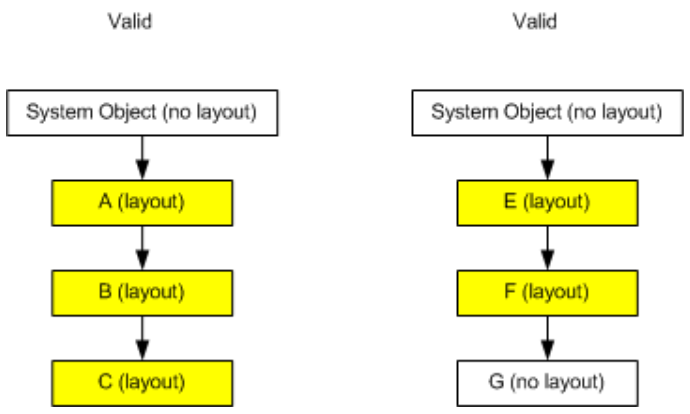
The situation with classes E, F, and G is similar. G has no layout, and this too is valid. The following picture shows two invalid setups:
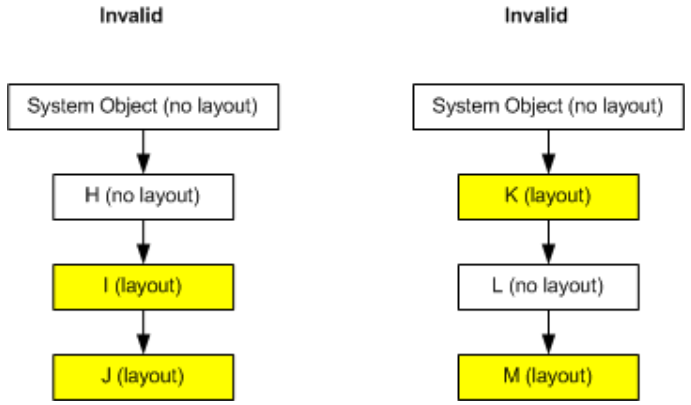
On the left, the "chain with layout" does not start at the 'highest' class. And on the right, there is a 'hole' in the "chain with layout".
Layout information for a class or value type is held in two tables (ClassLayout and FieldLayout), as shown in the following diagram:
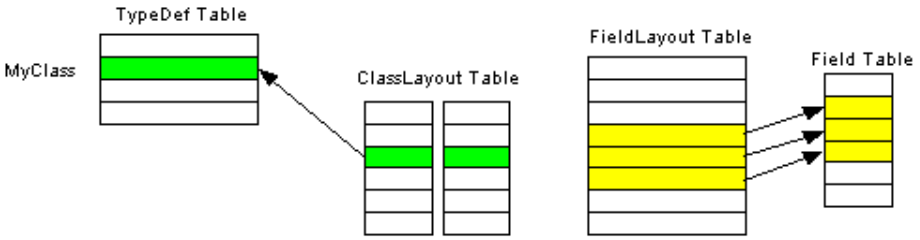
In this example, row 3 of the ClassLayout table points to row 2 in the TypeDef table (the definition for a Class, called "MyClass"). Rows 4-6 of the FieldLayout table point to corresponding rows in the Field table. This illustrates how the CLI stores the explicit offsets for the three fields that are defined in "MyClass" (there is always one row in the FieldLayout table for each field in the owning class or value type) So, the ClassLayout table acts as an extension to those rows of the TypeDef table that have layout info; since many classes do not have layout info, overall, this design saves space.
End informative text.
The ClassLayout table has the following columns:
PackingSize (a 2-byte constant)
ClassSize (a 4-byte constant)
Parent (an index into the TypeDef table)
The rows of the ClassLayout table are defined by placing .pack and .size directives on the body of the type declaration in which this type is declared (§II.10.2). When either of these directives is omitted, its corresponding value is zero. (See §II.10.7.)
ClassSize of zero does not mean the class has zero size. It means that no .size directive was specified at definition time, in which case, the actual size is calculated from the field types, taking account of packing size (default or specified) and natural alignment on the target, runtime platform.
This contains informative text only.
A ClassLayout table can contain zero or more rows
Parent shall index a valid row in the TypeDef table, corresponding to a Class or ValueType (but not to an Interface) [ERROR]
The Class or ValueType indexed by Parent shall be
SequentialLayout or ExplicitLayout (§II.23.1.15).
(That is, AutoLayout types shall not own any rows in the
ClassLayout table.) [ERROR]
If Parent indexes a SequentialLayout type,
then:
PackingSize shall be one of {0, 1, 2, 4, 8, 16, 32, 64, 128}. (0 means use the default pack size for the platform on which the application is running.) [ERROR]
If Parent indexes a ValueType, then ClassSize shall be less than 1 MByte (0x100000 bytes). [ERROR]
If Parent indexes an ExplicitLayout type,
then
if Parent indexes a ValueType, then ClassSize shall be less than 1 MByte (0x100000 bytes) [ERROR]
PackingSize shall be 0. (It makes no sense to provide explicit offsets for each field, as well as a packing size.) [ERROR]
Note that an ExplicitLayout type might result in a
verifiable type, provided the layout does not create a type whose fields
overlap.
Layout along the length of an inheritance chain shall follow the rules specified above (starting at 'highest' Type, with no 'holes', etc.) [ERROR]
End informative text.
The Constant table is used to store compile-time, constant values for fields, parameters, and properties.
The Constant table has the following columns:
Type (a 1-byte constant, followed by a 1-byte padding
zero); see §II.23.1.16.
The encoding of Type for the nullref value for
FieldInit in ilasm (§II.16.2) is
ELEMENT_TYPE_CLASS with a Value of a 4-byte zero.
Unlike uses of ELEMENT_TYPE_CLASS in signatures, this one
is not followed by a type token.
Parent (an index into the Param, Field, or Property table; more precisely, a HasConstant (§II.24.2.6) coded index)
Value (an index into the Blob heap)
Note that Constant information does not directly influence
runtime behavior, although it is visible via Reflection (and hence can
be used to implement functionality such as that provided by
System.Enum.ToString). Compilers inspect this information,
at compile time, when importing metadata, but the value of the constant
itself, if used, becomes embedded into the CIL stream the compiler
emits. There are no CIL instructions to access the Constant
table at runtime.
A row in the Constant table for a parent is created whenever a compile-time value is specified for that parent. (For an example, see §II.16.2.)
This contains informative text only.
Type shall be exactly one of:
ELEMENT_TYPE_BOOLEAN, ELEMENT_TYPE_CHAR,
ELEMENT_TYPE_I1, ELEMENT_TYPE_U1,
ELEMENT_TYPE_I2, ELEMENT_TYPE_U2,
ELEMENT_TYPE_I4, ELEMENT_TYPE_U4,
ELEMENT_TYPE_I8, ELEMENT_TYPE_U8,
ELEMENT_TYPE_R4, ELEMENT_TYPE_R8, or
ELEMENT_TYPE_STRING; or ELEMENT_TYPE_CLASS
with a Value of zero (§II.23.1.16) [ERROR]
Type shall not be any of: ELEMENT_TYPE_I1,
ELEMENT_TYPE_U2, ELEMENT_TYPE_U4, or
ELEMENT_TYPE_U8 (§II.23.1.16)
[CLS]
Parent shall index a valid row in the Field, Property, or Param table. [ERROR]
There shall be no duplicate rows, based upon Parent [ERROR]
Type shall match exactly the declared type of the Param, Field, or Property identified by Parent (in the case where the parent is an enum, it shall match exactly the underlying type of that enum). [CLS]
End informative text.
The CustomAttribute table has the following columns:
Parent (an index into a metadata table that has an associated HasCustomAttribute (§II.24.2.6) coded index).
Type (an index into the MethodDef or MemberRef table; more precisely, a CustomAttributeType (§II.24.2.6) coded index).
Value (an index into the Blob heap).
The CustomAttribute table stores data that can be used to instantiate a Custom Attribute (more precisely, an object of the specified Custom Attribute class) at runtime. The column called Type is slightly misleading—it actually indexes a constructor method—the owner of that constructor method is the Type of the Custom Attribute. A row in the CustomAttribute table for a parent is created by the .custom attribute, which gives the value of the Type column and optionally that of the Value column (§II.21).
This contains informative text only.
All binary values are stored in little-endian format (except for PackedLen items, which are used only as a count for the number of bytes to follow in a UTF8 string).
No CustomAttribute is required; that is, Value is permitted to be null.
Parent can be an index into any metadata table, except the CustomAttribute table itself [ERROR]
Type shall index a valid row in the Method or MemberRef table. That row shall be a constructor method (for the class of which this information forms an instance) [ERROR]
Value can be null or non-null.
If Value is non-null, it shall index a 'blob' in the Blob heap [ERROR]
The following rules apply to the overall structure of the Value 'blob' (§II.23.3):
Prolog shall be 0x0001 [ERROR]
There shall be as many occurrences of FixedArg as are declared in the Constructor method [ERROR]
NumNamed can be zero or more
There shall be exactly NumNamed occurrences of NamedArg [ERROR]
Each NamedArg shall be accessible by the caller [ERROR]
If NumNamed = 0 then there shall be no further items in the CustomAttrib [ERROR]
The following rules apply to the structure of FixedArg (§II.23.3):
If this item is not for a vector (a single-dimension array with lower bound of 0), then there shall be exactly one Elem [ERROR]
If this item is for a vector, then:
NumElem shall be 1 or more [ERROR]
This shall be followed by NumElem occurrences of Elem [ERROR]
The following rules apply to the structure of Elem (§II.23.3):
If this is a simple type or an enum (see §II.23.3 for how this is defined), then Elem consists simply of its value [ERROR]
If this is a string or a Type, then Elem consists of a SerString — PackedLen count of bytes, followed by the UTF8 characters [ERROR]
If this is a boxed simple value type (bool,
char, float32, float64,
int8, int16, int32,
int64, unsigned int8,
unsigned int16, unsigned int32, or
unsigned int64), then Elem consists of the corresponding
type denoter (ELEMENT_TYPE_BOOLEAN,
ELEMENT_TYPE_CHAR, ELEMENT_TYPE_I1,
ELEMENT_TYPE_U1, ELEMENT_TYPE_I2,
ELEMENT_TYPE_U2, ELEMENT_TYPE_I4,
ELEMENT_TYPE_U4, ELEMENT_TYPE_I8,
ELEMENT_TYPE_U8, ELEMENT_TYPE_R4, or
ELEMENT_TYPE_R8), followed by its value. [ERROR]
The following rules apply to the structure of NamedArg (§II.23.3):
A NamedArg shall begin with the single byte
FIELD (0x53) or PROPERTY (0x54) for
identification [ERROR]
If the parameter kind is a boxed simple value type, then the type
of the Field or Property is one of ELEMENT_TYPE_BOOLEAN,
ELEMENT_TYPE_CHAR, ELEMENT_TYPE_I1,
ELEMENT_TYPE_U1, ELEMENT_TYPE_I2,
ELEMENT_TYPE_U2, ELEMENT_TYPE_I4,
ELEMENT_TYPE_U4, ELEMENT_TYPE_I8,
ELEMENT_TYPE_U8, ELEMENT_TYPE_R4,
ELEMENT_TYPE_R8, ELEMENT_TYPE_STRING, or the
constant 0x50 (for an argument of type System.Type)
[ERROR]
The name of the Field or Property, respectively with the previous item, is stored as a SerString — PackedLen count of bytes, followed by the UTF8 characters of the name [ERROR]
A NamedArg is a FixedArg (see above) [ERROR]
End informative text.
Security attributes, which derive from
System.Security.Permissions.SecurityAttribute (see Partition
IV), can be attached to a TypeDef, a Method, or an
Assembly. All constructors of this class shall take a
System.Security.Permissions.SecurityAction value as their
first parameter, describing what should be done with the permission on
the type, method or assembly to which it is attached. Code access
security attributes, which derive from
System.Security.Permissions.
CodeAccessSecurityAttribute, can have any of the security
actions.
These different security actions are encoded in the
DeclSecurity table as a 2-byte enum (see below). All security
custom attributes for a given security action on a method, type, or
assembly shall be gathered together, and one
System.Security.PermissionSet instance shall be created,
stored in the Blob heap, and referenced from the DeclSecurity
table.
[Note: The general flow from a compiler's point of view is
as follows. The user specifies a custom attribute through some
language-specific syntax that encodes a call to the attribute's
constructor. If the attribute's type is derived (directly or indirectly)
from System.Security.Permissions.SecurityAttribute then it
is a security custom attribute and requires special treatment, as
follows (other custom attributes are handled by simply recording the
constructor in the metadata as described in §II.22.10). The attribute
object is constructed, and provides a method
(CreatePermission) to convert it into a security permission
object (an object derived from System.Security.Permission).
All the permission objects attached to a given metadata item with the
same security action are combined together into a
System.Security.PermissionSet. This permission set is
converted into a form that is ready to be stored in XML using its
ToXML method to create a
System.Security.SecurityElement. Finally, the XML that is
required for the metadata is created using the ToString
method on the security element. end note]
The DeclSecurity table has the following columns:
Action (a 2-byte value)
Parent (an index into the TypeDef, MethodDef, or Assembly table; more precisely, a HasDeclSecurity (§II.24.2.6) coded index)
PermissionSet (an index into the Blob heap)
Action is a 2-byte representation of Security Actions (see
System.Security.SecurityAction in Partition
IV). The values 0–0xFF are reserved for future standards use. Values
0x20–0x7F and 0x100–0x07FF are for uses where the action can be ignored
if it is not understood or supported. Values 0x80–0xFF and 0x0800–0xFFFF
are for uses where the action shall be implemented for secure operation;
in implementations where the action is not available, no access to the
assembly, type, or method shall be permitted.
| Security Action | Note | Explanation of behavior | Valid Scope |
|---|---|---|---|
| Assert | 1 | Without further checks, satisfy Demand for the specified permission. | Method, Type |
| Demand | 1 | Check that all callers in the call chain have been granted specified
permission, throw SecurityException (see Partition
IV) on failure. |
Method, Type |
| Deny | 1 | Without further checks refuse Demand for the specified permission. | Method, Type |
| InheritanceDemand | 1 | The specified permission shall be granted in order to inherit from class or override virtual method. | Method, Type |
| LinkDemand | 1 | Check that the immediate caller has been granted the specified
permission; throw SecurityException (see Partition
IV) on failure. |
Method, Type |
| NonCasDemand | 2 | Check that the current assembly has been granted the specified
permission; throw SecurityException (see Partition
IV) otherwise. |
Method, Type |
| NonCasLinkDemand | 2 | Check that the immediate caller has been granted the specified
permission; throw SecurityException (see Partition
IV) otherwise. |
Method, Type |
| PrejitGrant | Reserved for implementation-specific use. | Assembly | |
| PermitOnly | 1 | Without further checks, refuse Demand for all permissions other than those specified. | Method, Type |
| RequestMinimum | Specify the minimum permissions required to run. | Assembly | |
| RequestOptional | Specify the optional permissions to grant. | Assembly | |
| RequestRefuse | Specify the permissions not to be granted. | Assembly |
Note 1: The specified attribute shall derive from
System.Security.Permissions.CodeAccessSecurityAttribute
Note 2: The attribute shall derive from
System.Security.Permissions.SecurityAttribute, but shall
not derive from
System.Security.Permissions.CodeAccessSecurityAttribute
Parent is a metadata token that identifies the Method, Type, or Assembly on which security custom attributes encoded in PermissionSet was defined.
PermissionSet is a 'blob' having the following format:
A byte containing a period (.).
A compressed unsigned integer containing the number of attributes encoded in the blob.
An array of attributes each containing the following:
A String, which is the fully-qualified type name of the attribute. (Strings are encoded as a compressed unsigned integer to indicate the size followed by an array of UTF8 characters.)
A set of properties, encoded as the named arguments to a custom attribute would be (as in §II.23.3, beginning with NumNamed).
The permission set contains the permissions that were requested with an Action on a specific Method, Type, or Assembly (see Parent). In other words, the blob will contain an encoding of all the attributes on the Parent with that particular Action.
[Note: The first edition of this standard specified an XML encoding of a permission set. Implementations should continue supporting this encoding for backward compatibility. end note]
The rows of the DeclSecurity table are filled by attaching a .permission or .permissionset directive that specifies the Action and PermissionSet on a parent assembly (§II.6.6) or parent type or method (§II.10.2).
This contains informative text only.
Action shall have only those values set that are specified [ERROR]
Parent shall be one of TypeDef, MethodDef, or Assembly. That is, it shall index a valid row in the TypeDef table, the MethodDef table, or the Assembly table. [ERROR]
If Parent indexes a row in the TypeDef table, that row should not define an Interface. The security system ignores any such parent; compilers should not emit such permissions sets. [WARNING]
If Parent indexes a TypeDef, then its
TypeDef.Flags.HasSecurity bit shall be
set [ERROR]
If Parent indexes a MethodDef, then its
MethodDef.Flags.HasSecurity bit shall be
set [ERROR]
PermissionSet shall index a 'blob' in the Blob heap [ERROR]
The format of the 'blob' indexed by PermissionSet shall represent a valid, encoded CLI object graph. (The encoded form of all standardized permissions is specified in Partition IV.) [ERROR]
End informative text.
The EventMap table has the following columns:
Parent (an index into the TypeDef table)
EventList (an index into the Event table). It marks the first of a contiguous run of Events owned by this Type. That run continues to the smaller of:
the last row of the Event table
the next run of Events, found by inspecting the EventList of the next row in the EventMap table
Note that EventMap info does not directly influence runtime behavior; what counts is the information stored for each method that the event comprises. The EventMap and Event tables result from putting the .event directive on a class (§II.18).
This contains informative text only.
EventMap table can contain zero or more rows
There shall be no duplicate rows, based upon Parent (a given class has only one 'pointer' to the start of its event list) [ERROR]
There shall be no duplicate rows, based upon EventList (different classes cannot share rows in the Event table) [ERROR]
End informative text.
Events are treated within metadata much like Properties; that is, as
a way to associate a collection of methods defined on a given class.
There are two required methods (add_ and
remove_) plus an optional one (raise_);
additonal methods with other names are also permitted (§18). All of
the methods gathered together as an Event shall be defined on the class
(§I.8.11.4)
The association between a row in the TypeDef table and the collection of methods that make up a given Event is held in three separate tables (exactly analogous to the approach used for Properties), as follows:
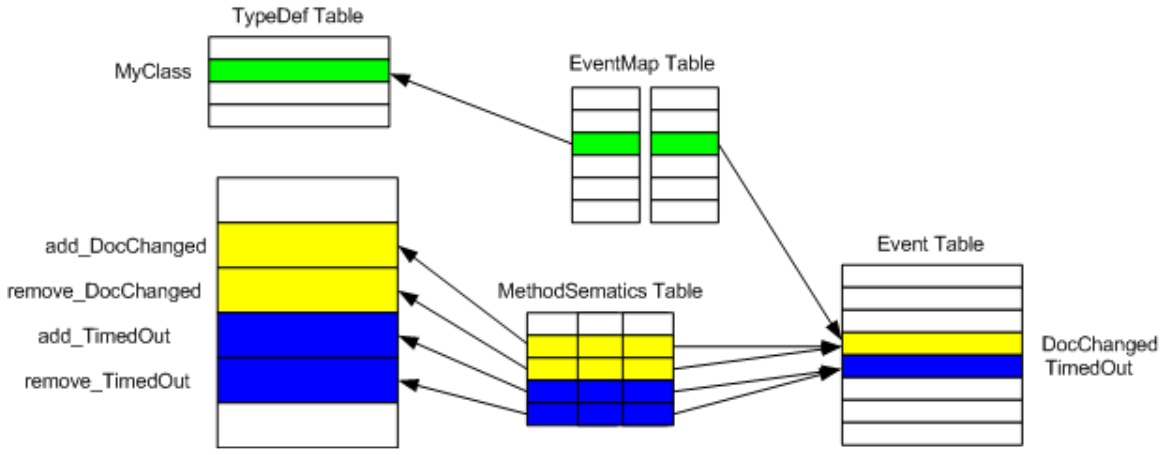
Row 3 of the EventMap table indexes row 2 of the
TypeDef table on the left (MyClass), whilst
indexing row 4 of the Event table on the right (the row for an
Event called DocChanged). This setup establishes that
MyClass has an Event called DocChanged. But
what methods in the MethodDef table are gathered together as
'belonging' to event DocChanged? That association is
contained in the MethodSemantics table — its row 2 indexes
event DocChanged to the right, and row 2 in the
MethodDef table to the left (a method called
add_DocChanged). Also, row 3 of the
MethodSemantics table indexes DocChanged to the
right, and row 3 in the MethodDef table to the left (a method
called remove_DocChanged). As the shading suggests,
MyClass has another event, called TimedOut,
with two methods, add_TimedOut and
remove_TimedOut.
Event tables do a little more than group together existing
rows from other tables. The Event table has columns for
EventFlags, Name (e.g., DocChanged and
TimedOut in the example here), and EventType. In
addition, the MethodSemantics table has a column to record
whether the method it indexes is an add_, a
remove_, a raise_, or other function.
The Event table has the following columns:
EventFlags (a 2-byte bitmask of type EventAttributes, §II.23.1.4)
Name (an index into the String heap)
EventType (an index into a TypeDef, a TypeRef, or TypeSpec table; more precisely, a TypeDefOrRef (§II.24.2.6) coded index) (This corresponds to the Type of the Event; it is not the Type that owns this event.)
Note that Event information does not directly influence runtime behavior; what counts is the information stored for each method that the event comprises. The EventMap and Event tables result from putting the .event directive on a class (§II.18).
This contains informative text only.
The Event table can contain zero or more rows
Each row shall have one, and only one, owner row in the EventMap table [ERROR]
EventFlags shall have only those values set that are specified (all combinations valid) [ERROR]
Name shall index a non-empty string in the String heap [ERROR]
The Name string shall be a valid CLS identifier [CLS]
EventType can be null or non-null
If EventType is non-null, then it shall index a valid row in the TypeDef or TypeRef table [ERROR]
If EventType is non-null, then the row in the TypeDef, TypeRef, or TypeSpec table that it indexes shall be a Class (not an Interface or a ValueType) [ERROR]
For each row, there shall be one add_ and one
remove_ row in the MethodSemantics table
[ERROR]
For each row, there can be zero or one raise_ row,
as well as zero or more other rows in the MethodSemantics table
[ERROR]
Within the rows owned by a given row in the TypeDef table, there shall be no duplicates based upon Name [ERROR]
There shall be no duplicate rows based upon Name, where Name fields are compared using CLS conflicting-identifier-rules [CLS]
End informative text.
The ExportedType table holds a row for each type:
Defined within other modules of this Assembly; that is exported out of this Assembly. In essence, it stores TypeDef row numbers of all types that are marked public in other modules that this Assembly comprises.
The actual target row in a TypeDef table is given by the combination of TypeDefId (in effect, row number) and Implementation (in effect, the module that holds the target TypeDef table). Note that this is the only occurrence in metadata of foreign tokens; that is, token values that have a meaning in another module. (A regular token value is an index into a table in the current module); OR
Originally defined in this Assembly but now moved to another
Assembly. Flags must have IsTypeForwarder set and
Implementation is an AssemblyRef indicating the
Assembly the type may now be found in.
The full name of the type need not be stored directly. Instead, it can be split into two parts at any included "." (although typically this is done at the last "." in the full name). The part preceding the "." is stored as the TypeNamespace and that following the "." is stored as the TypeName. If there is no "." in the full name, then the TypeNamespace shall be the index of the empty string.
The ExportedType table has the following columns:
Flags (a 4-byte bitmask of type TypeAttributes, §II.23.1.15)
TypeDefId (a 4-byte index into a TypeDef table
of another module in this Assembly). This column is used as a hint only.
If the entry in the target TypeDef table matches the
TypeName and TypeNamespace entries in this table,
resolution has succeeded. But if there is a mismatch, the CLI shall fall
back to a search of the target TypeDef table. Ignored and
should be zero if Flags has IsTypeForwarder
set.
TypeName (an index into the String heap)
TypeNamespace (an index into the String heap)
Implementation. This is an index (more precisely, an Implementation (§II.24.2.6) coded index) into either of the following tables:
File table, where that entry says which module in the current assembly holds the TypeDef
ExportedType table, where that entry is the enclosing Type of the current nested Type
AssemblyRef table, where that entry says in which
assembly the type may now be found (Flags must have the
IsTypeForwarder flag set).
The rows in the ExportedType table are the result of the .class extern directive (§II.6.7).
This contains informative text only.
The term "FullName" refers to the string created as follows: if the TypeNamespace is null, then use the TypeName, otherwise use the concatenation of TypeNamespace, ".", and TypeName.
The ExportedType table can contain zero or more rows
There shall be no entries in the ExportedType table for Types that are defined in the current module—just for Types defined in other modules within the Assembly [ERROR]
Flags shall have only those values set that are specified [ERROR]
If Implementation indexes the File table, then
Flags.VisibilityMask shall be Public
(§II.23.1.15)
[ERROR]
If Implementation indexes the ExportedType
table, then Flags.VisibilityMask shall be
NestedPublic (§II.23.1.15)
[ERROR]
If non-null, TypeDefId should index a valid row in a
TypeDef table in a module somewhere within this Assembly (but
not this module), and the row so indexed should have its
Flags.Public = 1 (§II.23.1.15)
[WARNING]
TypeName shall index a non-empty string in the String heap [ERROR]
TypeNamespace can be null, or non-null
If TypeNamespace is non-null, then it shall index a non-empty string in the String heap [ERROR]
FullName shall be a valid CLS identifier [CLS]
If this is a nested Type, then TypeNamespace should be null, and TypeName should represent the unmangled, simple name of the nested Type [ERROR]
Implementation shall be a valid index into either of the following: [ERROR]
the File table; that file shall hold a definition of the target Type in its TypeDef table
a different row in the current ExportedType table—this identifies the enclosing Type of the current, nested Type
FullName shall match exactly the corresponding FullName for the row in the TypeDef table indexed by TypeDefId [ERROR]
Ignoring nested Types, there shall be no duplicate rows, based upon FullName [ERROR]
For nested Types, there shall be no duplicate rows, based upon TypeName and enclosing Type [ERROR]
The complete list of Types exported from the current Assembly is
given as the catenation of the ExportedType table with all
public Types in the current TypeDef table, where "public" means
a Flags.VisibilityMask of either
Public or NestedPublic. There shall be no
duplicate rows, in this concatenated table, based upon FullName
(add Enclosing Type into the duplicates check if this is a nested Type)
[ERROR]
End informative text.
The Field table has the following columns:
Flags (a 2-byte bitmask of type FieldAttributes, §II.23.1.5)
Name (an index into the String heap)
Signature (an index into the Blob heap)
Conceptually, each row in the Field table is owned by one, and only one, row in the TypeDef table. However, the owner of any row in the Field table is not stored anywhere in the Field table itself. There is merely a 'forward-pointer' from each row in the TypeDef table (the FieldList column), as shown in the following illustration.
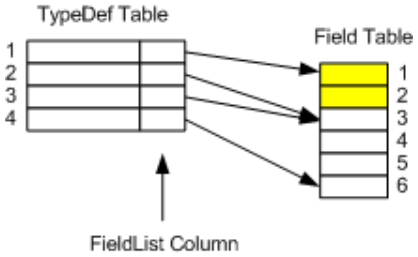
The TypeDef table has rows 1–4. The first row in the TypeDef table corresponds to a pseudo type, inserted automatically by the CLI. It is used to denote those rows in the Field table corresponding to global variables. The Field table has rows 1—6. Type 1 (pseudo type for 'module') owns rows 1 and 2 in the Field table. Type 2 owns no rows in the Field table, even though its FieldList indexes row 3 in the Field table. Type 3 owns rows 3—5 in the Field table. Type 4 owns row 6 in the Field table. So, in the Field table, rows 1 and 2 belong to Type 1 (global variables); rows 3—5 belong to Type 3; row 6 belongs to Type 4.
Each row in the Field table results from a top-level .field directive (§II.5.10), or a .field directive inside a Type (§II.10.2). (For an example, see §II.14.5.)
This contains informative text only.
The Field table can contain zero or more rows
Each row shall have one, and only one, owner row in the TypeDef table [ERROR]
The owner row in the TypeDef table shall not be an Interface [CLS]
Flags shall have only those values set that are specified [ERROR]
The FieldAccessMask subfield of Flags shall
contain precisely one of CompilerControlled,
Private, FamANDAssem, Assembly,
Family, FamORAssem, or Public
(§II.23.1.5)
[ERROR]
Flags can set either or neither of Literal
or InitOnly, but not both (§II.23.1.5)
[ERROR]
If Flags.Literal = 1 then
Flags.Static shall also be 1 (§II.23.1.5)
[ERROR]
If Flags.RTSpecialName = 1, then
Flags.SpecialName shall also be 1 (§II.23.1.5)
[ERROR]
If Flags.HasFieldMarshal = 1, then this row
shall 'own' exactly one row in the FieldMarshal table (§II.23.1.5)
[ERROR]
If Flags.HasDefault = 1, then this row
shall 'own' exactly one row in the Constant table (§II.23.1.5
[ERROR]
If Flags.HasFieldRVA = 1, then this row
shall 'own' exactly one row in the Field's RVA table (§II.23.1.5)
[ERROR]
Name shall index a non-empty string in the String heap [ERROR]
The Name string shall be a valid CLS identifier [CLS]
Signature shall index a valid field signature in the Blob heap [ERROR]
If Flags.CompilerControlled = 1 (§II.23.1.5),
then this row is ignored completely in duplicate checking.
If the owner of this field is the internally-generated type
called <Module>, it denotes that this field is
defined at module scope (commonly called a global variable). In this
case:
Flags.Static shall be 1 [ERROR]
Flags.MemberAccessMask subfield shall be
one of Public, CompilerControlled, or
Private (§II.23.1.5)
[ERROR]
module-scope fields are not allowed [CLS]
There shall be no duplicate rows in the Field table,
based upon owner+Name+Signature (where
owner is the owning row in the TypeDef table, as
described above) (Note however that if
Flags.CompilerControlled = 1, then this row is
completely excluded from duplicate checking) [ERROR]
There shall be no duplicate rows in the Field table,
based upon owner+Name, where Name fields are
compared using CLS conflicting-identifier-rules. So, for
example,"int i" and "float i" would be
considered CLS duplicates. (Note however that if
Flags.CompilerControlled = 1, then this row is
completely excluded from duplicate checking, as noted above)
[CLS]
If this is a field of an Enum then:
owner row in TypeDef table shall derive directly from
System.Enum [ERROR]
the owner row in TypeDef table shall have no other instance fields [CLS]
its Signature shall be one of
ELEMENT_TYPE_U1, ELEMENT_TYPE_I2,
ELEMENT_TYPE_I4, or ELEMENT_TYPE_I8 (§II.23.1.16)
[CLS]
its Signature shall be an integral type. [ERROR]
End informative text.
The FieldLayout table has the following columns:
Offset (a 4-byte constant)
Field (an index into the Field table)
Note that each Field in any Type is defined by its Signature. When a Type instance (i.e., an object) is laid out by the CLI, each Field is one of four kinds:
Scalar: for any member of built-in type, such as
int32. The size of the field is given by the size of that
intrinsic, which varies between 1 and 8 bytes
ObjectRef: for ELEMENT_TYPE_CLASS,
ELEMENT_TYPE_STRING, ELEMENT_TYPE_OBJECT,
ELEMENT_TYPE_ARRAY,
ELEMENT_TYPE_SZARRAY
Pointer: for ELEMENT_TYPE_PTR,
ELEMENT_TYPE_FNPTR
ValueType: for
ELEMENT_TYPE_VALUETYPE. The instance of that ValueType is
actually laid out in this object, so the size of the field is the size
of that ValueType
Note that metadata specifying explicit structure layout can be valid for use on one platform but not on another, since some of the rules specified here are dependent on platform-specific alignment rules.
A row in the FieldLayout table is created if the .field directive for the parent field has specified a field offset (§II.16).
This contains informative text only.
A FieldLayout table can contain zero or more or rows
The Type whose Fields are described by each row of the
FieldLayout table shall have
Flags.ExplicitLayout (§II.23.1.15) set
[ERROR]
Offset shall be zero or more [ERROR]
Field shall index a valid row in the Field table [ERROR]
Flags.Static for the row in the
Field table indexed by Field shall be non-static
(i.e., zero 0) [ERROR]
Among the rows owned by a given Type there shall be no duplicates, based upon Field. That is, a given Field of a Type cannot be given two offsets. [ERROR]
Each Field of kind ObjectRef shall be naturally aligned within the Type [ERROR]
Among the rows owned by a given Type it is perfectly valid for several rows to have the same value of Offset. ObjectRef and a valuetype cannot have the same offset [ERROR]
Every Field of an ExplicitLayout Type shall be given
an offset; that is, it shall have a row in the FieldLayout
table [ERROR]
End informative text.
The FieldMarshal table has two columns. It 'links' an existing row in the Field or Param table, to information in the Blob heap that defines how that field or parameter (which, as usual, covers the method return, as parameter number 0) shall be marshalled when calling to or from unmanaged code via PInvoke dispatch.
Note that FieldMarshal information is used only by code paths that arbitrate operation with unmanaged code. In order to execute such paths, the caller, on most platforms, would be installed with elevated security permission. Once it invokes unmanaged code, it lies outside the regime that the CLI can check—it is simply trusted not to violate the type system.
The FieldMarshal table has the following columns:
Parent (an index into Field or Param table; more precisely, a HasFieldMarshal (§II.24.2.6) coded index)
NativeType (an index into the Blob heap)
For the detailed format of the 'blob', see §II.23.4
A row in the FieldMarshal table is created if the .field directive for the parent field has specified a marshal attribute (§II.16.1).
This contains informative text only.
A FieldMarshal table can contain zero or more rows
Parent shall index a valid row in the Field or Param table (Parent values are encoded to say which of these two tables each refers to) [ERROR]
NativeType shall index a non-null 'blob' in the Blob heap [ERROR]
No two rows shall point to the same parent. In other words, after the Parent values have been decoded to determine whether they refer to the Field or the Param table, no two rows can point to the same row in the Field table or in the Param table [ERROR]
The following checks apply to the MarshalSpec 'blob' (§II.23.4):
NativeIntrinsic shall be exactly one of the constant values in its production (§II.23.4) [ERROR]
If ARRAY, then ArrayElemType shall be exactly one of
the constant values in its production [ERROR]
If ARRAY, then ParamNum can be
zero
If ARRAY, then ParamNum cannot be < 0
[ERROR]
If ARRAY, and ParamNum > 0, then
Parent shall point to a row in the Param table, not in
the Field table [ERROR]
If ARRAY, and ParamNum > 0, then
ParamNum cannot exceed the number of parameters supplied to the
MethodDef (or MethodRef if a VARARG call)
of which the parent Param is a member [ERROR]
If ARRAY, then ElemMult shall be ≥ 1
[ERROR]
If ARRAY and ElemMult ≠ 1 issue a warning,
because it is probably a mistake [WARNING]
If ARRAY and ParamNum = 0, then
NumElem shall be ≥ 1 [ERROR]
If ARRAY and ParamNum ≠ 0 and
NumElem ≠ 0 then issue a warning, because it is probably a
mistake [WARNING]
End informative text.
The FieldRVA table has the following columns:
RVA (a 4-byte constant)
Field (an index into Field table)
Conceptually, each row in the FieldRVA table is an extension to exactly one row in the Field table, and records the RVA (Relative Virtual Address) within the image file at which this field's initial value is stored.
A row in the FieldRVA table is created for each static parent field that has specified the optional data label §II.16). The RVA column is the relative virtual address of the data in the PE file (§II.16.3).
This contains informative text only.
RVA shall be non-zero [ERROR]
RVA shall point into the current module's data area (not its metadata area) [ERROR]
Field shall index a valid row in the Field table [ERROR]
Any field with an RVA shall be a ValueType (not a Class or an Interface). Moreover, it shall not have any private fields (and likewise for any of its fields that are themselves ValueTypes). (If any of these conditions were breached, code could overlay that global static and access its private fields.) Moreover, no fields of that ValueType can be Object References (into the GC heap) [ERROR]
So long as two RVA-based fields comply with the previous conditions, the ranges of memory spanned by the two ValueTypes can overlap, with no further constraints. This is not actually an additional rule; it simply clarifies the position with regard to overlapped RVA-based fields
End informative text.
The File table has the following columns:
Flags (a 4-byte bitmask of type FileAttributes, §II.23.1.6)
Name (an index into the String heap)
HashValue (an index into the Blob heap)
The rows of the File table result from .file directives in an Assembly (§II.6.2.3)
This contains informative text only.
Flags shall have only those values set that are specified (all combinations valid) [ERROR]
Name shall index a non-empty string in the String heap.
It shall be in the format
<filename>.<extension> (e.g.,
"foo.dll", but not
"c:\utils\foo.dll") [ERROR]
HashValue shall index a non-empty 'blob' in the Blob heap [ERROR]
There shall be no duplicate rows; that is, rows with the same Name value [ERROR]
If this module contains a row in the Assembly table (that is, if this module "holds the manifest") then there shall not be any row in the File table for this module; i.e., no self-reference [ERROR]
If the File table is empty, then this, by definition, is a single-file assembly. In this case, the ExportedType table should be empty [WARNING]
End informative text.
The GenericParam table has the following columns:
Number (the 2-byte index of the generic parameter, numbered left-to-right, from zero)
Flags (a 2-byte bitmask of type GenericParamAttributes, §II.23.1.7)
Owner (an index into the TypeDef or MethodDef table, specifying the Type or Method to which this generic parameter applies; more precisely, a TypeOrMethodDef (§II.24.2.6) coded index)
Name (a non-null index into the String heap, giving the name for the generic parameter. This is purely descriptive and is used only by source language compilers and by Reflection)
The following additional restrictions apply:
Owner cannot be a non nested enumeration type; and
If Owner is a nested enumeration type then Number must be less than or equal to the number of generic parameters of the enclosing class.
[Rationale: Generic enumeration types serve little purpose and usually only exist to meet CLS Rule 42. These additional restrictions limit the genericty of enumeration types while allowing CLS Rule 42 to be met. The GenericParam table stores the generic parameters used in generic type definitions and generic method definitions. These generic parameters can be constrained (i.e., generic arguments shall extend some class and/or implement certain interfaces) or unconstrained. (Such constraints are stored in the GenericParamConstraint table.)
Conceptually, each row in the GenericParam table is owned by one, and only one, row in either the TypeDef or MethodDef tables.
[Example:
.class Dict`2<([mscorlib]System.IComparable) K, V>The generic parameter K of class Dict is
constrained to implement System.IComparable.
.method static void ReverseArray<T>(!!0[] 'array')There is no constraint on the generic parameter T of the
generic method ReverseArray. end example]
This contains informative text only.
GenericParam table can contain zero or more rows
Each row shall have one, and only one, owner row in the TypeDef or MethodDef table (i.e., no row sharing) [ERROR]
Every generic type shall own one row in the GenericParam table for each of its generic parameters [ERROR]
Every generic method shall own one row in the GenericParam table for each of its generic parameters [ERROR]
Flags:
Can hold the value Covariant or
Contravariant, but only if the owner row corresponds to a
generic interface, or a generic delegate class. [ERROR]
Otherwise, shall hold the value None indicating
nonvariant (i.e., where the parameter is nonvariant or the owner is a
non delegate class, a value-type, or a generic method) [ERROR]
If Flags == Covariant then the
corresponding generic parameter can appear in a type definition only as:
[ERROR]
The result type of a method
A generic parameter to an inherited interface
If Flags == Contravariant then the
corresponding generic parameter can appear in a type definition only as
the argument to a method [ERROR]
Number shall have a value ≥ 0 and < the number of generic parameters in owner type or method. [ERROR]
Successive rows of the GenericParam table that are owned by the same method shall be ordered by increasing Number value; there shall be no gaps in the Number sequence [ERROR]
Name shall be non-null and index a string in the String heap [ERROR]
[Rationale: Otherwise, Reflection output is not fully usable. end rationale]
There shall be no duplicate rows based upon Owner+Name [ERROR]
[Rationale: Otherwise, code using Reflection cannot disambiguate the different generic parameters. end rationale]
There shall be no duplicate rows based upon Owner+Number [ERROR]
End informative text.
The GenericParamConstraint table has the following columns:
Owner (an index into the GenericParam table, specifying to which generic parameter this row refers)
Constraint (an index into the TypeDef, TypeRef, or TypeSpec tables, specifying from which class this generic parameter is constrained to derive; or which interface this generic parameter is constrained to implement; more precisely, a TypeDefOrRef (§II.24.2.6) coded index)
The GenericParamConstraint table records the constraints for each generic parameter. Each generic parameter can be constrained to derive from zero or one class. Each generic parameter can be constrained to implement zero or more interfaces.
Conceptually, each row in the GenericParamConstraint table is 'owned' by a row in the GenericParam table. All rows in the GenericParamConstraint table for a given Owner shall refer to distinct constraints.
Note that if Constraint is a TypeRef to
System.ValueType, then it means the constraint type shall
be System.ValueType, or one of its sub types. However,
since System.ValueType itself is a reference type, this
particular mechanism does not guarantee that the type is a non-reference
type.
This contains informative text only.
The GenericParamConstraint table can contain zero or more rows
Each row shall have one, and only one, owner row in the GenericParam table (i.e., no row sharing) [ERROR]
Each row in the GenericParam table shall 'own' a separate row in the GenericParamConstraint table for each constraint that generic parameter has [ERROR]
All of the rows in the GenericParamConstraint table that are owned by a given row in the GenericParam table shall form a contiguous range (of rows) [ERROR]
Any generic parameter (corresponding to a row in the GenericParam table) shall own zero or one row in the GenericParamConstraint table corresponding to a class constraint. [ERROR]
Any generic parameter (corresponding to a row in the GenericParam table) shall own zero or more rows in the GenericParamConstraint table corresponding to an interface constraint. [ERROR]
There shall be no duplicate rows based upon Owner+Constraint [ERROR]
Constraint shall not reference System.Void.
[ERROR]
End informative text.
The ImplMap table holds information about unmanaged methods that can be reached from managed code, using PInvoke dispatch. Each row of the ImplMap table associates a row in the MethodDef table (MemberForwarded) with the name of a routine (ImportName) in some unmanaged DLL (ImportScope).
[Note: A typical example would be: associate the managed
Method stored in row N of the Method table (so
MemberForwarded would have the value N) with the routine called
"GetEnvironmentVariable" (the string indexed by
ImportName) in the DLL called "kernel32" (the
string in the ModuleRef table indexed by ImportScope).
The CLI intercepts calls to managed Method number N, and instead
forwards them as calls to the unmanaged routine called
"GetEnvironmentVariable" in "kernel32.dll"
(including marshalling any arguments, as required)
The CLI does not support this mechanism to access fields that are exported from a DLL, only methods. end note]
The ImplMap table has the following columns:
MappingFlags (a 2-byte bitmask of type PInvokeAttributes, §23.1.8)
MemberForwarded (an index into the Field or MethodDef table; more precisely, a MemberForwarded (§II.24.2.6) coded index). However, it only ever indexes the MethodDef table, since Field export is not supported.
ImportName (an index into the String heap)
ImportScope (an index into the ModuleRef table)
A row is entered in the ImplMap table for each parent Method (§II.15.5) that is defined with a .pinvokeimpl interoperation attribute specifying the MappingFlags, ImportName, and ImportScope.
This contains informative text only.
ImplMap can contain zero or more rows
MappingFlags shall have only those values set that are specified [ERROR]
MemberForwarded shall index a valid row in the MethodDef table [ERROR]
The MappingFlags.CharSetMask (§II.23.1.7)
in the row of the MethodDef table indexed by
MemberForwarded shall have at most one of the following bits
set: CharSetAnsi, CharSetUnicode, or
CharSetAuto (if none is set, the default is
CharSetNotSpec) [ERROR]
ImportName shall index a non-empty string in the String heap [ERROR]
ImportScope shall index a valid row in the ModuleRef table [ERROR]
The row indexed in the MethodDef table by
MemberForwarded shall have its
Flags.PinvokeImpl = 1, and
Flags.Static = 1 [ERROR]
End informative text.
The InterfaceImpl table has the following columns:
Class (an index into the TypeDef table)
Interface (an index into the TypeDef, TypeRef, or TypeSpec table; more precisely, a TypeDefOrRef (§II.24.2.6) coded index)
The InterfaceImpl table records the interfaces a type implements explicitly. Conceptually, each row in the InterfaceImpl table indicates that Class implements Interface.
_ This contains informative text only._
The InterfaceImpl table can contain zero or more rows
Class shall be non-null [ERROR]
If Class is non-null, then:
Class shall index a valid row in the TypeDef table [ERROR]
Interface shall index a valid row in the TypeDef or TypeRef table [ERROR]
The row in the TypeDef, TypeRef, or
TypeSpec table indexed by Interface shall be an
interface (Flags.Interface = 1), not a Class or
ValueType [ERROR]
There should be no duplicates in the InterfaceImpl table, based upon non-null Class and Interface values [WARNING]
There can be many rows with the same value for Class (since a class can implement many interfaces)
There can be many rows with the same value for Interface (since many classes can implement the same interface)
End informative text.
The ManifestResource table has the following columns:
Offset (a 4-byte constant)
Flags (a 4-byte bitmask of type ManifestResourceAttributes, §II.23.1.9)
Name (an index into the String heap)
Implementation (an index into a File table, a AssemblyRef table, or null; more precisely, an Implementation (§II.24.2.6) coded index)
The Offset specifies the byte offset within the referenced file at which this resource record begins. The Implementation specifies which file holds this resource.
The rows in the table result from .mresource directives on the Assembly (§II.6.2.2).
This contains informative text only.
The ManifestResource table can contain zero or more rows
Offset shall be a valid offset into the target file, starting from the Resource entry in the CLI header [ERROR]
Flags shall have only those values set that are specified [ERROR]
The VisibilityMask (§II.23.1.9)
subfield of Flags shall be one of Public or
Private [ERROR]
Name shall index a non-empty string in the String heap [ERROR]
Implementation can be null or non-null (if null, it means the resource is stored in the current file)
If Implementation is null, then Offset shall be a valid offset in the current file, starting from the Resource entry in the CLI header [ERROR]
If Implementation is non-null, then it shall index a valid row in the File or AssemblyRef table [ERROR]
There shall be no duplicate rows, based upon Name [ERROR]
If the resource is an index into the File table, Offset shall be zero [ERROR]
End informative text.
The MemberRef table combines two sorts of references, to Methods and to Fields of a class, known as 'MethodRef' and ‘FieldRef’, respectively.
The MemberRef table has the following columns:
Class (an index into the MethodDef, ModuleRef, TypeDef, TypeRef, or TypeSpec tables; more precisely, a MemberRefParent (§II.24.2.6) coded index)
Name (an index into the String heap)
Signature (an index into the Blob heap)
An entry is made into the MemberRef table whenever a
reference is made in the CIL code to a method or field which is defined
in another module or assembly. (Also, an entry is made for a call to a
method with a VARARG signature, even when it is defined in
the same module as the call site.)
This contains informative text only.
Class shall be one of the following: [ERROR]
a TypeRef token, if the class that defines the member is defined in another module. (Note that it is unusual, but valid, to use a TypeRef token when the member is defined in this same module, in which case, its TypeDef token can be used instead.)
a ModuleRef token, if the member is defined, in another module of the same assembly, as a global function or variable.
a MethodDef token, when used to supply a call-site signature for a vararg method that is defined in this module. The Name shall match the Name in the corresponding MethodDef row. The Signature shall match the Signature in the target method definition [ERROR]
a TypeSpec token, if the member is a member of a generic type
Class shall not be null (as this would indicate an unresolved reference to a global function or variable) [ERROR]
Name shall index a non-empty string in the String heap [ERROR]
The Name string shall be a valid CLS identifier [CLS]
Signature shall index a valid field or method signature in the Blob heap. In particular, it shall embed exactly one of the following 'calling conventions': [ERROR]
DEFAULT (0x0)VARARG (0x5)FIELD (0x6)GENERIC (0x10)The MemberRef table shall contain no duplicates, where duplicate rows have the same Class, Name, and Signature [WARNING]
Signature shall not have the VARARG (0x5)
calling convention [CLS]
There shall be no duplicate rows, where Name fields are
compared using CLS conflicting-identifier-rules. (In particular, note
that the return type and whether parameters are marked
ELEMENT_TYPE_BYREF (§II.23.1.16)
are ignored in the CLS. For example, .method int32 M()and
.method float64 M() result in duplicate rows by CLS rules.
Similarly, .method void N(int32 i) and
.method void N(int32& i) also result in duplicate rows
by CLS rules.) [CLS]
If Class and Name resolve to a field, then that
field shall not have a value of CompilerControlled (§II.23.1.5) in
its Flags.FieldAccessMask subfield
[ERROR]
If Class and Name resolve to a method, then
that method shall not have a value of CompilerControlled in
its Flags.MemberAccessMask (§II.23.1.10)
subfield [ERROR]
The type containing the definition of a MemberRef shall be a TypeSpec representing an instantiated type.
End informative text.
The MethodDef table has the following columns:
RVA (a 4-byte constant)
ImplFlags (a 2-byte bitmask of type MethodImplAttributes, §II.23.1.11)
Flags (a 2-byte bitmask of type MethodAttributes, §II.23.1.10)
Name (an index into the String heap)
Signature (an index into the Blob heap)
ParamList (an index into the Param table). It marks the first of a contiguous run of Parameters owned by this method. The run continues to the smaller of:
the last row of the Param table
the next run of Parameters, found by inspecting the ParamList of the next row in the MethodDef table
Conceptually, every row in the MethodDef table is owned by one, and only one, row in the TypeDef table.
The rows in the MethodDef table result from
.method directives (§II.15).
The RVA column is computed when the image for the PE file is emitted and
points to the COR_ILMETHOD structure for the body of the
method (§II.25.4)
[Note: If Signature is GENERIC (0x10),
the generic arguments are described in the GenericParam table
(§II.22.20). end
note]
This contains informative text only.
The MethodDef table can contain zero or more rows
Each row shall have one, and only one, owner row in the TypeDef table [ERROR]
ImplFlags shall have only those values set that are specified [ERROR]
Flags shall have only those values set that are specified [ERROR]
If Name is .ctor and the method is marked
SpecialName, there shall not be a row in the
GenericParam table which has this MethodDef as its
owner. [ERROR]
The MemberAccessMask (§II.23.1.10)
subfield of Flags shall contain precisely one of
CompilerControlled, Private,
FamANDAssem, Assem, Family,
FamORAssem, or Public [ERROR]
The following combined bit settings in Flags are invalid [ERROR]
Static | Final
Static | Virtual
Static | NewSlot
Final | Abstract
Abstract | PinvokeImpl
CompilerControlled |
SpecialName
CompilerControlled |
RTSpecialName
An abstract method shall be virtual. So, if
Flags.Abstract = 1 then
Flags.Virtual shall also be 1 [ERROR]
If Flags.RTSpecialName = 1 then
Flags.SpecialName shall also be 1 [ERROR]
If Flags.HasSecurity = 1, then at least one
of the following conditions shall be true: [ERROR]
this Method owns at least row in the DeclSecurity table
this Method has a custom attribute called
SuppressUnmanagedCodeSecurityAttribute
If this Method owns one (or more) rows in the
DeclSecurity table then Flags.HasSecurity
shall be 1 [ERROR]
If this Method has a custom attribute called
SuppressUnmanagedCodeSecurityAttribute then
Flags.HasSecurity shall be 1 [ERROR]
A Method can have a custom attribute called
DynamicSecurityMethodAttribute, but this has no effect
whatsoever upon the value of its
Flags.HasSecurity
Name shall index a non-empty string in the String heap [ERROR]
Interfaces cannot have instance constructors. So, if this Method
is owned by an Interface, then its Name cannot be
.ctor [ERROR]
The Name string shall be a valid CLS identifier (unless
Flags.RTSpecialName is set - for example,
.cctor is valid) [CLS]
Signature shall index a valid method signature in the Blob heap [ERROR]
If Flags.CompilerControlled = 1, then this
row is ignored completely in duplicate checking
If the owner of this method is the internally-generated type
called <Module>, it denotes that this method is
defined at module scope. [Note: In C++, the method is called
global and can be referenced only within its compilation unit, from its
point of declaration forwards. end note] In this case:
Flags.Static shall be 1 [ERROR]
Flags.Abstract shall be 0 [ERROR]
Flags.Virtual shall be 0 [ERROR]
Flags.MemberAccessMask subfield shall be
one of CompilerControlled, Public, or
Private [ERROR]
module-scope methods are not allowed [CLS]
It makes no sense for ValueTypes, which have no identity, to have
synchronized methods (unless they are boxed). So, if the owner of this
method is a ValueType then the method cannot be synchronized. That is,
ImplFlags.Synchronized shall be 0 [ERROR]
There shall be no duplicate rows in the MethodDef table,
based upon owner + Name + Signature (where owner is
the owning row in the TypeDef table). (Note that the
Signature encodes whether or not the method is generic, and for
generic methods, it encodes the number of generic parameters.) (Note,
however, that if Flags.CompilerControlled = 1,
then this row is excluded from duplicate checking) [ERROR]
There shall be no duplicate rows in the MethodDef table,
based upon owner + Name + Signature, where
Name fields are compared using CLS conflicting-identifierrules;
also, the Type defined in the signatures shall be different. So, for
example, int i and float i would be considered
CLS duplicates; also, the return type of the method is ignored (Note,
however, that if Flags.CompilerControlled = 1,
this row is excluded from duplicate checking as explained above.)
[CLS]
If Final, NewSlot, or
Strict are set in Flags, then
Flags.Virtual shall also be set [ERROR]
If Flags.PInvokeImpl is set, then
Flags.Virtual shall be 0 [ERROR]
If Flags.Abstract ≠ 1 then exactly one of
the following shall also be true: [ERROR]
RVA ≠ 0
Flags.PInvokeImpl = 1
ImplFlags.Runtime = 1
If the method is CompilerControlled, then the RVA
shall be non-zero or marked with PinvokeImpl = 1
[ERROR]
Signature shall have exactly one of the following managed calling conventions [ERROR]
DEFAULT (0x0)
VARARG (0x5)
GENERIC (0x10)
Signature shall have the calling convention
DEFAULT (0x0) or GENERIC (0x10).
[CLS]
Signature: If and only if the method is not
Static then the calling convention byte in
Signature has its HASTHIS (0x20) bit set
[ERROR]
Signature: If the method is static, then
the HASTHIS (0x20) bit in the calling convention shall be 0
[ERROR]
If EXPLICITTHIS (0x40) in the signature is set, then
HASTHIS (0x20) shall also be set (note that if
EXPLICITTHIS is set, then the code is not verifiable)
[ERROR]
The EXPLICITTHIS (0x40) bit can be set only in
signatures for function pointers: signatures whose MethodDefSig is
preceded by FNPTR (0x1B) [ERROR]
If RVA = 0, then either: [ERROR]
Flags.Abstract = 1, or
ImplFlags.Runtime = 1, or
Flags.PinvokeImpl = 1, or
If RVA ≠ 0, then: [ERROR]
Flags.Abstract shall be 0, and
ImplFlags.CodeTypeMask shall have exactly
one of the following values: Native, CIL, or
Runtime, and
RVA shall point into the CIL code stream in this file
If Flags.PinvokeImpl = 1 then [ERROR]
If Flags.RTSpecialName = 1 then
Name shall be one of: [ERROR]
.ctor (an object constructor method)
.cctor (a class constructor method)
Conversely, if Name is any of the above special names
then Flags.RTSpecialName shall be set
[ERROR]
If Name = .ctor (an object constructor
method) then:
return type in Signature shall be
ELEMENT_TYPE_VOID (§II.23.1.16)
[ERROR]
Flags.Static shall be 0 [ERROR]
Flags.Abstract shall be 0 [ERROR]
Flags.Virtual shall be [ERROR]
'Owner' type shall be a valid Class or ValueType (not
<Module> and not an Interface) in the
TypeDef table [ERROR]
there can be zero or more .ctors for any given
'owner'
If Name = .cctor (a class constructor
method) then:
the return type in Signature shall be
ELEMENT_TYPE_VOID (§II.23.1.16)
[ERROR]
Signature shall have DEFAULT (0x0) for its
calling convention [ERROR]
there shall be no parameters supplied in Signature [ERROR]
Flags.Static shall be set [ERROR]
Flags.Virtual shall be clear
[ERROR]
Flags.Abstract shall be clear
[ERROR]
Among the set of methods owned by any given row in the
TypeDef table there can only be 0 or 1 methods named
.cctor [ERROR]
End informative text.
MethodImpl tables let a compiler override the default
inheritance rules provided by the CLI. Their original use was to allow a
class C, that inherited method M from both
interfaces I and J, to provide implementations
for both methods (rather than have only one slot for M in
its vtable). However, MethodImpls can be used for other reasons
too, limited only by the compiler writer's ingenuity within the
constraints defined in the Validation rules below.
In the example above, Class specifies C,
MethodDeclaration specifies I::M,
MethodBody specifies the method which provides the
implementation for I::M (either a method body within
C, or a method body implemented by a base class of
C).
The MethodImpl table has the following columns:
Class (an index into the TypeDef table)
MethodBody (an index into the MethodDef or MemberRef table; more precisely, a MethodDefOrRef (§II.24.2.6) coded index)
MethodDeclaration (an index into the MethodDef or MemberRef table; more precisely, a MethodDefOrRef (§II.24.2.6) coded index)
ILAsm uses the .override directive to specify the rows of the MethodImpl table (§II.10.3.2 and §II.15.4.1).
This contains informative text only.
The MethodImpl table can contain zero or more rows
Class shall index a valid row in the TypeDef table [ERROR]
MethodBody shall index a valid row in the MethodDef or MemberRef table [ERROR]
The method indexed by MethodDeclaration shall have
Flags.Virtual set [ERROR]
The owner Type of the method indexed by
MethodDeclaration shall not have
Flags.Sealed = 0 [ERROR]
The method indexed by MethodBody shall be a member of Class or some base class of Class (MethodImpls do not allow compilers to 'hook' arbitrary method bodies) [ERROR]
The method indexed by MethodBody shall be virtual [ERROR]
The method indexed by MethodBody shall have its Method.RVA ≠ 0 (cannot be an unmanaged method reached via PInvoke, for example) [ERROR]
MethodDeclaration shall index a method in the ancestor chain of Class (reached via its Extends chain) or in the interface tree of Class (reached via its InterfaceImpl entries) [ERROR]
The method indexed by MethodDeclaration shall not be
final (its Flags.Final shall be 0)
[ERROR]
If MethodDeclaration has the Strict flag
set, the method indexed by MethodDeclaration shall be
accessible to Class. [ERROR]
The method signature defined by MethodBody shall match those defined by MethodDeclaration [ERROR]
There shall be no duplicate rows, based upon Class+MethodDeclaration [ERROR]
End informative text.
The MethodSemantics table has the following columns:
Semantics (a 2-byte bitmask of type MethodSemanticsAttributes, §II.23.1.12)
Method (an index into the MethodDef table)
Association (an index into the Event or Property table; more precisely, a HasSemantics (§II.24.2.6) coded index)
The rows of the MethodSemantics table are filled by .property (§II.17) and .event directives (§II.18). (See §II.22.13 for more information.)
This contains informative text only.
MethodSemantics table can contain zero or more rows
Semantics shall have only those values set that are specified [ERROR]
Method shall index a valid row in the MethodDef table, and that row shall be for a method defined on the same class as the Property or Event this row describes [ERROR]
All methods for a given Property or Event shall have the same
accessibility (ie the MemberAccessMask subfield of their
Flags row) and cannot be CompilerControlled
[CLS]
Semantics: constrained as follows:
If this row is for a Property, then exactly one of
Setter, Getter, or Other shall be
set [ERROR]
If this row is for an Event, then exactly one of
AddOn, RemoveOn, Fire, or
Other shall be set [ERROR]
If this row is for an Event, and its Semantics is
Addon or RemoveOn, then the row in the
MethodDef table indexed by Method shall take a
Delegate as a parameter, and return void [ERROR]
If this row is for an Event, and its Semantics is
Fire, then the row indexed in the MethodDef table
by Method can return any type
For each property, there shall be a setter, or a getter, or both [CLS]
Any getter method for a property whose Name is
xxx shall be called get_xxx [CLS]
Any setter method for a property whose Name is
xxx shall be called set_xxx [CLS]
If a property provides both getter and setter methods, then these
methods shall have the same value in the
Flags.MemberAccessMask subfield [CLS]
If a property provides both getter and setter methods, then these
methods shall have the same value for their
Method.Flags.Virtual [CLS]
Any getter and setter methods shall have
Method.Flags.SpecialName = 1
[CLS]
Any getter method shall have a return type which matches the signature indexed by the Property.Type field [CLS]
The last parameter for any setter method shall have a type which matches the signature indexed by the Property.Type field [CLS]
Any setter method shall have return type
ELEMENT_TYPE_VOID (§II.23.1.16)
in Method.Signature [CLS]
If the property is indexed, the indexes for getter and setter shall agree in number and type [CLS]
Any AddOn method for an event whose Name is
xxx shall have the signature:
void add_xxx (<DelegateType>handler)
(§I.10.4) [CLS]
Any RemoveOn method for an event whose Name is
xxx shall have the signature:
void remove_xxx(<DelegateType> handler)
(§I.10.4) [CLS]
Any Fire method for an event whose Name is
xxx shall have the signature:
void raise_xxx(Event e) (§I.10.4) [CLS]
End informative text.
The MethodSpec table has the following columns:
Method (an index into the MethodDef or MemberRef table, specifying to which generic method this row refers; that is, which generic method this row is an instantiation of; more precisely, a MethodDefOrRef (§II.24.2.6) coded index)
Instantiation (an index into the Blob heap (§II.23.2.15), holding the signature of this instantiation)
The MethodSpec table records the signature of an instantiated generic method. Each unique instantiation of a generic method (i.e., a combination of Method and Instantiation) shall be represented by a single row in the table.
This contains informative text only.
The MethodSpec table can contain zero or more rows
One or more rows can refer to the same row in the MethodDef or MemberRef table. (There can be multiple instantiations of the same generic method.)
The signature stored at Instantiation shall be a valid instantiation of the signature of the generic method stored at Method [ERROR]
There shall be no duplicate rows based upon Method+Instantiation [ERROR]
End informative text.
The Module table has the following columns:
Generation (a 2-byte value, reserved, shall be zero)
Name (an index into the String heap)
Mvid (an index into the Guid heap; simply a Guid used to distinguish between two versions of the same module)
EncId (an index into the Guid heap; reserved, shall be zero)
EncBaseId (an index into the Guid heap; reserved, shall be zero)
The Mvid column shall index a unique GUID in the GUID heap (§II.24.2.5) that identifies this instance of the module. The Mvid can be ignored on read by conforming implementations of the CLI. The Mvid should be newly generated for every module, using the algorithm specified in ISO/IEC 11578:1996 (Annex A) or another compatible algorithm.
[Note: The term GUID stands for Globally Unique IDentifier, a 16-byte long number typically displayed using its hexadecimal encoding. A GUID can be generated by several well-known algorithms including those used for UUIDs (Universally Unique IDentifiers) in RPC and CORBA, as well as CLSIDs, GUIDs, and IIDs in COM. end note]
[Rationale: While the VES itself makes no use of the Mvid, other tools (such as debuggers, which are outside the scope of this standard) rely on the fact that the Mvid almost always differs from one module to another. end rationale]
The Generation, EncId, and EncBaseId columns can be written as zero, and can be ignored by conforming implementations of the CLI.
The rows in the Module table result from .module directives in the Assembly (§II.6.4).
This contains informative text only.
The Module table shall contain one and only one row [ERROR]
Name shall index a non-empty string. This string should match exactly any corresponding ModuleRef.Name string that resolves to this module. [ERROR]
Mvid shall index a non-null GUID in the Guid heap [ERROR]
End informative text.
The ModuleRef table has the following column:
The rows in the ModuleRef table result from .module extern directives in the Assembly (§II.6.5).
This contains informative text only.
Name shall index a non-empty string in the String heap. This string shall enable the CLI to locate the target module (typically, it might name the file used to hold the module) [ERROR]
There should be no duplicate rows [WARNING]
Name should match an entry in the Name column of the File table. Moreover, that entry shall enable the CLI to locate the target module (typically it might name the file used to hold the module) [ERROR]
End informative text.
The NestedClass table has the following columns:
NestedClass (an index into the TypeDef table)
EnclosingClass (an index into the TypeDef table)
NestedClass is defined as lexically 'inside' the text of its enclosing Type.
This contains informative text only.
The NestedClass table records which Type definitions are nested within which other Type definition. In a typical high-level language, the nested class is defined as lexically 'inside' the text of its enclosing Type
The NestedClass table can contain zero or more rows
NestedClass shall index a valid row in the TypeDef table [ERROR]
EnclosingClass shall index a valid row in the TypeDef table (note particularly, it is not allowed to index the TypeRef table) [ERROR]
There should be no duplicate rows (ie same values for NestedClass and EnclosingClass) [WARNING]
A given Type can only be nested by one encloser. So, there cannot be two rows with the same value for NestedClass, but different value for EnclosingClass [ERROR]
A given Type can 'own' several different nested Types, so it is perfectly valid to have two or more rows with the same value for EnclosingClass but different values for NestedClass
End informative text.
The Param table has the following columns:
Flags (a 2-byte bitmask of type ParamAttributes, §II.23.1.13)
Sequence (a 2-byte constant)
Name (an index into the String heap)
Conceptually, every row in the Param table is owned by one, and only one, row in the MethodDef table.
The rows in the Param table result from the parameters in a method declaration (§II.15.4), or from a .param attribute attached to a method (§II.15.4.1.
This contains informative text only.
Param table can contain zero or more rows
Each row shall have one, and only one, owner row in the MethodDef table [ERROR]
Flags shall have only those values set that are specified (all combinations valid) [ERROR]
Sequence shall have a value ≥ 0 and ≤ number of parameters in owner method. A Sequence value of 0 refers to the owner method's return type; its parameters are then numbered from 1 onwards [ERROR]
Successive rows of the Param table that are owned by the same method shall be ordered by increasing Sequence value – although gaps in the sequence are allowed [WARNING]
If Flags.HasDefault = 1 then this row shall
own exactly one row in the Constant table [ERROR]
If Flags.HasDefault = 0, then there shall
be no rows in the Constant table owned by this row
[ERROR]
If Flags.FieldMarshal = 1 then this row
shall own exactly one row in the FieldMarshal table
[ERROR]
Name can be null or non-null
If Name is non-null, then it shall index a non-empty string in the String heap [WARNING]
End informative text.
Properties within metadata are best viewed as a means to gather together collections of methods defined on a class, give them a name, and not much else. The methods are typically get_ and set_ methods, already defined on the class, and inserted like any other methods into the MethodDef table. The association is held together by three separate tables, as shown below:
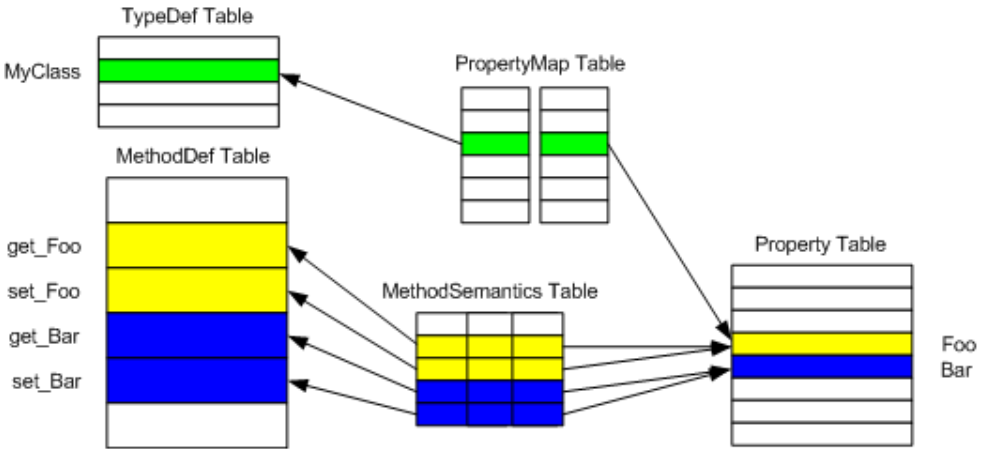
Row 3 of the PropertyMap table indexes row 2 of the
TypeDef table on the left (MyClass), whilst
indexing row 4 of the Property table on the right – the row for
a property called Foo. This setup establishes that MyClass
has a property called Foo. But what methods in the
MethodDef table are gathered together as 'belonging' to
property Foo? That association is contained in the
MethodSemantics table – its row 2 indexes property
Foo to the right, and row 2 in the MethodDef table
to the left (a method called get_Foo). Also, row 3 of the
MethodSemantics table indexes Foo to the right,
and row 3 in the MethodDef table to the left (a method called
set_Foo). As the shading suggests, MyClass has
another property, called Bar, with two methods,
get_Bar and set_Bar.
Property tables do a little more than group together existing rows
from other tables. The Property table has columns for
Flags, Name (eg Foo and Bar
in the example here) and Type. In addition, the
MethodSemantics table has a column to record whether the method
it points at is a set_, a get_ or other.
[Note: The CLS (see Partition I) refers to instance,
virtual, and static properties. The signature of a property (from the
Type column) can be used to distinguish a static property,
since instance and virtual properties will have the
"HASTHIS" bit set in the signature (§II.23.2.1) while a static property
will not. The distinction between an instance and a virtual property
depends on the signature of the getter and setter methods, which the CLS
requires to be either both virtual or both instance. end
note]
The Property (0x17) table has the following columns:
Flags (a 2-byte bitmask of type PropertyAttributes, §II.23.1.14)
Name (an index into the String heap)
Type (an index into the Blob heap) (The name of this column is misleading. It does not index a TypeDef or TypeRef table—instead it indexes the signature in the Blob heap of the Property)
This contains informative text only.
Property table can contain zero or more rows
Each row shall have one, and only one, owner row in the PropertyMap table (as described above) [ERROR]
PropFlags shall have only those values set that are specified (all combinations valid) [ERROR]
Name shall index a non-empty string in the String heap [ERROR]
The Name string shall be a valid CLS identifier [CLS]
Type shall index a non-null signature in the Blob heap [ERROR]
The signature indexed by Type shall be a valid signature for a property (ie, low nibble of leading byte is 0x8). Apart from this leading byte, the signature is the same as the property's get_ method [ERROR]
Within the rows owned by a given row in the TypeDef table, there shall be no duplicates based upon Name+Type [ERROR]
There shall be no duplicate rows based upon Name, where
Name fields are compared using CLS conflicting-identifier-rules
(in particular, properties cannot be overloaded by their Type – a class
cannot have two properties, "int Foo" and
"String Foo", for example) [CLS]
End informative text.
The PropertyMap table has the following columns:
Parent (an index into the TypeDef table)
PropertyList (an index into the Property table). It marks the first of a contiguous run of Properties owned by Parent. The run continues to the smaller of:
the last row of the Property table
the next run of Properties, found by inspecting the PropertyList of the next row in this PropertyMap table
The PropertyMap and Property tables result from putting the .property directive on a class (§II.17).
This contains informative text only.
PropertyMap table can contain zero or more rows
There shall be no duplicate rows, based upon Parent (a given class has only one 'pointer' to the start of its property list) [ERROR]
There shall be no duplicate rows, based upon PropertyList (different classes cannot share rows in the Property table) [ERROR]
End informative text.
Signatures are stored in the metadata Blob heap. In most cases, they are indexed by a column in some table—Field.Signature, Method.Signature, MemberRef.Signature, etc. However, there are two cases that require a metadata token for a signature that is not indexed by any metadata table. The StandAloneSig table fulfils this need. It has just one column, which points to a Signature in the Blob heap.
The signature shall describe either:
a method – code generators create a row in the
StandAloneSig table for each occurrence of a calli
CIL instruction. That row indexes the call-site signature for the
function pointer operand of the calli instruction
local variables – code generators create one row in the StandAloneSig table for each method, to describe all of its local variables. The .locals directive (§II.15.4.1) in ILAsm generates a row in the StandAloneSig table.
The StandAloneSig table has the following column:
[Example:
// On encountering the calli instruction, ilasm generates a signature
// in the blob heap (DEFAULT, ParamCount = 1, RetType = int32, Param1 = int32),
// indexed by the StandAloneSig table:
.assembly Test {}
.method static int32 AddTen(int32)
{ ldarg.0
  ldc.i4  10
  add
  ret
}
.class Test
{ .method static void main()
  { .entrypoint
    ldc.i4.1
    ldftn int32 AddTen(int32)
    calli int32(int32)
    pop
    ret
  }
}
end example]
This contains informative text only.
The StandAloneSig table can contain zero or more rows
Signature shall index a valid signature in the Blob heap [ERROR]
The signature 'blob' indexed by Signature shall be a
valid METHOD or LOCALS signature
[ERROR]
Duplicate rows are allowed
End informative text.
The TypeDef table has the following columns:
Flags (a 4-byte bitmask of type TypeAttributes, §II.23.1.15)
TypeName (an index into the String heap)
TypeNamespace (an index into the String heap)
Extends (an index into the TypeDef, TypeRef, or TypeSpec table; more precisely, a TypeDefOrRef (§II.24.2.6) coded index)
FieldList (an index into the Field table; it marks the first of a contiguous run of Fields owned by this Type). The run continues to the smaller of:
the last row of the Field table
the next run of Fields, found by inspecting the FieldList of the next row in this TypeDef table
MethodList (an index into the MethodDef table; it marks the first of a continguous run of Methods owned by this Type). The run continues to the smaller of:
the last row of the MethodDef table
the next run of Methods, found by inspecting the MethodList of the next row in this TypeDef table
The first row of the TypeDef table represents the pseudo class that acts as parent for functions and variables defined at module scope.
Note that any type shall be one, and only one, of
Class (Flags.Interface = 0, and derives
ultimately from System.Object)
Interface (Flags.Interface = 1)
Value type, derived ultimately from
System.ValueType
For any given type, there are two separate and distinct chains of pointers to other types (the pointers are actually implemented as indexes into metadata tables). The two chains are:
Extension chain – defined via the Extends column of the TypeDef table. Typically, a derived Class extends a base Class (always one, and only one, base Class)
Interface chains – defined via the InterfaceImpl table. Typically, a Class implements zero, one or more Interfaces
These two chains (extension and interface) are always kept separate in metadata. The Extends chain represents one-to-one relations—that is, one Class extends (or 'derives from') exactly one other Class (called its immediate base class). The Interface chains can represent one-to-many relations—that is, one Class might well implement two or more Interfaces.
An interface can also implement one or more other interfaces—metadata stores those links via the InterfaceImpl table (the nomenclature is a little inappropriate here—there is no "implementation" involved; perhaps a clearer name might have been Interface table, or InterfaceInherit table)
Another slightly specialized type is a nested type which is declared in ILAsm as lexically nested within an enclosing type declaration. Whether a type is nested can be determined by the value of its Flags.Visibility sub-field – it shall be one of the set {NestedPublic, NestedPrivate, NestedFamily, NestedAssembly, NestedFamANDAssem, NestedFamORAssem}.
If a type is generic, its parameters are defined in the GenericParam table (§II.22.20). Entries in the GenericParam table reference entries in the TypeDef table; there is no reference from the TypeDef table to the GenericParam table.
This contains informative text only.
The roots of the inheritance hierarchies look like this:
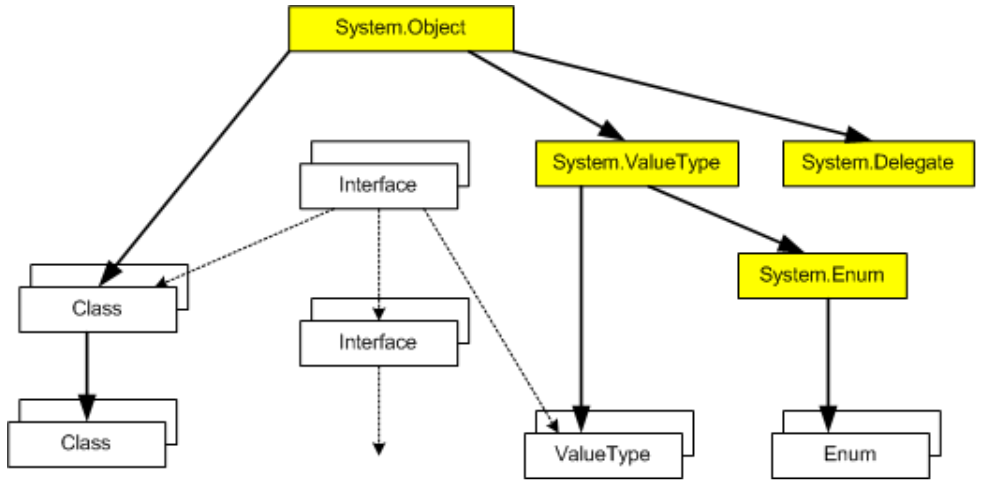
There is one system-defined root, System.Object. All
Classes and ValueTypes shall derive, ultimately, from
System.Object; Classes can derive from other Classes
(through a single, non-looping chain) to any depth required. This
Extends inheritance chain is shown with heavy arrows.
(See below for details of the System.Delegate Class)
Interfaces do not inherit from one another; however, they can have
zero or more required interfaces, which shall be implemented. The
Interface requirement chain is shown as light, dashed arrows.
This includes links between Interfaces and Classes/ValueTypes – where
the latter are said to implement that interface or interfaces.
Regular ValueTypes (i.e., excluding Enums — see later) are defined as
deriving directly from System.ValueType. Regular ValueTypes
cannot be derived to a depth of more than one. (Another way to state
this is that user-defined ValueTypes shall be sealed.)
User-defined Enums shall derive directly from System.Enum.
Enums cannot be derived to a depth of more than one below
System.Enum. (Another way to state this is that
user-defined Enums shall be sealed.) System.Enum
derives directly from System.ValueType.
User-defined delegates derive from System.Delegate.
Delegates cannot be derived to a depth of more than one.
For the directives to declare types see §II.9.
A TypeDef table can contain one or more rows.
Flags:
Flags shall have only those values set that are specified [ERROR]
can set 0 or 1 of SequentialLayout and
ExplicitLayout (if none set, then defaults to
AutoLayout) [ERROR]
can set 0 or 1 of UnicodeClass and
AutoClass (if none set, then defaults to
AnsiClass) [ERROR]
If Flags.HasSecurity = 1, then at least one
of the following conditions shall be true: [ERROR]
this Type owns at least one row in the DeclSecurity table
this Type has a custom attribute called
SuppressUnmanagedCodeSecurityAttribute
If this Type owns one (or more) rows in the DeclSecurity
table then Flags.HasSecurity shall be 1
[ERROR]
If this Type has a custom attribute called
SuppressUnmanagedCodeSecurityAttribute then
Flags.HasSecurity shall be 1 [ERROR]
Note that it is valid for an Interface to have
HasSecurity set. However, the security system ignores any
permission requests attached to that Interface
Name shall index a non-empty string in the String heap [ERROR]
The TypeName string shall be a valid CLS identifier [CLS]
TypeNamespace can be null or non-null
If non-null, then TypeNamespace shall index a non-empty string in the String heap [ERROR]
If non-null, TypeNamespace's string shall be a valid CLS Identifier [CLS]
Every Class (with the exception of System.Object and
the special class <Module>) shall extend one, and
only one, other Class – so Extends for a Class shall be
non-null [ERROR]
System.Object shall have an Extends value
of null [ERROR]
System.ValueType shall have an Extends
value of System.Object [ERROR]
With the exception of System.Object and the special
class <Module>, for any Class, Extends shall
index a valid row in the TypeDef, TypeRef, or
TypeSpec table, where valid means 1 ≤ row ≤ rowcount. In
addition, that row itself shall be a Class (not an Interface or
ValueType) In addition, that base Class shall not be sealed (its
Flags.Sealed shall be 0) [ERROR]
A Class cannot extend itself, or any of its children (i.e., its derived Classes), since this would introduce loops in the hierarchy tree [ERROR] (For generic types, see §II.9.1 and §II.9.2.)
An Interface never extends another Type – so Extends shall be null (Interfaces do implement other Interfaces, but recall that this relationship is captured via the InterfaceImpl table, rather than the Extends column) [ERROR]
FieldList can be null or non-null
A Class or Interface can 'own' zero or more fields
A ValueType shall have a non-zero size – either by defining at least one field, or by providing a non-zero ClassSize [ERROR]
If FieldList is non-null, it shall index a valid row in the Field table, where valid means 1 ≤ row ≤ rowcount+1 [ERROR]
MethodList can be null or non-null
A Type can 'own' zero or more methods
The runtime size of a ValueType shall not exceed 1 MByte (0x100000 bytes) [ERROR]
If MethodList is non-null, it shall index a valid row in the MethodDef table, where valid means 1 ≤ row ≤ rowcount+1 [ERROR]
A Class which has one or more abstract methods cannot be
instantiated, and shall have Flags.Abstract = 1.
Note that the methods owned by the class include all of those inherited
from its base class and interfaces it implements, plus those defined via
its MethodList. (The CLI shall analyze class definitions at
runtime; if it finds a class to have one or more abstract methods, but
has Flags.Abstract = 0, it will throw an
exception) [ERROR]
An Interface shall have Flags.Abstract = 1
[ERROR]
It is valid for an abstract Type to have a constructor method
(ie, a method named .ctor)
Any non-abstract Type (ie Flags.Abstract =
0) shall provide an implementation (body) for every method its contract
requires. Its methods can be inherited from its base class, from the
interfaces it implements, or defined by itself. The implementations can
be inherited from its base class, or defined by itself [ERROR]
An Interface (Flags.Interface = 1) can own
static fields (Field.Static = 1) but cannot own
instance fields (Field.Static = 0)
[ERROR]
An Interface cannot be sealed (if
Flags.Interface = 1, then
Flags.Sealed shall be 0) [ERROR]
All of the methods owned by an Interface
(Flags.Interface = 1) shall be abstract
(Flags.Abstract = 1) [ERROR]
There shall be no duplicate rows in the TypeDef table, based on TypeNamespace+TypeName (unless this is a nested type – see below) [ERROR]
If this is a nested type, there shall be no duplicate row in the TypeDef table, based upon TypeNamespace+TypeName+OwnerRowInNestedClassTable [ERROR]
There shall be no duplicate rows, where TypeNamespace+TypeName fields are compared using CLS conflicting-identifier-rules (unless this is a nested type – see below) [CLS]
If this is a nested type, there shall be no duplicate rows, based upon TypeNamespace+TypeName+OwnerRowInNestedClassTable and where TypeNamespace+TypeName fields are compared using CLS conflicting-identifier-rules [CLS]
If Extends = System.Enum (i.e., type is a
user-defined Enum) then:
shall be sealed (Sealed = 1) [ERROR]
shall not have any methods of its own (MethodList chain shall be zero length) [ERROR]
shall not implement any interfaces (no entries in InterfaceImpl table for this type) [ERROR]
shall not have any properties [ERROR]
shall not have any events [ERROR]
any static fields shall be literal (have
Flags.Literal = 1) [ERROR]
shall have one or more static, literal fields, each of which has the type of the Enum [CLS]
shall be exactly one instance field, of built-in integer type [ERROR]
the Name string of the instance field shall be
"value__", the field shall be marked
RTSpecialName, and that field shall have one of the CLS
integer types [CLS]
shall not have any static fields unless they are literal [ERROR]
A Nested type (defined above) shall own exactly one row in the NestedClass table, where 'owns' means a row in that NestedClass table whose NestedClass column holds the TypeDef token for this type definition [ERROR]
A ValueType shall be sealed [ERROR]
End informative text.
The TypeRef table has the following columns:
ResolutionScope (an index into a Module, ModuleRef, AssemblyRef or TypeRef table, or null; more precisely, a ResolutionScope (§II.24.2.6) coded index)
TypeName (an index into the String heap)
TypeNamespace (an index into the String heap)
This contains informative text only.
ResolutionScope shall be exactly one of:
null – in this case, there shall be a row in the ExportedType table for this Type – its Implementation field shall contain a File token or an AssemblyRef token that says where the type is defined [ERROR]
a TypeRef token, if this is a nested type (which can be
determined by, for example, inspecting the Flags column in its
TypeDef table – the accessibility subfield is one of the
tdNestedXXX set) [ERROR]
a ModuleRef token, if the target type is defined in another module within the same Assembly as this one [ERROR]
a Module token, if the target type is defined in the current module – this should not occur in a CLI ("compressed metadata") module [WARNING]
an AssemblyRef token, if the target type is defined in a different Assembly from the current module [ERROR]
TypeName shall index a non-empty string in the String heap [ERROR]
TypeNamespace can be null, or non-null
If non-null, TypeNamespace shall index a non-empty string in the String heap [ERROR]
The TypeName string shall be a valid CLS identifier [CLS]
There shall be no duplicate rows, where a duplicate has the same ResolutionScope, TypeName and TypeNamespace [ERROR]
There shall be no duplicate rows, where TypeName and TypeNamespace fields are compared using CLS conflicting-identifier-rules [CLS]
End informative text.
The TypeSpec table has just one column, which indexes the specification of a Type, stored in the Blob heap. This provides a metadata token for that Type (rather than simply an index into the Blob heap). This is required, typically, for array operations, such as creating, or calling methods on the array class.
The TypeSpec table has the following column:
Note that TypeSpec tokens can be used with any of the CIL
instructions that take a TypeDef or TypeRef token;
specifically, castclass, cpobj,
initobj, isinst, ldelema,
ldobj, mkrefany, newarr,
refanyval, sizeof, stobj,
box, and unbox.
This contains informative text only.
The TypeSpec table can contain zero or more rows
Signature shall index a valid Type specification in the Blob heap [ERROR]
There shall be no duplicate rows, based upon Signature [ERROR]
End informative text.
This subclause explains the flags and bitmasks used in the metadata tables. When a conforming implementation encounters a metadata structure (such as a flag) that is not specified in this standard, the behavior of the implementation is unspecified.
| Algorithm | Value |
|---|---|
None |
0x0000 |
Reserved (MD5) |
0x8003 |
SHA1 |
0x8004 |
| Flag | Value | Description |
|---|---|---|
PublicKey |
0x0001 | The assembly reference holds the full (unhashed) public key. |
Retargetable |
0x0100 | The implementation of this assembly used at runtime is not expected to match the version seen at compile time. (See the text following this table.) |
DisableJITcompileOptimizer |
0x4000 | Reserved (a conforming implementation of the CLI can ignore this setting on read; some implementations might use this bit to indicate that a CIL-to-native-code compiler should not generate optimized code) |
EnableJITcompileTracking |
0x8000 | Reserved (a conforming implementation of the CLI can ignore this setting on read; some implementations might use this bit to indicate that a CIL-to-native-code compiler should generate CIL-to-native code map) |
ar-SA |
ar-IQ |
ar-EG |
ar-LY |
ar-DZ |
ar-MA |
ar-TN |
ar-OM |
ar-YE |
ar-SY |
ar-JO |
ar-LB |
ar-KW |
ar-AE |
ar-BH |
ar-QA |
bg-BG |
ca-ES |
zh-TW |
zh-CN |
zh-HK |
zh-SG |
zh-MO |
cs-CZ |
da-DK |
de-DE |
de-CH |
de-AT |
de-LU |
de-LI |
el-GR |
en-US |
en-GB |
en-AU |
en-CA |
en-NZ |
en-IE |
en-ZA |
en-JM |
en-CB |
en-BZ |
en-TT |
en-ZW |
en-PH |
es-ES-Ts |
es-MX |
es-ES-Is |
es-GT |
es-CR |
es-PA |
es-DO |
es-VE |
es-CO |
es-PE |
es-AR |
es-EC |
es-CL |
es-UY |
es-PY |
es-BO |
es-SV |
es-HN |
es-NI |
es-PR |
fi-FI |
fr-FR |
fr-BE |
fr-CA |
fr-CH |
fr-LU |
fr-MC |
he-IL |
hu-HU |
is-IS |
it-IT |
it-CH |
ja-JP |
ko-KR |
nl-NL |
nl-BE |
nb-NO |
nn-NO |
pl-PL |
pt-BR |
pt-PT |
ro-RO |
ru-RU |
hr-HR |
lt-sr-SP |
cy-sr-SP |
sk-SK |
sq-AL |
sv-SE |
sv-FI |
th-TH |
tr-TR |
ur-PK |
id-ID |
uk-UA |
be-BY |
sl-SI |
et-EE |
lv-LV |
lt-LT |
fa-IR |
vi-VN |
hy-AM |
lt-az-AZ |
cy-az-AZ |
eu-ES |
mk-MK |
af-ZA |
ka-GE |
fo-FO |
hi-IN |
ms-MY |
ms-BN |
kk-KZ |
ky-KZ |
sw-KE |
lt-uz-UZ |
cy-uz-UZ |
tt-TA |
pa-IN |
gu-IN |
ta-IN |
te-IN |
kn-IN |
mr-IN |
sa-IN |
mn-MN |
gl-ES |
kok-IN |
syr-SY |
div-MV |
Note on RFC 1766, Locale names: a typical string
would be "en-US". The first part ("en" in the
example) uses ISO 639 characters ("Latin-alphabet
characters in lowercase. No diacritical marks of modified characters are
used"). The second part ("US" in the example) uses ISO 3166
characters (similar to ISO 639, but uppercase); that is, the familiar
ASCII characters a—z and
A—Z, respectively. However, whilst RFC 1766
recommends the first part be lowercase and the second part be uppercase,
it allows mixed case. Therefore, the validation rule checks only that
Culture is one of the strings in the list above—but the check
is totally case-blind—where case-blind is the
familiar fold on values less than U+0080.
| Flag | Value | Description |
|---|---|---|
SpecialName |
0x0200 | Event is special. |
RTSpecialName |
0x0400 | CLI provides 'special' behavior, depending upon the name of the event |
| Flag | Value | Description |
|---|---|---|
FieldAccessMask |
0x0007 | These 3 bits contain one of the following values: |
CompilerControlled |
0x0000 | Member not referenceable |
Private |
0x0001 | Accessible only by the parent type |
FamANDAssem |
0x0002 | Accessible by sub-types only in this Assembly |
Assembly |
0x0003 | Accessibly by anyone in the Assembly |
Family |
0x0004 | Accessible only by type and sub-types |
FamORAssem |
0x0005 | Accessibly by sub-types anywhere, plus anyone in assembly |
Public |
0x0006 | Accessibly by anyone who has visibility to this scope field contract attributes |
Static |
0x0010 | Defined on type, else per instance |
InitOnly |
0x0020 | Field can only be initialized, not written to after init |
Literal |
0x0040 | Value is compile time constant |
NotSerialized |
0x0080 | Reserved (to indicate this field should not be serialized when type is remoted) |
SpecialName |
0x0200 | Field is special |
| Interop Attributes | ||
PInvokeImpl |
0x2000 | Implementation is forwarded through PInvoke. |
| Additional flags | ||
RTSpecialName |
0x0400 | CLI provides 'special' behavior, depending upon the name of the field |
HasFieldMarshal |
0x1000 | Field has marshalling information |
HasDefault |
0x8000 | Field has default |
HasFieldRVA |
0x0100 | Field has RVA |
| Flag | Value | Description |
|---|---|---|
ContainsMetaData |
0x0000 | This is not a resource file |
ContainsNoMetaData |
0x0001 | This is a resource file or other non-metadata-containing file |
| Flag | Value | Description |
|---|---|---|
VarianceMask |
0x0003 | These 2 bits contain one of the following values: |
None |
0x0000 | The generic parameter is non-variant and has no special constraints |
Covariant |
0x0001 | The generic parameter is covariant |
Contravariant |
0x0002 | The generic parameter is contravariant |
SpecialConstraintMask |
0x001C | These 3 bits contain one of the following values: |
ReferenceTypeConstraint |
0x0004 | The generic parameter has the class special constraint |
NotNullableValueTypeConstraint |
0x0008 | The generic parameter has the valuetype special constraint |
DefaultConstructorConstraint |
0x0010 | The generic parameter has the .ctor special
constraint |
| Flag | Value | Description |
|---|---|---|
NoMangle |
0x0001 | PInvoke is to use the member name as specified |
| Character set | ||
CharSetMask |
0x0006 | This is a resource file or other non-metadata-containing file. These 2 bits contain one of the following values: |
CharSetNotSpec |
0x0000 | |
CharSetAnsi |
0x0002 | |
CharSetUnicode |
0x0004 | |
CharSetAuto |
0x0006 | |
SupportsLastError |
0x0040 | Information about target function. Not relevant for fields |
| Calling convention | ||
CallConvMask |
0x0700 | These 3 bits contain one of the following values: |
CallConvPlatformapi |
0x0100 | |
CallConvCdecl |
0x0200 | |
CallConvStdcall |
0x0300 | |
CallConvThiscall |
0x0400 | |
CallConvFastcall |
0x0500 |
| Flag | Value | Description |
|---|---|---|
VisibilityMask |
0x0007 | These 3 bits contain one of the following values: |
Public |
0x0001 | The Resource is exported from the Assembly |
Private |
0x0002 | The Resource is private to the Assembly |
| Flag | Value | Description |
|---|---|---|
MemberAccessMask |
0x0007 | These 3 bits contain one of the following values: |
CompilerControlled |
0x0000 | Member not referenceable |
Private |
0x0001 | Accessible only by the parent type |
FamANDAssem |
0x0002 | Accessible by sub-types only in this Assembly |
Assem |
0x0003 | Accessibly by anyone in the Assembly |
Family |
0x0004 | Accessible only by type and sub-types |
FamORAssem |
0x0005 | Accessibly by sub-types anywhere, plus anyone in assembly |
Public |
0x0006 | Accessibly by anyone who has visibility to this scope |
Static |
0x0010 | Defined on type, else per instance |
Final |
0x0020 | Method cannot be overridden |
Virtual |
0x0040 | Method is virtual |
HideBySig |
0x0080 | Method hides by name+sig, else just by name |
VtableLayoutMask |
0x0100 | Use this mask to retrieve vtable attributes. This bit contains one of the following values: |
ReuseSlot |
0x0000 | Method reuses existing slot in vtable |
NewSlot |
0x0100 | Method always gets a new slot in the vtable |
Strict |
0x0200 | Method can only be overriden if also accessible |
Abstract |
0x0400 | Method does not provide an implementation |
SpecialName |
0x0800 | Method is special |
| Interop attributes | ||
PInvokeImpl |
0x2000 | Implementation is forwarded through PInvoke |
UnmanagedExport |
0x0008 | Reserved: shall be zero for conforming implementations |
| Additional flags | ||
RTSpecialName |
0x1000 | CLI provides 'special' behavior, depending upon the name of the method |
HasSecurity |
0x4000 | Method has security associate with it |
RequireSecObject |
0x8000 | Method calls another method containing security code. |
| Flag | Value | Description |
|---|---|---|
CodeTypeMask |
0x0003 | These 2 bits contain one of the following values: |
IL |
0x0000 | Method impl is CIL |
Native |
0x0001 | Method impl is native |
OPTIL |
0x0002 | Reserved: shall be zero in conforming implementations |
Runtime |
0x0003 | Method impl is provided by the runtime |
ManagedMask |
0x0004 | Flags specifying whether the code is managed or unmanaged. This bit contains one of the following values: |
Unmanaged |
0x0004 | Method impl is unmanaged, otherwise managed |
Managed |
0x0000 | Method impl is managed |
| Implementation info and interop | ||
ForwardRef |
0x0010 | Indicates method is defined; used primarily in merge scenarios |
PreserveSig |
0x0080 | Reserved: conforming implementations can ignore |
InternalCall |
0x1000 | Reserved: shall be zero in conforming implementations |
Synchronized |
0x0020 | Method is single threaded through the body |
NoInlining |
0x0008 | Method cannot be inlined |
MaxMethodImplVal |
0xffff | Range check value |
NoOptimization |
0x0040 | Method will not be optimized when generating native code |
| Flag | Value | Description |
|---|---|---|
Setter |
0x0001 | Setter for property |
Getter |
0x0002 | Getter for property |
Other |
0x0004 | Other method for property or event |
AddOn |
0x0008 | AddOn method for event. This refers to the required
add_ method for events. (§22.13) |
RemoveOn |
0x0010 | RemoveOn method for event. This refers to the required
remove_ method for events. (§22.13) |
Fire |
0x0020 | Fire method for event. This refers to the optional
raise_ method for events. (§22.13) |
| Flag | Value | Description |
|---|---|---|
In |
0x0001 | Param is [in] |
Out |
0x0002 | Param is [out] |
Optional |
0x0010 | Param is optional |
HasDefault |
0x1000 | Param has default value |
HasFieldMarshal |
0x2000 | Param has FieldMarshal |
Unused |
0xcfe0 | Reserved: shall be zero in a conforming implementation |
| Flag | Value | Description |
|---|---|---|
SpecialName |
0x0200 | Property is special |
RTSpecialName |
0x0400 | Runtime (metadata internal APIs) should check name encoding |
HasDefault |
0x1000 | Property has default |
Unused |
0xe9ff | Reserved: shall be zero in a conforming implementation |
| Flag | Value | Description |
|---|---|---|
| Visibility attributes | ||
VisibilityMask |
0x00000007 | Use this mask to retrieve visibility information. These 3 bits contain one of the following values: |
NotPublic |
0x00000000 | Class has no public scope |
Public |
0x00000001 | Class has public scope |
NestedPublic |
0x00000002 | Class is nested with public visibility |
NestedPrivate |
0x00000003 | Class is nested with private visibility |
NestedFamily |
0x00000004 | Class is nested with family visibility |
NestedAssembly |
0x00000005 | Class is nested with assembly visibility |
NestedFamANDAssem |
0x00000006 | Class is nested with family and assembly visibility |
NestedFamORAssem |
0x00000007 | Class is nested with family or assembly visibility |
| Class layout attributes | ||
LayoutMask |
0x00000018 | Use this mask to retrieve class layout information. These 2 bits contain one of the following values: |
AutoLayout |
0x00000000 | Class fields are auto-laid out |
SequentialLayout |
0x00000008 | Class fields are laid out sequentially |
ExplicitLayout |
0x00000010 | Layout is supplied explicitly |
| Class semantics attributes | ||
ClassSemanticsMask |
0x00000020 | Use this mask to retrive class semantics information. This bit contains one of the following values: |
Class |
0x00000000 | Type is a class |
Interface |
0x00000020 | Type is an interface |
| Special semantics in addition to class semantics | ||
Abstract |
0x00000080 | Class is abstract |
Sealed |
0x00000100 | Class cannot be extended |
SpecialName |
0x00000400 | Class name is special |
| Implementation Attributes | ||
Import |
0x00001000 | Class/Interface is imported |
Serializable |
0x00002000 | Reserved (Class is serializable) |
| String formatting Attributes | ||
StringFormatMask |
0x00030000 | Use this mask to retrieve string information for native interop. These 2 bits contain one of the following values: |
AnsiClass |
0x00000000 | LPSTR is interpreted as ANSI |
UnicodeClass |
0x00010000 | LPSTR is interpreted as Unicode |
AutoClass |
0x00020000 | LPSTR is interpreted automatically |
CustomFormatClass |
0x00030000 | A non-standard encoding specified by
CustomStringFormatMask |
CustomStringFormatMask |
0x00C00000 | Use this mask to retrieve non-standard encoding information for native interop. The meaning of the values of these 2 bits is unspecified. |
| Class Initialization Attributes | ||
BeforeFieldInit |
0x00100000 | Initialize the class before first static field access |
| Additional Flags | ||
RTSpecialName |
0x00000800 | CLI provides 'special' behavior, depending upon the name of the Type |
HasSecurity |
0x00040000 | Type has security associate with it |
IsTypeForwarder |
0x00200000 | This ExportedType entry is a type forwarder |
The following table lists the values for ELEMENT_TYPE
constants. These are used extensively in metadata signature blobs – see
§II.23.2.
| Name | Value | Remarks |
|---|---|---|
ELEMENT_TYPE_END |
0x00 | Marks end of a list |
ELEMENT_TYPE_VOID |
0x01 | |
ELEMENT_TYPE_BOOLEAN |
0x02 | |
ELEMENT_TYPE_CHAR |
0x03 | |
ELEMENT_TYPE_I1 |
0x04 | |
ELEMENT_TYPE_U1 |
0x05 | |
ELEMENT_TYPE_I2 |
0x06 | |
ELEMENT_TYPE_U2 |
0x07 | |
ELEMENT_TYPE_I4 |
0x08 | |
ELEMENT_TYPE_U4 |
0x09 | |
ELEMENT_TYPE_I8 |
0x0a | |
ELEMENT_TYPE_U8 |
0x0b | |
ELEMENT_TYPE_R4 |
0x0c | |
ELEMENT_TYPE_R8 |
0x0d | |
ELEMENT_TYPE_STRING |
0x0e | |
ELEMENT_TYPE_PTR |
0x0f | Followed by type |
ELEMENT_TYPE_BYREF |
0x10 | Followed by type |
ELEMENT_TYPE_VALUETYPE |
0x11 | Followed by TypeDef or TypeRef token |
ELEMENT_TYPE_CLASS |
0x12 | Followed by_ TypeDef_ or TypeRef token |
ELEMENT_TYPE_VAR |
0x13 | Generic parameter in a generic type definition, represented as number (compressed unsigned integer) |
ELEMENT_TYPE_ARRAY |
0x14 | type rank boundsCount bound1 … loCount lo1 … |
ELEMENT_TYPE_GENERICINST |
0x15 | Generic type instantiation. Followed by type type-arg-count type-1 … type-n |
ELEMENT_TYPE_TYPEDBYREF |
0x16 | |
ELEMENT_TYPE_I |
0x18 | System.IntPtr |
ELEMENT_TYPE_U |
0x19 | System.UIntPtr |
ELEMENT_TYPE_FNPTR |
0x1b | Followed by full method signature |
ELEMENT_TYPE_OBJECT |
0x1c | System.Object |
ELEMENT_TYPE_SZARRAY |
0x1d | Single-dim array with 0 lower bound |
ELEMENT_TYPE_MVAR |
0x1e | Generic parameter in a generic method definition, represented as number (compressed unsigned integer) |
ELEMENT_TYPE_CMOD_REQD |
0x1f | Required modifier: followed by a TypeDef or TypeRef token |
ELEMENT_TYPE_CMOD_OPT |
0x20 | Optional modifier: followed by a TypeDef or TypeRef token |
ELEMENT_TYPE_INTERNAL |
0x21 | Implemented within the CLI |
ELEMENT_TYPE_MODIFIER |
0x40 | Or'd with following element types |
ELEMENT_TYPE_SENTINEL |
0x41 | Sentinel for vararg method signature |
ELEMENT_TYPE_PINNED |
0x45 | Denotes a local variable that points at a pinned object |
| 0x50 | Indicates an argument of type System.Type. |
|
| 0x51 | Used in custom attributes to specify a boxed object (§II.23.3). | |
| 0x52 | Reserved | |
| 0x53 | Used in custom attributes to indicate a FIELD (§II.22.10, II.23.3). |
|
| 0x54 | Used in custom attributes to indicate a PROPERTY (§II.22.10, II.23.3). |
|
| 0x55 | Used in custom attributes to specify an enum (§II.23.3). |
The word signature is conventionally used to describe the type info for a function or method; that is, the type of each of its parameters, and the type of its return value. Within metadata, the word signature is also used to describe the type info for fields, properties, and local variables. Each Signature is stored as a (counted) byte array in the Blob heap. There are several kinds of Signature, as follows:
MethodRefSig (differs from a MethodDefSig only
for VARARG calls)
MethodDefSig
FieldSig
PropertySig
LocalVarSig
TypeSpec
MethodSpec
The value of the first byte of a Signature 'blob' indicates what kind
of Signature it is. Its lowest 4 bits hold one of the following:
C, DEFAULT, FASTCALL,
STDCALL, THISCALL, or VARARG
(whose values are defined in §II.23.2.3), which qualify
method signatures; FIELD, which denotes a field signature
(whose value is defined in §II.23.2.4); or PROPERTY,
which denotes a property signature (whose value is defined in §II.23.2.5). This subclause defines
the binary 'blob' format for each kind of Signature. In the syntax
diagrams that accompany many of the definitions, shading is used to
combine into a single diagram what would otherwise be multiple diagrams;
the accompanying text describes the use of shading.
Signatures are compressed before being stored into the Blob heap (described below) by compressing the integers embedded in the signature. The maximum encodable unsigned integer is 29 bits long, 0x1FFFFFFF. For signed integers, as occur in ArrayShape (§II.23.2.13), the range is -228 (0xF0000000) to 228-1 (0x0FFFFFFF). The compression algorithm used is as follows (bit 0 is the least significant bit):
For unsigned integers:
If the value lies between 0 (0x00) and 127 (0x7F), inclusive, encode as a one-byte integer (bit 7 is clear, value held in bits 6 through 0)
If the value lies between 28 (0x80) and 214-1 (0x3FFF), inclusive, encode as a 2-byte integer with bit 15 set, bit 14 clear (value held in bits 13 through 0)
Otherwise, encode as a 4-byte integer, with bit 31 set, bit 30 set, bit 29 clear (value held in bits 28 through 0)
For signed integers:
If the value lies between -26 and 26-1 inclusive:
Represent the value as a 7-bit 2's complement number, giving 0x40 (-26) to 0x3F (26-1);
Rotate this value 1 bit left, giving 0x01 (-26) to 0x7E (26-1);
Encode as a one-byte integer, bit 7 clear, rotated value in bits 6 through 0, giving 0x01 (-26) to 0x7E (26-1).
If the value lies between -213 and 213-1 inclusive:
Represent the value as a 14-bit 2’s complement number, giving 0x2000 (-213) to 0x1FFF (213-1);
Rotate this value 1 bit left, giving 0x0001 (-213) to 0x3FFE (213-1);
Encode as a two-byte integer: bit 15 set, bit 14 clear, rotated value in bits 13 through 0, giving 0x8001 (-213) to 0xBFFE (213-1).
If the value lies between -228 and 228-1 inclusive:
Represent the value as a 29-bit 2's complement representation, giving 0x10000000 (-228) to 0xFFFFFFF (228-1);
Rotate this value 1-bit left, giving 0x00000001 (-228) to 0x1FFFFFFE (228-1);
Encode as a four-byte integer: bit 31 set, 30 set, bit 29 clear, rotated value in bits 28 through 0, giving 0xC0000001 (-228) to 0xDFFFFFFE (228-1).
A null string should be represented with the reserved single byte 0xFF, and no following data
[Note: The tables below show several examples. The first column gives a value, expressed in familiar (C-like) hex notation. The second column shows the corresponding, compressed result, as it would appear in a PE file, with successive bytes of the result lying at successively higher byte offsets within the file. (This is the opposite order from how regular binary integers are laid out in a PE file.)
Unsigned examples:
| Original Value | Compressed Representation |
|---|---|
| 0x03 | 03 |
| 0x7F | 7F (7 bits set) |
| 0x80 | 8080 |
| 0x2E57 | AE57 |
| 0x3FFF | BFFF |
| 0x4000 | C000 4000 |
| 0x1FFF FFFF | DFFF FFFF |
Signed examples:
| Original Value | Compressed Representation |
|---|---|
| 3 | 06 |
| -3 | 7B |
| 64 | 8080 |
| -64 | 01 |
| 8192 | C000 4000 |
| -8192 | 8001 |
| 268435455 | DFFF FFFE |
| -268435456 | C000 0001 |
end note]
The most significant bits (the first ones encountered in a PE file) of a "compressed" field, can reveal whether it occupies 1, 2, or 4 bytes, as well as its value. For this to work, the "compressed" value, as explained above, is stored in big-endian order; i.e., with the most significant byte at the smallest offset within the file.
Signatures make extensive use of constant values called
ELEMENT_TYPE_xxx – see §II.23.1.16.
In particular, signatures include two modifiers called:
ELEMENT_TYPE_BYREF – this element is a managed
pointer (see Partition
I). This modifier can only occur in the definition of
LocalVarSig (§II.23.2.6), Param (§II.23.2.10) or RetType (§II.23.2.11). It shall not occur within
the definition of a Field (§II.23.2.4)
ELEMENT_TYPE_PTR – this element is an unmanaged
pointer (see Partition
I). This modifier can occur in the definition of
LocalVarSig (§II.23.2.6), Param (§II.23.2.10), RetType (§II.23.2.11) or Field (§II.23.2.4)
A MethodDefSig is indexed by the Method.Signature column. It captures the signature of a method or global function. The syntax diagram for a MethodDefSig is:
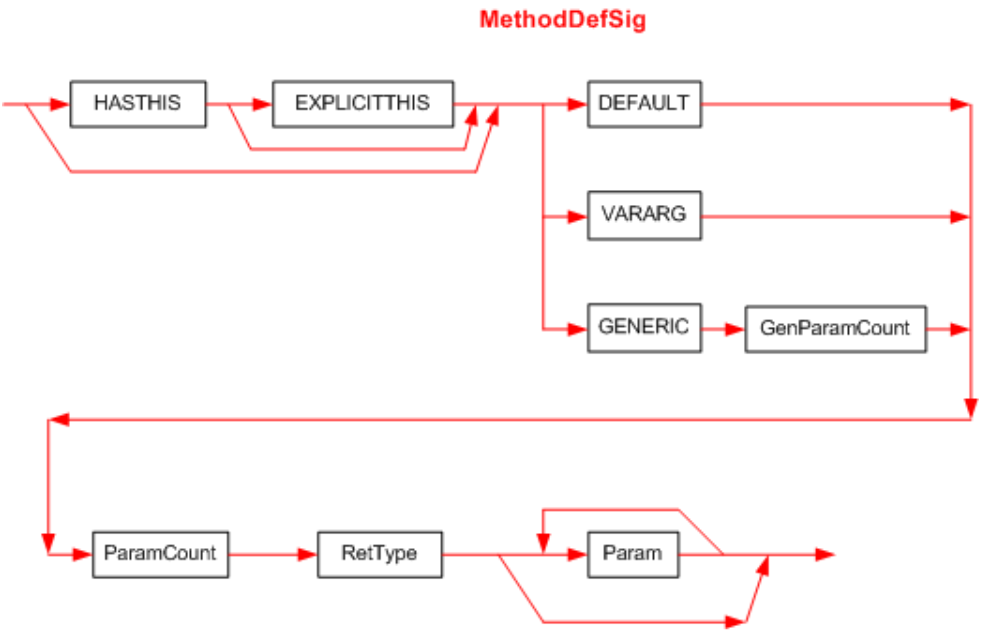
This diagram uses the following abbreviations:
HASTHIS = 0x20, used to encode the keyword
instance in the calling convention, see §II.15.3
EXPLICITTHIS = 0x40, used to encode the keyword
explicit in the calling convention, see §II.15.3
DEFAULT = 0x0, used to encode the keyword
default in the calling convention, see §II.15.3
VARARG = 0x5, used to encode the keyword
vararg in the calling convention, see §II.15.3
GENERIC = 0x10, used to indicate that the method has
one or more generic parameters.
The first byte of the Signature holds bits for HASTHIS,
EXPLICITTHIS and calling convention (DEFAULT,
VARARG, or GENERIC). These are ORed
together.
GenParamCount is the number of generic parameters for the method. This is a compressed unsigned integer.
[Note: For generic methods, both MethodDef and
MemberRef shall include the GENERIC calling
convention, together with GenParamCount; these are significant
for binding—they enable the CLI to overload on generic methods by the
number of generic parameters they include. end note]
ParamCount is an unsigned integer that holds the number of parameters (0 or more). It can be any number between 0 and 0x1FFFFFFF. The compiler compresses it too (see §15) – before storing into the 'blob' (ParamCount counts just the method parameters – it does not include the method's return type)
The RetType item describes the type of the method's return value (§II.23.2.11)
The Param item describes the type of each of the method's parameters. There shall be ParamCount instances of the Param item (§II.23.2.10).
A MethodRefSig is indexed by the
MemberRef.Signature column. This provides the call
site Signature for a method. Normally, this call site Signature
shall match exactly the Signature specified in the definition of the
target method. For example, if a method Foo is defined that
takes two unsigned int32s and returns void;
then any call site shall index a signature that takes exactly two
unsigned int32s and returns void. In this
case, the syntax diagram for a MethodRefSig is identical with
that for a MethodDefSig – see §II.23.2.1
The Signature at a call site differs from that at its definition,
only for a method with the VARARG calling convention. In
this case, the call site Signature is extended to include info about the
extra VARARG arguments (for example, corresponding to the
"..." in C syntax). The syntax diagram for this case
is:
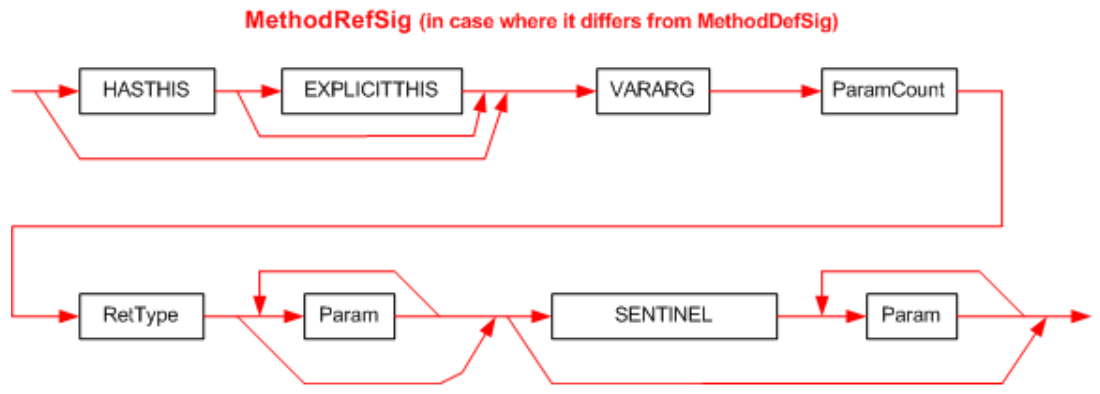
This diagram uses the following abbreviations:
HASTHIS = 0x20, used to encode the keyword
instance in the calling convention, see §II.15.3
EXPLICITTHIS = 0x40, used to encode the keyword
explicit in the calling convention, see §II.15.3
VARARG = 0x5, used to encode the keyword
vararg in the calling convention, see §II.15.3
SENTINEL = 0x41 (§II.23.1.16),
used to encode "..." in the parameter list, see §II.15.3
The first byte of the Signature holds bits for HASTHIS,
EXPLICITTHIS, and the calling convention
VARARG. These are ORed together.
ParamCount is an unsigned integer that holds the number of parameters (0 or more). It can be any number between 0 and 0x1FFFFFFF. The compiler compresses it (see §15) – before storing into the 'blob' (ParamCount counts just the method parameters – it does not include the method's return type)
The RetType item describes the type of the method’s return value (§II.23.2.11)
The Param item describes the type of each of the method's parameters. There shall be ParamCount instances of the Param item (§II.23.2.10).
The Param item describes the type of each of the method's
parameters. There shall be ParamCount instances of the
Param item. This starts just like the MethodDefSig for
a VARARG method (§II.23.2.1). But then a
SENTINEL token is appended, followed by extra
Param items to describe the extra VARARG
arguments. Note that the ParamCount item shall indicate the
total number of Param items in the Signature – before and after
the SENTINEL byte (0x41).
In the unusual case that a call site supplies no extra arguments, the
signature shall not include a SENTINEL (this is the route
shown by the lower arrow that bypasses SENTINEL and goes to
the end of the MethodRefSig definition).
A StandAloneMethodSig is indexed by the
StandAloneSig.Signature column. It is typically
created as preparation for executing a calli instruction.
It is similar to a MethodRefSig, in that it represents a call
site signature, but its calling convention can specify an unmanaged
target (the calli instruction invokes either managed, or
unmanaged code). Its syntax diagram is:
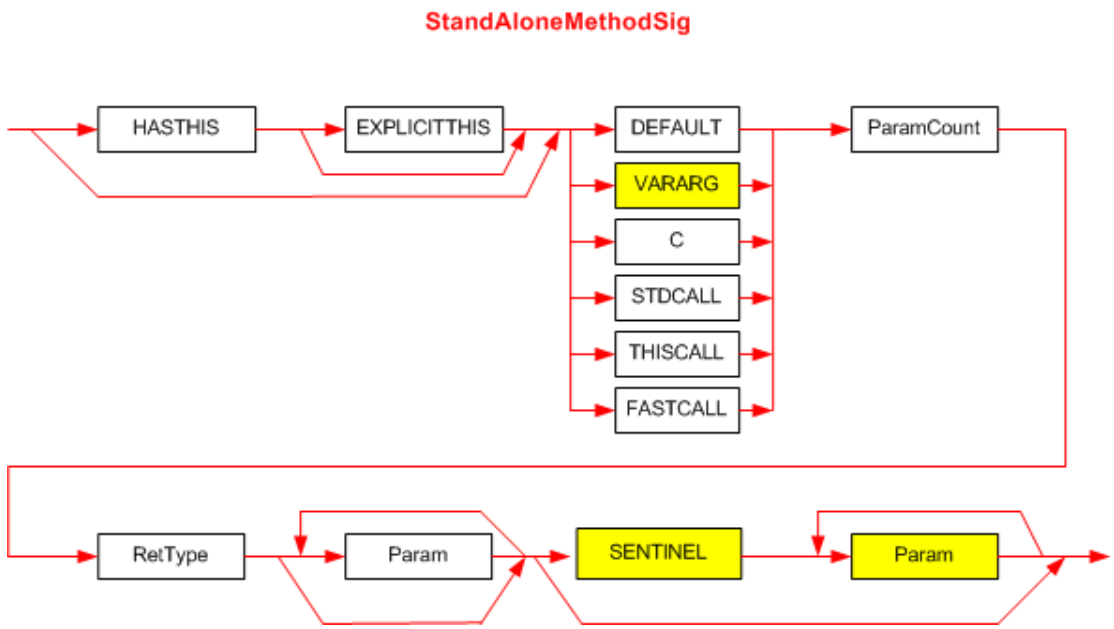
This diagram uses the following abbreviations (§II.15.3):
HASTHIS for 0x20EXPLICITTHIS for 0x40DEFAULT for 0x0VARARG for 0x5C for 0x1STDCALL for 0x2THISCALL for 0x3FASTCALL for 0x4SENTINEL for 0x41 (§II.23.1.16
and §II.15.3)The first byte of the Signature holds bits for HASTHIS,
EXPLICITTHIS and calling convention – DEFAULT,
VARARG, C, STDCALL,
THISCALL, or FASTCALL. These are OR'd
together.
ParamCount is an unsigned integer that holds the number of non-vararg and vararg parameters, combined. It can be any number between 0 and 0x1FFFFFFF. The compiler compresses it (see §15) – before storing into the blob (ParamCount counts just the method parameters – it does not include the method's return type)
The RetType item describes the type of the method's return value (§II.23.2.11)
The first Param item describes the type of each of the method's non-vararg parameters. The (optional) second Param item describes the type of each of the method's vararg parameters. There shall be ParamCount instances of Param (§II.23.2.10).
This is the most complex of the various method signatures. Two
separate diagrams have been combined into one in this diagram, using
shading to distinguish between them. Thus, for the following calling
conventions: DEFAULT (managed), STDCALL,
THISCALL and FASTCALL (unmanaged), the
signature ends just before the SENTINEL item (these are all
non vararg signatures). However, for the managed and unmanaged vararg
calling conventions:
VARARG (managed) and C (unmanaged), the
signature can include the SENTINEL and final Param items (they
are not required, however). These options are indicated by the shading
of boxes in the syntax diagram.
In the unusual case that a call site supplies no extra arguments, the
signature shall not include a SENTINEL (this is the route
shown by the lower arrow that bypasses SENTINEL and goes to
the end of the StandAloneMethodSig definition).
A FieldSig is indexed by the Field.Signature column, or by the MemberRef.Signature column (in the case where it specifies a reference to a field, not a method, of course). The Signature captures the field's definition. The field can be a static or instance field in a class, or it can be a global variable. The syntax diagram for a FieldSig looks like this:
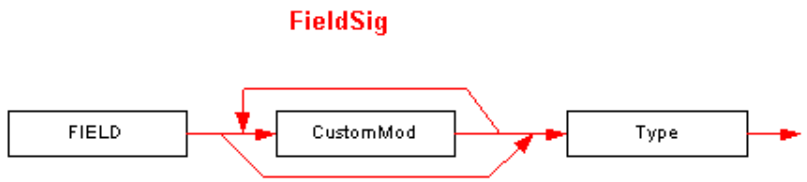
This diagram uses the following abbreviations:
FIELD for 0x6CustomMod is defined in §II.23.2.7. Type is defined in §II.23.2.12.
A PropertySig is indexed by the Property.Type column. It captures the type information for a Property – essentially, the signature of its getter method:
the number of parameters supplied to its getter method
the base type of the Property (the type returned by its getter method)
type information for each parameter in the getter method (that is, the index parameters)
Note that the signatures of getter and setter are related precisely as follows:
The types of a getter's ParamCount parameters are exactly the same as the first ParamCount parameters of the setter
The return type of a getter is exactly the same as the type of the last parameter supplied to the setter
The syntax diagram for a PropertySig looks like this:

The first byte of the Signature holds bits for HASTHIS
and PROPERTY. These are OR’d together.
Type specifies the type returned by the getter method for this property. Type is defined in §II.23.2.12.
Param is defined in §II.23.2.10.
ParamCount is a compressed unsigned integer that holds the number of index parameters in the getter methods (0 or more). (§II.23.2.1) (ParamCount counts just the method parameters – it does not include the method's base type of the Property)
A LocalVarSig is indexed by the StandAloneSig.Signature column. It captures the type of all the local variables in a method. Its syntax diagram is:
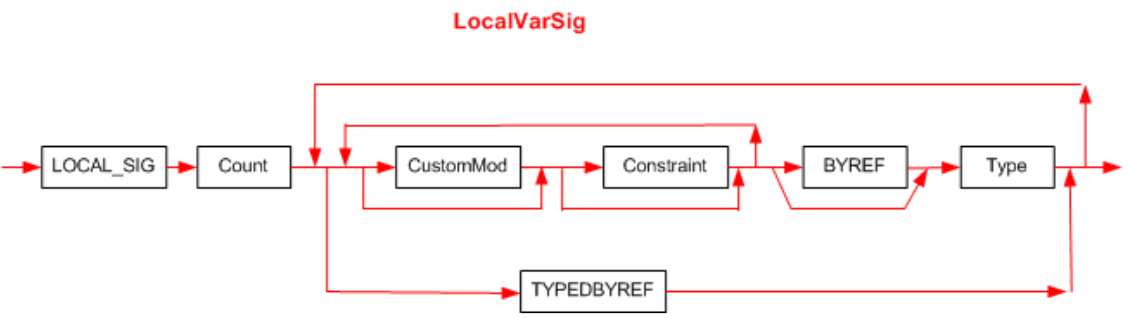
This diagram uses the following abbreviations:
LOCAL_SIG for 0x7, used for the
.locals directive, see §II.15.4.1.3
BYREF for ELEMENT_TYPE_BYREF (§II.23.1.16)
Constraint is defined in §II.23.2.9.
Type is defined in §II.23.2.12
Count is a compressed unsigned integer that holds the number of local variables. It can be any number between 1 and 0xFFFE.
There shall be Count instances of the Type in the LocalVarSig
The CustomMod (custom modifier) item in Signatures has a syntax diagram like this:
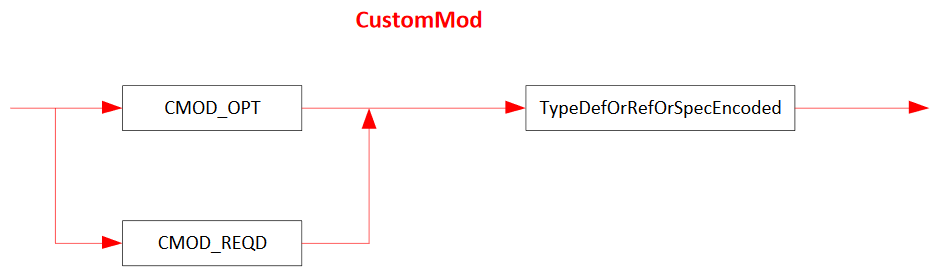
This diagram uses the following abbreviations:
CMOD_OPT for ELEMENT_TYPE_CMOD_OPT (§II.23.1.16)
CMOD_REQD for ELEMENT_TYPE_CMOD_REQD
(§II.23.1.16)
The CMOD_OPT or CMOD_REQD value is
compressed, see §II.23.2.
The CMOD_OPT or CMOD_REQD is followed by a
metadata token that indexes a row in the TypeDef table or the
TypeRef table. However, these tokens are encoded and compressed
– see §II.23.2.8
for details
If the CustomModifier is tagged CMOD_OPT, then any
importing compiler can freely ignore it entirely. Conversely, if the
CustomModifier is tagged CMOD_REQD, any importing compiler
shall 'understand' the semantic implied by this CustomModifier in order
to reference the surrounding Signature.
These items are compact ways to store a TypeDef, TypeRef, or TypeSpec token in a Signature (§II.23.2.12). Consider a regular TypeRef token, such as 0x01000012. The top byte of 0x01 indicates that this is a TypeRef token (see §II.22 for a list of the supported metadata token types). The lower 3 bytes (0x000012) index row number 0x12 in the TypeRef table.
The encoded version of this TypeRef token is made up as follows:
encode the table that this token indexes as the least significant 2 bits. The bit values to use are 0, 1 and 2, specifying the target table is the TypeDef, TypeRef or TypeSpec table, respectively
shift the 3-byte row index (0x000012 in this example) left by 2 bits and OR into the 2-bit encoding from step 1
compress the resulting value (§II.23.2).
This example yields the following encoded value:
a)  encoded = value for TypeRef table = 0x01 (from 1. above)
b)  encoded = ( 0x000012 << 2 ) |  0x01
            = 0x48 | 0x01
            = 0x49
c)  encoded = Compress (0x49)
            = 0x49
So, instead of the original, regular TypeRef token value of 0x01000012, requiring 4 bytes of space in the Signature 'blob', this TypeRef token is encoded as a single byte.
The Constraint item in Signatures currently has only one
possible value, ELEMENT_TYPE_PINNED (§II.23.1.16),
which specifies that the target type is pinned in the runtime heap, and
will not be moved by the actions of garbage collection.
A Constraint can only be applied within a
LocalVarSig (not a FieldSig). The Type of the local
variable shall either be a reference type (in other words, it
points to the actual variable – for example, an Object, or a
String); or it shall include the BYREF item. The reason is
that local variables are allocated on the runtime stack – they are never
allocated from the runtime heap; so unless the local variable
points at an object allocated in the GC heap, pinning makes no
sense.
The Param (parameter) item in Signatures has this syntax diagram:
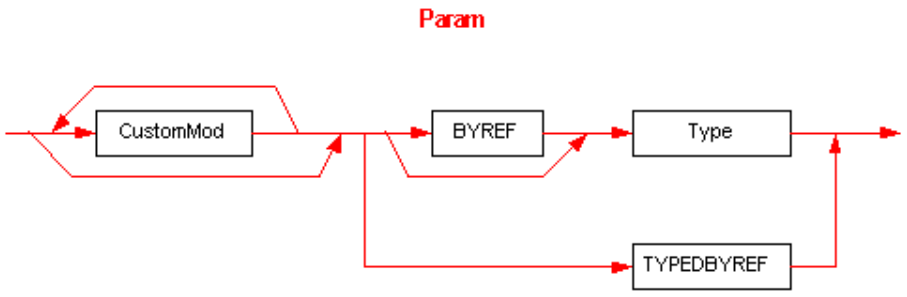
This diagram uses the following abbreviations:
BYREF for 0x10 (§II.23.1.16)
TYPEDBYREF for 0x16 (§II.23.1.16)
CustomMod is defined in §II.23.2.7
Type is defined in §II.23.2.12.
The RetType (return type) item in Signatures has this syntax diagram:
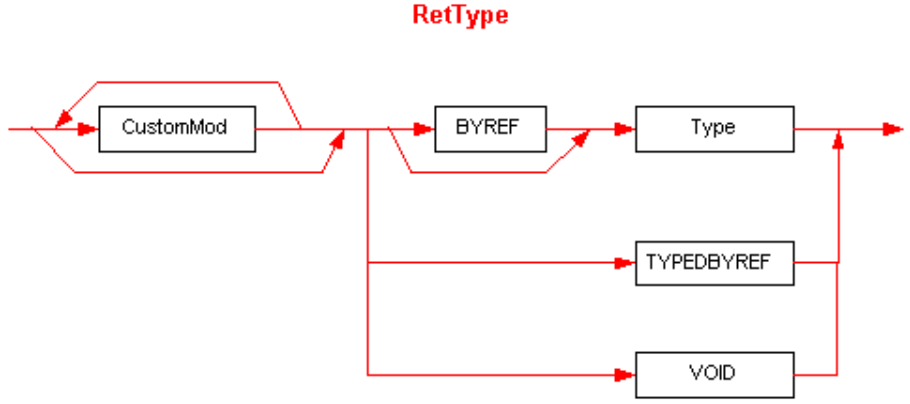
RetType is identical to Param except for one extra
possibility, that it can include the type VOID.
This diagram uses the following abbreviations:
BYREF for ELEMENT_TYPE_BYREF (§II.23.1.16)
TYPEDBYREF for ELEMENT_TYPE_TYPEDBYREF
(§II.23.1.16)
VOID for ELEMENT_TYPE_VOID (§II.23.1.16)
Type is encoded in signatures as follows (I1 is
an abbreviation for ELEMENT_TYPE_I1, U1 is an
abbreviation for ELEMENT_TYPE_U1, and so on; see II.23.1.16):
| Type ::= |
|---|
BOOLEAN | CHAR | I1 |
U1 | I2 | U2 | I4 |
U4 | I8 | U8 | R4 |
R8 | I | U |
| ARRAY Type ArrayShape (general
array, see §II.23.2.13) |
| CLASS TypeDefOrRefOrSpecEncoded |
| FNPTR MethodDefSig |
| FNPTR MethodRefSig |
| GENERICINST (CLASS |
VALUETYPE) TypeDefOrRefOrSpecEncoded
GenArgCount Type* |
| MVAR number |
| OBJECT |
| PTR CustomMod* Type |
| PTR CustomMod* VOID |
| STRING |
| SZARRAY CustomMod* Type (single
dimensional, zero-based array i.e., vector) |
| VALUETYPE TypeDefOrRefOrSpecEncoded |
| VAR number |
The GenArgCount non-terminal is an unsigned integer value
(compressed) specifying the number of generic arguments in this
signature. The number non-terminal following MVAR or
VAR is an unsigned integer value (compressed).
An ArrayShape has the following syntax diagram:

Rank is an unsigned integer (stored in compressed form, see §II.23.2) that specifies the number of dimensions in the array (shall be 1 or more).
NumSizes is a compressed unsigned integer that says how many dimensions have specified sizes (it shall be 0 or more).
Size is a compressed unsigned integer specifying the size of that dimension – the sequence starts at the first dimension, and goes on for a total of NumSizes items.
Similarly, NumLoBounds is a compressed unsigned integer that says how many dimensions have specified lower bounds (it shall be 0 or more).
And LoBound is a compressed signed integer specifying the lower bound of that dimension – the sequence starts at the first dimension, and goes on for a total of NumLoBounds items.
None of the dimensions in these two sequences can be skipped, but the number of specified dimensions can be less than Rank.
Here are a few examples, all for element type int32:
| Type | Rank | NumSizes | Size | NumLoBounds | LoBound | |
|---|---|---|---|---|---|---|
[0...2] |
I4 |
1 |
1 |
3 |
0 |
|
| [,,,,,,] | I4 |
7 |
0 |
0 |
||
[0...3, 0...2,,,,] |
I4 |
6 |
2 |
4 3 |
2 |
0 0 |
[1...2, 6...8] |
I4 |
2 |
2 |
2 3 |
2 |
1 6 |
[5, 3...5, , ] |
I4 |
4 |
2 |
5 3 |
2 |
0 3 |
[Note: definitions can nest, since the Type can itself be an array. end note]
The signature in the Blob heap indexed by a TypeSpec token has the following format
| TypeSpecBlob ::= |
|---|
PTR CustomMod* VOID |
| PTR CustomMod* Type |
| FNPTR MethodDefSig |
| FNPTR MethodRefSig |
| ARRAY Type ArrayShape |
| SZARRAY CustomMod* Type |
| GENERICINST ( CLASS |
VALUETYPE ) TypeDefOrRefOrSpecEncoded
GenArgCount Type Type* |
For compactness, the ELEMENT_TYPE_ prefixes have been
omitted from this list. So, for example, PTR is shorthand
for ELEMENT_TYPE_PTR. (§II.23.1.16)
Note that a TypeSpecBlob does not begin with a calling-convention byte,
so it differs from the various other signatures that are stored into
Metadata.
The signature in the Blob heap indexed by a MethodSpec token has the following format
| MethodSpecBlob ::= |
|---|
GENERICINST GenArgCount Type
Type* |
GENERICINST has the value 0x0A. [Note: This
value is known as IMAGE_CEE_CS_CALLCONV_GENERICINST in the
Microsoft CLR implementation. end note]
The GenArgCount is a compressed unsigned integer indicating the number of generic arguments in the method. The blob then specifies the instantiated type, repeating a total of GenArgCount times.
The general specification for signatures leaves some leeway in how to encode certain items. For example, it appears valid to encode a String as either
ELEMENT_TYPE_CLASS,
TypeRef-to-System.String)ELEMENT_TYPE_STRINGOnly the short form is valid. The following table shows which
short-forms should be used in place of each long-form item. (As usual,
for compactness, the ELEMENT_TYPE_ prefix have been omitted
here – so VALUETYPE is short for
ELEMENT_TYPE_VALUETYPE)
| Long Form | Short Form | |
|---|---|---|
| Prefix | TypeRef to: | |
CLASS |
System.String |
STRING |
CLASS |
System.Object |
OBJECT |
VALUETYPE |
System.Void |
VOID |
VALUETYPE |
System.Boolean |
BOOLEAN |
VALUETYPE |
System.Char |
CHAR |
VALUETYPE |
System.Byte |
U1 |
VALUETYPE |
System.Sbyte |
I1 |
VALUETYPE |
System.Int16 |
I2 |
VALUETYPE |
System.UInt16 |
U2 |
VALUETYPE |
System.Int32 |
I4 |
VALUETYPE |
System.UInt32 |
U4 |
VALUETYPE |
System.Int64 |
I8 |
VALUETYPE |
System.UInt64 |
U8 |
VALUETYPE |
System.IntPtr |
I |
VALUETYPE |
System.UIntPtr |
U |
VALUETYPE |
System.TypedReference |
TYPEDBYREF |
A Custom Attribute has the following syntax diagram:

All binary values are stored in little-endian format (except PackedLen items, which are used only as counts for the number of bytes to follow in a UTF8 string). If there are no fields, parameters, or properties specified the entire attribute is represented as an empty blob.
CustomAttrib starts with a Prolog – an unsigned int16, with value 0x0001.
Next comes a description of the fixed arguments for the constructor
method. Their number and type is found by examining that constructor's
row in the MethodDef table; this information is not repeated in
the CustomAttrib itself. As the syntax diagram shows, there can
be zero or more FixedArgs. (Note that VARARG
constructor methods are not allowed in the definition of Custom
Attributes.)
Next is a description of the optional "named" fields and properties. This starts with NumNamed – an unsigned int16 giving the number of "named" properties or fields that follow. Note that NumNamed shall always be present. A value of zero indicates that there are no "named" properties or fields to follow (and of course, in this case, the CustomAttrib shall end immediately after NumNamed). In the case where NumNamed is non-zero, it is followed by NumNamed repeats of NamedArgs.
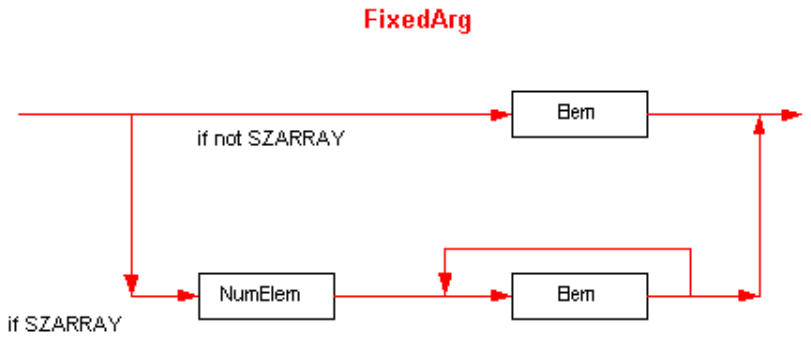
The format for each FixedArg depends upon whether that
argument is an SZARRAY or not – this is shown in the lower
and upper paths, respectively, of the syntax diagram. So each
FixedArg is either a single Elem, or NumElem
repeats of Elem.
(SZARRAY is the single byte 0x1D, and denotes a vector –
a single-dimension array with a lower bound of zero.)
NumElem is an unsigned int32 specifying the number
of elements in the SZARRAY, or 0xFFFFFFFF to indicate that
the value is null.
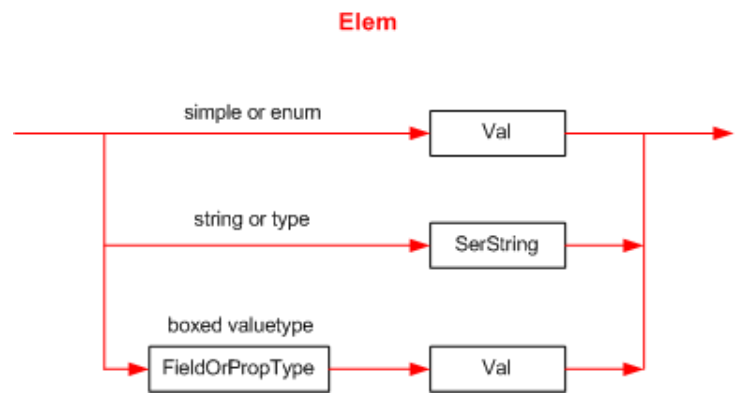
An Elem takes one of the forms in this diagram, as follows:
If the parameter kind is simple (first line in the above diagram) (bool, char, float32, float64, int8, int16, int32, int64, unsigned int8, unsigned int16, unsigned int32 or unsigned int64) then the 'blob' contains its binary value (Val). (A bool is a single byte with value 0 (false) or 1 (true); char is a two-byte Unicode character; and the others have their obvious meaning.) This pattern is also used if the parameter kind is an enum – simply store the value of the enum's underlying integer type.
If the parameter kind is string, (middle line in above diagram) then the blob contains a SerString – a PackedLen count of bytes, followed by the UTF8 characters. If the string is null, its PackedLen has the value 0xFF (with no following characters). If the string is empty (""), then PackedLen has the value 0x00 (with no following characters).
If the parameter kind is System.Type, (also, the
middle line in above diagram) its value is stored as a
SerString (as defined in the previous paragraph), representing
its canonical name. The canonical name is its full type name, followed
optionally by the assembly where it is defined, its version, culture and
public-key-token. If the assembly name is omitted, the CLI looks first
in the current assembly, and then in the system library
(mscorlib); in these two special cases, it is permitted to
omit the assembly-name, version, culture and public-key-token.
If the parameter kind is System.Object, (third line
in the above diagram) the value stored represents the "boxed" instance
of that value-type. In this case, the blob contains the actual type's
FieldOrPropType (see below), followed by the argument's unboxed
value. [Note: it is not possible to pass a value of null in
this case. end note]
If the type is a boxed simple value type (bool,
char, float32,
float64, int8, int16,
int32, int64, unsigned
int8, unsigned int16, unsigned
int32 or unsigned int64) then
FieldOrPropType is immediately preceded by a byte containing
the value 0x51 . The FieldOrPropType shall be exactly one of:
ELEMENT_TYPE_BOOLEAN, ELEMENT_TYPE_CHAR,
ELEMENT_TYPE_I1, ELEMENT_TYPE_U1,
ELEMENT_TYPE_I2, ELEMENT_TYPE_U2,
ELEMENT_TYPE_I4, ELEMENT_TYPE_U4,
ELEMENT_TYPE_I8, ELEMENT_TYPE_U8,
ELEMENT_TYPE_R4, ELEMENT_TYPE_R8,
ELEMENT_TYPE_STRING. A single-dimensional, zero-based array
is specified as a single byte 0x1D followed by the
FieldOrPropTypeof the element type. (See §II.23.1.16)
An enum is specified as a single byte 0x55 followed by a
SerString.
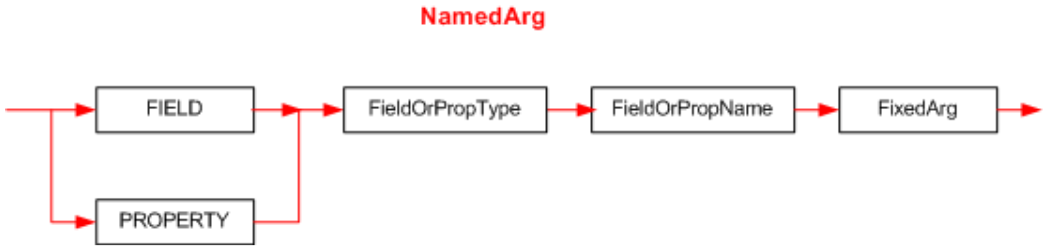
A NamedArg is simply a FixedArg (discussed above) preceded by information to identify which field or property it represents. [Note: Recall that the CLI allows fields and properties to have the same name; so we require a means to disambiguate such situations. end note]
FIELD is the single byte 0x53.
PROPERTY is the single byte 0x54.
The FieldOrPropName is the name of the field or property, stored as a SerString (defined above). A number of examples involving custom attributes are contained in Annex B of Partition VI.
A Marshalling Descriptor is like a signature – it's a 'blob' of
binary data. It describes how a field or parameter (which, as usual,
covers the method return, as parameter number 0) should be marshalled
when calling to or from unmanaged code via PInvoke dispatch. The ILAsm
syntax marshal can be used to create a marshalling
descriptor, as can the pseudo custom attribute
MarshalAsAttribute – see §II.21.2.1)
Note that a conforming implementation of the CLI need only support marshalling of the types specified earlier – see §II.15.5.4.
Marshalling descriptors make use of constants named
NATIVE_TYPE_xxx. Their names and values are listed in the
following table:
| Name | Value |
|---|---|
NATIVE_TYPE_BOOLEAN |
0x02 |
NATIVE_TYPE_I1 |
0x03 |
NATIVE_TYPE_U1 |
0x04 |
NATIVE_TYPE_I2 |
0x05 |
NATIVE_TYPE_U2 |
0x06 |
NATIVE_TYPE_I4 |
0x07 |
NATIVE_TYPE_U4 |
0x08 |
NATIVE_TYPE_I8 |
0x09 |
NATIVE_TYPE_U8 |
0x0a |
NATIVE_TYPE_R4 |
0x0b |
NATIVE_TYPE_R8 |
0x0c |
NATIVE_TYPE_LPSTR |
0x14 |
NATIVE_TYPE_LPWSTR |
0x15 |
NATIVE_TYPE_INT |
0x1f |
NATIVE_TYPE_UINT |
0x20 |
NATIVE_TYPE_FUNC |
0x26 |
NATIVE_TYPE_ARRAY |
0x2a |
The 'blob' has the following format
| MarshalSpec ::= |
|---|
| NativeIntrinsic |
| ARRAY ArrayElemType |
| ARRAY ArrayElemType ParamNum |
| ARRAY ArrayElemType ParamNum
NumElem |
| NativeIntrinsic ::= |
|---|
BOOLEAN | I1 | U1 |
I2 | U2 | I4 | U4 |
I8 | U8 | R4 | R8 |
LPSTR | LPSTR | INT |
UINT | FUNC |
For compactness, the NATIVE_TYPE_ prefixes have been
omitted in the above lists; for example, ARRAY is shorthand
for NATIVE_TYPE_ARRAY.
| ArrayElemType ::= |
|---|
| NativeIntrinsic |
ParamNum is an unsigned integer (compressed as described in §II.23.2) specifying the parameter in the method call that provides the number of elements in the array – see below.
NumElem is an unsigned integer (compressed as described in §II.23.2) specifying the number of elements or additional elements – see below.
[Note: For example, in the method declaration:
.method void M(int32[] ar1, int32 size1, unsigned int8[] ar2, int32 size2) { … }The ar1 parameter might own a row in the
FieldMarshal table, which indexes a MarshalSpec in the
Blob heap with the format:
ARRAY MAX 2 1This says the parameter is marshalled to a
NATIVE_TYPE_ARRAY. There is no additional info about the
type of each element (signified by that NATIVE_TYPE_MAX).
The value of ParamNum is 2, which indicates that parameter
number 2 in the method (the one called size1) will specify
the number of elements in the actual array – let's suppose its value on
a particular call is 42. The value of NumElem is 0. The
calculated total size, in bytes, of the array is given by the
formula:
if ParamNum = 0
   SizeInBytes = NumElem * sizeof (elem)
else
   SizeInBytes = ( @ParamNum +  NumElem ) * sizeof (elem)
endif
The syntax @ParamNum is used here to denote the value
passed in for parameter number ParamNum – it would be 42 in
this example. The size of each element is calculated from the metadata
for the ar1 parameter in Foo's signature – an
ELEMENT_TYPE_I4 (§II.23.1.16)
of size 4 bytes. end note]
The physical on-disk representation of metadata is a direct reflection of the logical representation described in §II.22 and §II.23. That is, data is stored in streams representating the metadata tables and heaps. The main complication is that, where the logical representation is abstracted from the number of bytes needed for indexing into tables and columns, the physical representation has to take care of that explicitly by defining how to map logical metadata heaps and tables into their physical representations.
Unless stated otherwise, all binary values are stored in little-endian format.
Complete CLI components (metadata and CIL instructions) are stored in a subset of the current Portable Executable (PE) File Format (§II.25). Because of this heritage, some of the fields in the physical representation of metadata have fixed values. When writing these fields it is best that they be set to the value indicated, on reading they should be ignored.
The root of the physical metadata starts with a magic signature, several bytes of version and other miscellaneous information, followed by a count and an array of stream headers, one for each stream that is present. The actual encoded tables and heaps are stored in the streams, which immediately follow this array of headers.
| Offset | Size | Field | Description |
|---|---|---|---|
| 0 | 4 | Signature | Magic signature for physical metadata: 0x424A5342. |
| 4 | 2 | MajorVersion | Major version, 1 (ignore on read) |
| 6 | 2 | MinorVersion | Minor version, 1 (ignore on read) |
| 8 | 4 | Reserved | Reserved, always 0 (§II.24.1). |
| 12 | 4 | Length | Number of bytes allocated to hold version string (including null
terminator), call this x. Call the length of the string (including the terminator) m (we require m ≤ 255); the length x is m rounded up to a multiple of four. |
| 16 | m | Version | UTF8-encoded null-terminated version string of length m (see above) |
| 16+m | x-m | Padding to next 4 byte boundary. | |
| 16+x | 2 | Flags | Reserved, always 0 (§II.24.1). |
| 16+x+2 | 2 | Streams | Number of streams, say n. |
| 16+x+4 | StreamHeaders | Array of n StreamHdr structures. |
The Version string shall be "Standard CLI 2005" for any
file that is intended to be executed on any conforming implementation of
the CLI, and all conforming implementations of the CLI shall accept
files that use this version string. Other strings shall be used when the
file is restricted to a vendor-specific implementation of the CLI.
Future versions of this standard shall specify different strings, but
they shall begin "Standard CLI". Other standards that
specify additional functionality shall specify their own specific
version strings beginning with "Standard□", where
"□" represents a single space. Vendors that provide
implementation-specific extensions shall provide a version string that
does not begin with "Standard□". (For the first version of
this Standard, the Version string was
"Standard CLI 2002".)
A stream header gives the names, and the position and length of a particular table or heap. Note that the length of a Stream header structure is not fixed, but depends on the length of its name field (a variable length null-terminated string).
| Offset | Size | Field | Description |
|---|---|---|---|
| 0 | 4 | Offset | Memory offset to start of this stream from start of the metadata root (§II.24.2.1) |
| 4 | 4 | Size | Size of this stream in bytes, shall be a multiple of 4. |
| 8 | Name | Name of the stream as null-terminated variable length array of ASCII
characters, padded to the next 4-byte boundary with \0
characters. The name is limited to 32 characters. |
Both logical tables and heaps are stored in streams. There are five
possible kinds of streams. A stream header with name
"#Strings" that points to the physical representation of
the string heap where identifier strings are stored; a stream header
with name "#US" that points to the physical representation
of the user string heap; a stream header with name "#Blob"
that points to the physical representation of the blob heap, a stream
header with name "#GUID" that points to the physical
representation of the GUID heap; and a stream header with name
"#~" that points to the physical representation of a set of
tables.
Each kind of stream shall occur at most once, that is, a meta-data
file shall not contain two "#US" streams, or five
"#Blob" streams. Streams need not be there if they are
empty.
The next subclauses describe the structure of each kind of stream in more detail.
The stream of bytes pointed to by a "#Strings" header is
the physical representation of the logical string heap. The physical
heap can contain garbage, that is, it can contain parts that are
unreachable from any of the tables, but parts that are reachable from a
table shall contain a valid null-terminated UTF8 string. When the
#Strings heap is present, the first entry is always the empty string
(i.e., \0).
The stream of bytes pointed to by a "#US" or
"#Blob" header are the physical representation of logical
Userstring and 'blob' heaps respectively. Both these heaps can contain
garbage, as long as any part that is reachable from any of the tables
contains a valid 'blob'. Individual blobs are stored with their length
encoded in the first few bytes:
If the first one byte of the 'blob' is 0bbbbbbb2, then the rest of the 'blob' contains the bbbbbbb2 bytes of actual data.
If the first two bytes of the 'blob' are 10bbbbbb2 and x, then the rest of the 'blob' contains the (bbbbbb2 << 8 + x) bytes of actual data.
If the first four bytes of the 'blob' are 110bbbbb2, x, y, and z, then the rest of the 'blob' contains the (bbbbb2 << 24 + x << 16 + y << 8 + z) bytes of actual data.
The first entry in both these heaps is the empty 'blob' that consists of the single byte 0x00.
Strings in the #US (user string) heap are encoded using 16-bit Unicode encodings. The count on each string is the number of bytes (not characters) in the string. Furthermore, there is an additional terminal byte (so all byte counts are odd, not even). This final byte holds the value 1 if and only if any UTF16 character within the string has any bit set in its top byte, or its low byte is any of the following: 0x01–0x08, 0x0E–0x1F, 0x27, 0x2D, 0x7F. Otherwise, it holds 0. The 1 signifies Unicode characters that require handling beyond that normally provided for 8-bit encoding sets.
The "#GUID" header points to a sequence of 128-bit
GUIDs. There might be unreachable GUIDs stored in the stream.
The "#~" streams contain the actual physical
representations of the logical metadata tables (§II.22). A
"#~" stream has the following top-level structure:
| Offset | Size | Field | Description |
|---|---|---|---|
| 0 | 4 | Reserved | Reserved, always 0 (§II.24.1). |
| 4 | 1 | MajorVersion | Major version of table schemata; shall be 2 (§II.24.1). |
| 5 | 1 | MinorVersion | Minor version of table schemata; shall be 0 (§II.24.1). |
| 6 | 1 | HeapSizes | Bit vector for heap sizes. |
| 7 | 1 | Reserved | Reserved, always 1 (§II.24.1). |
| 8 | 8 | Valid | Bit vector of present tables, let n be the number of bits that are 1. |
| 16 | 8 | Sorted | Bit vector of sorted tables. |
| 24 | 4*n | Rows | Array of n 4-byte unsigned integers indicating the number of rows for each present table. |
| 24+4*n | Tables | The sequence of physical tables. |
The HeapSizes field is a bitvector that encodes the width of
indexes into the various heaps. If bit 0 is set, indexes into the
"#Strings" heap are 4 bytes wide; if bit 1 is set, indexes
into the "#GUID" heap are 4 bytes wide; if bit 2 is set,
indexes into the "#Blob" heap are 4 bytes wide. Conversely,
if the HeapSizes bit for a particular heap is not set, indexes
into that heap are 2 bytes wide.
| Heap size flag | Description |
|---|---|
| 0x01 | Size of "#Strings" stream ≥ 216. |
| 0x02 | Size of "#GUID" stream ≥ 216. |
| 0x04 | Size of "#Blob" stream ≥ 216. |
The Valid field is a 64-bit bitvector that has a specific bit set for each table that is stored in the stream; the mapping of tables to indexes is given at the start of §II.22. For example when the DeclSecurity table is present in the logical metadata, bit 0x0e should be set in the Valid vector. It is invalid to include non-existent tables in Valid, so all bits above 0x2c shall be zero.
The Rows array contains the number of rows for each of the tables that are present. When decoding physical metadata to logical metadata, the number of 1's in Valid indicates the number of elements in the Rows array.
A crucial aspect in the encoding of a logical table is its schema. The schema for each table is given in §II.22. For example, the table with assigned index 0x02 is a TypeDef table, which, according to its specification in §II.22.37, has the following columns: a 4-byte-wide flags, an index into the String heap, another index into the String heap, an index into TypeDef, TypeRef, or TypeSpec table, an index into Field table, and an index into MethodDef table.
The physical representation of a table with n columns and m rows with schema (C0,…,Cn-1) consists of the concatenation of the physical representation of each of its rows. The physical representation of a row with schema (C0,…,Cn-1) is the concatenation of the physical representation of each of its elements. The physical representation of a row cell e at a column with type C is defined as follows:
If e is a constant, it is stored using the number of bytes as specified for its column type C (i.e., a 2-bit mask of type PropertyAttributes)
If e is an index into the GUID heap, 'blob', or String heap, it is stored using the number of bytes as defined in the HeapSizes field.
If e is a simple index into a table with index i, it is stored using 2 bytes if table i has less than 216 rows, otherwise it is stored using 4 bytes.
If e is a coded index that points into table ti out of n possible tables t0,…tn-1, then it is stored as e << (log n) | tag{ t0,…tn-1 }[ ti ] using 2 bytes if the maximum number of rows of tables t0,…tn-1, is less than 2(16 – (log n)), and using 4 bytes otherwise. The family of finite maps tag{ t0,…tn-1 } is defined below. Note that decoding a physical row requires the inverse of this mapping. [For example, the Parent column of the Constant table indexes a row in the Field, Param, or Property tables. The actual table is encoded into the low 2 bits of the number, using the values: 0 => Field, 1 => Param, 2 => Property. The remaining bits hold the actual row number being indexed. For example, a value of 0x321, indexes row number 0xC8 in the Param table.]
| TypeDefOrRef: 2 bits to encode tag | Tag |
|---|---|
TypeDef |
0 |
TypeRef |
1 |
TypeSpec |
2 |
| HasConstant: 2 bits to encode tag | Tag |
|---|---|
Field |
0 |
Param |
1 |
Property |
2 |
| HasCustomAttribute: 5 bits to encode tag | Tag |
|---|---|
MethodDef |
0 |
Field |
1 |
TypeRef |
2 |
TypeDef |
3 |
Param |
4 |
InterfaceImpl |
5 |
MemberRef |
6 |
Module |
7 |
Permission |
8 |
Property |
9 |
Event |
10 |
StandAloneSig |
11 |
ModuleRef |
12 |
TypeSpec |
13 |
Assembly |
14 |
AssemblyRef |
15 |
File |
16 |
ExportedType |
17 |
ManifestResource |
18 |
GenericParam |
19 |
GenericParamConstraint |
20 |
MethodSpec |
21 |
[Note: HasCustomAttributes only has values for tables that are "externally visible"; that is, that correspond to items in a user source program. For example, an attribute can be attached to a TypeDef table and a Field table, but not a ClassLayout table. As a result, some table types are missing from the enum above. end note]
| HasFieldMarshall: 1 bit to encode tag | Tag |
|---|---|
Field |
0 |
Param |
1 |
| HasDeclSecurity: 2 bits to encode tag | Tag |
|---|---|
TypeDef |
0 |
MethodDef |
1 |
Assembly |
2 |
| MemberRefParent: 3 bits to encode tag | Tag |
|---|---|
TypeDef |
0 |
TypeRef |
1 |
ModuleRef |
2 |
MethodDef |
3 |
TypeSpec |
4 |
| HasSemantics: 1 bit to encode tag | Tag |
|---|---|
Event |
0 |
Property |
1 |
| MethodDefOrRef: 1 bit to encode tag | Tag |
|---|---|
MethodDef |
0 |
MemberRef |
1 |
| MemberForwarded: 1 bit to encode tag | Tag |
|---|---|
Field |
0 |
MethodDef |
1 |
| Implementation: 2 bits to encode tag | Tag |
|---|---|
File |
0 |
AssemblyRef |
1 |
ExportedType |
2 |
| CustomAttributeType: 3 bits to encode tag | Tag |
|---|---|
| Not used | 0 |
| Not used | 1 |
MethodDef |
2 |
MemberRef |
3 |
| Not used | 4 |
| ResolutionScope: 2 bits to encode tag | Tag |
|---|---|
Module |
0 |
ModuleRef |
1 |
AssemblyRef |
2 |
TypeRef |
3 |
| TypeOrMethodDef: 1 bit to encode tag | Tag |
|---|---|
TypeDef |
0 |
MethodDef |
1 |
This contains informative text only.
The file format for CLI components is a strict extension of the current Portable Executable (PE) File Format. This extended PE format enables the operating system to recognize runtime images, accommodates code emitted as CIL or native code, and accommodates runtime metadata as an integral part of the emitted code. There are also specifications for a subset of the full Windows PE/COFF file format, in sufficient detail that a tool or compiler can use the specifications to emit valid CLI images.
The PE format frequently uses the term RVA (Relative Virtual Address). An RVA is the address of an item once loaded into memory, with the base address of the image file subtracted from it (i.e., the offset from the base address where the file is loaded). The RVA of an item will almost always differ from its position within the file on disk. To compute the file position of an item with RVA r, search all the sections in the PE file to find the section with RVA s, length l and file position p in which the RVA lies, ie s ≤ r < s+l. The file position of the item is then given by p+(r-s).
Unless stated otherwise, all binary values are stored in little-endian format.
End informative text.
The figure below provides a high-level view of the CLI file format. All runtime images contain the following:
PE headers, with specific guidelines on how field values should be set in a runtime file.
A CLI header that contains all of the runtime specific data entries. The runtime header is read-only and shall be placed in any read-only section.
The sections that contain the actual data as described by the headers, including imports/exports, data, and code.
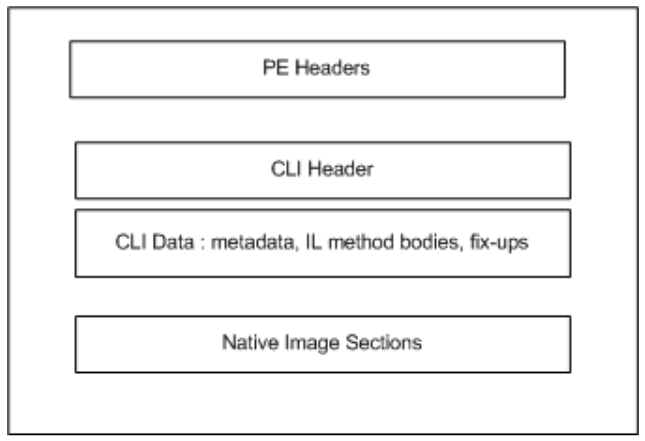
The CLI header (§II.25.3.3) is found using CLI Header directory entry in the PE header. The CLI header in turn contains the address and sizes of the runtime data (for metadata, see §II.24; for CIL see §II.25.4) in the rest of the image. Note that the runtime data can be merged into other areas of the PE format with the other data based on the attributes of the sections (such as read only versus execute, etc.).
A PE image starts with an MS-DOS header followed by a PE signature, followed by the PE file header, and then the PE optional header followed by PE section headers.
The PE format starts with an MS-DOS stub of exactly the following 128
bytes to be placed at the front of the module. At offset 0x3c in the DOS
header is a 4-byte unsigned integer offset, lfanew, to the PE
signature (shall be "PE\0\0"), immediately followed by the
PE file header.
| 0x4d | 0x5a | 0x90 | 0x00 | 0x03 | 0x00 | 0x00 | 0x00 |
| 0x04 | 0x00 | 0x00 | 0x00 | 0xFF | 0xFF | 0x00 | 0x00 |
| 0xb8 | 0x00 | 0x00 | 0x00 | 0x00 | 0x00 | 0x00 | 0x00 |
| 0x40 | 0x00 | 0x00 | 0x00 | 0x00 | 0x00 | 0x00 | 0x00 |
| 0x00 | 0x00 | 0x00 | 0x00 | 0x00 | 0x00 | 0x00 | 0x00 |
| 0x00 | 0x00 | 0x00 | 0x00 | 0x00 | 0x00 | 0x00 | 0x00 |
| 0x00 | 0x00 | 0x00 | 0x00 | 0x00 | 0x00 | 0x00 | 0x00 |
| 0x00 | 0x00 | 0x00 | 0x00 | lfanew | |||
| 0x0e | 0x1f | 0xba | 0x0e | 0x00 | 0xb4 | 0x09 | 0xcd |
| 0x21 | 0xb8 | 0x01 | 0x4c | 0xcd | 0x21 | 0x54 | 0x68 |
| 0x69 | 0x73 | 0x20 | 0x70 | 0x72 | 0x6f | 0x67 | 0x72 |
| 0x61 | 0x6d | 0x20 | 0x63 | 0x61 | 0x6e | 0x6e | 0x6f |
| 0x74 | 0x20 | 0x62 | 0x65 | 0x20 | 0x72 | 0x75 | 0x6e |
| 0x20 | 0x69 | 0x6e | 0x20 | 0x44 | 0x4f | 0x53 | 0x20 |
| 0x6d | 0x6f | 0x64 | 0x65 | 0x2e | 0x0d | 0x0d | 0x0a |
| 0x24 | 0x00 | 0x00 | 0x00 | 0x00 | 0x00 | 0x00 | 0x00 |
Immediately after the PE signature is the PE File header consisting of the following:
| Offset | Size | Field | Description |
|---|---|---|---|
| 0 | 2 | Machine | Always 0x14c. |
| 2 | 2 | Number of Sections | Number of sections; indicates size of the Section Table, which immediately follows the headers. |
| 4 | 4 | Time/Date Stamp | Time and date the file was created in seconds since January 1st 1970 00:00:00 or 0. |
| 8 | 4 | Pointer to Symbol Table | Always 0 (§II.24.1). |
| 12 | 4 | Number of Symbols | Always 0 (§II.24.1). |
| 16 | 2 | Optional Header Size | Size of the optional header, the format is described below. |
| 18 | 2 | Characteristics | Flags indicating attributes of the file, see §II.25.2.2.1. |
A CIL-only DLL sets flag 0x2000 to 1, while a CIL-only
.exe has flag 0x2000 set to zero:
| Flag | Value | Description |
|---|---|---|
IMAGE_FILE_RELOCS_STRIPPED |
0x0001 | Shall be zero |
IMAGE_FILE_EXECUTABLE_IMAGE |
0x0002 | Shall be one |
IMAGE_FILE_32BIT_MACHINE |
0x0100 | Shall be one if and only if
COMIMAGE_FLAGS_32BITREQUIRED is one (§25.3.3.1) |
IMAGE_FILE_DLL |
0x2000 | The image file is a dynamic-link library (DLL). |
For the flags not mentioned above, flags 0x0010, 0x0020, 0x0400 and 0x0800 are implementationspecific, and all others should be zero (§II.24.1).
Immediately after the PE Header is the PE Optional Header. This header contains the following information:
| Offset | Size | Header part | Description |
|---|---|---|---|
| 0 | 28 | Standard fields | These define general properties of the PE file, see §II.25.2.3.1. |
| 28 | 68 | NT-specific fields | These include additional fields to support specific features of Windows, see §II.25.2.3.2. |
| 96 | 128 | Data directories | These fields are address/size pairs for special tables, found in the image file (for example, Import Table and Export Table). |
These fields are required for all PE files and contain the following information:
| Offset | Size | Field | Description |
|---|---|---|---|
| 0 | 2 | Magic | Always 0x10B. |
| 2 | 1 | LMajor | Always 6 (§II.24.1). |
| 3 | 1 | LMinor | Always 0 (§II.24.1). |
| 4 | 4 | Code Size | Size of the code (text) section, or the sum of all code sections if there are multiple sections. |
| 8 | 4 | Initialized Data Size | Size of the initialized data section, or the sum of all such sections if there are multiple data sections. |
| 12 | 4 | Uninitialized Data Size | Size of the uninitialized data section, or the sum of all such sections if there are multiple unitinitalized data sections. |
| 16 | 4 | Entry Point RVA | RVA of entry point, needs to point to bytes 0xFF 0x25 followed by the RVA in a section marked execute/read for EXEs or 0 for DLLs |
| 20 | 4 | Base Of Code | RVA of the code section. (This is a hint to the loader.) |
| 24 | 4 | Base Of Data | RVA of the data section. (This is a hint to the loader.) |
This contains informative text only.
The entry point RVA shall always be either the x86 entry point stub
or be 0. On non-CLI aware platforms, this stub will call the entry point
API of mscoree (_CorExeMain or
_CorDllMain). The mscoree entry point will use
the module handle to load the metadata from the image, and invoke the
entry point specified in the CLI header.
End informative text.
These fields are Windows NT specific:
| Offset | Size | Field | Description |
|---|---|---|---|
| 28 | 4 | Image Base | Shall be a multiple of 0x10000. |
| 32 | 4 | Section Alignment | Shall be greater than File Alignment. |
| 36 | 4 | File Alignment | Should be 0x200 (§II.24.1). |
| 40 | 2 | OS Major | Should be 5 (§II.24.1). |
| 42 | 2 | OS Minor | Should be 0 (§II.24.1). |
| 44 | 2 | User Major | Should be 0 (§II.24.1). |
| 46 | 2 | User Minor | Should be 0 (§II.24.1). |
| 48 | 2 | SubSys Major | Should be 5 (§II.24.1). |
| 50 | 2 | SubSys Minor | Should be 0 (§II.24.1). |
| 52 | 4 | Reserved | Shall be zero |
| 56 | 4 | Image Size | Size, in bytes, of image, including all headers and padding; shall be a multiple of Section Alignment. |
| 60 | 4 | Header Size | Combined size of MS-DOS Header, PE Header, PE Optional Header and padding; shall be a multiple of the file alignment. |
| 64 | 4 | File Checksum | Should be 0 (§II.24.1). |
| 68 | 2 | SubSystem | Subsystem required to run this image. Shall be either
IMAGE_SUBSYSTEM_WINDOWS_CUI (0x3) or
IMAGE_SUBSYSTEM_WINDOWS_GUI (0x2). |
| 70 | 2 | DLL Flags | Bits 0x100f shall be zero. |
| 72 | 4 | Stack Reserve Size | Should be 0x100000 (1Mb) (§II.24.1). |
| 76 | 4 | Stack Commit Size | Should be 0x1000 (4Kb) (§II.24.1). |
| 80 | 4 | Heap Reserve Size | Should be 0x100000 (1Mb) (§II.24.1). |
| 84 | 4 | Heap Commit Size | Should be 0x1000 (4Kb) (§II.24.1). |
| 88 | 4 | Loader Flags | Shall be 0 |
| 92 | 4 | Number of Data Directories | Shall be 0x10 |
The optional header data directories give the address and size of several tables that appear in the sections of the PE file. Each data directory entry contains the RVA and Size of the structure it describes, in that order.
| Offset | Size | Field | Description |
|---|---|---|---|
| 96 | 8 | Export Table | Always 0 (§II.24.1). |
| 104 | 8 | Import Table | RVA and Size of Import Table, (§II.25.3.1). |
| 112 | 8 | Resource Table | Always 0 (§II.24.1). |
| 120 | 8 | Exception Table | Always 0 (§II.24.1). |
| 128 | 8 | Certificate Table | Always 0 (§II.24.1). |
| 136 | 8 | Base Relocation Table | Relocation Table; set to 0 if unused (§). |
| 144 | 8 | Debug | Always 0 (§II.24.1). |
| 152 | 8 | Copyright | Always 0 (§II.24.1). |
| 160 | 8 | Global Ptr | Always 0 (§II.24.1). |
| 168 | 8 | TLS Table | Always 0 (§II.24.1). |
| 176 | 8 | Load Config Table | Always 0 (§II.24.1). |
| 184 | 8 | Bound Import | Always 0 (§II.24.1). |
| 192 | 8 | IAT | RVA and Size of Import Address Table, (§II.25.3.1). |
| 200 | 8 | Delay Import Descriptor | Always 0 (§II.24.1). |
| 208 | 8 | CLI Header | CLI Header with directories for runtime data, (§II.25.3.1). |
| 216 | 8 | Reserved | Always 0 (§II.24.1). |
The tables pointed to by the directory entries are stored in one of the PE file's sections; these sections themselves are described by section headers.
Immediately following the optional header is the Section Table, which contains a number of section headers. This positioning is required because the file header does not contain a direct pointer to the section table; the location of the section table is determined by calculating the location of the first byte after the headers.
Each section header has the following format, for a total of 40 bytes per entry:
| Offset | Size | Field | Description |
|---|---|---|---|
| 0 | 8 | Name | An 8-byte, null-padded ASCII string. There is no terminating null if the string is exactly eight characters long. |
| 8 | 4 | VirtualSize | Total size of the section in bytes. If this value is greater than SizeOfRawData, the section is zero-padded. |
| 12 | 4 | VirtualAddress | For executable images this is the address of the first byte of the section, when loaded into memory, relative to the image base. |
| 16 | 4 | SizeOfRawData | Size of the initialized data on disk in bytes, shall be a multiple of FileAlignment from the PE header. If this is less than VirtualSize the remainder of the section is zero filled. Because this field is rounded while the VirtualSize field is not it is possible for this to be greater than VirtualSize as well. When a section contains only uninitialized data, this field should be 0. |
| 20 | 4 | PointerToRawData | Offset of section's first page within the PE file. This shall be a multiple of FileAlignment from the optional header. When a section contains only uninitialized data, this field should be 0. |
| 24 | 4 | PointerToRelocations | Should be 0 (§II.24.1). |
| 28 | 4 | PointerToLinenumbers | Should be 0 (§II.24.1). |
| 32 | 2 | NumberOfRelocations | Should be 0 (§II.24.1). |
| 34 | 2 | NumberOfLinenumbers | Should be 0 (§II.24.1). |
| 36 | 4 | Characteristics | Flags describing section's characteristics; see below. |
The following table defines the possible characteristics of the section.
| Flag | Value | Description |
|---|---|---|
IMAGE_SCN_CNT_CODE |
0x00000020 | Section contains code. |
IMAGE_SCN_CNT_INITIALIZED_DATA |
0x00000040 | Section contains initialized data. |
IMAGE_SCN_CNT_UNINITIALIZED_DATA |
0x00000080 | Section contains uninitialized data. |
IMAGE_SCN_MEM_EXECUTE |
0x20000000 | Section can be executed as code. |
IMAGE_SCN_MEM_READ |
0x40000000 | Section can be read. |
IMAGE_SCN_MEM_WRITE |
0x80000000 | Section can be written to. |
The Import Table and the Import Address Table (IAT) are used to
import the _CorExeMain (for a .exe) or
_CorDllMain (for a .dll) entries of the
runtime engine (mscoree.dll). The Import Table directory
entry points to a one element zero terminated array of Import Directory
entries (in a general PE file there is one entry for each imported
DLL):
| Offset | Size | Field | Description |
|---|---|---|---|
| 0 | 4 | ImportLookupTable | RVA of the Import Lookup Table |
| 4 | 4 | DateTimeStamp | Always 0 (§II.24.1). |
| 8 | 4 | ForwarderChain | Always 0 (§II.24.1). |
| 12 | 4 | Name | RVA of null-terminated ASCII string "mscoree.dll". |
| 16 | 4 | ImportAddressTable | RVA of Import Address Table (this is the same as the RVA of the IAT descriptor in the optional header). |
| 20 | 20 | End of Import Table. Shall be filled with zeros. |
The Import Lookup Table and the Import Address Table (IAT) are both one element, zero terminated arrays of RVAs into the Hint/Name table. Bit 31 of the RVA shall be set to 0. In a general PE file there is one entry in this table for every imported symbol.
| Offset | Size | Field | Description |
|---|---|---|---|
| 0 | 4 | Hint/Name Table RVA | A 31-bit RVA into the Hint/Name Table. Bit 31 shall be set to 0 indicating import by name. |
| 4 | 4 | End of table, shall be filled with zeros. |
The IAT should be in an executable and writable section as the loader will replace the pointers into the Hint/Name table by the actual entry points of the imported symbols.
The Hint/Name table contains the name of the dll-entry that is imported.
| Offset | Size | Field | Description |
|---|---|---|---|
| 0 | 2 | Hint | Shall be 0. |
| 2 | variable | Name | Case sensitive, null-terminated ASCII string containing name to
import. Shall be "_CorExeMain" for a .exe file
and "_CorDllMain" for a .dll file. |
In a pure CIL image, a single fixup of type
IMAGE_REL_BASED_HIGHLOW (0x3) is required for the x86
startup stub which access the IAT to load the runtime engine on down
level loaders. When building a mixed CIL/native image or when the image
contains embedded RVAs in user data, the relocation section contains
relocations for these as well.
The relocations shall be in their own section, named
".reloc", which shall be the final section in the PE file.
The relocation section contains a Fixup Table. The fixup table is broken
into blocks of fixups. Each block represents the fixups for a 4K page,
and each block shall start on a 32-bit boundary.
Each fixup block starts with the following structure:
| Offset | Size | Field | Description |
|---|---|---|---|
| 0 | 4 | PageRVA | The RVA of the block in which the fixup needs to be applied. The low 12 bits shall be zero. |
| 4 | 4 | Block Size | Total number of bytes in the fixup block, including the Page RVA and Block Size fields, as well as the Type/Offset fields that follow, rounded up to the next multiple of 4. |
The Block Size field is then followed by (BlockSize - 8)/2 Type/Offset. Each entry is a word (2 bytes) and has the following structure (if necessary, insert 2 bytes of 0 to pad to a multiple of 4 bytes in length):
| Offset | Size | Field | Description |
|---|---|---|---|
| 0 | 4 bits | Type | Stored in high 4 bits of word. Value indicating which type of fixup is to be applied (described above) |
| 0 | 12 bits | Offset | Stored in remaining 12 bits of word. Offset from starting address specified in the Page RVA field for the block. This offset specifies where the fixup is to be applied. |
The CLI header contains all of the runtime-specific data entries and other information. The header should be placed in a read-only, sharable section of the image. This header is defined as follows:
| Offset | Size | Field | Description |
|---|---|---|---|
| 0 | 4 | Cb | Size of the header in bytes |
| 4 | 2 | MajorRuntimeVersion | The minimum version of the runtime required to run this program, currently 2. |
| 6 | 2 | MinorRuntimeVersion | The minor portion of the version, currently 0. |
| 8 | 8 | MetaData | RVA and size of the physical metadata (§II.24). |
| 16 | 4 | Flags | Flags describing this runtime image. (§II.25.3.3.1). |
| 20 | 4 | EntryPointToken | Token for the MethodDef or File of the entry point for the image |
| 24 | 8 | Resources | RVA and size of implementation-specific resources. |
| 32 | 8 | StrongNameSignature | RVA of the hash data for this PE file used by the CLI loader for binding and versioning |
| 40 | 8 | CodeManagerTable | Always 0 (§II.24.1). |
| 48 | 8 | VTableFixups | RVA of an array of locations in the file that contain an array of function pointers (e.g., vtable slots), see below. |
| 56 | 8 | ExportAddressTableJumps | Always 0 (§II.24.1). |
| 64 | 8 | ManagedNativeHeader | Always 0 (§II.24.1). |
The following flags describe this runtime image and are used by the loader. All unspecified bits should be zero.
| Flag | Value | Description |
|---|---|---|
COMIMAGE_FLAGS_ILONLY |
0x00000001 | Shall be 1. |
COMIMAGE_FLAGS_32BITREQUIRED |
0x00000002 | Image can only be loaded into a 32-bit process, for instance if
there are 32-bit vtablefixups, or casts from
native integers to int32. CLI implementations
that have 64-bit native integers shall refuse loading binaries with this
flag set. |
COMIMAGE_FLAGS_STRONGNAMESIGNED |
0x00000008 | Image has a strong name signature. |
COMIMAGE_FLAGS_NATIVE_ENTRYPOINT |
0x00000010 | Shall be 0. |
COMIMAGE_FLAGS_TRACKDEBUGDATA |
0x00010000 | Should be 0 (§II.24.1). |
Certain languages, which choose not to follow the common type system runtime model, can have virtual functions which need to be represented in a v-table. These v-tables are laid out by the compiler, not by the runtime. Finding the correct v-table slot and calling indirectly through the value held in that slot is also done by the compiler. The VtableFixups field in the runtime header contains the location and size of an array of Vtable Fixups (§II.15.5.1). V-tables shall be emitted into a read-write section of the PE file.
Each entry in this array describes a contiguous array of v-table slots of the specified size. Each slot starts out initialized to the metadata token value for the method they need to call. At image load time, the runtime Loader will turn each entry into a pointer to machine code for the CPU and can be called directly.
| Offset | Size | Field | Description |
|---|---|---|---|
| 0 | 4 | VirtualAddress | RVA of Vtable |
| 4 | 2 | Size | Number of entries in Vtable |
| 6 | 2 | Type | Type of the entries, as defined in table below |
| Constant | Value | Description |
|---|---|---|
COR_VTABLE_32BIT |
0x01 | Vtable slots are 32 bits. |
COR_VTABLE_64BIT |
0x02 | Vtable slots are 64 bits. |
COR_VTABLE_FROM_UNMANAGED |
0x04 | Transition from unmanaged to managed code. |
COR_VTABLE_CALL_MOST_DERIVED |
0x10 | Call most derived method described by the token (only valid for virtual methods). |
This header entry points to the strong name hash for an image that can be used to deterministically identify a module from a referencing point (§II.6.2.1.3).
This section contains the layout of the data structures used to describe a CIL method and its exceptions. Method bodies can be stored in any read-only section of a PE file. The MethodDef (§II.22.26) records in metadata carry each method's RVA.
A method consists of a method header immediately followed by the
method body, possibly followed by extra method data sections (§II.25.4.5), typically
exception handling data. If exception-handling data is present, then
CorILMethod_MoreSects flag (§II.25.4.4) shall be
specified in the method header and for each chained item after that.
There are two flavors of method headers – tiny (§II.25.4.2) and fat (§II.25.4.3). The two least significant bits in a method header indicate which type is present (§II.25.4.1). The tiny header is 1 byte long and stores only the method's code size. A method is given a tiny header if it has no local variables, maxstack is 8 or less, the method has no exceptions, the method size is less than 64 bytes, and the method has no flags above 0x7. Fat headers carry full information – local vars signature token, maxstack, code size, flag. Tiny method headers can start on any byte boundary. Fat method headers shall start on a 4-byte boundary.
The two least significant bits of the first byte of the method header indicate what type of header is present. These 2 bits will be one and only one of the following:
| Value | Value | Description |
|---|---|---|
CorILMethod_TinyFormat |
0x2 | The method header is tiny (§II.25.4.2). |
CorILMethod_FatFormat |
0x3 | The method header is fat (§II.25.4.3). |
Tiny headers use a 6-bit length encoding. The following is true for all tiny headers:
No local variables are allowed
No exceptions
No extra data sections
The operand stack shall be no bigger than 8 entries
A Tiny Format header is encoded as follows:
| Start bit | Count of Bits | Description |
|---|---|---|
| 0 | 2 | Flags (CorILMethod_TinyFormat shall be set, see §II.25.4.4). |
| 2 | 6 | Size, in bytes, of the method body immediately following this header. |
The fat format is used whenever the tiny format is not sufficient. This can be true for one or more of the following reasons:
The method is too large to encode the size (i.e., at least 64 bytes)
There are exceptions
There are extra data sections
There are local variables
The operand stack needs more than 8 entries
A fat header has the following structure
| Offset | Size | Field | Description |
|---|---|---|---|
| 0 | 12 (bits) | Flags | Flags (CorILMethod_FatFormat shall be set in bits 0:1,
see §II.25.4.4) |
| 12 (bits) | 4 (bits) | Size | Size of this header expressed as the count of 4-byte integers occupied (currently 3) |
| 2 | 2 | MaxStack | Maximum number of items on the operand stack |
| 4 | 4 | CodeSize | Size in bytes of the actual method body |
| 8 | 4 | LocalVarSigTok | Meta Data token for a signature describing the layout of the local variables for the method. 0 means there are no local variables present |
The first byte of a method header can also contain the following flags, valid only for the Fat format, that indicate how the method is to be executed:
| Flag | Value | Description |
|---|---|---|
CorILMethod_FatFormat |
0x3 | Method header is fat. |
CorILMethod_TinyFormat |
0x2 | Method header is tiny. |
CorILMethod_MoreSects |
0x8 | More sections follow after this header (§II.25.4.5). |
CorILMethod_InitLocals |
0x10 | Call default constructor on all local variables. |
At the next 4-byte boundary following the method body can be extra method data sections. These method data sections start with a two byte header (1 byte for flags, 1 byte for the length of the actual data) or a 4-byte header (1 byte for flags, and 3 bytes for length of the actual data). The first byte determines the kind of the header, and what data is in the actual section:
| Flag | Value | Description |
|---|---|---|
CorILMethod_Sect_EHTable |
0x1 | Exception handling data. |
CorILMethod_Sect_OptILTable |
0x2 | Reserved, shall be 0. |
CorILMethod_Sect_FatFormat |
0x40 | Data format is of the fat variety, meaning there is a 3-byte length least-significant byte first format. If not set, the header is small with a 1-byte length |
CorILMethod_Sect_MoreSects |
0x80 | Another data section occurs after this current section |
Currently, the method data sections are only used for exception tables (§II.19). The layout of a small exception header structure as is a follows:
| Offset | Size | Field | Description |
|---|---|---|---|
| 0 | 1 | Kind | Flags as described above. |
| 1 | 1 | DataSize | Size of the data for the block, including the header, say n*12+4. |
| 2 | 2 | Reserved | Padding, always 0. |
| 4 | n | Clauses | n small exception clauses (§II.25.4.6). |
The layout of a fat exception header structure is as follows:
| Offset | Size | Field | Description |
|---|---|---|---|
| 0 | 1 | Kind | Which type of exception block is being used |
| 1 | 3 | DataSize | Size of the data for the block, including the header, say n*24+4. |
| 4 | n | Clauses | n fat exception clauses (§II.25.4.6). |
Exception handling clauses also come in small and fat versions.
The small form of the exception clause should be used whenever the code sizes for the try block and the handler code are both smaller than 256 bytes and both their offsets are smaller than 65536. The format for a small exception clause is as follows:
| Offset | Size | Field | Description |
|---|---|---|---|
| 0 | 2 | Flags | Flags, see below. |
| 2 | 2 | TryOffset | Offset in bytes of try block from start of method body. |
| 4 | 1 | TryLength | Length in bytes of the try block |
| 5 | 2 | HandlerOffset | Location of the handler for this try block |
| 7 | 1 | HandlerLength | Size of the handler code in bytes |
| 8 | 4 | ClassToken | Meta data token for a type-based exception handler |
| 8 | 4 | FilterOffset | Offset in method body for filter-based exception handler |
The layout of the fat form of exception handling clauses is as follows:
| Offset | Size | Field | Description |
|---|---|---|---|
| 0 | 4 | Flags | Flags, see below. |
| 4 | 4 | TryOffset | Offset in bytes of try block from start of method body. |
| 8 | 4 | TryLength | Length in bytes of the try block |
| 12 | 4 | HandlerOffset | Location of the handler for this try block |
| 16 | 4 | HandlerLength | Size of the handler code in bytes |
| 20 | 4 | ClassToken | Meta data token for a type-based exception handler |
| 20 | 4 | FilterOffset | Offset in method body for filter-based exception handler |
The following flag values are used for each exception-handling clause:
| Flag | Value | Description |
|---|---|---|
COR_ILEXCEPTION_CLAUSE_EXCEPTION |
0x0000 | A typed exception clause |
COR_ILEXCEPTION_CLAUSE_FILTER |
0x0001 | An exception filter and handler clause |
COR_ILEXCEPTION_CLAUSE_FINALLY |
0x0002 | A finally clause |
COR_ILEXCEPTION_CLAUSE_FAULT |
0x0004 | Fault clause (finally that is called on exception only) |
This partition is a detailed description of the Common Intermediate Language (CIL) instruction set, part of the specification of the CLI. Partition I describes the architecture of the CLI and provides an overview of a large number of issues relating to the CIL instruction set. That overview is essential to an understanding of the instruction set as described here.
In this partition, each instruction is described in its own subclause, one per page. Related CLI machine instructions are described together. Each instruction description consists of the following parts:
A table describing the binary format, assembly language notation, and description of each variant of the instruction. See §III.1.2.
A stack transition diagram, that describes the state of the evaluation stack before and after the instruction is executed. (See §III.1.3.)
An English description of the instruction. See §III.1.4.
A list of exceptions that might be thrown by the instruction. (See Partition I for details.) There are three exceptions which can be thrown by any instruction and are not listed with the instruction:
System.ExecutionEngineException: indicates that the
internal state of the Execution Engine is corrupted and execution cannot
continue. In a system that executes only verifiable code this exception
is not thrown.
System.StackOverflowException: indicates that the
hardware stack size has been exceeded. The precise timing of this
exception and the conditions under which it occurs are
implementation-specific. [Note: this exception is unrelated to
the maximum stack size described in §III.1.7.4. That size
relates to the depth of the evaluation stack that is part of the method
state described in Partition I,
while this exception has to do with the implementation of that method
state on physical hardware.]
System.OutOfMemoryException: indicates that the
available memory space has been exhausted, either because the
instruction inherently allocates memory (newobj,
newarr) or for an implementation-specific reason (e.g., an
implementation based on JIT compilation to native code can run out of
space to store the translated method while executing the first call or
callvirt to a given method).
A section describing the verifiability conditions associated with the instruction. See §III.1.8.
In addition, operations that have a numeric operand also specify an operand type table that describes how they operate based on the type of the operand. See §III.1.5.
Note that not all instructions are included in all CLI Profiles. See Partition IV for details.
While the CTS defines a rich type system and the CLS specifies a subset that can be used for language interoperability, the CLI itself deals with a much simpler set of types. These types include user-defined value types and a subset of the built-in types. The subset, collectively called the "basic CLI types", contains the following types:
A subset of the full numeric types (int32,
int64, native int, and
F).
Object references (O) without distinction between
the type of object referenced.
Pointer types (native unsigned int and
&) without distinction as to the type pointed
to.
Note that object references and pointer types can be assigned the
value null. This is defined throughout the CLI to be zero
(a bit pattern of all-bits-zero).
[Note: As far as VES operations on the evaluation stack are concerned, there is only one floatingpoint type, and the VES does not care about its size. The VES makes the distinction about the size of numerical values only when storing these values to, or reading from, the heap, statics, local variables, or method arguments. end note]
The CLI only operates on the numeric types int32
(4-byte signed integers), int64 (8-byte signed integers),
native int (native-size integers), and F
(native-size floating-point numbers). However, the CIL instruction set
allows additional data types to be implemented:
Short integers: The evaluation stack only holds 4- or 8-byte integers, but other locations (arguments, local variables, statics, array elements, fields) can hold 1- or 2-byte integers. For the purpose of stack operations the bool (§III.1.1.2) and char types are treated as unsigned 1-byte and 2-byte integers respectively. Loading from these locations onto the stack converts them to 4-byte values by:
zero-extending for types unsigned int8,
unsigned int16, bool and
char;
sign-extending for types int8 and
int16;
zero-extends for unsigned indirect and element loads
(ldind.u*, ldelem.u*, etc.); and
sign-extends for signed indirect and element loads
(ldind.i*, ldelem.i*, etc.)
Storing to integers, booleans, and characters (stloc,
stfld, stind.i1, stelem.i2, etc.)
truncates. Use the conv.ovf.* instructions to detect when
this truncation results in a value that doesn't correctly represent the
original value.
[Note: Short (i.e., 1- and 2-byte) integers are loaded as
4-byte numbers on all architectures and these 4-byte numbers are always
tracked as distinct from 8-byte numbers. This helps portability of code
by ensuring that the default arithmetic behavior (i.e., when no
conv or conv.ovf instruction is executed) will
have identical results on all implementations. end note]
Convert instructions that yield short integer values actually leave
an int32 (32-bit) value on the stack, but it is guaranteed
that only the low bits have meaning (i.e., the more significant bits are
all zero for the unsigned conversions or a sign extension for the signed
conversions). To correctly simulate the full set of short integer
operations a conversion to a short integer is required before the
div, rem, shr, comparison and
conditional branch instructions.
In addition to the explicit conversion instructions there are four cases where the CLI handles short integers in a special way:
Assignment to a local (stloc) or argument
(starg) whose type is declared to be a short integer type
automatically truncates to the size specified for the local or
argument.
Loading from a local (ldloc) or argument
(ldarg) whose type is declared to be a short signed integer
type automatically sign extends
Calling a procedure with an argument that is a short integer type is equivalent to assignment to the argument value, so it truncates.
Returning a value from a method whose return type is a short integer is modeled as storing into a short integer within the called procedure (i.e., the CLI automatically truncates) and then loading from a short integer within the calling procedure (i.e., the CLI automatically zero- or sign-extends).
In the last two cases it is up to the native calling convention to
determine whether values are actually truncated or extended, as well as
whether this is done in the called procedure or the calling procedure.
The CIL instruction sequence is unaffected and it is as though the CIL
sequence included an appropriate conv instruction.
4-byte integers: The shortest value actually
stored on the stack is a 4-byte integer. These can be converted to
8-byte integers or native-size integers using conv.*
instructions. Native-size integers can be converted to 4-byte integers,
but doing so is not portable across architectures. The
conv.i4 and conv.u4 can be used for this
conversion if the excess significant bits should be ignored; the
conv.ovf.i4 and conv.ovf.u4 instructions can
be used to detect the loss of information. Arithmetic operations allow
4-byte integers to be combined with native size integers, resulting in
native size integers. 4-byte integers cannot be directly combined with
8-byte integers (they shall be converted to 8-byte integers
first).
Native-size integers: Native-size integers can be combined with 4-byte integers using any of the normal arithmetic instructions, and the result will be a native-size integer. Native-size integers shall be explicitly converted to 8-byte integers before they can be combined with 8-byte integers.
8-byte integers: Supporting 8-byte integers on
32-bit hardware can be expensive, whereas 32-bit arithmetic is available
and efficient on current 64-bit hardware. For this reason, numeric
instructions allow int32 and I data types to
be intermixed (yielding the largest type used as input), but these types
cannot be combined with int64s. Instead, a
native int or int32 shall be explicitly
converted to int64 before it can be combined with an
int64.
Unsigned integers: Special instructions are used to interpret integers on the stack as though they were unsigned, rather than tagging the stack locations as being unsigned.
Floating-point numbers: See also Partition
I, Handling of Floating Point Datatypes. Storage locations for
floating-point numbers (statics, array elements, and fields of classes)
are of fixed size. The supported storage sizes are float32
and float64. Everywhere else (on the evaluation stack, as
arguments, as return types, and as local variables) floating-point
numbers are represented using an internal floating-point type. In each
such instance, the nominal type of the variable or expression is either
float32 or float64, but its value might be
represented internally with additional range and/or precision. The size
of the internal floating-point representation is
implementation-dependent, might vary, and shall have precision at least
as great as that of the variable or expression being represented. An
implicit widening conversion to the internal representation from
float32 or float64 is performed when those
types are loaded from storage. The internal representation is typically
the natural size for the hardware, or as required for efficient
implementation of an operation. The internal representation shall have
the following characteristics:
The internal representation shall have precision and range greater than or equal to the nominal type.
Conversions to and from the internal representation shall
preserve value. [Note: This implies that an implicit widening
conversion from float32 (or float64) to the
internal representation, followed by an explicit conversion from the
internal representation to float32 (or
float64), will result in a value that is identical to the
original float32 (or float64)
value.]
[Note: The above specification allows a compliant implementation to avoid rounding to the precision of the target type on intermediate computations, and thus permits the use of wider precision hardware registers, as well as the application of optimizing transformations (such as contractions), which result in the same or greater precision. Where exactly reproducible behavior precision is required by a language or application (e.g., the Kahan Summation Formula), explicit conversions can be used. Reproducible precision does not guarantee reproducible behavior, however. Implementations with extra precision might round twice: once for the floating-point operation, and once for the explicit conversion. Implementations without extra precision effectively round only once. In rare cases, rounding twice versus rounding once can yield results differing by one unit of least precision. end note]
When a floating-point value whose internal representation has greater
range and/or precision than its nominal type is put in a storage
location, it is automatically coerced to the type of the storage
location. This might involve a loss of precision or the creation of an
out-of-range value (NaN, +infinity, or
-infinity). However, the value might be retained in the
internal representation for future use, if it is reloaded from the
storage location without having been modified. It is the responsibility
of the compiler to ensure that the memory location is still valid at the
time of a subsequent load, taking into account the effects of aliasing
and other execution threads (see memory model section). This freedom to
carry extra precision is not permitted, however, following the execution
of an explicit conversion (conv.r4 or
conv.r8), at which time the internal representation shall
be exactly representable in the associated type.
[Note: To detect values that cannot be converted to a
particular storage type, use a conversion instruction
(conv.r4, or conv.r8) and then check for an
out-of-range value using ckfinite. To detect underflow when converting
to a particular storage type, a comparison to zero is required before
and after the conversion. end note]
[Note: This standard does not specify the behavior of arithmetic operations on denormalized floating point numbers, nor does it specify when or whether such representations should be created. This is in keeping with IEC 60559:1989. In addition, this standard does not specify how to access the exact bit pattern of NaNs that are created, nor the behavior when converting a NaN between 32-bit and 64-bit representation. All of this behavior is deliberately left implementation-specific. end note]
A CLI Boolean type occupies 1 byte in memory. A bit pattern of all zeroes denotes a value of false. A bit pattern with any one or more bits set (analogous to a non-zero integer) denotes a value of true. For the purpose of stack operations boolean values are treated as unsigned 1-byte integers (§III.1.1.1).
A CLI char type occupies 2 bytes in memory and represents a Unicode code unit using UTF-16 encoding. For the purpose of stack operations char values are treated as unsigned 2-byte integers (§III.1.1.1).
Object references (type O) are completely opaque. There
are no arithmetic instructions that allow object references as operands,
and the only comparison operations permitted are equality and inequality
between two object references. There are no conversion operations
defined on object references. Object references are created by certain
CIL object instructions (notably newobj and
newarr). Object references can be passed as arguments,
stored as local variables, returned as values, and stored in arrays and
as fields of objects.
There are two kinds of pointers: unmanaged pointers and managed pointers. For pointers into the same array or object (see Partition I), the following arithmetic operations are defined:
Adding an integer to a pointer, where the integer is interpreted as a number of bytes, results in a pointer of the same kind.
Subtracting an integer (number of bytes) from a pointer results in a pointer of the same kind. (Note that subtracting a pointer from an integer is not permitted.)
Two pointers, regardless of kind, can be subtracted one from the other, producing a signed integer that specifies the number of bytes between the addresses they reference.
None of these operations is allowed in verifiable code.
It is important to understand the impact on the garbage collector of using arithmetic on the different kinds of pointers. Since unmanaged pointers shall never reference memory that is controlled by the garbage collector, performing arithmetic on them can endanger the memory safety of the system (hence it is not verifiable), but since they are not reported to the garbage collector there is no impact on its operation.
Managed pointers, however, are reported to the garbage collector. As part of garbage collection both the contents of the location to which they point and the pointer itself can be modified. The garbage collector will ignore managed pointers if they point into memory that is not under its control (the evaluation stack, the call stack, static memory, or memory under the control of another allocator). If, however, a managed pointer refers to memory controlled by the garbage collector it shall point to either a field of an object, an element of an array, or the address of the element just past the end of an array. If address arithmetic is used to create a managed pointer that refers to any other location (an object header or a gap in the allocated memory) the garbage collector’s behavior is unspecified.
Unmanaged pointers are the traditional pointers used in languages
like C and C++. There are no restrictions on their use, although for the
most part they result in code that cannot be verified. While it is
perfectly valid to mark locations that contain unmanaged pointers as
though they were unsigned integers (and this is, in fact, how they are
treated by the CLI), it is often better to mark them as unmanaged
pointers to a specific type of data. This is done by using
ELEMENT_TYPE_PTR in a signature for a return value, local
variable or an argument or by using a pointer type for a field or array
element.
Unmanaged pointers are not reported to the garbage collector and can be used in any way that an integer can be used.
Unmanaged pointers should be treated as unsigned (i.e., using
conv.ovf.u rather than conv.ovf.i,
etc.).
Verifiable code cannot use unmanaged pointers to reference memory.
Unverified code can pass an unmanaged pointer to a method that expects a managed pointer. This is safe only if one of the following is true:
The unmanaged pointer refers to memory that is not in memory managed by the garbage collector.
The unmanaged pointer refers to a field within an object.
The unmanaged pointer refers to an element within an array.
The unmanaged pointer refers to the location where the element following the last element in an array would be located.
Managed pointers (&) can point to a local variable,
a method argument, a field of an object, a field of a value type, an
element of an array, a static field, or the address where an element
just past the end of an array would be stored (for pointer indexes into
managed arrays). Managed pointers cannot be null. (They
shall be reported to the garbage collector, even if they do not point to
managed memory)
Managed pointers are specified by using
ELEMENT_TYPE_BYREF in a signature for a return value, local
variable or an argument or by using a byref type for a field or array
element.
Managed pointers can be passed as arguments and stored in local variables.
If you pass a parameter by reference, the corresponding argument is a managed pointer.
Managed pointers cannot be stored in static variables, array elements, or fields of objects or value types.
Managed pointers are not interchangeable with object references.
A managed pointer cannot point to another managed pointer, but it can point to an object reference or a value type.
Managed pointers that do not point to managed memory can be
converted (using conv.u or conv.ovf.u) into
unmanaged pointers, but this is not verifiable.
Unverified code that erroneously converts a managed pointer into an unmanaged pointer can seriously compromise the integrity of the CLI. This conversion is safe if any of the following is known to be true:
the managed pointer does not point into the garbage collector's memory area
the memory referred to has been pinned for the entire time that the unmanaged pointer is in use
a garbage collection cannot occur while the unmanaged pointer is in use
the garbage collector for the given implementation of the CLI is known to not move the referenced memory
In §III.3 an Instruction Variant Table is presented for each instruction. It describes each variant of the instructions. The format column of the table lists the opcode for the instruction variant, along with any operands that follow the instruction in the instruction stream. For example:
| Format | Assembly Format | Description |
|---|---|---|
| FE 0A <unsigned int16> | ldarga argNum |
Fetch the address of argument argNum. |
| 0F <unsigned int8> | ldarga.s argNum |
Fetch the address of argument argNum, short form. |
The first one or two hex numbers in the format show how this
instruction is encoded (its "opcode"). For example, the
ldarga instruction is encoded as a byte holding FE,
followed by another holding 0A. Italicized type names delimited by <
and > represent numbers that should follow in the instruction stream;
for example, a 2-byte quantity that is to be treated as an unsigned
integer directly follows the FE 0A opcode. [Example: One of the
forms of the ldc.<type> instruction is
ldc.r8 num, which has a Format "23
<float64>". For the instruction ldc.r8
3.1415926535897931, the resulting code is 23 182D4454FB210940, where
182D4454FB210940 is the 8-byte hex representation for
3.1415926535897931.
Similarly, another of the forms of the
ldc.<type> instruction is
ldc.i4.s num, which a Format of "1F
<int8>". For the instruction ldc.i4.s -3,
the resulting code is 1F FD, where FD is the 1-byte hex representation
for -3. The .s suffix indicates an instruction is a
short-form instruction. In this case, it requires 2 bytes rather than
the long form ldc.i4, which requires 5 bytes. end
example]
Any of the fixed-size built-in types (int8,
unsigned int8, int16,
unsigned int16, int32,
unsigned int32, int64,
unsigned in64, float32, and
float64) can appear in format descriptions. These types
define the number of bytes for the operand and how it should be
interpreted (signed, unsigned or floating-point). In addition, a
metadata token can appear, indicated as <T>. Tokens are
encoded as 4-byte integers. All operand numbers are encoded
least-significant-byte-at-smallest-address (a pattern commonly termed
"little-endian"). Bytes for instruction opcodes and operands are packed
as tightly as possible (no alignment padding is done).
The assembly format column defines an assembly code mnemonic for each instruction variant. For those instructions having instruction stream operands, this column also assigns names to each of the operands to the instruction. For each instruction operand, there is a name in the assembly format. These names are used later in the instruction description.
CIL opcodes are one or more bytes long; they can be followed by zero or more operand bytes. All opcodes whose first byte lies in the ranges 0x00 through 0xEF, or 0xFC through 0xFF are reserved for standardization. Opcodes whose first byte lies in the range 0xF0 through 0xFB inclusive, are available for experimental purposes. The use of experimental opcodes in any method renders the method invalid and hence unverifiable.
The currently defined encodings are specified in Table 1: Opcode Encodings.
| Opcode | Instruction |
|---|---|
| 0x00 | nop |
| 0x01 | break |
| 0x02 | ldarg.0 |
| 0x03 | ldarg.1 |
| 0x04 | ldarg.2 |
| 0x05 | ldarg.3 |
| 0x06 | ldloc.0 |
| 0x07 | ldloc.1 |
| 0x08 | ldloc.2 |
| 0x09 | ldloc.3 |
| 0x0A | stloc.0 |
| 0x0B | stloc.1 |
| 0x0C | stloc.2 |
| 0x0D | stloc.3 |
| 0x0E | ldarg.s |
| 0x0F | ldarga.s |
| 0x10 | starg.s |
| 0x11 | ldloc.s |
| 0x12 | ldloca.s |
| 0x13 | stloc.s |
| 0x14 | ldnull |
| 0x15 | ldc.i4.m1 |
| 0x16 | ldc.i4.0 |
| 0x17 | ldc.i4.1 |
| 0x18 | ldc.i4.2 |
| 0x19 | ldc.i4.3 |
| 0x1A | ldc.i4.4 |
| 0x1B | ldc.i4.5 |
| 0x1C | ldc.i4.6 |
| 0x1D | ldc.i4.7 |
| 0x1E | ldc.i4.8 |
| 0x1F | ldc.i4.s |
| 0x20 | ldc.i4 |
| 0x21 | ldc.i8 |
| 0x22 | ldc.r4 |
| 0x23 | ldc.r8 |
| 0x25 | dup |
| 0x26 | pop |
| 0x27 | jmp |
| 0x28 | call |
| 0x29 | calli |
| 0x2A | ret |
| 0x2B | br.s |
| 0x2C | brfalse.s |
| 0x2D | brtrue.s |
| 0x2E | beq.s |
| 0x2F | bge.s |
| 0x30 | bgt.s |
| 0x31 | ble.s |
| 0x32 | blt.s |
| 0x33 | bne.un.s |
| 0x34 | bge.un.s |
| 0x35 | bgt.un.s |
| 0x36 | ble.un.s |
| 0x37 | blt.un.s |
| 0x38 | br |
| 0x39 | brfalse |
| 0x3A | brtrue |
| 0x3B | beq |
| 0x3C | bge |
| 0x3D | bgt |
| 0x3E | ble |
| 0x3F | blt |
| 0x40 | bne.un |
| 0x41 | bge.un |
| 0x42 | bgt.un |
| 0x43 | ble.un |
| 0x44 | blt.un |
| 0x45 | switch |
| 0x46 | ldind.i1 |
| 0x47 | ldind.u1 |
| 0x48 | ldind.i2 |
| 0x49 | ldind.u2 |
| 0x4A | ldind.i4 |
| 0x4B | ldind.u4 |
| 0x4C | ldind.i8 |
| 0x4D | ldind.i |
| 0x4E | ldind.r4 |
| 0x4F | ldind.r8 |
| 0x50 | ldind.ref |
| 0x51 | stind.ref |
| 0x52 | stind.i1 |
| 0x53 | stind.i2 |
| 0x54 | stind.i4 |
| 0x55 | stind.i8 |
| 0x56 | stind.r4 |
| 0x57 | stind.r8 |
| 0x58 | add |
| 0x59 | sub |
| 0x5A | mul |
| 0x5B | div |
| 0x5C | div.un |
| 0x5D | rem |
| 0x5E | rem.un |
| 0x5F | and |
| 0x60 | or |
| 0x61 | xor |
| 0x62 | shl |
| 0x63 | shr |
| 0x64 | shr.un |
| 0x65 | neg |
| 0x66 | not |
| 0x67 | conv.i1 |
| 0x68 | conv.i2 |
| 0x69 | conv.i4 |
| 0x6A | conv.i8 |
| 0x6B | conv.r4 |
| 0x6C | conv.r8 |
| 0x6D | conv.u4 |
| 0x6E | conv.u8 |
| 0x6F | callvirt |
| 0x70 | cpobj |
| 0x71 | ldobj |
| 0x72 | ldstr |
| 0x73 | newobj |
| 0x74 | castclass |
| 0x75 | isinst |
| 0x76 | conv.r.un |
| 0x79 | unbox |
| 0x7A | throw |
| 0x7B | ldfld |
| 0x7C | ldflda |
| 0x7D | stfld |
| 0x7E | ldsfld |
| 0x7F | ldsflda |
| 0x80 | stsfld |
| 0x81 | stobj |
| 0x82 | conv.ovf.i1.un |
| 0x83 | conv.ovf.i2.un |
| 0x84 | conv.ovf.i4.un |
| 0x85 | conv.ovf.i8.un |
| 0x86 | conv.ovf.u1.un |
| 0x87 | conv.ovf.u2.un |
| 0x88 | conv.ovf.u4.un |
| 0x89 | conv.ovf.u8.un |
| 0x8A | conv.ovf.i.un |
| 0x8B | conv.ovf.u.un |
| 0x8C | box |
| 0x8D | newarr |
| 0x8E | ldlen |
| 0x8F | ldelema |
| 0x90 | ldelem.i1 |
| 0x91 | ldelem.u1 |
| 0x92 | ldelem.i2 |
| 0x93 | ldelem.u2 |
| 0x94 | ldelem.i4 |
| 0x95 | ldelem.u4 |
| 0x96 | ldelem.i8 |
| 0x97 | ldelem.i |
| 0x98 | ldelem.r4 |
| 0x99 | ldelem.r8 |
| 0x9A | ldelem.ref |
| 0x9B | stelem.i |
| 0x9C | stelem.i1 |
| 0x9D | stelem.i2 |
| 0x9E | stelem.i4 |
| 0x9F | stelem.i8 |
| 0xA0 | stelem.r4 |
| 0xA1 | stelem.r8 |
| 0xA2 | stelem.ref |
| 0xA3 | ldelem |
| 0xA4 | stelem |
| 0xA5 | unbox.any |
| 0xB3 | conv.ovf.i1 |
| 0xB4 | conv.ovf.u1 |
| 0xB5 | conv.ovf.i2 |
| 0xB6 | conv.ovf.u2 |
| 0xB7 | conv.ovf.i4 |
| 0xB8 | conv.ovf.u4 |
| 0xB9 | conv.ovf.i8 |
| 0xBA | conv.ovf.u8 |
| 0xC2 | refanyval |
| 0xC3 | ckfinite |
| 0xC6 | mkrefany |
| 0xD0 | ldtoken |
| 0xD1 | conv.u2 |
| 0xD2 | conv.u1 |
| 0xD3 | conv.i |
| 0xD4 | conv.ovf.i |
| 0xD5 | conv.ovf.u |
| 0xD6 | add.ovf |
| 0xD7 | add.ovf.un |
| 0xD8 | mul.ovf |
| 0xD9 | mul.ovf.un |
| 0xDA | sub.ovf |
| 0xDB | sub.ovf.un |
| 0xDC | endfinally |
| 0xDD | leave |
| 0xDE | leave.s |
| 0xDF | stind.i |
| 0xE0 | conv.u |
| 0xFE 0x00 | arglist |
| 0xFE 0x01 | ceq |
| 0xFE 0x02 | cgt |
| 0xFE 0x03 | cgt.un |
| 0xFE 0x04 | clt |
| 0xFE 0x05 | clt.un |
| 0xFE 0x06 | ldftn |
| 0xFE 0x07 | ldvirtftn |
| 0xFE 0x09 | ldarg |
| 0xFE 0x0A | ldarga |
| 0xFE 0x0B | starg |
| 0xFE 0x0C | ldloc |
| 0xFE 0x0D | ldloca |
| 0xFE 0x0E | stloc |
| 0xFE 0x0F | localloc |
| 0xFE 0x11 | endfilter |
| 0xFE 0x12 | unaligned. |
| 0xFE 0x13 | volatile. |
| 0xFE 0x14 | tail. |
| 0xFE 0x15 | initobj |
| 0xFE 0x16 | constrained. |
| 0xFE 0x17 | cpblk |
| 0xFE 0x18 | initblk |
| 0xFE 0x19 | no. |
| 0xFE 0x1A | rethrow |
| 0xFE 0x1C | sizeof |
| 0xFE 0x1D | refanytype |
| 0xFE 0x1E | readonly. |
The stack transition diagram displays the state of the evaluation stack before and after the instruction is executed. Below is a typical stack transition diagram.
…, value1, value2 → …, result
This diagram indicates that the stack shall have at least two elements on it, and in the definition the topmost value ("top-of-stack" or "most-recently-pushed") will be called value2 and the value underneath (pushed prior to value2) will be called value1. (In diagrams like this, the stack grows to the right, across the page). The instruction removes these values from the stack and replaces them by another value, called result in the description.
The English description describes any details about the instructions that are not immediately apparent once the format and stack transition have been described.
Many CIL operations take numeric operands on the stack. These
operations fall into several categories, depending on how they deal with
the types of the operands. The following tables summarize the valid
kinds of operand types and the type of the result. Notice that the type
referred to here is the type as tracked by the CLI rather than the more
detailed types used by tools such as CIL verification. The types tracked
by the CLI are: int32, int64,
native int, F, O, and
&.
Table
III.2 shows the result type for A op B—where
op is add, div, mul,
rem, or sub—for each possible combination of
operand types. Boxes holding simply a result type, apply to all five
instructions. Boxes marked ✗ indicate an invalid CIL instruction.
Shaded boxes Boxes marked with nv
indicate a CIL instruction that is not verifiable. Boxes with a list of
instructions are valid only for those instructions.
| A's Type | B's Type | |||||
|---|---|---|---|---|---|---|
int32 |
int64 |
native int |
F |
& |
O |
|
int32 |
int32 |
✗ | native int |
✗ | & (add) nv |
✗ |
int64 |
✗ | int64 |
✗ | ✗ | ✗ | ✗ |
native int |
native int |
✗ | native int |
✗ | & (add) nv |
✗ |
F |
✗ | ✗ | ✗ | F |
✗ | ✗ |
& |
& (add, sub)
nv |
✗ | & (add, sub)
nv |
✗ native int (sub)
nv |
✗ | |
O |
✗ | ✗ | ✗ | ✗ | ✗ | ✗ |
Table
III.3 shows the result type for the unary numeric operations. Used
for the neg instruction. Boxes marked ✗ indicate an invalid
CIL instruction. All valid uses of this instruction are verifiable.
| Operand Type | Result Type |
|---|---|
int32 |
int32 |
int64 |
int64 |
native int |
native int |
F |
F |
& |
✗ |
O |
✗ |
Table
III.4 shows the result type for the comparison and branch
instructions. The binary comparison returns a Boolean value and the
branch operations branch based on the top two values on the stack. Used
for beq, beq.s, bge,
bge.s, bge.un, bge.un.s,
bgt, bgt.s, bgt.un,
bgt.un.s, ble, ble.s,
ble.un, ble.un.s, blt,
blt.s, blt.un, blt.un.s,
bne.un, bne.un.s, ceq,
cgt, cgt.un, clt,
clt.un. Boxes marked ✓ indicate that all instructions are
valid for that combination of operand types. Boxes marked ✗ indicate
invalid CIL sequences. Shaded boxes Boxes marked
nv indicate a CIL instruction that is not verifiable.
Boxes with a list of instructions are valid only for those
instructions.
int32 |
int64 |
native int |
F |
& |
O |
|
|---|---|---|---|---|---|---|
int32 |
✓ | ✗ | ✓ | ✗ | ✗ | ✗ |
int64 |
✗ | ✓ | ✗ | ✗ | ✗ | ✗ |
native int |
✓ | ✗ | ✓ | ✗ | beq[.s], bne.un[.s], ceq
nv |
✗ |
F |
✗ | ✗ | ✗ | ✓ | ✗ | ✗ |
& |
✗ | ✗ | beq[.s], bne.un[.s], ceq
nv |
✗ | ✓ 1 | ✗ |
O |
✗ | ✗ | ✗ | ✗ | ✗ | beq[.s], bne.un[.s], ceq
2 |
1 Except for beq, bne.un,
beq.s, bne.un.s, or ceq these
combinations make sense if both operands are known to be pointers to
elements of the same array. However, there is no security issue for a
CLI that does not check this constraint [Note: if the two
operands are not pointers into the same array, then the result is simply
the distance apart in the garbage-collected heap of two unrelated data
items. This distance apart will almost certainly change at the next
garbage collection. Essentially, the result cannot be used to compute
anything useful end note]
2 cgt.un is allowed and verifiable on
ObjectRefs (O). This is commonly used when comparing an
ObjectRef with null (there is no "compare-not-equal"
instruction, which would otherwise be a more obvious solution)
Table
III.5 shows the result type for each possible combination of operand
types in integer operations. Used for and,
div.un, not, or,
rem.un, xor. The div.un and
rem.un instructions treat their operands as unsigned
integers and produce the bit pattern corresponding to the unsigned
result. As described in the CLI standard, however, the CLI makes no
distinction between signed and unsigned integers on the stack. The
not instruction is unary and returns the same type as the
input. The shl and shr instructions return the
same type as their first operand, and their second operand shall be of
type int32 or native int. Boxes marked ✗
indicate invalid CIL sequences. All other boxes denote verifiable
combinations of operands.
int32 |
int64 |
native int |
F |
& |
O |
|
|---|---|---|---|---|---|---|
int32 |
int32 |
✗ | native int |
✗ | ✗ | ✗ |
int64 |
✗ | int64 |
✗ | ✗ | ✗ | ✗ |
native int |
native int |
✗ | native int |
✗ | ✗ | ✗ |
F |
✗ | ✗ | ✗ | ✗ | ✗ | ✗ |
& |
✗ | ✗ | ✗ | ✗ | ✗ | ✗ |
O |
✗ | ✗ | ✗ | ✗ | ✗ | ✗ |
Table
III.6 shows the valid combinations of operands and result for the
shift instructions: shl, shr,
shr.un. Boxes marked ✗ indicate invalid CIL sequences. All
other boxes denote verifiable combinations of operand. If the "Shift-By"
operand is larger than the width of the "To-Be-Shifted" operand, then
the results are unspecified. (e.g., shift an int32 integer
left by 37 bits)
| To Be Shifted | Shift-By | |||||
|---|---|---|---|---|---|---|
int32 |
int64 |
native int |
F |
& |
O |
|
int32 |
int32 |
✗ | int32 |
✗ | ✗ | ✗ |
int64 |
int64 |
✗ | int64 |
✗ | ✗ | ✗ |
native int |
native int |
✗ | native int |
✗ | ✗ | ✗ |
F |
✗ | ✗ | ✗ | ✗ | ✗ | ✗ |
& |
✗ | ✗ | ✗ | ✗ | ✗ | ✗ |
O |
✗ | ✗ | ✗ | ✗ | ✗ | ✗ |
Table
III.7 shows the result type for each possible combination of operand
types in the arithmetic operations with overflow checking. An exception
shall be thrown if the result cannot be represented in the result type.
Used for add.ovf, add.ovf.un,
mul.ovf, mul.ovf.un, sub.ovf, and
sub.ovf.un. For details of the exceptions thrown, see the
descriptions of the specific instructions. The shaded uses
marked nv are not verifiable, while boxes marked ✗
indicate invalid CIL sequences.
int32 |
int64 |
native int |
F |
& |
O |
|
|---|---|---|---|---|---|---|
int32 |
int32 |
✗ | native int |
✗ | & add.ovf.un nv |
✗ |
int64 |
✗ | int64 |
✗ | ✗ | ✗ | ✗ |
native int |
native int |
✗ | native int |
✗ | & add.ovf.un nv |
✗ |
F |
✗ | ✗ | ✗ | ✗ | ✗ | ✗ |
& |
& add.ovf.un, sub.ovf.un
nv |
✗ | & add.ovf.un, sub.ovf.un
nv |
✗ | native int sub.ovf.un nv |
✗ |
O |
✗ | ✗ | ✗ | ✗ | ✗ | ✗ |
Table
III.8 shows the result type for the conversion operations.
Conversion operations convert the top item on the evaluation stack from
one numeric type to another. While converting, truncation or extension
occurs as shown in the table. The result type is guaranteed to be
representable as the data type specified as part of the operation (i.e.,
the conv.u2 instruction returns a value that can be stored
in an unsigned int16). The stack, however, can only store
values that are a minimum of 4 bytes wide. Used for the
conv.<to type>,
conv.ovf.<to type>, and
conv.ovf.<to type>.un instructions. The
shaded uses marked nv are not
verifiable, while boxes marked ✗ indicate invalid CIL sequences.
| Convert-To | Input (from evaluation stack) | |||||
|---|---|---|---|---|---|---|
int32 |
int64 |
native int |
F |
& |
O |
|
int8,unsigned int8,int16,unsigned int16 |
Truncate1 | Truncate1 | Truncate1 | Truncate to zero2 | ✗ | ✗ |
int32,unsigned int32 |
Nop | Truncate1 | Truncate1 | Truncate to zero2 | ✗ | ✗ |
int64 |
Sign extend | Nop | Sign extend | Truncate to zero2 | Stop GC trackingnv | Stop GC trackingnv |
unsigned int64 |
Zero extend | Nop | Zero extend | Truncate to zero2 | Stop GC tracking4,nv | Stop GC tracking4,nv |
native int |
Sign extend | Truncate1 | Nop | Truncate to zero2 | Stop GC tracking4,nv | Stop GC tracking4,nv |
native unsigned int |
Zero extend | Truncate1 | Nop | Truncate to zero2 | Stop GC tracking4,nv | Stop GC tracking4,nv |
| All Float Types | To Float | To Float | To Float | Change precision3 | ✗ | ✗ |
1 "Truncate" means that the number is truncated to the
desired size (i.e., the most significant bytes of the input value are
simply ignored). If the result is narrower than the minimum stack width
of 4 bytes, then this result is zero extended (if the result type is
unsigned) or sign-extended (if the result type is signed). Thus,
converting the value 0x1234 ABCD from the evaluation stack to an 8-bit
datum yields the result 0xCD; if the result type were int8,
this is sign-extended to give 0xFFFF FFCD; if, instead, the result type
were unsigned int8, this is zero-extended to give 0x0000
00CD.
2 "Truncate to zero" means that the floating-point number will be converted to an integer by truncation toward zero. Thus 1.1 is converted to 1, and -1.1 is converted to -1.
3 Converts from the current precision available on the evaluation stack to the precision specified by the instruction. If the stack has more precision than the output size the conversion is performed using the IEC 60559:1989 "round-to-nearest" mode to compute the low order bit of the result.
4 "Stop GC Tracking" means that, following the conversion, the item's value will not be reported to subsequent garbage-collection operations (and therefore will not be updated by such operations).
Rounding mode for integer to and from F conversions is
the same as for arithmetic.
A method call involves the implicit assignment of argument values on
the stack to the parameters of the called method (accessed using the
ldarg, §III.3.38, or ldarga, §III.3.39, instructions). The
assignment is an implicit starg (§III.3.61) instruction and may be
referred to as implicit argument coercion. In Verified CLI the validity
of implicit argument coercion, as with the starg (§III.3.61) instruction, is
determined by the verifier-assignable-to relation (§III.1.8.1.2.3).
Correct CIL also allows a native int to be passed as a
byref (&); in which case following implicit conversion
the value will be tracked by garbage collection.
The remainder of this clause contains only informative text.
While the CLI operates only on 6 types (int32,
native int, int64, F,
O, and &) the metadata supplies a much
richer model for parameters of methods. When about to call a method, the
CLI performs implicit type conversions, detailed in the following table.
(Conceptually, it inserts the appropriate conv.*
instruction into the CIL stream, which might result in an information
loss through truncation or rounding) This implicit conversion occurs for
boxes marked ✓. Shaded boxes Boxes marked
nv are not verifiable. Boxes marked ✗ indicate invalid
CIL sequences. (A compiler is, of course, free to emit explicit
conv.* or conv.*.ovf instructions to achieve
any desired effect.)
| Type In Signature | Stack Parameter | ||||||
|---|---|---|---|---|---|---|---|
int32 |
native int |
int64 |
F |
& |
O |
value type1 | |
int8 |
✓ Truncate |
✓ Truncate |
✗ | ✗ | ✗ | ✗ | ✗ |
unsigned int8,bool |
✓ Truncate |
✓ Truncate |
✗ | ✗ | ✗ | ✗ | ✗ |
int16 |
✓ Truncate |
✓ Truncate |
✗ | ✗ | ✗ | ✗ | ✗ |
unsigned int16,char |
✓ Truncate |
✓ Truncate |
✗ | ✗ | ✗ | ✗ | ✗ |
int32 |
✓ Nop |
✓ Truncate |
✗ | ✗ | ✗ | ✗ | ✗ |
unsigned int32 |
✓ Nop |
✓ Truncate |
✗ | ✗ | ✗ | ✗ | ✗ |
int64 |
✗ | ✗ | ✓ Nop |
✗ | ✗ | ✗ | ✗ |
unsigned int64 |
✗ | ✗ | ✓ Nop |
✗ | ✗ | ✗ | ✗ |
native int |
✓ Sign extend |
✓ Nop |
✗ | ✗ | ✗ | ✗ | ✗ |
native unsigned int |
✓ Zero extend |
✓ Nop |
✗ | ✗ | ✗ | ✗ | ✗ |
float32 |
✗ | ✗ | ✗ Note4 | ✗ | ✗ | ✗ | ✗ |
float64 |
✗ | ✗ | ✗ Note4 | ✗ | ✗ | ✗ | ✗ |
| Class | ✗ | ✗ | ✗ | ✗ | ✗ | ✓ | ✗ |
| Value Type1 | ✗ | ✗ | ✗ | ✗ | ✗ | ✗ | ✓2 |
By-reference (Byref) (&) |
✗ | ✓ Start GC trackingnv |
✗ | ✗ | ✓ | ✗ | ✗ |
| Typed Reference (RefAny)3 | ✗ | ✗ | ✗ | ✗ | ✗ | ✗ | ✗ |
1 A value type in a signature cannot be the long form of a built-in type (§II.23.2.15).
2 The CLI's stack can contain a value type. These can only be passed if the particular value type on the stack exactly matches the value type required by the corresponding parameter.
3 There are special instructions to construct and pass a
RefAny.
4 The CLI is permitted to pass floating point arguments
using its internal F type, see §III.1.1.1. CIL generators
can, of course, include an explicit conv.r4,
conv.r4.ovf, or similar instruction.
Further notes concerning this table:
The meaning of Truncate is defined for Table 8 above; Nop means no conversion is performed.
"Start GC Tracking" means that, following the implicit conversion, the item's value will be reported to any subsequent garbage-collection operations, and perhaps changed as a result of the item pointed-to being relocated in the heap.
As well as detailed restrictions on CIL code sequences to ensure:
Correct CIL
Verifiable CIL
There are a few further restrictions, imposed to make it easier to construct a simple CIL-to-native-code compiler. This subclause specifies the general restrictions that apply in addition to this listed for individual instructions.
The implementation of a method is provided by a contiguous block of CIL instructions, encoded as specified below. The address of the instruction block for a method as well as its length is specified in the file format (see Partition II, CIL Physical Layout). The first instruction is at the first byte (lowest address) of the instruction block.
Instructions are variable in size. The size of each instruction can be determined (decoded) from the content of the instruction bytes themselves. The size of and ordering of the bytes within an instruction is specified by each instruction definition. Instructions follow each other without padding in a stream of bytes that is both alignment and byte-order insensitive.
Each instruction occupies an exact number of bytes, and until the end of the instruction block, the next instruction begins immediately at the next byte. It is invalid for the instruction block (as specified by the block’s length) to end without forming a complete last instruction.
Instruction prefixes extend the length of an instruction without introducing a new instruction; an instruction having one or more prefixes introduces only one instruction that begins at the first byte of the first instruction prefix.
[Note: Until the end of the instruction block, the instruction following any control transfer instruction is decoded as an instruction and thus participates in locating subsequent instructions even if it is not the target of a branch. Only instructions can appear in the instruction stream, even if unreachable. There are no address-relative data addressing modes and raw data cannot be directly embedded within the instruction stream. Certain instructions allow embedding of immediate data as part of the instruction; however that differs from allowing raw data embedded directly in the instruction stream. Unreachable code can appear as the result of machinegenerated code and is allowed, but it shall always be in the form of properly formed instruction sequences.
The instruction stream can be translated and the associated instruction block discarded prior to execution of the translation. Thus, even instructions that capture and manipulate code addresses, such as call, ret, etc. can be virtualized to operate on translated addresses instead of addresses in the CIL instruction stream. end note]
The set of addresses composed of the first byte of each instruction identified in the instruction stream defines the only valid instruction targets. Instruction targets include branch targets as specified in branch instructions, targets specified in exception tables such as protected ranges (see Partition I and Partition II), filter, and handler targets.
Branch instructions specify branch targets as either a 1-byte or 4-byte signed relative offset; the size of the offset is differentiated by the opcode of the instruction. The offset is defined as being relative to the byte following the branch instruction. [Note: Thus, an offset value of zero targets the immediately following instruction.] The value of a 1-byte offset is computed by interpreting that byte as a signed 8-bit integer.
The value of a 4-byte offset is can be computed by concatenating the bytes into a signed integer in the following manner: the byte of lowest address forms the least significant byte, and the byte with highest address forms the most significant byte of the integer. [Note: This representation is often called "a signed integer in little-endian byte-order".]
Exception tables describe ranges of instructions that are protected by catch, fault, or finally handlers (see Partition I and Partition II). The starting address of a protected block, filter clause, or handler shall be a valid branch target as specified in §III.1.7.2. It is invalid for a protected block, filter clause, or handler to end without forming a complete last instruction.
Every method specifies a maximum number of items that can be pushed
onto the CIL evaluation stack. The value is stored in the
IMAGE_COR_ILMETHOD structure that precedes the CIL body of
each method. A method that specifies a maximum number of items less than
the amount required by a static analysis of the method (using a
traditional control flow graph without analysis of the data) is invalid
(hence also unverifiable) and need not be supported by a conforming
implementation of the CLI.
[Note: Maxstack is related to analysis of the program, not to the size of the stack at runtime. It does not specify the maximum size in bytes of a stack frame, but rather the number of items that shall be tracked by an analysis tool. end note]
[Rationale: By analyzing the CIL stream for any method, it is easy to determine how many items will be pushed on the CIL Evaluation stack. However, specifying that maximum number ahead of time helps a CIL-to-native-code compiler (especially a simple one that does only a single pass through the CIL stream) in allocating internal data structures that model the stack and/or verification algorithm. end rationale]
It shall be possible, with a single forward-pass through the CIL instruction stream for any method, to infer the exact state of the evaluation stack at every instruction (where by "state" we mean the number and type of each item on the evaluation stack).
In particular, if that single-pass analysis arrives at an instruction, call it location X, that immediately follows an unconditional branch, and where X is not the target of an earlier branch instruction, then the state of the evaluation stack at X, clearly, cannot be derived from existing information. In this case, the CLI demands that the evaluation stack at X be empty.
Following on from this rule, it would clearly be invalid CIL if a later branch instruction to X were to have a non-empty evaluation stack.
[Rationale: This constraint ensures that CIL code can be processed by a simple CIL-to-nativecode compiler. It ensures that the state of the evaluation stack at the beginning of each CIL can be inferred from a single, forward-pass analysis of the instruction stream. end rationale]
[Note: the stack state at location X in the above can be inferred by various means: from a previous forward branch to X; because X marks the start of an exception handler, etc. end note]
See the following for further information:
tail. prefix: §III.3.19The target of all branch instruction shall be a valid branch target (see §III.1.7.2) within the method holding that branch instruction.
Memory safety is a property that ensures programs running in the same address space are correctly isolated from one another (see Partition I). Thus, it is desirable to test whether programs are memory safe prior to running them. Unfortunately, it is provably impossible to do this with 100% accuracy. Instead, the CLI can test a stronger restriction, called verifiability. Every program that is verified is memory safe, but some programs that are not verifiable are still memory safe.
Correct CIL is CIL that executes on all conforming implementations of the CLI, with welldefined behavior as specified in this standard. However, correct CIL need not result in identical behavior across conforming implementations; that is, the behavior might be implementation-specific.
It is perfectly acceptable to generate correct CIL code that is not
verifiable, but which is known to be memory safe by the compiler writer.
Thus, correct CIL might not be verifiable, even though the producing
compiler might know that it is memory safe. Several important
uses of CIL instructions are not verifiable, such as the pointer
arithmetic versions of add that are required for the
faithful and efficient compilation of C programs. For non-verifiable
code, memory safety is the responsibility of the application
programmer.
Correct CIL contains a verifiable subset. The Verifiability description gives details of the conditions under which a use of an instruction falls within the verifiable subset of CIL. Verification tracks the types of values in much finer detail than is required for the basic functioning of the CLI, because it is checking that a CIL code sequence respects not only the basic rules of the CLI with respect to the safety of garbage collection, but also the typing rules of the CTS. This helps to guarantee the sound operation of the entire CLI.
The verifiability section of each operation description specifies requirements both for correct CIL generation and for verification. Correct CIL generation always requires guaranteeing that the top items on the stack correspond to the types shown in the stack transition diagram. The verifiability section specifies only requirements for correct CIL generation that are not captured in that diagram. Verification tests both the requirements for correct CIL generation and the specific verification conditions that are described with the instruction. The operation of CIL sequences that do not meet the CIL correctness requirements is unspecified. The operation of CIL sequences that meet the correctness requirements, but which are not verifiable, might violate type safety and hence might violate security or memory access constraints. See II.3 for additional information.
This subclause specifies a verification algorithm that, combined with information on individual CIL instructions (see §III.3) and metadata validation (see Partition II), guarantees memory integrity.
The algorithm specified here creates a minimum level for all compliant implementations of the CLI in the sense that any program that is considered verifiable by this algorithm shall be considered verifiable and run correctly on all compliant implementations of the CLI.
The CLI provides a security permission (see Partition IV) that controls whether or not the CLI shall run programs that might violate memory safety. Any program that is verifiable according to this standard does not violate memory safety, and a conforming implementation of the CLI shall run such programs. The implementation might also run other programs provided it is able to show they do not violate memory safety (typically because they use a verification algorithm that makes use of specific knowledge about the implementation).
[Note: While a compliant implementation is required to accept and run any program this verification algorithm states is verifiable, there might be programs that are accepted as verifiable by a given implementation but which this verification algorithm will fail to consider verifiable. Such programs will run in the given implementation but need not be considered verifiable by other implementations.
Implementers of the CLI are urged to provide a means for testing whether programs generated on their implementation meet this portable verifiability standard. They are also urged to specify where their verification algorithms are more permissive than this standard. end note]
Only valid programs shall be verifiable. For ease of explanation, the verification algorithm described here assumes that the program is valid and does not explicitly call for tests of all validity conditions. Validity conditions are specified on a per-CIL instruction basis (see §III.3), and on the overall file format in Partition II.
The verification algorithm shall attempt to associate a valid stack state with every CIL instruction. The stack state specifies the number of slots on the CIL stack at that point in the code and for each slot a required type that shall be present in that slot. The initial stack state is empty (there are no items on the stack).
Verification assumes that the CLI zeroes all memory other than the evaluation stack before it is made visible to programs. A conforming implementation of the CLI shall provide this observable behavior. Furthermore, verifiable methods shall have the localsinit bit set, see Partition II (Flags for Method Headers). If this bit is not set, then a CLI might throw a Verification exception at any point where a local variable is accessed, and where the assembly containing that method has not been granted SecurityPermission.SkipVerification.
[Rationale: This requirement strongly enhances program
portability, and a well-known technique (definite assignment analysis)
allows a CIL-to-native-code compiler to minimize its performance impact.
Note that a CLI might optionally choose to perform definite-assignment
analysis—in such a case, it might confirm that a method, even without
the localsinit bit set, might in fact be verifiable (and
therefore not throw a Verification exception) end
rationale]
[Note: Definite assignment analysis can be used by the CLI to determine which locations are written before they are read. Such locations needn't be zeroed, since it isn't possible to observe the contents of the memory as it was provided by the VES.
Performance measurements on C++ implementations (which do not require definite-assignment analysis) indicate that adding this requirement has almost no impact, even in highly optimized code. Furthermore, customers incorrectly attribute bugs to the compiler when this zeroing is not performed, since such code often fails when small, unrelated changes are made to the program. end note]
The verification algorithm shall simulate all possible control flow paths through the code and ensure that a valid stack state exists for every reachable CIL instruction. The verification algorithm does not take advantage of any data values during its simulation (e.g., it does not perform constant propagation), but uses only type assignments. Details of the type system used for verification and the algorithm used to merge stack states are provided in §III.1.8.1.3. The verification algorithm terminates as follows:
Successfully, when all control paths have been simulated.
Unsuccessfully when it is not possible to compute a valid stack state for a particular CIL instruction.
Unsuccessfully when additional tests specified in this clause fail.
With the exception of the unconditional branch instructions,
throw, rethrow, and ret, there is
a control flow path from every instruction to the subsequent
instruction. There is also a control flow path from each branch
instruction (conditional or unconditional) to the branch target (or
targets, in the case of the switch instruction).
Verification simulates the operation of each CIL instruction to compute the new stack state, and any type mismatch between the specified conditions on the stack state (see §III.3) and the simulated stack state shall cause the verification algorithm to fail. (Note that verification simulates only the effect on the stack state: it does not perform the actual computation). The algorithm shall also fail if there is an existing stack state at the next instruction address (for conditional branches or instructions within a try block there might be more than one such address) that cannot be merged with the stack state just computed. For rules of this merge operation, see §III.1.8.1.3.
The CLI supports the notion of a controlled-mutability
managed pointer. (See §III.1.8.1.2.2,
the merging rules in §III.1.8.1.3, the
readonly. instruction prefix in §III.2.3, the ldfld
instruction in §III.4.10, the
stfld instruction in §III.4.28, and the unbox
instruction in §III.4.32.)
The VES ensures that both special constraints and type constraints are satisfied. The constraints can be checked as early as when a closed type is constructed, or as late as when a method on the constrained generic type is invoked, a constrained generic method is invoked, a field in a constrained generic type is accessed, or an instance of a constrained generic type is created.
To accommodate generics, the type compatibility relation is extended to deal with:
generic parameters: a generic parameter is only assignable-to (§I.8.7.3) itself.
boxed generic parameters: a boxed generic parameter is assignable-to (§I.8.7.3) the constraint types declared on the generic parameter.
In the verification semantics, boxing a value of primitive or value
type on the stack introduces a value of type "boxed" type; if the value
type is Nullable<T> (Partition
I.8.2.4), a value of type "boxed" T is introduced. This
notion of boxed type is extended to generic parameters. Boxing a value
whose type is a generic parameter (!0, for example)
introduces a value of the boxed parameter type on the stack ("boxed"
!0, for example). The boxed forms of value types, and now
generic parameters, are used to support efficient instance and virtual
method calls on boxed values. Because the "boxed" type statically
records the exact type of the underlying value, there is no need to
perform a checked cast on the instance from some less informative, but
syntactically expressible, reference type.
Just like the boxed forms of primitive and non-primitive value types,
the boxed forms of generic parameters only occur on the verification
stack (after being introduced by a box instruction). They
cannot be explicitly specified using metadata signatures.
The verification algorithm compresses types that are logically equivalent, since they cannot lead to memory safety violations. The types used by the verification algorithm are specified in §III.1.8.1.2.1, the type compatibility rules are specified in §III.1.8.1.2.2, and the rules for merging stack states are in §III.1.8.1.3.
§I.8.7 specifies the mapping of types used in the CLI and those used in verification. Notice that verification compresses the CLI types to a smaller set that maintains information about the size of those types in memory, but then compresses these again to represent the fact that the CLI stack expands 1, 2 and 4-byte built-in types into 4-byte types on the stack. Similarly, verification treats floating-point numbers on the stack as 64-bit quantities regardless of the actual representation.
Arrays are objects, but with special compatibility rules.
There is a special encoding for null that represents an
object known to be the null value, hence with indeterminate actual type.
A null value may be known to have some reference type; e.g., when it has
been loaded from a local or field; or to have the special null type when
it results from a ldnull instruction. A null value of null type can only
exist on the evaluation stack. When the correctness or verification
sections (§III.1.8) of any
instruction require a value of some particular reference type, then a
value of null type is also permitted. If a value of null type is
supplied and the instruction dereferences it, then a
System.NullReferenceException is thrown; this is noted in the
appropriate exception areas of the instruction descriptions.
This block contains only informative text.
In the following table, "CLI Type" is the type as it is described in metadata. The "Verification Type" is a corresponding type used for type compatibility rules in verification (see §I.8.7, verification type, and §III.1.8.1.2.2) when considering the types of local variables, arguments, and parameters on methods being called. The column "Verification Type (in stack state)" corresponds with intermediate type, §I.8.7, and is used to simulate instructions that load data onto the stack, and shows the types that are actually maintained in the stack state information of the verification algorithm. The column "Managed Pointer to Type" shows the type tracked for managed pointers (see §I.8.7.2, pointer-element-compatible-with).
| CLI Type | Verification Type | Verification Type (in stack state) | Managed Pointer to Type |
|---|---|---|---|
int8, unsigned int8,
bool |
int8 |
int32 |
int8& |
int16, unsigned int16,
char |
int16 |
int32 |
int16& |
int32, unsigned int32 |
int32 |
int32 |
int32& |
int64, unsigned int64 |
int64 |
int64 |
int64& |
native int, native unsigned int |
native int |
native int |
native int& |
float32 |
float32 |
float64 |
float32& |
float64 |
float64 |
float64 |
float64& |
| Any value type | Same type | Same type | Same type& |
| Any object type | Same type | Same type | Same type& |
| Method pointer | Same type | Same type | Not valid |
End informative text.
A method can be defined as returning a managed pointer, but calls upon such methods are not verifiable. When returning byrefs, verification is done at the return site, not at the call site.
[Rationale: Some uses of returning a managed pointer are perfectly verifiable (e.g., returning a reference to a field in an object); but some not (e.g., returning a pointer to a local variable of the called method). Tracking this in the general case is a burden, and therefore not included in this standard. end rationale]
The readonly. prefix and unbox instructions
can produce what is called a controlled-mutability managed
pointer. Unlike ordinary managed pointer types, a
controlled-mutability managed pointer is not
verifier-assignable-to (§III.1.8.1.2.3)
ordinary managed pointers; e.g., it cannot be passed as a byref argument
to a method. At control flow points, a controlled-mutability managed
pointer can be merged with a managed pointer of the same type to yield a
controlled-mutability managed pointer.
Controlled-mutability managed pointers can only be used in the following ways:
As the object parameter for an ldfld,
ldflda, stfld, call,
callvirt, or constrained. callvirt
instruction.
As the pointer parameter to a ldind.* or
ldobj instruction.
As the source parameter to a cpobj
instruction.
All other operations (including stobj,
stind.*, initobj, and mkrefany)
are invalid.
The pointer is called a controlled-mutability managed pointer because
the defining type decides whether the value can be mutated. For value
classes that expose no public fields or methods that update the value in
place, the pointer is read-only (hence the name of the prefix). In
particular, the classes representing primitive types (such as
System.Int32) do not expose mutators and thus are
read-only.
Verification type compatibility is defined in terms of assignment compatibility (see §I.8.7).
A type Q is verifier-assignable-to
R (sometimes written R := Q) if
and only if T is the verification type of Q,
and U is the verification type of R, and at
least one of the following holds:
T is identical to U. [Note:
this is reflexivity for verification type
compatibility.]
There exists some V such that T is
verifier-assignable-to V and V is
verifier-assignable-to U. [Note: this is
transitivity for verification type compatibility.]
T is assignable-to U according
to the rules in §I.8.7.3.
T is a controlled-mutability managed pointer type to
type V and U is a controlled-mutability
managed pointer type to type W and V is
pointer-element-assignable-to W.
T is a managed pointer type V& and
U is a controlled-mutability managed pointer type to type
W and V is
pointer-element-assignable-to W.
T is boxed V and U is the
immediate base class of V.
T is boxed V and U is an
interface directly implemented by V.
T is boxed X for a generic parameter
X and V is a generic constraint declared on
parameter X.
T is the null type, and U is a
reference type.
[Note: verifier-assignable-to extends assignable-to to deal with types that can occur only on the stack, namely boxed types, controlled-mutability managed pointer types, and the null type. end note]
In the remainder of Partition
III, the use of the notation "U := T" is
sometimes used to mean T is verifier-assignable-to
U.
As the verification algorithm simulates all control flow paths it shall merge the simulated stack state with any existing stack state at the next CIL instruction in the flow. If there is no existing stack state, the simulated stack state is stored for future use. Otherwise the merge shall be computed as follows and stored to replace the existing stack state for the CIL instruction. If the merge fails, the verification algorithm shall fail.
The merge shall be computed by comparing the number of slots in each
stack state. If they differ, the merge shall fail. If they match, then
the overall merge shall be computed by merging the states slot-by-slot
as follows. Let T be the type from the slot on the newly
computed state and S be the type from the corresponding slot on the
previously stored state. The merged type, U, shall be
computed as follows (recall that S := T is the
compatibility function defined in §III.1.8.1.2.2):
if S := T then
U=S
Otherwise, if T := S then
U=T
Otherwise, if S and T are both object
types, then let V be the closest common supertype of
S and T then
U=V.
Otherwise, the merge shall fail.
Merging a controlled-mutability managed pointer with an ordinary (that is, non-controlled-mutability) managed pointer to the same type results in a controlled-mutability managed pointer to that type.
The VES ensures that all statics are initially zeroed (i.e., built-in types are 0 or false, object references are null), hence the verification algorithm does not test for definite assignment to statics.
An object constructor shall not return unless a constructor for the base class or a different construct for the object’s class has been called on the newly constructed object. The verification algorithm shall treat the this pointer as uninitialized unless the base class constructor has been called. No operations can be performed on an uninitialized this except for storing into and loading from the object's fields.
[Note: If the constructor generates an exception the this pointer in the corresponding catch block is still uninitialized. end note]
Verification of delegate construction is based on code sequences
rather than individual instructions. These are detailed in the
description of the newobj instruction (§III.4.21).
The verification algorithm shall fail if a branch target is within these instruction sequences (other than at the start of the sequence).
[Note: See Partition II for the signature of delegates and a validity requirement regarding the signature of the method used in the constructor and the signature of Invoke and other methods on the delegate class. end note]
Many CIL instructions are followed by a "metadata token". This is a 4-byte value, that specifies a row in a metadata table, or a starting byte offset in the User String heap. The most-significant byte of the token specifies the table or heap. For example, a value of 0x02 specifies the TypeDef table; a value of 0x70 specifies the User String heap. The value corresponds to the number assigned to that metadata table (see Partition II for the full list of tables) or to 0x70 for the User String heap. The least-significant 3 bytes specify the target row within that metadata table, or starting byte offset within the User String heap. The rows within metadata tables are numbered one upwards, whilst offsets in the heap are numbered zero upwards. (So, for example, the metadata token with value 0x02000007 specifies row number 7 in the TypeDef table)
A CIL instruction can throw a range of exceptions. The CLI can also
throw the general purpose exception called
ExecutionEngineException. See Partition
I for details.
These special values are reserved to precede specific instructions. They do not constitute full instructions in their own right. It is not valid CIL to branch to the instruction following the prefix, but the prefix itself is a valid branch target. It is not valid CIL to have a prefix without immediately following it by one of the instructions it is permitted to precede.
| Format | Assembly Format | Description |
|---|---|---|
| FE 16 <T> | constrained. thisType |
Call a virtual method on a type constrained to be type
T |
…, ptr, arg1, … argN → …, ptr, arg1, … argN
The constrained. prefix is permitted only on a
callvirt instruction. The type of ptr must be a managed
pointer (&) to thisType. The constrained
prefix is designed to allow callvirt instructions to be
made in a uniform way independent of whether thisType is a
value type or a reference type.
When callvirt method instruction has been prefixed by
constrained. thisType the instruction is executed
as follows.
If thisType is a reference type (as opposed to a value type) then
callvirt of methodIf thisType is a value type and thisType implements method then
If thisType is a value type and thisType does not implement method then
callvirt of
methodThis last case can only occur when method was defined on
System.Object, System.ValueType, or
System.Enum and not overridden by thisType. In
this last case, the boxing causes a copy of the original object to be
made, however since all methods on System.Object,
System.ValueType, and System.Enum do not
modify the state of the object, this fact cannot be detected.
The need for the constrained prefix was motivated by the needs IL
generators creating generic code. Normally the callvirt
instruction is not valid on value types. Instead it is required that IL
compilers effectively perform the this transformation
outlined above at IL compile time, depending on the type of ptr
and the method being called. It is not possible to do this
transformation at IL compile time, however, when ptr is a
generic type (which is unknown at IL compile time). This is why the
constrained. prefix is needed. The
constrained. opcode allows IL compilers to make a call to a
virtual function in a uniform way independent of whether ptr is
a value type or reference type. While this was targeted for the case
were thisType is a generic type variable,
constrained. works for non-generic types too, and can ease
the complexity of generating virtual calls in languages that hide the
distinction between value and reference types.
None.
The constrained prefix will be immediately followed by a
callvirt instruction. thisType shall be a valid
typedef, typeref, or typespec
metadata token.
The ptr argument will be a managed pointer
(&) to thisType. In addition all the normal
verification rules of the callvirt instruction apply after
the ptr transformation as described above. This is equivalent
to requiring that a boxed thisType must be a subclass of the
class which method belongs to.
[Rationale: The goal of this instruction was to achieve
uniformity of calling virtual functions, so such calls could be made
verifiably in generic routines. One way of achieving this uniformity was
to always box the this pointer before making a
callvirt. This works for both reference type (where
box is a no-op), and value types. The problem with this
approach is that a copy is made in the value type case. Thus if the
method being called modifies the state of the value type, this will not
be reflected after the call completes since this modification was made
in the boxed copy. This semantic difference (as well as the performance
cost of the extra boxing), makes this alternative unacceptable. end
rationale]
| Format | Assembly Format | Description |
|---|---|---|
| FE 19 <unsigned int8> | no. { typecheck | rangecheck
| nullcheck } |
The specified fault check(s) normally performed as part of the execution of the subsequent instruction can/shall be skipped. |
This prefix indicates that the subsequent instruction need not perform the specified fault check when it is executed. The byte that follows the instruction code indicates which checks can optionally be skipped. This instruction is not verifiable.
The prefix can be used in the following circumstances:
0x01: typecheck (castclass,
unbox, ldelema, stelem,
stelem). The CLI can optionally skip any type checks
normally performed as part of the execution of the subsequent
instruction. InvalidCastException can optionally still be
thrown if the check would fail.
0x02: rangecheck (ldelem.*,
ldelema, stelem.*). The CLI can optionally
skip any array range checks normally performed as part of the execution
of the subsequent instruction. IndexOutOfRangeException can
optionally still be thrown if the check would fail.
0x04: nullcheck (ldfld,
stfld, callvirt, ldvirtftn,
ldelem.*, stelem.*, ldelema). The
CLI can optionally skip any null-reference checks normally performed as
part of the execution of the subsequent instruction.
NullReferenceException can optionally still be thrown if
the check would fail.
The byte values can be OR-ed; e.g.; a value of 0x05 indicates that
both typecheck and nullcheck can optionally be
omitted.
None.
Correct IL permits the prefix only on the instructions specified above.
Verifiable IL does not permit the use of no.
| Format | Assembly Format | Description |
|---|---|---|
| FE 1E | readonly. |
Specify that the subsequent array address operation performs no type check at runtime, and that it returns a controlled-mutability managed pointer |
This prefix can only appear only immediately preceding the
ldelema instruction and calls to the special
Address method on arrays. Its effect on the subsequent
operation is twofold.
At run-time, no type check operation is performed. (For the value class case there is never a runtime time check so this is a noop in that case).
The verifier treats the result of the address-of operation as a controlled-mutability managed pointer (§III.1.8.1.2.2).
None.
A controlled-mutability managed pointer must obey the verifier rules given in (2) of §III.1.8.1.2.2. See also §III.1.8.1.3.
[Rationale: The main goal of the readonly.
prefix is to avoid a type check when fetching an element from an array
in generic code. For example the expression
array[i].method()
where array has type T[] (where T
is a generic parameter), and T has been constrained to have
an interface with method method might compile into the
following IL code.
ldloc array
ldloc j          // j is array index
readonly.
ldelema !0       // loads the pointer to the object
…                // load the arguments to the call
constrained. !0
callvirt method
Without the readonly. prefix the ldelema
would do a type check in the case that !0 was a reference
class. Not only is this type check inefficient, but it is semantically
incorrect. The type check for ldelema does an exact match
typecheck, which is too strong in general. If the array held derived
classes of !0 then the code above would fail the
ldelema typecheck. The only reason we fetch the address of
the array element instead of the element itself (which is what the
source code says), is because we need a handle for
array[i] that works both for value types and reference
types that can be passed to the constrained callvirt
instruction.
If the array holds elements of a reference type, in general, skipping the runtime check would be unsafe. To be safe we have to insure that no modifications of the array happen through this pointer. The verifier rules stated above insure this. Since we explicitly allow read-only pointers to be passed as the object of instance method calls, these pointers are not strictly read-only for value types, but there is no type safety problem for value types. end rationale]
| Format | Assembly Format | Description |
|---|---|---|
| FE 14 | tail. |
Subsequent call terminates current method |
The tail. prefix shall immediately precede a
call, calli, or callvirt
instruction. It indicates that the current method's stack frame is no
longer required and thus can be removed before the call instruction is
executed. Because the value returned by the call will be the value
returned by this method, the call can be converted into a cross-method
jump.
The evaluation stack shall be empty except for the arguments being
transferred by the following call. The instruction following the call
instruction shall be a ret. Thus the only valid code
sequence is
tail. call (or calli or
callvirt) somewhere
ret
Correct CIL shall not branch to the call instruction,
but it is permitted to branch to the ret. The only values
on the stack shall be the arguments for the method being called.
The tail. call (or calli or
callvirt) instruction cannot be used to transfer control
out of a try, filter, catch, or finally block. See Partition I.
The current frame cannot be discarded when control is transferred
from untrusted code to trusted code, since this would jeopardize code
identity security. Security checks can therefore cause the
tail. to be ignored, leaving a standard call
instruction.
Similarly, in order to allow the exit of a synchronized region to
occur after the call returns, the tail. prefix is ignored
when used to exit a method that is marked synchronized.
There can also be implementation-specific restrictions that prevent
the tail. prefix from being obeyed in certain cases. While
an implementation is free to ignore the tail. prefix under
these circumstances, they should be clearly documented as they can
affect the behavior of programs.
CLI implementations are required to honor tail. call
requests where caller and callee methods can be statically determined to
lie in the same assembly; and where the caller is not in a synchronized
region; and where caller and callee satisfy all conditions listed in the
"Verifiability" rules below. (To "honor" the tail. prefix
means to remove the caller's frame, rather than revert to a regular call
sequence). Consequently, a CLI implementation need not honor
tail. calli or tail.
callvirt sequences.
[Rationale: tail. calls allow some linear space
algorithms to be converted to constant space algorithms and are required
by some languages. In the presence of ldloca and
ldarga instructions it isn't always possible for a compiler
from CIL to native code to optimally determine when a tail. can be
automatically inserted. end rationale]
None.
Correct CIL obeys the control transfer constraints listed above. In addition, no managed pointers can be passed to the method being called if they point into the stack frame that is about to be removed. The return type of the method being called shall be assignable-to (§I.8.7.3) the return type of the current method.
Verification requires that no managed pointers are passed to the method being called, since it does not track pointers into the current frame.
| Format | Assembly Format | Description |
|---|---|---|
| FE 12 <unsigned int8> | unaligned. alignment |
Subsequent pointer instruction might be unaligned. |
…, addr → …, addr
The unaligned. prefix specifies that addr (an
unmanaged pointer (&), or native int) on
the stack might not be aligned to the natural size of the immediately
following ldind, stind, ldfld,
stfld, ldobj, stobj,
initblk, or cpblk instruction. That is, for a
ldind.i4 instruction the alignment of addr might
not be to a 4-byte boundary. For initblk and
cpblk the default alignment is architecture-dependent
(4-byte on 32-bit CPUs, 8-byte on 64-bit CPUs). Code generators that do
not restrict their output to a 32-bit word size (see Partition I and
Partition
II) shall use unaligned. if the alignment is not known
at compile time to be 8-byte.
The value of alignment shall be 1, 2, or 4 and means that the generated code should assume that addr is byte, double-byte, or quad-byte-aligned, respectively.
[Rationale: While the alignment for a cpblk
instruction would logically require two numbers (one for the source and
one for the destination), there is no noticeable impact on performance
if only the lower number is specified. end rationale]
The unaligned. and volatile. prefixes can
be combined in either order. They shall immediately precede a
ldind, stind, ldfld,
stfld, ldobj, stobj,
initblk, or cpblk instruction.
[Note: See Partition I, 12.7 for information about atomicity and data alignment. end note]
None.
An unaligned. prefix shall be followed immediately by
one of the instructions listed above.
| Format | Assembly Format | Description |
|---|---|---|
| FE 13 | volatile. |
Subsequent pointer reference is volatile. |
…, addr → …, addr
The volatile. prefix specifies that addr is a
volatile address (i.e., it can be referenced externally to the current
thread of execution) and the results of reading that location cannot be
cached or that multiple stores to that location cannot be suppressed.
Marking an access as volatile. affects only that single
access; other accesses to the same location shall be marked separately.
Access to volatile locations need not be performed atomically. (See Partition I, "Memory
Model and Optimizations")
The unaligned. and volatile. prefixes can
be combined in either order. They shall immediately precede a
ldind, stind, ldfld,
stfld, ldobj, stobj,
initblk, or cpblk instruction. Only the
volatile. prefix is allowed with the ldsfld
and stsfld instructions.
None.
A volatile. prefix should be followed immediately by one
of the instructions listed above.
These instructions form a "Turing Complete" set of basic operations. They are independent of the object model that might be employed. Operations that are specifically related to the CTS's object model are contained in the Object Model Instructions section.
| Format | Assembly Format | Description |
|---|---|---|
| 58 | add |
Add two values, returning a new value. |
…, value1, value2 → …, result
The add instruction adds value2 to
value1 and pushes the result on the stack. Overflow is not
detected for integral operations (but see add.ovf);
floating-point overflow returns +inf or
-inf.
The acceptable operand types and their corresponding result data type are encapsulated in Table 2: Binary Numeric Operations.
None.
See Table 2: Binary Numeric Operations.
| Format | Assembly Format | Description |
|---|---|---|
| D6 | add.ovf |
Add signed integer values with overflow check. |
| D7 | add.ovf.un |
Add unsigned integer values with overflow check. |
…, value1, value2 → …, result
The add.ovf instruction adds value1 and
value2 and pushes the result on the stack. The acceptable
operand types and their corresponding result data type are encapsulated
in Table 7:
Overflow Arithmetic Operations.
System.OverflowException is thrown if the result cannot
be represented in the result type.
See Table 7: Overflow Arithmetic Operations.
| Format | Instruction | Description |
|---|---|---|
| 5F | and |
Bitwise AND of two integral values, returns an integral value. |
…, value1, value2 → …, result
The and instruction computes the bitwise AND of
value1 and value2 and pushes the result on the stack.
The acceptable operand types and their corresponding result data type
are encapsulated in Table 5: Integer
Operations.
None.
See Table 5: Integer Operations.
| Format | Assembly Format | Description |
|---|---|---|
| FE 00 | arglist |
Return argument list handle for the current method. |
… → …, argListHandle
The arglist instruction returns an opaque handle (having
type System.RuntimeArgumentHandle) representing the
argument list of the current method. This handle is valid only during
the lifetime of the current method. The handle can, however, be passed
to other methods as long as the current method is on the thread of
control. The arglist instruction can only be executed
within a method that takes a variable number of arguments.
[Rationale: This instruction is needed to implement the C
va_* macros used to implement procedures like
printf. It is intended for use with the class library
implementation of System.ArgIterator. end
rationale]
None.
It is incorrect CIL generation to emit this instruction except in the body of a method whose signature indicates it accepts a variable number of arguments.
Its use is verifiable within the body of a method whose signature
indicates it accepts a variable number of arguments, but verification
requires that the result be an instance of the
System.RuntimeArgumentHandle class.
| Format | Assembly Format | Description |
|---|---|---|
| 3B <int32> | beq target |
Branch to target if equal. |
| 2E <int8> | beq.s target |
Branch to target if equal, short form. |
…, value1, value2 → …
The beq instruction transfers control to target if
value1 is equal to value2. The effect is identical to
performing a ceq instruction followed by a
brtrue target. target is represented as a signed
offset (4 bytes for beq, 1 byte for beq.s)
from the beginning of the instruction following the current
instruction.
The acceptable operand types are encapsulated in Table 4: Binary Comparison or Branch Operations.
If the target instruction has one or more prefix codes, control can only be transferred to the first of these prefixes.
Control transfers into and out of try,
catch, filter, and
finally blocks cannot be performed by this instruction.
(Such transfers are severely restricted and shall use the
leave instruction instead; see Partition I
for details).
None.
Correct CIL shall observe all of the control transfer rules specified above and shall guarantee that the top two items on the stack correspond to the types shown in Table 4: Binary Comparison or Branch Operations.
Verifiable code requires the type-consistency of the stack, locals and arguments for every possible path to the destination instruction. See §III.1.8 for more details.
| Format | Assembly Format | Description |
|---|---|---|
| 3C <int32> | bge target |
Branch to target if greater than or equal to. |
| 2F _<int8_> | bge.s target |
Branch to target if greater than or equal to, short form. |
…, value1, value2 → …
The bge instruction transfers control to target if
value1 is greater than or equal to value2. The effect
is identical to performing a clt.un instruction followed by
a brfalse target. target is represented as a
signed offset (4 bytes for bge, 1 byte for
bge.s) from the beginning of the instruction following the
current instruction.
The effect of a "bge target" instruction is
identical to:
If stack operands are integers, then clt followed by
a brfalse target
If stack operands are floating-point, then clt.un
followed by a brfalse target
The acceptable operand types are encapsulated in Table 4: Binary Comparison or Branch Operations.
If the target instruction has one or more prefix codes, control can only be transferred to the first of these prefixes.
Control transfers into and out of try,
catch, filter, and
finally blocks cannot be performed by this instruction.
(Such transfers are severely restricted and shall use the
leave instruction instead; see Partition I
for details).
None.
Correct CIL shall observe all of the control transfer rules specified above and shall guarantee that the top two items on the stack correspond to the types shown in Table 4: Binary Comparison or Branch Operations.
Verifiable code requires the type-consistency of the stack, locals and arguments for every possible path to the destination instruction. See §III.1.8 for more details.
| Format | Assembly Format | Description |
|---|---|---|
| 41 <int32> | bge.un target |
Branch to target if greater than or equal to (unsigned or unordered). |
| 34 <int8> | bge.un.s target |
Branch to target if greater than or equal to (unsigned or unordered), short form. |
…, value1, value2 → …
The bge.un instruction transfers control to
target if value1 is greater than or equal to
value2, when compared unsigned (for integer values) or
unordered (for floating-point values).
target is represented as a signed offset (4 bytes for
bge.un, 1 byte for bge.un.s) from the
beginning of the instruction following the current instruction.
The acceptable operand types are encapsulated in Table 4: Binary Comparison or Branch Operations.
If the target instruction has one or more prefix codes, control can only be transferred to the first of these prefixes.
Control transfers into and out of try,
catch, filter, and
finally blocks cannot be performed by this instruction.
(Such transfers are severely restricted and shall use the
leave instruction instead; see Partition I
for details).
Correct CIL shall observe all of the control transfer rules specified above and shall guarantee that the top two items on the stack correspond to the types shown in Table 4: Binary Comparison or Branch Operations.
Verifiable code requires the type-consistency of the stack, locals and arguments for every possible path to the destination instruction. See §III.1.8 for more details.
| Format | Assembly Format | Description |
|---|---|---|
| 3D <int32> | bgt target |
Branch to target if greater than. |
| 30 <int8> | bgt.s target |
Branch to target if greater than, short form. |
…, value1, value2 → …
The bgt instruction transfers control to target
if value1 is greater than value2. The effect is
identical to performing a cgt instruction followed by a
brtrue target. target is represented as a signed
offset (4 bytes for bgt, 1 byte for bgt.s)
from the beginning of the instruction following the current
instruction.
The acceptable operand types are encapsulated in Table 4: Binary Comparison or Branch Operations.
If the target instruction has one or more prefix codes, control can only be transferred to the first of these prefixes.
Control transfers into and out of try,
catch, filter, and
finally blocks cannot be performed by this instruction.
(Such transfers are severely restricted and shall use the
leave instruction instead; see Partition I
for details).
None.
Correct CIL shall observe all of the control transfer rules specified above and shall guarantee that the top two items on the stack correspond to the types shown in Table 4: Binary Comparison or Branch Operations.
Verifiable code requires the type-consistency of the stack, locals and arguments for every possible path to the destination instruction. See §III.1.8 for more details.
| Format | Assembly Format | Description |
|---|---|---|
| 42 <int32> | bgt.un target |
Branch to target if greater than (unsigned or unordered). |
| 35 <int8> | bgt.un.s target |
Branch to target if greater than (unsigned or unordered), short form. |
…, value1, value2 → …
The bgt.un instruction transfers control to
target if value1 is greater than value2, when
compared unsigned (for integer values) or unordered (for floating-point
values). The effect is identical to performing a cgt.un
instruction followed by a brtrue target. target is
represented as a signed offset (4 bytes for bgt.un, 1 byte
for bgt.un.s) from the beginning of the instruction
following the current instruction.
The acceptable operand types are encapsulated in Table 4: Binary Comparison or Branch Operations.
If the target instruction has one or more prefix codes, control can only be transferred to the first of these prefixes.
Control transfers into and out of try,
catch, filter, and
finally blocks cannot be performed by this instruction.
(Such transfers are severely restricted and shall use the
leave instruction instead; see Partition I
for details).
None.
Correct CIL shall observe all of the control transfer rules specified above and shall guarantee that the top two items on the stack correspond to the types shown in Table 4: Binary Comparison or Branch Operations.
Verifiable code requires the type-consistency of the stack, locals and arguments for every possible path to the destination instruction. See §III.1.8 for more details.
| Format | Assembly Format | Description |
|---|---|---|
| 3E <int32> | ble target |
Branch to target if less than or equal to. |
| 31 <int8> | ble.s target |
Branch to target if less than or equal to, short form. |
…, value1, value2 → …
The ble instruction transfers control to target
if value1 is less than or equal to value2.
target is represented as a signed offset (4 bytes for
ble, 1 byte for ble.s) from the beginning of
the instruction following the current instruction.
The effect of a ble target instruction is
identical to:
If stack operands are integers, then: cgt followed
by a brfalse target
If stack operands are floating-point, then: cgt.un
followed by a brfalse target
The acceptable operand types are encapsulated in Table 4: Binary Comparison or Branch Operations.
If the target instruction has one or more prefix codes, control can only be transferred to the first of these prefixes.
Control transfers into and out of try,
catch, filter, and
finally blocks cannot be performed by this instruction.
(Such transfers are severely restricted and shall use the
leave instruction instead; see Partition I
for details).
None.
Correct CIL shall observe all of the control transfer rules specified above and shall guarantee that the top two items on the stack correspond to the types shown in Table 4: Binary Comparison or Branch Operations.
Verifiable code requires the type-consistency of the stack, locals and arguments for every possible path to the destination instruction. See §III.1.8 for more details.
| Format | Assembly Format | Description |
|---|---|---|
| 43 <int32> | ble.un target |
Branch to target if less than or equal to (unsigned or unordered). |
| 36 <int8> | ble.un.s target |
Branch to target if less than or equal to (unsigned or unordered), short form. |
…, value1, value2 → …
The ble.un instruction transfers control to
target if value1 is less than or equal to
value2, when compared unsigned (for integer values) or
unordered (for floating-point values).
target is represented as a signed offset (4 bytes for
ble.un, 1 byte for ble.un.s) from the
beginning of the instruction following the current instruction.
The effect of a ble.un target instruction is
identical to:
If stack operands are integers, then cgt.un followed
by a brfalse target
If stack operands are floating-point, then cgt
followed by a brfalse target
The acceptable operand types are encapsulated in Table 4: Binary Comparison or Branch Operations.
If the target instruction has one or more prefix codes, control can
only be transferred to the first of these prefixes. Control transfers
into and out of try, catch,
filter, and finally blocks cannot be
performed by this instruction. (Such transfers are severely restricted
and shall use the leave instruction instead; see Partition
I for details).
None.
Correct CIL shall observe all of the control transfer rules specified above and shall guarantee that the top two items on the stack correspond to the types shown in Table 4: Binary Comparison or Branch Operations.
Verifiable code requires the type-consistency of the stack, locals and arguments for every possible path to the destination instruction. See §III.1.8 for more details.
| Format | Assembly Format | Description |
|---|---|---|
| 3F <int32> | blt target |
Branch to target if less than. |
| 32 <int8> | blt.s target |
Branch to target if less than, short form. |
…, value1, value2 … …
The blt instruction transfers control to target
if value1 is less than value2. The effect is identical
to performing a clt instruction followed by a
brtrue target.
target is represented as a signed offset (4 bytes for
blt, 1 byte for blt.s) from the beginning of
the instruction following the current instruction.
The acceptable operand types are encapsulated in Table 4: Binary Comparison or Branch Operations.
If the target instruction has one or more prefix codes, control can only be transferred to the first of these prefixes.
Control transfers into and out of try,
catch, filter, and
finally blocks cannot be performed by this instruction.
(Such transfers are severely restricted and shall use the
leave instruction instead; see Partition I
for details).
None.
Correct CIL shall observe all of the control transfer rules specified above and shall guarantee that the top two items on the stack correspond to the types shown in Table 4: Binary Comparison or Branch Operations.
Verifiable code requires the type-consistency of the stack, locals and arguments for every possible path to the destination instruction. See §III.1.8 for more details.
| Format | Assembly Format | Description |
|---|---|---|
| 44 <int32> | blt.un target |
Branch to target if less than (unsigned or unordered). |
| 37 <int8> | blt.un.s target |
Branch to target if less than (unsigned or unordered), short form. |
…, value1, value2 → …
The blt.un instruction transfers control to
target if value1 is less than value2, when
compared unsigned (for integer values) or unordered (for floating-point
values). The effect is identical to performing a clt.un
instruction followed by a brtrue target.
target is represented as a signed offset (4 bytes for
blt.un, 1 byte for blt.un.s) from the
beginning of the instruction following the current instruction.
The acceptable operand types are encapsulated in Table 4: Binary Comparison or Branch Operations.
If the target instruction has one or more prefix codes, control can only be transferred to the first of these prefixes.
Control transfers into and out of try,
catch, filter, and
finally blocks cannot be performed by this instruction.
(Such transfers are severely restricted and shall use the
leave instruction instead; see Partition
I for details).
None.
Correct CIL shall observe all of the control transfer rules specified above and shall guarantee that the top two items on the stack correspond to the types shown in Table 4: Binary Comparison or Branch Operations.
Verifiable code requires the type-consistency of the stack, locals and arguments for every possible path to the destination instruction. See §III.1.8 for more details.
| Format | Assembly Format | Description |
|---|---|---|
| 40 <int32> | bne.un target |
Branch to target if unequal or unordered. |
| 33 <int8> | bne.un.s target |
Branch to target if unequal or unordered, short form. |
…, value1, value2 → …
The bne.un instruction transfers control to
target if value1 is not equal to value2, when
compared unsigned (for integer values) or unordered (for floating-point
values). The effect is identical to performing a ceq
instruction followed by a brfalse target.
target is represented as a signed offset (4 bytes for
bne.un, 1 byte for bne.un.s) from the
beginning of the instruction following the current instruction.
The acceptable operand types are encapsulated in Table 4: Binary Comparison or Branch Operations.
If the target instruction has one or more prefix codes, control can only be transferred to the first of these prefixes.
Control transfers into and out of try,
catch, filter, and
finally blocks cannot be performed by this instruction.
(Such transfers are severely restricted and shall use the
leave instruction instead; see Partition
I for details).
None.
Correct CIL shall observe all of the control transfer rules specified above and shall guarantee that the top two items on the stack correspond to the types shown in Table 4: Binary Comparison or Branch Operations.
Verifiable code requires the type-consistency of the stack, locals and arguments for every possible path to the destination instruction. See §III.1.8 for more details.
| Format | Assembly Format | Description |
|---|---|---|
| 38 <int32> | br target |
Branch to target. |
| 2B <int8> | br.s target |
Branch to target, short form. |
…, → …
The br instruction unconditionally transfers control to
target. target is represented as a signed offset (4
bytes for br, 1 byte for br.s) from the
beginning of the instruction following the current instruction.
If the target instruction has one or more prefix codes, control can only be transferred to the first of these prefixes.
Control transfers into and out of try,
catch, filter, and
finally blocks cannot be performed by this instruction.
(Such transfers are severely restricted and shall use the
leave instruction instead; see Partition I
for details).
[Rationale: While a leave instruction can be
used instead of a br instruction when the evaluation stack
is empty, doing so might increase the resources required to compile from
CIL to native code and/or lead to inferior native code. Therefore CIL
generators should use a br instruction in preference to a
leave instruction when both are valid. end
rationale]
None.
Correct CIL shall observe all of the control transfer rules specified above.
Verifiable code requires the type-consistency of the stack, locals and arguments for every possible path to the destination instruction. See §III.1.8 for more details.
| Format | Assembly Format | Description |
|---|---|---|
| 01 | break |
Inform a debugger that a breakpoint has been reached. |
…, → …
The break instruction is for debugging support. It
signals the CLI to inform the debugger that a break point has been
tripped. It has no other effect on the interpreter state.
The break instruction has the smallest possible
instruction size so that code can be patched with a breakpoint with
minimal disturbance to the surrounding code.
The break instruction might trap to a debugger, do
nothing, or raise a security exception: the exact behavior is
implementation-defined.
None.
The break instruction is always verifiable.
| Format | Assembly Format | Description |
|---|---|---|
| 39 <int32> | brfalse target |
Branch to target if value is zero (false). |
| 2C <int8> | brfalse.s target |
Branch to target if value is zero (false), short form. |
| 39 <int32> | brnull target |
Branch to target if value is null (alias for
brfalse). |
| 2C <int8> | brnull.s target |
Branch to target if value is null (alias for
brfalse.s), short form. |
| 39 <int32> | brzero target |
Branch to target if value is zero (alias for
brfalse). |
| 2C <int8> | brzero.s target |
Branch to target if value is zero (alias for
brfalse.s), short form. |
…, value → …
The brfalse instruction transfers control to
target if value (of type int32,
int64, object reference, managed pointer, unmanaged pointer
or native int) is zero (false). If value is
nonzero (true), execution continues at the next instruction.
target is represented as a signed offset (4 bytes for
brfalse, 1 byte for brfalse.s) from the
beginning of the instruction following the current instruction.
If the target instruction has one or more prefix codes, control can only be transferred to the first of these prefixes.
Control transfers into and out of try,
catch, filter, and
finally blocks cannot be performed by this instruction.
(Such transfers are severely restricted and shall use the
leave instruction instead; see Partition
I for details).
None.
Correct CIL shall observe all of the control transfer rules specified above and shall guarantee there is a minimum of one item on the stack.
Verifiable code requires the type-consistency of the stack, locals and arguments for every possible path to the destination instruction. See §III.1.8 for more details.
| Format | Assembly Format | Description |
|---|---|---|
| 3A <int32> | brtrue target |
Branch to target if value is non-zero (true). |
| 2D <int8> | brtrue.s target |
Branch to target if value is non-zero (true), short form. |
| 3A <int32> | brinst target |
Branch to target if value is a non-null object
reference (alias for brtrue). |
| 2D <int8> | brinst.s target |
Branch to target if value is a non-null object
reference, short form (alias for brtrue.s). |
…, value → …
The brtrue instruction transfers control to
target if value (of type native int) is
nonzero (true). If value is zero (false) execution continues at the next
instruction.
If the value is an object reference (type O)
then brinst (an alias for brtrue) transfers
control if it represents an instance of an object (i.e., isn't the null
object reference, see ldnull).
target is represented as a signed offset (4 bytes for
brtrue, 1 byte for brtrue.s) from the
beginning of the instruction following the current instruction.
If the target instruction has one or more prefix codes, control can only be transferred to the first of these prefixes.
Control transfers into and out of try,
catch, filter, and
finally blocks cannot be performed by this instruction.
(Such transfers are severely restricted and shall use the
leave instruction instead; see Partition
I for details).
None.
Correct CIL shall observe all of the control transfer rules specified above and shall guarantee there is a minimum of one item on the stack.
Verifiable code requires the type-consistency of the stack, locals and arguments for every possible path to the destination instruction. See §III.1.8 for more details.
| Format | Assembly Format | Description |
|---|---|---|
| 28 <T> | call method |
Call method described by method. |
…, arg0, arg1 … argN → …, retVal (not always returned)
The call instruction calls the method indicated by the
descriptor method. method is a metadata token (a
methodref, methoddef, or
methodspec; See Partition II) that
indicates the method to call, and the number, type, and order of the
arguments that have been placed on the stack to be passed to that
method, as well as the calling convention to be used. (See Partition I for a
detailed description of the CIL calling sequence.) The call
instruction can be immediately preceded by a tail. prefix
to specify that the current method state should be released before
transferring control (see §III.2.3).
The metadata token carries sufficient information to determine
whether the call is to a static method, an instance method, a virtual
method, or a global function. In all of these cases the destination
address is determined entirely from the metadata token. (Contrast this
with the callvirt instruction for calling virtual methods,
where the destination address also depends upon the exact type of the
instance reference pushed before the callvirt; see
below.)
The CLI resolves the method to be called according to the rules specified in §I.12.4.1.3 (Computed destinations), except that the destination is computed with respect to the class specified by the metadata token.
[Rationale: This implements "call base class" behavior. end rationale]
The arguments are placed on the stack in left-to-right order. That is, the first argument is computed and placed on the stack, then the second argument, and so on. There are three important special cases:
Calls to an instance (or virtual, see below) method shall push that instance reference (the this pointer) first. The signature carried in the metadata may not contain an entry in the parameter list for the this pointer but the calling convention always indicates whether one is required and if its signature is explicit or inferred (see §I.8.6.1.5 and §II.15.3) [Note: for calls to methods on value types, the this pointer is a managed pointer, not an instance reference §[I.8.6.1.5(#todo-missing-hyperlink). end note]
It is valid to call a virtual method using call
(rather than callvirt); this indicates that the method is
to be resolved using the class specified by method rather than as
specified dynamically from the object being invoked. This is used, for
example, to compile calls to "methods on super" (i.e., the statically
known parent class).
Note that a delegate's Invoke method can be called
with either the call or callvirt
instruction.
The arguments are passed as though by implicit starg
(§III.3.61) instructions, see
Implicit argument coercion §III.1.6.
call pops the this pointer, if any, and the
arguments off the evaluation stack before calling the method. If the
method has a return value, it is pushed on the stack upon method
completion. On the callee side, the arg0
parameter/this pointer is accessed as argument 0, arg1
as argument 1, and so on.
System.SecurityException can be thrown if system
security does not grant the caller access to the called method. The
security check can occur when the CIL is converted to native code rather
than at runtime.
System.MethodAccessException can be thrown when there is
an invalid attempt to access a non-public method.
System.MissingMethodException can be thrown when there
is an attempt to dynamically access a method that does not exist.
Correct CIL ensures that the stack contains a this pointer
if required and the correct number and type of arguments for the method
being called. Unlike Verified CIL, Correct CIL also allows a
native int to be passed as a byref (&); in
which case following the store the value will be tracked by garbage
collection.
For a typical use of the call instruction, verification
checks that:
method refers to a valid methodref,
methoddef, or methodspec token;
if method requires a this pointer, as specified by its method signature (§I.8.6.1.5), then one is one the stack and its verification type is verifier-assignable-to (§III.1.8.1.2.3) the this signature of the method's signature;
the types of the arguments on the stack are verifier-assignable-to (§III.1.8.1.2.3) the parameter signatures of the method's signature;
the method is accessible from the call site; and
the method is not abstract (i.e., it has an implementation).
If the call returns a value then verification also tracks that the type of the value returned as the intermediate type of the called method's return type.
The call instruction can also be used to call an
object's base class constructor, or to initialize a value type location
by calling an appropriate constructor, both of which are treated as
special cases by verification. A call annotated by
tail. is also a special case.
If the target method is global (defined outside of any type), then the method shall be static.
When using the call opcode to call a non-final virtual
method on an instance other than a boxed value type, verification checks
that the instance reference to the method being called is the result of
ldarg.s 0, ldarg 0 or ldarg.0 and
the caller's body does not contain starg.s 0,
starg 0 or ldarga.s 0, ldarga
0.
[Rationale: This means that non-virtually calling a non-final virtual method is only verifiable in the case where the subclass methods calls one of its superclasses using the same this object reference, where "same" is easy to verify. This means that an override implementation effectively "hides" the superclass' implementation, and can assume that the override implementation cannot be bypassed by code outside the class hierarchy. For non-sealed class hierarchies, malicious code can attempt to extend the class hierarchy in an attempt to bypass a class' override implementation. However, this can only be done on an object of the malicious type, and not of the class with the override, which mitigates much of the security concern. end rationale]
| Format | Assembly Format | Description |
|---|---|---|
| 29 <T> | calli callsitedescr |
Call method indicated on the stack with arguments described by callsitedescr. |
…, arg0, arg1 … argN, ftn → …, retVal (not always returned)
The calli instruction calls ftn (a pointer to a
method entry point) with the arguments arg0 … argN.
The types of these arguments are described by the signature
callsitedescr. (See Partition I for a
description of the CIL calling sequence.) The calli
instruction can be immediately preceded by a tail. prefix
to specify that the current method state should be released before
transferring control. If the call would transfer control to a method of
higher trust than the originating method the stack frame will not be
released; instead, the execution will continue silently as if the
tail. prefix had not been supplied.
[A callee of "higher trust" is defined as one whose permission grant-set is a strict superset of the grant-set of the caller.]
The ftn argument must be a method pointer to a method that
can be legitimately called with the arguments described by
callsitedescr (a metadata token for a stand-alone signature).
Such a pointer can be created using the ldftn or
ldvirtftn instructions, or could have been passed in from
native code.
The standalone signature specifies the number and type of parameters
being passed, as well as the calling convention (See Partition II) The
calling convention is not checked dynamically, so code that uses a
calli instruction will not work correctly if the
destination does not actually use the specified calling convention.
The arguments are placed on the stack in left-to-right order. That is, the first argument is computed and placed on the stack, then the second argument, and so on. The argument-building code sequence for an instance or virtual method shall push that instance reference (the this pointer, which shall not be null) first. [Note: for calls to methods on value types, the this pointer is a managed pointer, not an instance reference. §I.8.6.1.5. end note]
The arguments are passed as though by implicit starg
(§III.3.61) instructions, see
Implicit argument coercion §III.1.6.
calli pops the this pointer, if any, and the
arguments off the evaluation stack before calling the method. If the
method has a return value, it is pushed on the stack upon method
completion. On the callee side, the arg0
parameter/this pointer is accessed as argument 0, arg1
as argument 1, and so on.
System.SecurityException can be thrown if the system
security does not grant the caller access to the called method. The
security check can occur when the CIL is converted to native code rather
than at runtime.
Correct CIL requires that the function pointer contains the address
of a method whose signature is method-signature compatible-with
that specified by callsitedescr and that the arguments
correctly correspond to the types of the destination function's
this pointer, if required, and parameters. For the purposes of
signature matching, the HASTHIS and
EXPLICITTHIS flags are ignored; all other items must be
identical in the two signatures. Unlike Verified CIL, Correct CIL also
allows a native int to be passed as a byref
(&); in which case following the store the value will
be tracked by garbage collection.
[Note: In correct CIL, the required type of an instance
function's this pointer is not included in
callsitedescr if HASTHIS is set and
EXPLICITTHIS is not set; but to be correct, the type of the
supplied this parameter must be appropriate for the called function.
end note]
Verification checks that:
the tracked type of ftn is a method signature (e.g.,
ftn was generated by ldftn, ldvirtfn,
or loaded from a variable with the function type);
if ftn's tracked method signature specifies an instance method then a value for this pointer is on the stack and its verification type is verifiable-assignable-to (§III.1.8.1.2.3) method signature's this pointer; and
the argument types are verifier-assignable-to (§III.1.8.1.2.3) the types of ftn's tracked method signature parameters.
If the call returns a value then verification also tracks that the type of the value returned as the intermediate type of ftn's tracked method signature's return type.
[Note: In the case of calling via a method pointer produced
by ldvirtftn, which has a statically indeterminate
this pointer type (and thus did not verify), the
calli instruction does not verify. end note]
[Note: Verification is based on the tracked type of ftn and not callsitedescr as the former may carry the type of this in the case that the latter does not. However, verification requires correctness so the tracked type of ftn must be method-signature compatible-with sitedescr, the latter is not simply ignored. end note]
| Format | Assembly Format | Description |
|---|---|---|
| FE 01 | ceq |
Push 1 (of type int32) if value1 equals
value2, else push 0. |
…, value1, value2 → …, result
The ceq instruction compares value1 and
value2. If value1 is equal to value2, then 1
(of type int32) is pushed on the stack. Otherwise, 0 (of
type int32) is pushed on the stack.
For floating-point numbers, ceq will return 0 if the
numbers are unordered (either or both are NaN). The
infinite values are equal to themselves.
The acceptable operand types are encapsulated in Table 4: Binary Comparison or Branch Operations.
None.
Correct CIL provides two values on the stack whose types match those specified in Table 4: Binary Comparison or Branch Operations
There are no additional verification requirements.
| Format | Assembly Format | Description |
|---|---|---|
| FE 02 | cgt |
Push 1 (of type int32) if value1 >
value2, else push 0. |
…, value1, value2 → …, result
The cgt instruction compares value1 and
value2. If value1 is strictly greater than
value2, then 1 (of type int32) is pushed on the
stack. Otherwise, 0 (of type int32) is pushed on the
stack.
For floating-point numbers, cgt returns 0 if the numbers
are unordered (that is, if one or both of the arguments are
NaN). As with IEC 60559:1989, infinite values are
ordered with respect to normal numbers (e.g., +infinity > 5.0 >
-infinity).
The acceptable operand types are encapsulated in Table 4: Binary Comparison or Branch Operations.
None.
Correct CIL provides two values on the stack whose types match those specified in Table 4: Binary Comparison or Branch Operations
There are no additional verification requirements.
| Format | Assembly Format | Description |
|---|---|---|
| FE 03 | cgt.un |
Push 1 (of type int32) if value1 >
value2, unsigned or unordered, else push 0. |
…, value1, value2 → …, result
The cgt.un instruction compares value1 and
value2. A value of 1 (of type int32) is pushed on
the stack if
for floating-point numbers, either value1 is strictly greater than value2, or value1 is not ordered with respect to value2.
for integer values, value1 is strictly greater than value2 when considered as unsigned numbers.
Otherwise, 0 (of type int32) is pushed on the stack.
As per IEC 60559:1989, infinite values are ordered with respect to normal numbers (e.g., +infinity > 5.0 > -infinity). The acceptable operand types are encapsulated in Table 4: Binary Comparison or Branch Operations.
None.
Correct CIL provides two values on the stack whose types match those specified in Table 4: Binary Comparison or Branch Operations
There are no additional verification requirements.
| Format | Assembly Format | Description |
|---|---|---|
| C3 | ckfinite |
Throw ArithmeticException if value is not a
finite number. |
…, value …, value
The ckfinite instruction throws
ArithmeticException if value (a floating-point
number) is either a "not a number" value (NaN) or +/-
infinity value. ckfinite leaves the value on the stack if
no exception is thrown. Execution behavior is unspecified if
value is not a floating-point number.
System.ArithmeticException is thrown if value
is a NaN or an infinity.
Correct CIL guarantees that value is a floating-point number.
There are no additional verification requirements.
| Format | Assembly Format | Description |
|---|---|---|
| FE 04 | clt |
Push 1 (of type int32) if value1 <
value2, else push 0. |
…, value1, value2 → …, result
The clt instruction compares value1 and
value2. If value1 is strictly less than
value2, then 1 (of type int32) is pushed on the
stack. Otherwise, 0 (of type int32) is pushed on the
stack.
For floating-point numbers, clt will return 0 if the
numbers are unordered (that is, one or both of the arguments are
NaN). As per IEC 60559:1989, infinite values are
ordered with respect to normal numbers (e.g., +infinity > 5.0 >
-infinity). The acceptable operand types are encapsulated in Table 4: Binary
Comparison or Branch Operations.
None.
Correct CIL provides two values on the stack whose types match those specified in Table 4: Binary Comparison or Branch Operations
There are no additional verification requirements.
| Format | Assembly Format | Description |
|---|---|---|
| FE 05 | clt.un |
Push 1 (of type int32) if value1 <
value2, unsigned or unordered, else push 0. |
…, value1, value2 → …, result
The clt.un instruction compares value1 and
value2. A value of 1 (of type int32) is pushed on
the stack if
for floating-point numbers, either value1 is strictly less than value2, or value1 is not ordered with respect to value2.
for integer values, value1 is strictly less than value2 when considered as unsigned numbers.
Otherwise, 0 (of type int32) is pushed on the stack.
As per IEC 60559:1989, infinite values are ordered with respect to normal numbers (e.g., +infinity > 5.0 > -infinity). The acceptable operand types are encapsulated in Table 4: Binary Comparison or Branch Operations.
None.
Correct CIL provides two values on the stack whose types match those specified in Table 4: Binary Comparison or Branch Operations
There are no additional verification requirements.
| Format | Assembly Format | Description |
|---|---|---|
| 67 | conv.i1 |
Convert to int8, pushing int32 on
stack. |
| 68 | conv.i2 |
Convert to int16, pushing int32 on
stack. |
| 69 | conv.i4 |
Convert to int32, pushing int32 on
stack. |
| 6A | conv.i8 |
Convert to int64, pushing int64 on
stack. |
| 6B | conv.r4 |
Convert to float32, pushing F on
stack. |
| 6C | conv.r8 |
Convert to float64, pushing F on
stack. |
| D2 | conv.u1 |
Convert to unsigned int8, pushing int32 on
stack. |
| D1 | conv.u2 |
Convert to unsigned int16, pushing int32
on stack. |
| 6D | conv.u4 |
Convert to unsigned int32, pushing int32
on stack. |
| 6E | conv.u8 |
Convert to unsigned int64, pushing int64
on stack. |
| D3 | conv.i |
Convert to native int, pushing native int
on stack. |
| E0 | conv.u |
Convert to native unsigned int, pushing
native int on stack. |
| 76 | conv.r.un |
Convert unsigned integer to floating-point, pushing F
on stack. |
…, value → …, result
Convert the value on top of the stack to the type specified in the
opcode, and leave that converted value on the top of the stack. The
verification type on the stack is as specified in §III.1.8.1.2.1 for the
target type. Note that integer values of less than 4 bytes are extended
to int32 (not native int) when they are loaded
onto the evaluation stack, and floating-point values are converted to
the F type.
Conversion from floating-point numbers to integral values truncates
the number toward zero. When converting from a float64 to a
float32, precision might be lost. If value is too large to
fit in a float32, the IEC 60559:1989 positive infinity (if
value is positive) or IEC 60559:1989 negative infinity (if value is
negative) is returned.
If overflow occurs when converting one integer type to another, the
high-order bits are silently truncated. If the result is smaller than an
int32, then the value is sign-extended to fill the slot. If
overflow occurs converting a floating-point type to an integer, or if
the floating-point value being converted to an integer is a
NaN, the value returned is unspecified. The
conv.r.un operation takes an integer off the stack,
interprets it as unsigned, and replaces it with an F type
floating-point number to represent the integer.
The acceptable operand types and their corresponding result data type is encapsulated in Table 8: Conversion Operations.
No exceptions are ever thrown. See conv.ovf for
instructions that will throw an exception when the result type cannot
properly represent the result value.
Correct CIL has at least one value, of a type specified in Table 8: Conversion Operations, on the stack.
The table Table 8: Conversion Operations specifies a restricted set of types that are acceptable in verified code.
| Format | Assembly Format | Description |
|---|---|---|
| B3 | conv.ovf.i1 |
Convert to an int8 (on the stack as int32)
and throw an exception on overflow. |
| B5 | conv.ovf.i2 |
Convert to an int16 (on the stack as
int32) and throw an exception on overflow. |
| B7 | conv.ovf.i4 |
Convert to an int32 (on the stack as
int32) and throw an exception on overflow. |
| B9 | conv.ovf.i8 |
Convert to an int64 (on the stack as
int64) and throw an exception on overflow. |
| B4 | conv.ovf.u1 |
Convert to an unsigned int8 (on the stack as
int32) and throw an exception on overflow. |
| B6 | conv.ovf.u2 |
Convert to an unsigned int16 (on the stack as
int32) and throw an exception on overflow. |
| B8 | conv.ovf.u4 |
Convert to an unsigned int32 (on the stack as
int32) and throw an exception on overflow |
| BA | conv.ovf.u8 |
Convert to an unsigned int64 (on the stack as
int64) and throw an exception on overflow. |
| D4 | conv.ovf.i |
Convert to a native int (on the stack as
native int) and throw an exception on overflow. |
| D5 | conv.ovf.u |
Convert to a native unsigned int (on the stack as
native int) and throw an exception on overflow. |
…, value → …, result
Convert the value on top of the stack to the type specified in the opcode, and leave that converted value on the top of the stack. If the result cannot be represented in the target type, an exception is thrown.
Conversions from floating-point numbers to integral values truncate
the number toward zero. Note that integer values of less than 4 bytes
are extended to int32 (not native int) on the
evaluation stack.
The acceptable operand types and their corresponding result data type is encapsulated in Table 8: Conversion Operations.
System.OverflowException is thrown if the result cannot
be represented in the result type.
Correct CIL has at least one value, of a type specified in Table 8: Conversion Operations, on the stack.
The table Table 8: Conversion Operations specifies a restricted set of types that are acceptable in verified code.
| Format | Assembly Format | Description |
|---|---|---|
| 82 | conv.ovf.i1.un |
Convert unsigned to an int8 (on the stack as
int32) and throw an exception on overflow. |
| 83 | conv.ovf.i2.un |
Convert unsigned to an int16 (on the stack as
int32) and throw an exception on overflow. |
| 84 | conv.ovf.i4.un |
Convert unsigned to an int32 (on the stack as
int32) and throw an exception on overflow. |
| 85 | conv.ovf.i8.un |
Convert unsigned to an int64 (on the stack as
int64) and throw an exception on overflow. |
| 86 | conv.ovf.u1.un |
Convert unsigned to an unsigned int8 (on the stack as
int32) and throw an exception on overflow. |
| 87 | conv.ovf.u2.un |
Convert unsigned to an unsigned int16 (on the stack as
int32) and throw an exception on overflow. |
| 88 | conv.ovf.u4.un |
Convert unsigned to an unsigned int32 (on the stack as
int32) and throw an exception on overflow. |
| 89 | conv.ovf.u8.un |
Convert unsigned to an unsigned int64 (on the stack as
int64) and throw an exception on overflow. |
| 8A | conv.ovf.i.un |
Convert unsigned to a native int (on the stack as
native int) and throw an exception on overflow. |
| 8B | conv.ovf.u.un |
Convert unsigned to a native unsigned int (on the stack
as native int) and throw an exception on overflow. |
…, value → …, result
Convert the value on top of the stack to the type specified in the opcode, and leave that converted value on the top of the stack. If the value cannot be represented, an exception is thrown. The item on the top of the stack is treated as an unsigned value before the conversion.
Conversions from floating-point numbers to integral values truncate
the number toward zero. Note that integer values of less than 4 bytes
are extended to int32 (not native int) on the
evaluation stack.
The acceptable operand types and their corresponding result data type are encapsulated in Table 8: Conversion Operations.
System.OverflowException is thrown if the result cannot
be represented in the result type.
Correct CIL has at least one value, of a type specified in Table 8: Conversion Operations, on the stack.
The table [Table 8: Conversion Operations(#todo-missing-hyperlink) specifies a restricted set of types that are acceptable in verified code.
| Format | Instruction | Description |
|---|---|---|
| FE 17 | cpblk |
Copy data from memory to memory. |
…, destaddr, srcaddr, size → …
The cpblk instruction copies size (of type
unsigned int32) bytes from address srcaddr (of
type native int, or &) to address
destaddr (of type native int, or
&). The behavior of cpblk is unspecified
if the source and destination areas overlap.
cpblk assumes that both destaddr and
srcaddr are aligned to the natural size of the machine (but see
the unaligned. prefix instruction). The operation of the
cpblk instruction can be altered by an immediately
preceding volatile. or unaligned. prefix
instruction.
[Rationale: cpblk is intended for copying
structures (rather than arbitrary byte-runs). All such structures,
allocated by the CLI, are naturally aligned for the current platform.
Therefore, there is no need for the compiler that generates
cpblk instructions to be aware of whether the code will
eventually execute on a 32-bit or 64-bit platform. end
rationale]
System.NullReferenceException can be thrown if an
invalid address is detected.
CIL ensures the conditions specified above.
The cpblk instruction is never verifiable.
| Format | Assembly Format | Description |
|---|---|---|
| 5B | div |
Divide two values to return a quotient or floating-point result. |
…, value1, value2 → …, result
result = value1 div value2
satisfies the following conditions:
|result| = |value1| / |value2|, and
sign(result) = +, if sign(value1) =
sign(value2), or
–, if sign(value1) ~= sign(value2)
The div instruction computes result and pushes
it on the stack. Integer division truncates towards zero.
Floating-point division is per IEC 60559:1989. In particular, division of a finite number by 0 produces the correctly signed infinite value and
0 / 0 = NaN
infinity / infinity = NaN
X / infinity = 0
The acceptable operand types and their corresponding result data type are encapsulated in Table 2: Binary Numeric Operations.
Integral operations throw System.ArithmeticException if
the result cannot be represented in the result type. (This can happen if
value1 is the smallest representable integer value, and
value2 is -1.)
Integral operations throw DivideByZeroException if
value2 is zero.
Floating-point operations never throw an exception (they produce NaNs or infinities instead, see Partition I).
| +14 div +3 is 4 |
| +14 div -3 is -4 |
| -14 div +3 is -4 |
| -14 div -3 is 4 |
See Table 2: Binary Numeric Operations.
| Format | Assembly Format | Description |
|---|---|---|
| 5C | div.un |
Divide two values, unsigned, returning a quotient. |
…, value1, value2 → …, result
The div.un instruction computes value1 divided
by value2, both taken as unsigned integers, and pushes the
result on the stack.
The acceptable operand types and their corresponding result data type are encapsulated in Table 5: Integer Operations.
System.DivideByZeroException is thrown if
value2 is zero.
+5 div.un +3 is 1 |
+5 div.un -3 is 0 |
-5 div.un +3 is 14316557630 or 0x55555553 |
-5 div.un -3 is 0 |
See Table 5: Integer Operations.
| Format | Assembly Format | Description |
|---|---|---|
| 25 | dup |
Duplicate the value on the top of the stack. |
…, value → …, value, value
The dup instruction duplicates the top element of the
stack.
None.
No additional requirements.
| Format | Assembly Format | Description |
|---|---|---|
| FE 11 | `endfilter | End an exception handling filter clause. |
…, value → …
Used to return from the filter clause of an
exception (see the Exception Handling subclause of Partition I
for a discussion of exceptions). value (which shall be of type
int32 and one of a specific set of values) is returned from
the filter clause. It should be one of:
exception_continue_search (0) to continue searching
for an exception handler
exception_execute_handler (1) to start the second
phase of exception handling where finally blocks are
run until the handler associated with this filter
clause is located. Then the handler is executed.
The result of using any other integer value is unspecified.
The entry point of a filter, as shown in the method's exception
table, shall be the (lexically) first instruction in the
filter's code block. The endfilter shall
be the (lexically) last instruction in the filter's code block (hence
there can only be one endfilter for any single filter
block). After executing the endfilter instruction, control
logically flows back to the CLI exception handling mechanism.
Control cannot be transferred into a filter block
except through the exception mechanism. Control cannot be transferred
out of a filter block except through the use of a
throw instruction or executing the final
endfilter instruction. In particular, it is not valid to
execute a ret or leave instruction within a
filter block. It is not valid to embed a
try block within a filter block. If an
exception is thrown inside the filter block, it is
intercepted and a value of exception_continue_search is
returned.
None.
Correct CIL guarantees the control transfer restrictions specified above.
The stack shall contain exactly one item (of type
int32).
| Format | Assembly Format | Description |
|---|---|---|
| DC | endfault |
End fault clause of an exception block. |
| DC | endfinally |
End finally clause of an exception block. |
… → …
Return from the finally or fault clause of an exception block (see the Exception Handling subclause of Partition I for details).
Signals the end of the finally or
fault clause so that stack unwinding can continue until
the exception handler is invoked. The endfinally or
endfault instruction transfers control back to the CLI
exception mechanism. This then searches for the next
finally clause in the chain, if the protected block was
exited with a leave instruction. If the protected block was
exited with an exception, the CLI will search for the next
finally or fault, or enter the
exception handler chosen during the first pass of exception
handling.
An endfinally instruction can only appear lexically
within a finally block. Unlike the
endfilter instruction, there is no requirement that the
block end with an endfinally instruction, and there can be
as many endfinally instructions within the block as
required. These same restrictions apply to the endfault
instruction and the fault block, mutatis
mutandis.
Control cannot be transferred into a finally (or
fault) block except through the exception mechanism.
Control cannot be transferred out of a finally (or
fault) block except through the use of a
throw instruction or executing the endfinally
(or endfault) instruction. In particular, it is not valid
to "fall out" of a finally (or fault)
block or to execute a ret or leave instruction
within a finally (or fault) block.
Note that the endfault and endfinally
instructions are aliases—they correspond to the same opcode.
endfinally empties the evaluation stack as a
side-effect.
None.
Correct CIL guarantees the control transfer restrictions specified above.
There are no additional verification requirements.
| Format | Assembly Format | Description |
|---|---|---|
| FE 18 | initblk |
Set all bytes in a block of memory to a given byte value. |
…, addr, value, size → …
The initblk instruction sets size (of type
unsigned int32) bytes starting at addr (of type
native int, or &) to value (of
type unsigned int8). initblk assumes that
addr is aligned to the natural size of the machine (but see the
unaligned. prefix instruction).
[Rationale: initblk is intended for
initializing structures (rather than arbitrary byte-runs). All such
structures, allocated by the CLI, are naturally aligned for the current
platform. Therefore, there is no need for the compiler that generates
initblk instructions to be aware of whether the code will
eventually execute on a 32-bit or 64-bit platform. end
rationale]
The operation of the initblk instructions can be altered
by an immediately preceding volatile. or
unaligned. prefix instruction.
System.NullReferenceException can be thrown if an
invalid address is detected.
Correct CIL code ensures the restrictions specified above.
The initblk instruction is never verifiable.
| Format | Assembly Format | Description |
|---|---|---|
| 27 <T> | jmp method |
Exit current method and jump to the specified method. |
… → …
Transfer control to the method specified by method, which is
a metadata token (either a methodref or
methoddef (See Partition II). The
current arguments are transferred to the destination method.
The evaluation stack shall be empty when this instruction is executed.
The calling convention, number and type of arguments at the destination address shall match that of the current method.
The jmp instruction cannot be used to transferred
control out of a try, filter,
catch, fault or
finally block; or out of a synchronized region. If this
is done, results are undefined. See Partition I.
None.
Correct CIL code obeys the control flow restrictions specified above.
The jmp instruction is never verifiable.
| Format | Assembly Format | Description |
|---|---|---|
| FE 09 <unsigned int16> | ldarg num |
Load argument numbered num onto the stack. |
| 0E <unsigned int8> | ldarg.s num |
Load argument numbered num onto the stack, short form. |
| 02 | ldarg.0 |
Load argument 0 onto the stack. |
| 03 | ldarg.1 |
Load argument 1 onto the stack. |
| 04 | ldarg.2 |
Load argument 2 onto the stack. |
| 05 | ldarg.3 |
Load argument 3 onto the stack. |
… → …, value
The ldarg num instruction pushes onto the
evaluation stack, the num'th incoming argument, where arguments
are numbered 0 onwards (see Partition
I). The type of the value on the stack is tracked by verification as
the intermediate type (§I.8.7) of the argument
type, as specified by the current method's signature.
The ldarg.0, ldarg.1, ldarg.2,
and ldarg.3 instructions are efficient encodings for
loading any one of the first 4 arguments. The ldarg.s
instruction is an efficient encoding for loading argument numbers
4–255.
For procedures that take a variable-length argument list, the
ldarg instructions can be used only for the initial fixed
arguments, not those in the variable part of the signature. (See the
arglist instruction.)
If required, arguments are converted to the representation of their intermediate type (§I.8.7) when loaded onto the stack (§III.1.1.1).
[Note: that is arguments that hold an integer value smaller
than 4 bytes, a boolean, or a character are converted to 4 bytes by sign
or zero-extension as appropriate. Floating-point values are converted to
their native size (type F). end note]
None.
Correct CIL guarantees that num is a valid argument index.
Verification (§III.1.8) tracks the type of the value loaded onto the stack as the intermediate type (§I.8.7) of the method's declared argument type.
| Format | Assembly Format | Description |
|---|---|---|
| FE 0A <unsigned int16> | ldarga argNum |
Fetch the address of argument argNum. |
| 0F <unsigned int8> | ldarga.s argNum |
Fetch the address of argument argNum, short form. |
…, → …, address of argument number argNum
The ldarga instruction fetches the address (of type
&, i.e., managed pointer) of the argNum'th
argument, where arguments are numbered 0 onwards. The address will
always be aligned to a natural boundary on the target machine (cf.
cpblk and initblk). The short form
(ldarga.s) should be used for argument numbers 0–255. The
result is a managed pointer (type &).
For procedures that take a variable-length argument list, the
ldarga instructions can be used only for the initial fixed
arguments, not those in the variable part of the signature.
[Rationale: ldarga is used for byref parameter
passing (see Partition
I). In other cases, ldarg and starg should
be used. end rationale]
None.
Correct CIL ensures that argNum is a valid argument index.
Verification (§III.1.8) tracks the type of the value loaded onto the stack as a managed pointer to the verification type (§I.8.7) of the method's declared argument type.
| Format | Assembly Format | Description |
|---|---|---|
| 20 <int32> | ldc.i4 num |
Push num of type int32 onto the stack as
int32. |
| 21 <int64> | ldc.i8 num |
Push num of type int64 onto the stack as
int64. |
| 22 <float32> | ldc.r4 num |
Push num of type float32 onto the stack as
F. |
| 23 <float64> | ldc.r8 num |
Push num of type float64 onto the stack as
F. |
| 16 | ldc.i4.0 |
Push 0 onto the stack as int32. |
| 17 | ldc.i4.1 |
Push 1 onto the stack as int32. |
| 18 | ldc.i4.2 |
Push 2 onto the stack as int32. |
| 19 | ldc.i4.3 |
Push 3 onto the stack as int32. |
| 1A | ldc.i4.4 |
Push 4 onto the stack as int32. |
| 1B | ldc.i4.5 |
Push 5 onto the stack as int32. |
| 1C | ldc.i4.6 |
Push 6 onto the stack as int32. |
| 1D | ldc.i4.7 |
Push 7 onto the stack as int32. |
| 1E | ldc.i4.8 |
Push 8 onto the stack as int32. |
| 15 | ldc.i4.m1 |
Push -1 onto the stack as int32. |
| 15 | ldc.i4.M1 |
Push -1 of type int32 onto the stack as
int32 (alias for ldc.i4.m1). |
| 1F <int8> | ldc.i4.s num |
Push num onto the stack as int32, short
form. |
… → …, num
The ldc num instruction pushes number
num or some constant onto the stack. There are special short
encodings for the integers -128 through 127 (with especially short
encodings for -1 through 8). All short encodings push 4-byte integers on
the stack. Longer encodings are used for 8-byte integers and 4- and
8-byte floating-point numbers, as well as 4-byte values that do not fit
in the short forms.
There are three ways to push an 8-byte integer constant onto the stack
For constants that shall be expressed in more than 32 bits, use
the ldc.i8 instruction.
For constants that require 9-32 bits, use the ldc.i4
instruction followed by a conv.i8.
For constants that can be expressed in 8 or fewer bits, use a
short form instruction followed by a conv.i8.
There is no way to express a floating-point constant that has a larger range or greater precision than a 64-bit IEC 60559:1989 number, since these representations are not portable across architectures.
None.
The ldc instruction is always verifiable.
| Format | Assembly Format | Description |
|---|---|---|
| FE 06 <T> | ldftn method |
Push a pointer to a method referenced by method, on the stack. |
… → …, ftn
The ldftn instruction pushes a method pointer (§II.14.5) to the native code
implementing the method described by method (a metadata token,
either a methoddef or methodref (see Partition II)), or
to some other implementation-specific description of method
(see Note) onto the stack). The value pushed can be called using the
calli instruction if it references a managed method (or a
stub that transitions from managed to unmanaged code). It may also be
used to construct a delegate, stored in a variable, etc.
The CLI resolves the method pointer according to the rules specified in §I.12.4.1.3 (Computed destinations), except that the destination is computed with respect to the class specified by method.
The value returned points to native code (see Note) using the calling convention specified by method. Thus a method pointer can be passed to unmanaged native code (e.g., as a callback routine). Note that the address computed by this instruction can be to a thunk produced specially for this purpose (for example, to re-enter the CIL interpreter when a native version of the method isn't available).
[Note: There are many options for implementing this instruction. Conceptually, this instruction places on the virtual machine's evaluation stack a representation of the address of the method specified. In terms of native code this can be an address (as specified), a data structure that contains the address, or any value that can be used to compute the address, depending on the architecture of the underlying machine, the native calling conventions, and the implementation technology of the VES (JIT, interpreter, threaded code, etc.). end note]
System.MethodAccessException can be thrown when there is
an invalid attempt to access a non-public method.
Correct CIL requires that method is a valid methoddef or
methodref token.
Verification tracks the method signature (§I.8.6.1.5) of the value, which includes the number and types of parameters, the type of the this pointer (for an instance method), and the return type and the calling convention. [Note: the type of this pointer for an instance method is determined as described in §I.8.6.1.5 based on the resolved method definition. end note]
See also the newobj instruction.
| Format | Assembly Format | Description |
|---|---|---|
| 46 | ldind.i1 |
Indirect load value of type int8 as int32
on the stack. |
| 48 | ldind.i2 |
Indirect load value of type int16 as int32
on the stack. |
| 4A | ldind.i4 |
Indirect load value of type int32 as int32
on the stack. |
| 4C | ldind.i8 |
Indirect load value of type int64 as int64
on the stack. |
| 47 | ldind.u1 |
Indirect load value of type unsigned int8 as
int32 on the stack. |
| 49 | ldind.u2 |
Indirect load value of type unsigned int16 as
int32 on the stack. |
| 4B | ldind.u4 |
Indirect load value of type unsigned int32 as
int32 on the stack. |
| 4E | ldind.r4 |
Indirect load value of type float32 as F
on the stack. |
| 4C | ldind.u8 |
Indirect load value of type unsigned int64 as
int64 on the stack (alias for ldind.i8). |
| 4F | ldind.r8 |
Indirect load value of type float64 as F
on the stack. |
| 4D | ldind.i |
Indirect load value of type native int as
native int on the stack |
| 50 | ldind.ref |
Indirect load value of type object ref as O on the
stack. |
…, addr → …, value
The ldind.<type> instruction indirectly loads a
value from address addr (an unmanaged pointer,
native int, or managed pointer, &) onto
the stack. The source value is indicated by the instruction suffix. The
ldind.ref instruction is a shortcut for a
ldobj instruction that specifies the type pointed at by
addr, all of the other ldind instructions are
shortcuts for a ldobj instruction that specifies the
corresponding built-in value class.
If required, values are converted to the representation of the intermediate type (§I.8.7) of the <type> in the instruction when loaded onto the stack (§III.1.1.1).
[Note: that is integer values smaller than 4 bytes, a
boolean, or a character converted to 4 bytes by sign or zero-extension
as appropriate. Floating-point values are converted to F
type. end note]
Correct CIL ensures that the ldind instructions are used
in a manner consistent with the type of the pointer.
The address specified by addr shall be to a location with
the natural alignment of <type> or a
NullReferenceException might occur (but see the
unaligned. prefix instruction). (Alignment is discussed in
Partition
I.) The results of all CIL instructions that return addresses (e.g.,
ldloca and ldarga) are safely aligned. For
data types larger than 1 byte, the byte ordering is dependent on the
target CPU. Code that depends on byte ordering might not run on all
platforms.
The operation of the ldind instructions can be altered
by an immediately preceding volatile. or
unaligned. prefix instruction.
[Rationale: Signed and unsigned forms for the small integer
types are needed so that the CLI can know whether to sign extend or zero
extend. The ldind.u8 and ldind.u4 variants are
provided for convenience; ldind.u8 is an alias for
ldind.i8; ldind.u4 and ldind.i4
have different opcodes, but their effect is identical. end
rationale]
System.NullReferenceException can be thrown if an
invalid address is detected.
Correct CIL only uses an ldind instruction in a manner
consistent with the type of the pointer. For ldind.ref the
type pointer at by addr cannot be a generic parameter.
[Note: A ldobj instruction can be used with
generic parameter types. end note]
For ldind.ref addr shall be a managed pointer,
T&, T shall be a reference type, and
verification tracks the type of the result value as the verification
type of T.
For the other instruction variants, addr shall be a managed
pointer, T&, and T shall be
assignable-to (§I.8.7.3) the
<type> in the instruction. Verification tracks the type
of the result value as the intermediate type of
<type>.
| Format | Assembly Format | Description |
|---|---|---|
| FE 0C <unsigned int16> | ldloc indx |
Load local variable of index indx onto stack. |
| 11 <unsigned int8> | ldloc.s indx |
Load local variable of index indx onto stack, short form. |
| 06 | ldloc.0 |
Load local variable 0 onto stack. |
| 07 | ldloc.1 |
Load local variable 1 onto stack. |
| 08 | ldloc.2 |
Load local variable 2 onto stack. |
| 09 | ldloc.3 |
Load local variable 3 onto stack. |
… → …, value
The ldloc indx instruction pushes the contents
of the local variable number indx onto the evaluation stack,
where local variables are numbered 0 onwards. Local variables are
initialized to 0 before entering the method only if the
localsinit on the method is true (see Partition I). The
ldloc.0, ldloc.1, ldloc.2, and
ldloc.3 instructions provide an efficient encoding for
accessing the first 4 local variables. The ldloc.s
instruction provides an efficient encoding for accessing local variables
4–255.
The type of the value on the stack is tracked by verification as the intermediate type (§I.8.7) of the local variable type, which is specified in the method header. See Partition I.
If required, local variables are converted to the representation of their intermediate type (§I.8.7) when loaded onto the stack (§III.1.1.1)
[Note: that is local variables smaller than 4 bytes, a
boolean or a character are converted to 4 bytes by sign or
zero-extension as appropriate. Floating-point values are converted to
their native size (type F). end note]
System.VerificationException is thrown if the the
localsinit bit for this method has not been set, and
the assembly containing this method has not been granted
System.Security.Permissions.SecurityPermission.SkipVerification
(and the CIL does not perform automatic definite-assignment
analysis)
Correct CIL ensures that indx is a valid local index. For
the ldloc indx instruction, indx shall
lie in the range 0–65534 inclusive (specifically, 65535 is not
valid).
[Rationale: The reason for excluding 65535 is pragmatic: likely implementations will use a 2-byte integer to track both a local's index, as well as the total number of locals for a given method. If an index of 65535 had been made valid, it would require a wider integer to track the number of locals in such a method. end rationale]
For verifiable code, this instruction shall guarantee that it is not loading an uninitialized value – whether that initialization is done explicitly by having set the localsinit bit for the method, or by previous instructions (where the CLI performs definite-assignment analysis).
Verification (§III.1.8) tracks the type of the value loaded onto the stack as the intermediate type (§I.8.7) of the local variable.
| Format | Assembly Format | Description |
|---|---|---|
| FE 0D <unsigned int16> | ldloca indx |
Load address of local variable with index indx. |
| 12 <unsigned int8> | ldloca.s indx |
Load address of local variable with index indx, short form. |
… → …, address
The ldloca instruction pushes the address of the local
variable number indx onto the stack, where local variables are
numbered 0 onwards. The value pushed on the stack is already aligned
correctly for use with instructions like ldind and
stind. The result is a managed pointer (type
&). The ldloca.s instruction provides an
efficient encoding for use with the local variables 0–255. (Local
variables that are the subject of ldloca shall be aligned
as described in the ldind instruction, since the address
obtained by ldloca can be used as an argument to
ldind.)
System.VerificationException is thrown if the
localsinit bit for this method has not been set, and
the assembly containing this method has not been granted
System.Security.Permissions.SecurityPermission.SkipVerification
(and the CIL does not perform automatic definite-assignment
analysis)
Correct CIL ensures that indx is a valid local index.
For the ldloca indx instruction, indx
shall lie in the range 0–65534 inclusive (specifically, 65535 is not
valid).
[Rationale: The reason for excluding 65535 is pragmatic: likely implementations will use a 2-byte integer to track both a local's index, as well as the total number of locals for a given method. If an index of 65535 had been made valid, it would require a wider integer to track the number of locals in such a method. end rationale]
Verification (§III.1.8) tracks the type of the value loaded onto the stack as a managed pointer to the verification type (§I.8.7) of the local variable. For verifiable code, this instruction shall guarantee that it is not loading the address of an uninitialized value – whether that initialization is done explicitly by having set the localsinit bit for the method, or by previous instructions (where the CLI performs definite-assignment analysis)
| Format | Assembly Format | Description |
|---|---|---|
| 14 | ldnull |
Push a null reference on the stack. |
… → …, null value
The ldnull pushes a null reference (type O)
on the stack. This is used to initialize locations before they become
live or when they become dead.
[Rationale: It might be thought that ldnull is
redundant: why not use ldc.i4.0 or ldc.i8.0
instead? The answer is that ldnull provides a size-agnostic
null – analogous to an ldc.i instruction, which does not
exist. However, even if CIL were to include an ldc.i
instruction it would still benefit verification algorithms to retain the
ldnull instruction because it makes type tracking easier.
end rationale]
None.
The ldnull instruction is always verifiable, and
produces a value of the null type (§III.1.8.1.2) that is
assignable-to (§I.8.7.3) any
other reference type.
| Format | Assembly Format | Description |
|---|---|---|
| DD <int32> | leave target |
Exit a protected region of code. |
| DE <int8> | leave.s target |
Exit a protected region of code, short form. |
…, →
The leave instruction unconditionally transfers control
to target. target is represented as a signed offset (4
bytes for leave, 1 byte for leave.s) from the
beginning of the instruction following the current instruction.
The leave instruction is similar to the br
instruction, but the former can be used to exit a try,
filter, or catch block whereas the
ordinary branch instructions can only be used in such a block to
transfer control within it. The leave instruction empties
the evaluation stack and ensures that the appropriate surrounding
finally blocks are executed.
It is not valid to use a leave instruction to exit a
finally block. To ease code generation for exception
handlers it is valid from within a catch block to use a
leave instruction to transfer control to any instruction
within the associated try block.
The leave instruction can be used to exit multiple
nested blocks (see Partition
I).
If an instruction has one or more prefix codes, control can only be transferred to the first of these prefixes.
None.
Correct CIL requires the computed destination lie within the current method.
See §III.1.8 for details.
| Format | Assembly Format | Description |
|---|---|---|
| FE 0F | localloc |
Allocate space from the local memory pool. |
size → address
The localloc instruction allocates size (type
native unsigned int or U4) bytes from the
local dynamic memory pool and returns the address (an unmanaged pointer,
type native int) of the first allocated byte. If the
localsinit flag on the method is true, the block of
memory returned is initialized to 0; otherwise, the initial value of
that block of memory is unspecified. The area of memory is newly
allocated. When the current method returns, the local memory pool is
available for reuse.
address is aligned so that any built-in data type can be
stored there using the stind instructions and loaded using
the ldind instructions.
The localloc instruction cannot occur within an
exception block: filter, catch,
finally, or fault.
[Rationale: localloc is used to create local
aggregates whose size shall be computed at runtime. It can be used for
C's intrinsic alloca method. end rationale]
System.StackOverflowException is thrown if there is
insufficient memory to service the request.
Correct CIL requires that the evaluation stack be empty, apart from the size item
This instruction is never verifiable.
| Format | Assembly Format | Description |
|---|---|---|
| 5A | mul |
Multiply values. |
…, value1, value2 → …, result
The mul instruction multiplies value1 by
value2 and pushes the result on the stack. Integral operations
silently truncate the upper bits on overflow (see
mul.ovf).
For floating-point types, 0 × infinity = NaN.
The acceptable operand types and their corresponding result data types are encapsulated in Table 2: Binary Numeric Operations.
None.
See Table 2: Binary Numeric Operations.
| Format | Assembly Format | Description |
|---|---|---|
| D8 | mul.ovf |
Multiply signed integer values. Signed result shall fit in same size. |
| D9 | mul.ovf.un |
Multiply unsigned integer values. Unsigned result shall fit in same size. |
…, value1, value2 → …, result
The mul.ovf instruction multiplies integers,
value1 and value2, and pushes the result on the stack.
An exception is thrown if the result will not fit in the result
type.
The acceptable operand types and their corresponding result data types are encapsulated in Table 7: Overflow Arithmetic Operations.
System.OverflowException is thrown if the result can not
be represented in the result type.
See Table 8: Conversion Operations.
| Format | Assembly Format | Description |
|---|---|---|
| 65 | neg |
Negate value. |
…, value → …, result
The neg instruction negates value and pushes
the result on top of the stack. The return type is the same as the
operand type.
Negation of integral values is standard twos-complement negation. In
particular, negating the most negative number (which does not have a
positive counterpart) yields the most negative number. To detect this
overflow use the sub.ovf instruction instead (i.e.,
subtract from 0).
Negating a floating-point number cannot overflow; negating NaN returns NaN. The acceptable operand types and their corresponding result data types are encapsulated in Table 3: Unary Numeric Operations.
None.
See Table 3: Unary Numeric Operations.
| Format | Assembly Format | Description |
|---|---|---|
| 00 | nop |
Do nothing. |
…, → …,
The nop instruction does nothing. It is intended to fill
in space if bytecodes are patched.
None.
The nop instruction is always verifiable.
| Format | Assembly Format | Description |
|---|---|---|
| 66 | not |
Bitwise complement. |
…, value → …, result
The not instruction computes the bitwise complement of
the integer value on top of the stack and leaves the result on top of
the stack. The return type is the same as the operand type.
The acceptable operand types and their corresponding result data type are encapsulated in Table 5: Integer Operations.
None.
See Table 5: Integer Operations.
| Format | Instruction | Description |
|---|---|---|
| 60 | or |
Bitwise OR of two integer values, returns an integer. |
…, value1, value2 → …, result
The or instruction computes the bitwise OR of the top
two values on the stack and leaves the result on the stack.
The acceptable operand types and their corresponding result data type are encapsulated in Table 5: Integer Operations.
None.
See Table 5: Integer Operations.
| Format | Assembly Format | Description |
|---|---|---|
| 26 | pop |
Pop value from the stack. |
…, value → …
The pop instruction removes the top element from the
stack.
None.
No additional requirements.
| Format | Assembly Format | Description | 5D | rem |
Remainder when dividing one value by another.
…, value1, value2 → …, result
The rem instruction divides value1 by
value2 and pushes the remainder result on the
stack.
The acceptable operand types and their corresponding result data type are encapsulated in Table 2: Binary Numeric Operations.
result = value1 rem value2
satisfies the following conditions:
result = value1 - value2 ×
(value1 div value2), and
0 ≤ |result| < |value2|, and
sign(result) = sign(value1),
where div is the division instruction, which truncates
towards zero.
rem is defined similarly as for integer operands, except
that, if value2 is zero or value1 is infinity, result
is NaN. If value2 is infinity, result
is value1. This definition is different from the one for
floating-point remainder in the IEC 60559:1989 Standard. That Standard
specifies that value1 div value2 is the
nearest integer instead of truncating towards zero.
System.Math.IEEERemainder (see Partition IV)
provides the IEC 60559:1989 behavior.
Integral operations throw System.DivideByZeroException
if value2 is zero.
Integral operations can throw System.ArithmeticException
if value1 is the smallest representable integer value and
value2 is -1.
+10 rem +6 is 4 |
(+10 div +6 = 1) |
+10 rem -6 is 4 |
(+10 div -6 = -1) |
-10 rem +6 is -4 |
(-10 div +6 = -1) |
-10 rem -6 is -4 |
(-10 div -6 = 1) |
For the various floating-point values of 10.0 and 6.0,
rem gives the same values;
System.Math.IEEERemainder, however, gives the following
values.
System.Math.IEEERemainder(+10.0, +6.0) is -2 |
(+10.0 div +6.0 = 1.666…7) |
System.Math.IEEERemainder(+10.0, -6.0) is -2 |
(+10.0 div -6.0 = -1.666…7) |
System.Math.IEEERemainder(-10.0, +6.0) is 2 |
(-10.0 div +6.0 = -1.666…7) |
System.Math.IEEERemainder(-10.0, -6.0) is 2 |
(-10.0 div -6.0 = 1.666…7) |
See Table 2: Binary Numeric Operations.
| Format | Assembly Format | Description |
|---|---|---|
| 5E | rem.un |
Remainder when dividing one unsigned value by another. |
…, value1, value2 → …, result
The rem.un instruction divides value1 by
value2 and pushes the remainder result on the stack.
(rem.un treats its arguments as unsigned integers, while
rem treats them as signed integers.)
result = value1 rem.un value2
satisfies the following conditions:
result = value1 – value2 ×
(value1 div.un value2), and
0 ≤ result < value2,
where div.un is the unsigned division instruction.
rem.un is unspecified for floating-point numbers. The
acceptable operand types and their corresponding result data type are
encapsulated in Table 5: Integer
Operations.
Integral operations throw System.DivideByZeroException
if value2 is zero.
+5 rem.un +3 is 2 |
(+5 div.un +3 = 1) |
+5 rem.un -3 is 5 |
(+5 div.un -3 = 0) |
-5 rem.un +3 is 2 |
( -5 div.un +3 = 1431655763 or 0x55555553) |
-5 rem.un -3 is -5 or 0xfffffffb |
( -5 div.un -3 = 0) |
See Table 5: Integer Operations.
| Format | Assembly Format | Description |
|---|---|---|
| 2A | ret |
Return from method, possibly with a value. |
retVal on callee evaluation stack (not always present) → …, retVal on caller evaluation stack (not always present)
Return from the current method. The return type, if any, of the current method determines the type of value to be fetched from the top of the stack and copied onto the stack of the method that called the current method. The evaluation stack for the current method shall be empty except for the value to be returned.
The ret instruction cannot be used to transfer control
out of a try, filter,
catch, or finally block. From within a
try or catch, use the
leave instruction with a destination of a ret
instruction that is outside all enclosing exception blocks. Because the
filter and finally blocks are
logically part of exception handling, not the method in which their code
is embedded, correctly generated CIL does not perform a method return
from within a filter or finally. See
Partition I.
None.
Correct CIL obeys the control constraints describe above.
Verification requires that the type of retVal is verifier-assignable-to the declared return type of the current method. [Note: as the operation is stack-to-stack no representation changes occur. end note]
| Format | Assembly Format | Description |
|---|---|---|
| 62 | shl |
Shift an integer left (shifting in zeros), return an integer. |
…, value, shiftAmount → …, result
The shl instruction shifts value
(int32, int64 or native int) left
by the number of bits specified by shiftAmount.
shiftAmount is of type int32 or
native int. The return value is unspecified if
shiftAmount is greater than or equal to the width of
value. See Table III.6: Shift
Operations for details of which operand types are allowed, and their
corresponding result type.
None.
See Table 5: Integer Operations.
| Format | Assembly Format | Description |
|---|---|---|
| 63 | shr |
Shift an integer right (shift in sign), return an integer. |
…, value, shiftAmount → …, result
The shr instruction shifts value
(int32, int64 or native int)
right by the number of bits specified by shiftAmount.
shiftAmount is of type int32 or
native int. The return value is unspecified if
shiftAmount is greater than or equal to the width of
value. shr replicates the high order bit on each
shift, preserving the sign of the original value in result. See Table III.6: Shift
Operations for details of which operand types are allowed, and their
corresponding result type.
None.
See Table 5: Integer Operations.
| Format | Assembly Format | Description |
|---|---|---|
| 64 | shr.un |
Shift an integer right (shift in zero), return an integer. |
…, value, shiftAmount → …, result
The shr.un instruction shifts value
(int32, int64 or native int)
right by the number of bits specified by shiftAmount.
shiftAmount is of type int32 or
native int. The return value is unspecified if
shiftAmount is greater than or equal to the width of
value. shr.un inserts a zero bit on each shift.
See Table III.6:
Shift Operations for details of which operand types are allowed, and
their corresponding result type.
None.
See Table 5: Integer Operations.
| Format | Assembly Format | Description |
|---|---|---|
| FE 0B <unsigned int16> | starg num |
Store value to the argument numbered num. |
| 10 <unsigned int8> | starg.s num |
Store value to the argument numbered num, short form. |
…, value → …,
The starg num instruction pops a value from the
stack and places it in argument slot num (see Partition
I). The type of the value shall match the type of the argument, as
specified in the current method's signature. The starg.s
instruction provides an efficient encoding for use with the first 256
arguments.
For procedures that take a variable argument list, the
starg instructions can be used only for the initial fixed
arguments, not those in the variable part of the signature. Storing into
arguments that hold a value smaller than 4 bytes whose intermediate type
is int32 truncates the value as it moves from the stack to
the argument. Floating-point values are rounded from their native size
(type F) to the size associated with the argument. (See §III.1.1.1, Numeric data
types.)
None.
Correct CIL requires that num is a valid argument slot. In
addition to the stores allowed by Verified CIL, Correct CIL also allows
a native int to be stored as a byref (&);
in which case following the store the value will be tracked by garbage
collection.
Verification checks that the type of value is verifier-assignable-to (§III.1.8.1.2.3) the type of the argument, as specified in the current method's signature.
| Format | Assembly Format | Description |
|---|---|---|
| 52 | stind.i1 |
Store value of type int8 into memory at
address |
| 53 | stind.i2 |
Store value of type int16 into memory at
address |
| 54 | stind.i4 |
Store value of type int32 into memory at
address |
| 55 | stind.i8 |
Store value of type int64 into memory at
address |
| 56 | stind.r4 |
Store value of type float32 into memory at
address |
| 57 | stind.r8 |
Store value of type float64 into memory at
address |
| DF | stind.i |
Store value of type native int into memory at
address |
| 51 | stind.ref |
Store value of type object ref (type O) into memory at
address |
…, addr, val → …
The stind instruction stores value val at address
addr (an unmanaged pointer, type native int, or
managed pointer, type &). The address specified by
addr shall be aligned to the natural size of val or a
NullReferenceException can occur (but see the
unaligned. prefix instruction). The results of all CIL
instructions that return addresses (e.g., ldloca and
ldarga) are safely aligned. For data types larger than 1
byte, the byte ordering is dependent on the target CPU. Code that
depends on byte ordering might not run on all platforms.
Storing into locations smaller than 4 bytes truncates the value as it
moves from the stack to memory. Floating-point values are rounded from
their native size (type F) to the size associated with the
instruction. (See §III.1.1.1, Numeric data
types.)
The stind.ref instruction is a shortcut for a
stobj instruction that specifies the type pointed at by
addr, all of the other stind instructions are
shortcuts for a stobj instruction that specifies the
corresponding built-in value class.
Type-safe operation requires that the stind instruction
be used in a manner consistent with the type of the pointer. The
operation of the stind instruction can be altered by an
immediately preceding volatile. or unaligned.
prefix instruction.
System.NullReferenceException is thrown if addr
is not naturally aligned for the argument type implied by the
instruction suffix.
Correct CIL ensures that addr is a pointer to T
and the type of val is verifier-assignable-to
T. For stind.ref the type pointer at by
addr cannot be a generic parameter. [Note: A
stobj instruction can be used with generic parameter types.
end note]
For verifiable code, addr shall be a managed pointer,
T&, and the type of val shall be
verifier-assignable-to T.
| Format | Assembly Format | Description |
|---|---|---|
| FE 0E <unsigned int16> | stloc indx |
Pop a value from stack into local variable indx. |
| 13 <unsigned int8> | stloc.s indx |
Pop a value from stack into local variable indx, short form. |
| 0A | stloc.0 |
Pop a value from stack into local variable 0. |
| 0B | stloc.1 |
Pop a value from stack into local variable 1. |
| 0C | stloc.2 |
Pop a value from stack into local variable 2. |
| 0D | stloc.3 |
Pop a value from stack into local variable 3. |
…, value → …
The stloc indx instruction pops the top value
off the evaluation stack and moves it into local variable number
indx (see Partition I),
where local variables are numbered 0 onwards. The type of value shall
match the type of the local variable as specified in the current
method's locals signature. The stloc.0,
stloc.1, stloc.2, and stloc.3
instructions provide an efficient encoding for the first 4 local
variables; the stloc.s instruction provides an efficient
encoding for local variables 4–255.
Storing into locals that hold a value smaller than 4 bytes long
truncates the value as it moves from the stack to the local variable.
Floating-point values are rounded from their native size (type
F) to the size associated with the argument. (See §III.1.1.1, Numeric data
types.)
None.
Correct CIL requires that indx be a valid local index. For
the stloc indx instruction, indx shall
lie in the range 0–65534 inclusive (specifically, 65535 is not
valid).
[Rationale: The reason for excluding 65535 is pragmatic: likely implementations will use a 2-byte integer to track both a local's index, as well as the total number of locals for a given method. If an index of 65535 had been made valid, it would require a wider integer to track the number of locals in such a method. end rationale]
Verification also checks that the type of value is verifier-assignable-to the type of the local, as specified in the current method’s locals signature.
| Format | Assembly Format | Description |
|---|---|---|
| 59 | sub |
Subtract value2 from value1, returning a new value. |
…, value1, value2 → …, result
The sub instruction subtracts value2 from
value1 and pushes the result on the stack. Overflow is not
detected for the integral operations (see sub.ovf); for
floating-point operands, sub returns +inf on
positive overflow, -inf on negative overflow, and zero on
floating-point underflow.
The acceptable operand types and their corresponding result data type are encapsulated in Table III.2: Binary Numeric Operations.
None.
See Table 2: Binary Numeric Operations.
| Format | Assembly Format | Description |
|---|---|---|
| DA | sub.ovf |
Subtract native int from a native int. Signed result shall fit in same size. |
| DB | sub.ovf.un |
Subtract native unsigned int from a native unsigned int. Unsigned result shall fit in same size. |
…, value1, value2 → …, result
The sub.ovf instruction subtracts value2 from
value1 and pushes the result on the stack. The type of the
values and the return type are specified by the instruction. An
exception is thrown if the result does not fit in the result type.
The acceptable operand types and their corresponding result data type is encapsulated in Table 7: Overflow Arithmetic Operations.
System.OverflowException is thrown if the result can not
be represented in the result type.
See Table 7: Overflow Arithmetic Operations.
| Format | Assembly Format | Description |
|---|---|---|
| 45 <unsigned int32> <int32> … <int32> | switch ( t1, t2 … tN ) |
Jump to one of n values. |
…, value → …,
The switch instruction implements a jump table. The
format of the instruction is an unsigned int32 representing
the number of targets N, followed by N
int32 values specifying jump targets: these targets are
represented as offsets (positive or negative) from the beginning of the
instruction following this switch instruction.
The switch instruction pops value off the stack and
compares it, as an unsigned integer, to n. If value is less
than n, execution is transferred to the value'th
target, where targets are numbered from 0 (i.e., a value of 0 takes the
first target, a value of 1 takes the second target, and so on). If
value is not less than n, execution continues at the
next instruction (fall through).
If the target instruction has one or more prefix codes, control can
only be transferred to the first of these prefixes. Control transfers
into and out of try, catch,
filter, and finally blocks cannot be
performed by this instruction. (Such transfers are severely restricted
and shall use the leave instruction instead; see Partition I for
details).
None.
Correct CIL obeys the control transfer constraints listed above.
Verification requires the type-consistency of the stack, locals and arguments for every possible way of reaching all destination instructions. See §III.1.8 for more details.
| Format | Assembly Format | Description |
|---|---|---|
| 61 | xor |
Bitwise XOR of integer values, returns an integer. |
…, value1, value2 → …, result
The xor instruction computes the bitwise XOR of
value1 and value2 and leaves the result on the stack.
The acceptable operand types and their corresponding result data type is
encapsulated in Table
III.5: Integer Operations.
None.
See Table III.5: Integer Operations.
The instructions described in the base instruction set are independent of the object model being executed. Those instructions correspond closely to what would be found on a real CPU. The object model instructions are less built-in than the base instructions in the sense that they could be built out of the base instructions and calls to the underlying operating system.
[Rationale: The object model instructions provide a common, efficient implementation of a set of services used by many (but by no means all) higher-level languages. They embed in their operation a set of conventions defined by the CTS. This include (among other things):
Field layout within an object
Layout for late bound method calls (vtables)
Memory allocation and reclamation
Exception handling
Boxing and unboxing to convert between reference-based objects and value types For more details, see Partition I. end rationale]
| Format | Assembly Format | Description |
|---|---|---|
| 8C <T> | box typeTok |
Convert a boxable value to its boxed form |
…, val → …, obj
If typeTok is a value type, the box instruction
converts val to its boxed form. When typeTok is a non-nullable
type (§I.8.2.4),
this is done by creating a new object and copying the data from
val into the newly allocated object. If it is a nullable type,
this is done by inspecting val's HasValue
property; if it is false, a null reference is pushed onto
the stack; otherwise, the result of boxing val's
Value property is pushed onto the stack.
If typeTok is a reference type, the box
instruction does returns val unchanged as obj.
If typeTok is a generic parameter, the behavior of
box instruction depends on the actual type at runtime. If
this type is a value type it is boxed as above, if it is a reference
type then val is not changed. However the type tracked by
verification is always "boxed" typeTok for generic parameters,
regardless of whether the actual type at runtime is a value or reference
type.
typeTok is a metadata token (a typedef,
typeref, or typespec) indicating the type of
val. typeTok can represent a value type, a reference
type, or a generic parameter.
System.OutOfMemoryException is thrown if there is
insufficient memory to satisfy the request.
System.TypeLoadException is thrown if typeTok
cannot be found. (This is typically detected when CIL is converted to
native code rather than at runtime.)
typeTok shall be a valid typedef,
typeref, or typespec metadata token. The type
operand typeTok shall represent a boxable type (§I.8.2.4).
The top-of-stack shall be verifier-assignable-to the type
represented by typeTok. When typeTok represents a
non-nullable value type or a generic parameter, the resulting type is
"boxed" typeTok; when typeTok is
Nullable<T>, the resulting type is "boxed"
T. When typeTok is a reference type, the resulting
type is typeTok. The type operand typeTok shall not be
a byref-like type.
| Format | Assembly Format | Description |
|---|---|---|
| 6F <T> | callvirt method |
Call a method associated with an object. |
…, obj, arg1, … argN → …, returnVal (not always returned)
The callvirt instruction calls a late-bound method on an
object. That is, the method is chosen based on the exact type of
obj rather than the compile-time class visible in the
method metadata token. callvirt can be used to
call both virtual and instance methods. See Partition I for
a detailed description of the CIL calling sequence. The
callvirt instruction can be immediately preceded by a
tail. prefix to specify that the current stack frame should
be released before transferring control. If the call would transfer
control to a method of higher trust than the original method the stack
frame will not be released.
[A callee of "higher trust" is defined as one whose permission grant-set is a strict superset of the grant-set of the caller]
method is a metadata token (a methoddef,
methodref or methodspec see Partition II) that
provides the name, class and signature of the method to call. In more
detail, callvirt can be thought of as follows. Associated
with obj is the class of which it is an instance. The CLI
resolves the method to be called according to the rules specified in §I.12.4.1.3 (Computed
destinations).
callvirt pops the object and the arguments off the
evaluation stack before calling the method. If the method has a return
value, it is pushed on the stack upon method completion. On the callee
side, the obj parameter is accessed as argument 0,
arg1 as argument 1, and so on.
The arguments are placed on the stack in left-to-right order. That
is, the first argument is computed and placed on the stack, then the
second argument, etc. The this pointer (always required
for callvirt) shall be pushed first. The signature carried
in the metadata does not contain an entry in the parameter list for the
this pointer, but the calling convention always
indicates whether one is required and if its signature is explicit or
inferred (see §I.8.6.1.5 and
§II.15.3) [Note:
For calls to methods on value types, the this pointer
may be a managed pointer, not an instance reference (§I.8.6.1.5).
end note]
The arguments are passed as though by implicit starg
(§III.3.61) instructions, see
Implicit argument coercion §III.1.6.
Note that a virtual method can also be called using the
call instruction.
System.MethodAccessException can be thrown when there is
an invalid attempt to access a nonpublic method.
System.MissingMethodException is thrown if a non-static
method with the indicated name and signature could not be found in
obj's class or any of its base classes. This is typically
detected when CIL is converted to native code, rather than at
runtime.
System.NullReferenceException is thrown if obj
is null.
System.SecurityException is thrown if system security
does not grant the caller access to the called method. The security
check can occur when the CIL is converted to native code rather than at
runtime.
Correct CIL ensures that the destination method exists and the values
on the stack correspond to the types of the parameters of the method
being called. In addition to the arguments types allowed by Verified
CIL, Correct CIL also allows a native int to be passed as a
byref (&); in which case following the store the value
will be tracked by garbage collection.
In its typical use, callvirt is verifiable if:
the above restrictions are met;
the verification type of obj is verifier-assignable-to (§III.1.8.1.2.3) with the this signature of the method's signature;
the types of the arguments on the stack are verifier-assignable-to (§III.1.8.1.2.3) the parameter signatures of the method's signature; and
the method is accessible from the call site.
If returnVal is present its type is tracked as the intermediate type of the called method's signature return type.
A callvirt annotated by tail. has
additional considerations – see §III.1.8.
| Format | Assembly Format | Description |
|---|---|---|
| 74 <T> | castclass typeTok |
Cast obj to typeTok. |
…, obj → …, obj2
typeTok is a metadata token (a typeref,
typedef or typespec), indicating the desired
class. If typeTok is a non-nullable value type or a generic
parameter type it is interpreted as "boxed" typeTok. If
typeTok is a nullable type, Nullable<T>, it
is interpreted as "boxed" T.
The castclass instruction determines if obj (of
type O) is an instance of the type typeTok, termed
"casting". If the actual type (not the verifier tracked type) of
obj is verifier-assignable-to the type
typeTok the cast succeeds and obj (as obj2)
is returned unchanged while verification tracks its type as
typeTok.
Unlike coercions (§III.1.6) and conversions (§III.3.27), a cast never changes the actual type of an object and preserves object identity (see Partition I).
If the cast fails then an InvalidCastException is
thrown. If obj is null, castclass succeeds and
returns null. This behavior differs semantically from
isinst where if obj is null, isinst
fails and returns null.
System.InvalidCastException is thrown if obj
cannot be cast to typeTok.
System.TypeLoadException is thrown if typeTok
cannot be found. This is typically detected when CIL is converted to
native code rather than at runtime.
Correct CIL ensures that typeTok is a valid
typeRef, typeDef or typeSpec
token, and that obj is always either null or an object
reference.
Verification tracks the type of obj2 as typeTok.
| Format | Assembly Format | Description |
|---|---|---|
| 70 <T> | cpobj typeTok |
Copy a value type from src to dest. |
…, dest, src → …,
The cpobj instruction copies the value at the address
specified by src (an unmanaged pointer,
native int, or a managed pointer, &) to
the address specified by dest (also a pointer).
typeTok can be a typedef, typeref, or
typespec. The behavior is unspecified if the type of the
location referenced by src is not assignable-to (§I.8.7.3) the
type of the location referenced by dest. If typeTok is
a reference type, the cpobj instruction has the same effect
as ldind.ref followed by stind.ref.
System.NullReferenceException can be thrown if an
invalid address is detected.
System.TypeLoadException is thrown if typeTok
cannot be found. This is typically detected when CIL is converted to
native code rather than at runtime.
typeTok shall be a valid typedef,
typeref, or typespec metadata token.
The tracked types of the destination (dest) and source
(src) values shall both be managed pointers
(&) to values whose types we denote destType
and srcType, respectively. Finally, srcType shall be
assignable-to (§I.8.7.3)
typeTok, and typeTok shall be assignable-to
(§I.8.7.3)
destType. In the case of an Enum, its type is that of the
underlying, or base, type of the Enum.
| Format | Assembly Format | Description |
|---|---|---|
| FE 15 <T> | initobj typeTok |
Initialize the value at address dest. |
…, dest → …,
The initobj instruction initializes an address with a
default value. typeTok is a metadata token (a
typedef, typeref, or typespec).
dest is an unmanaged pointer (native int), or a
managed pointer (&). If typeTok is a value
type, the initobj instruction initializes each field of
dest to null or a zero of the appropriate built-in type. If
typeTok is a value type, then after this instruction is
executed, the instance is ready for a constructor method to be called.
If typeTok is a reference type, the initobj
instruction has the same effect as ldnull followed by
stind.ref.
Unlike newobj, the initobj instruction does
not call any constructor method.
None.
typeTok shall be a valid typedef,
typeref, or typespec metadata token.
The type of the destination value on top of the stack shall be a managed pointer to some type destType, and typeTok shall be assignable-to destType. If typeTok is a non-reference type, the definition of subtyping implies that destType and typeTok shall be equal.
| Format | Assembly Format | Description |
|---|---|---|
| 75 <T> | isinst typeTok |
Test if obj is an instance of typeTok, returning null or an instance of that class or interface. |
…, obj → …, result
typeTok is a metadata token (a typeref,
typedef or typespec), indicating the desired
class. If typeTok is a non-nullable value type or a generic
parameter type it is interpreted as "boxed" typeTok. If
typeTok is a nullable type, Nullable<T>, it
is interpreted as "boxed" T.
The isinst instruction tests whether obj (type
O) is an instance of the type typeTok. If the
actual type (not the verifier tracked type) of obj is
verifier-assignable-to the type typeTok then
isinst succeeds and obj (as result) is
returned unchanged while verification tracks its type as
typeTok. Unlike coercions (§III.1.6) and
conversions (§III.3.27),
isinst never changes the actual type of an object and
preserves object identity (see Partition I).
If obj is null, or obj is not
verifier-assignable-to the type typeTok,
isinst fails and returns null.
System.TypeLoadException is thrown if typeTok
cannot be found. This is typically detected when CIL is converted to
native code rather than at runtime.
Correct CIL ensures that typeTok is a valid
typeref or typedef or typespec
token, and that obj is always either null or an object
reference.
Verification tracks the type of result as typeTok.
| Format | Assembly Format | Description |
|---|---|---|
| A3 <T> | ldelem typeTok |
Load the element at index onto the top of the stack. |
…, array, index → …, value
The ldelem instruction loads the value of the element
with index index (of type native int or
int32) in the zero-based one-dimensional array
array, and places it on the top of the stack. The type of the
return value is indicated by the type token typeTok in the
instruction. If required elements are converted to the representation of
their intermediate type (§I.8.7) when loaded onto
the stack (§III.1.1.1).
[Note: that is elements that are smaller than 4 bytes, a
boolean or a character are converted to 4 bytes by sign or
zero-extension as appropriate. Floating-point values are converted to
their native size (type F). end note]
System.IndexOutOfRangeException is thrown if
index is larger than the bound of array.
System.NullReferenceException is thrown if
array is null.
typeTok shall be a valid typedef,
typeref, or typespec metadata token.
array shall be either null or a single dimensional, zero-based array.
Verification requires that:
the tracked type of array is T[], for some
T;
T is array-element-compatible-with (§I.8.7.1)
typeTok; and
the type of index is int32 or
native int.
Verification tracks the type of the result value as typeTok.
| Format | Assembly Format | Description |
|---|---|---|
| 90 | ldelem.i1 |
Load the element with type int8 at index onto
the top of the stack as an int32. |
| 92 | ldelem.i2 |
Load the element with type int16 at index onto
the top of the stack as an int32. |
| 94 | ldelem.i4 |
Load the element with type int32 at index onto
the top of the stack as an int32. |
| 96 | ldelem.i8 |
Load the element with type int64 at index onto
the top of the stack as an int64. |
| 91 | ldelem.u1 |
Load the element with type unsigned int8 at
index onto the top of the stack as an int32. |
| 93 | ldelem.u2 |
Load the element with type unsigned int16 at
index onto the top of the stack as an int32. |
| 95 | ldelem.u4 |
Load the element with type unsigned int32 at
index onto the top of the stack as an int32. |
| 96 | ldelem.u8 |
Load the element with type unsigned int64 at
index onto the top of the stack as an int64 (alias
for ldelem.i8). |
| 98 | ldelem.r4 |
Load the element with type float32 at index
onto the top of the stack as an F |
| 99 | ldelem.r8 |
Load the element with type float64 at index
onto the top of the stack as an F. |
| 97 | ldelem.i |
Load the element with type native int at index
onto the top of the stack as a native int. |
| 9A | ldelem.ref |
Load the element at index onto the top of the stack as an
O. The type of the O is the same as the
element type of the array pushed on the CIL stack. |
…, array, index → …, value
The ldelem.<type> instruction loads the value of
the element with index index (of type int32 or
native int) in the zero-based one-dimensional array
array and places it on the top of the stack. For
ldelem.ref the type of the return value is the
element type of array, for the other instruction variants it is
the <type> indicated by the instruction.
All variants are equivalent to the ldelem instruction
(§III.4.7) with an appropriate
typeTok.
[Note: For one-dimensional arrays that aren't zero-based and
for multidimensional arrays, the array class provides a Get
method. end note]
If required elements are converted to the representation of their intermediate type (§I.8.7) when loaded onto the stack (§III.1.1.1).
[Note: that is elements that are smaller than 4 bytes, a
boolean or a character are converted to 4 bytes by sign or
zero-extension as appropriate. Floating-point values are converted to
their native size (type F). end note]
System.NullReferenceException is thrown if
array is null.
System.IndexOutOfRangeException is thrown if
index is negative, or larger than the bound of
array.
Correct CIL code requires that array is either null or a zero-based, one-dimensional array whose declared element type is array-element-compatible-with (§I.8.7.1) the type for this particular instruction suffix.
Verification requires that:
the tracked type of array is T[], for some
T;
for ldelem.ref T is a reference type,
for other instruction variants T is
array-element-compatible-with the type in the instruction;
and
the type of index is int32 or
native int.
Verification tracks the type of the result value as
T for ldelem.ref, or as the
<type> in the instruction for the other variants.
| Format | Assembly Format | Description |
|---|---|---|
| 8F <T> | ldelema typeTok |
Load the address of element at index onto the top of the stack. |
…, array, index → …, address
The ldelema instruction loads the address of the element
with index index (of type int32 or
native int) in the zero-based one-dimensional array
array (of element type verifier-assignable-to
typeTok) and places it on the top of the stack. Arrays are
objects and hence represented by a value of type O. The
return address is a managed pointer (type &).
[Note: For one-dimensional arrays that aren't zero-based and
for multidimensional arrays, the array class provides an
Address method. end note]
If this instruction is prefixed by the readonly. prefix,
it produces a controlled-mutability managed pointer (§III.1.8.1.2.2).
System.NullReferenceException is thrown if
array is null.
System.IndexOutOfRangeException is thrown if
index is negative, or larger than the bound of
array.
System.ArrayTypeMismatchException is thrown if
array doesn't hold elements of the required type.
Correct CIL ensures that class is a typeref or
typedef or typespec token to a class, and that
array is indeed always either null or a zero-based,
one-dimensional array whose declared element type is
verifier-assignable-to typeTok.
Verification requires that:
the tracked type of array is T[], for some
T, or the Null type (§III.1.8.1.2);
a managed pointer to T is
pointer-element-compatible-with (§I.8.7.1)
a managed pointer to typeTok; and
the type of index is int32 or
native int.
Verification tracks the type of the result address as a managed pointer to the verification type of typeTok.
| Format | Assembly Format | Description |
|---|---|---|
| 7B <T> | ldfld field |
Push the value of field of object (or value type) obj, onto the stack. |
…, obj → …, value
The ldfld instruction pushes onto the stack the value of
a field of obj. obj shall be an object (type
O), a managed pointer (type &), an
unmanaged pointer (type native int), or an instance of a
value type. The use of an unmanaged pointer is not permitted in
verifiable code. field is a metadata token (a
fieldref or fielddef see Partition II) that
shall refer to a field member. The return type is that associated with
field. ldfld pops the object reference off the
stack and pushes the value for the field in its place. The field can be
either an instance field (in which case obj shall not be null)
or a static field.
The ldfld instruction can be preceded by either or both
of the unaligned. and volatile. prefixes. If
required field values are converted to the representation of their
intermediate type (§I.8.7) when loaded onto
the stack (§III.1.1.1).
[Note: That is field values that are smaller than 4 bytes, a
boolean or a character are converted to 4 bytes by sign or
zero-extension as appropriate. Floating-point values are converted to
their native size (type F). end note]
System.FieldAccessException is thrown if field
is not accessible.
System.MissingFieldException is thrown if field
is not found in the metadata. This is typically checked when CIL is
converted to native code, not at runtime.
System.NullReferenceException is thrown if obj
is null and the field is not static.
Correct CIL ensures that field is a valid token referring to a field, and that the type of obj is compatible-with the Class of field.
For verifiable code, obj shall not be an unmanaged pointer. The tracked type of obj shall have, or be a managed pointer to a type which has, a static or instance field.
It is not verifiable to access an overlapped object reference field.
A field is accessible only if every field that overlaps it is also accessible.
Verification tracks the type of the value on the stack as the intermediate type (§I.8.7) of the field type.
| Format | Assembly Format | Description |
|---|---|---|
| 7C <T> | ldflda field |
Push the address of field of object obj on the stack. |
…, obj → …, address
The ldflda instruction pushes the address of a field of
obj. obj is either an object, type O, a
managed pointer, type &, or an unmanaged pointer, type
native int. The use of an unmanaged pointer is not allowed
in verifiable code. The value returned by ldflda is a
managed pointer (type &) unless obj is an
unmanaged pointer, in which case it is an unmanaged pointer (type
native int).
field is a metadata token (a fieldref or
fielddef; see Partition II) that
shall refer to a field member. The field can be either an instance field
(in which case obj shall not be null) or a static field.
System.FieldAccessException is thrown if field
is not accessible.
System.InvalidOperationException is thrown if the
obj is not within the application domain from which it is being
accessed. The address of a field that is not inside the accessing
application domain cannot be loaded.
System.MissingFieldException is thrown if field
is not found in the metadata. This is typically checked when CIL is
converted to native code, not at runtime.
System.NullReferenceException is thrown if obj
is null and the field isn't static.
Correct CIL ensures that field is a valid
fieldref token and that the type of obj is
compatible-with the Class of field.
For verifiable code, obj shall not be an unmanaged pointer.
The tracked type of obj shall have, or be a managed pointer to a type which has, a static or instance field.
For verifiable code, field cannot be init-only.
It is not verifiable to access an overlapped object reference field.
A field is accessible only if every field that overlaps it is also accessible.
Verification (§III.1.8) tracks the type of the value loaded onto the stack as a managed pointer to the verification type (§I.8.7) of field.
Using ldflda to compute the address of a static,
init-only field and then using the resulting pointer to modify that
value outside the body of the class initializer might lead to
unpredictable behavior.
| Format | Assembly Format | Description |
|---|---|---|
| 8E | ldlen |
Push the length (of type native unsigned int) of array
on the stack. |
…, array → …, length
The ldlen instruction pushes the number of elements of
array (a zero-based, one-dimensional array) on the stack.
Arrays are objects and hence represented by a value of type
O. The return value is a
native unsigned int.
System.NullReferenceException is thrown if
array is null.
Correct CIL ensures that array is indeed always null or
a zero-based, one dimensional array.
| Format | Assembly Format | Description |
|---|---|---|
| 71 <\T> | ldobj typeTok |
Copy the value stored at_address src to the stack. |
…, src → …, val
The ldobj instruction copies a value to the evaluation
stack. typeTok is a metadata token (a typedef,
typeref, or typespec). src is an
unmanaged pointer (native int), or a managed pointer
(&). If typeTok is not a generic parameter and
either a reference type or a built-in value class, then the
ldind instruction provides a shorthand for the
ldobj instruction.
[Rationale: The ldobj instruction can be used
to pass a value type as an argument. end rationale]
If required values are converted to the representation of the intermediate type (§I.8.7) of typeTok when loaded onto the stack (§III.1.1.1).
[Note: That is integer values of less than 4 bytes, a
boolean or a character are converted to 4 bytes by sign or
zero-extension as appropriate. Floating-point values are converted to
F type. end note]
The operation of the ldobj instruction can be altered by
an immediately preceding volatile. or
unaligned. prefix instruction.
System.NullReferenceException can be thrown if an
invalid address is detected.
System.TypeLoadException is thrown if typeTok
cannot be found. This is typically detected when CIL is converted to
native code rather than at runtime.
typeTok shall be a valid typedef,
typeref, or typespec metadata token.
[Note: Unlike the ldind instruction a
ldobj instruction can be used with a generic parameter
type. end note]
The tracked type of the source value on top of the stack shall be a managed pointer to some type srcType, and srcType shall be assignable-to the type typeTok.
Verification tracks the type of the result val as the intermediate type of typeTok.
| Format | Assembly Format | Description |
|---|---|---|
| 7E <T> | ldsfld field |
Push the value of field on the stack. |
…, → …, value
The ldsfld instruction pushes the value of a static
(shared among all instances of a class) field on the stack.
field is a metadata token (a fieldref or
fielddef; see Partition II)
referring to a static field member. The return type is that associated
with field.
The ldsfld instruction can have a volatile.
prefix. If required field values are converted to the representation of
their intermediate type (§I.8.7) when loaded onto
the stack (§III.1.1.1).
[Note: That is field values that are smaller than 4 bytes, a
boolean or a character are converted to 4 bytes by sign or
zero-extension as appropriate. Floating-point values are converted to
their native size (type F). end note]
System.FieldAccessException is thrown if field
is not accessible.
System.MissingFieldException is thrown if field
is not found in the metadata. This is typically checked when CIL is
converted to native code, not at runtime.
Correct CIL ensures that field is a valid metadata token referring to a static field member.
Verification tracks the type of the value on the stack as the intermediate type (§I.8.7) of the field type.
| Format | Assembly Format | Description |
|---|---|---|
| 7F <T> | ldsflda field |
Push the address of the static field field on the stack. |
…, → …, address
The ldsflda instruction pushes the address (a managed
pointer, type &, if field refers to a type
whose memory is managed; otherwise an unmanaged pointer, type
native int) of a static field on the stack.
field is a metadata token (a fieldref or
fielddef; see Partition II)
referring to a static field member. (Note that field can be a
static global with assigned RVA, in which case its memory is unmanaged;
where RVA stands for Relative Virtual Address, the offset of the field
from the base address at which its containing PE file is loaded into
memory)
System.FieldAccessException is thrown if field
is not accessible.
System.MissingFieldException is thrown if field
is not found in the metadata. This is typically checked when CIL is
converted to native code, not at runtime.
Correct CIL ensures that field is a valid metadata token referring to a static field member if field refers to a type whose memory is managed.
For verifiable code, field cannot be init-only.
If field refers to a type whose memory is managed, verification (§III.1.8) tracks the type of the value loaded onto the stack as a managed pointer to the verification type (§I.8.7) of field. If field refers to a type whose memory is unmanaged, verification (§III.1.8) tracks the type of the value loaded onto the stack as an unmanaged pointer.
Using ldsflda to compute the address of a static,
init-only field and then using the resulting pointer to modify that
value outside the body of the class initializer can lead to
unpredictable behavior.
| Format | Assembly Format | Description |
|---|---|---|
| 72 <T> | ldstr string |
Push a string object for the literal string. |
…, → …, string
The ldstr instruction pushes a new string object
representing the literal stored in the metadata as string
(which is a string literal).
By default, the CLI guarantees that the result of two
ldstr instructions referring to two metadata tokens that
have the same sequence of characters, return precisely the same string
object (a process known as "string interning"). This behavior can be
controlled using the
System.Runtime.CompilerServices.CompilationRelaxationsAttribute
and the
System.Runtime.CompilerServices.CompilationRelaxations.NoStringInterning
(see Partition
IV).
None.
Correct CIL requires that string is a valid string literal metadata token.
There are no additional verification requirements.
| Format | Assembly Format | Description |
|---|---|---|
| D0 <T> | ldtoken token |
Convert metadata token to its runtime representation. |
… → …, RuntimeHandle
The ldtoken instruction pushes a
RuntimeHandle for the specified metadata token. The token
shall be one of:
A methoddef, methodref or
methodspec: pushes a
RuntimeMethodHandle
A typedef, typeref, or
typespec: pushes a RuntimeTypeHandle
A fielddef or fieldref: pushes a
RuntimeFieldHandle
The value pushed on the stack can be used in calls to reflection methods in the system class library
None.
Correct CIL requires that token describes a valid metadata token of the kinds listed above
There are no additional verification requirements.
| Format | Assembly Format | Description |
|---|---|---|
| FE 07 <T> | ldvirtftn method |
Push address of virtual method method on the
stack. |
… object → …, ftn
The ldvirtftn instruction pushes a method pointer (§II.14.5) to the native code
implementing the virtual method associated with object and
described by the method reference method (a metadata token, a
methoddef, methodref or
methodspec; see Partition II), or to
some other implementation-specific description of the method associated
with object (see Note), onto the stack. The value pushed can be
called using the calli instruction if it references a
managed method (or a stub that transitions from managed to unmanaged
code). It may also be used to construct a delegate, stored in a
variable, etc.
The value returned points to native code (see Note) using the calling convention specified by method. Thus a method pointer can be passed to unmanaged native code (e.g., as a callback routine) if that routine expects the corresponding calling convention. [Note: that the address computed by this instruction can be to a thunk produced specially for this purpose (for example, to re-enter the CLI when a native version of the method isn't available). end note]
[Note: There are many options for implementing this instruction. Conceptually, this instruction places on the virtual machine's evaluation stack a representation of the address of the method specified. In terms of native code this can be an address (as specified), a data structure that contains the address, or any value that can be used to compute the address, depending on the architecture of the underlying machine, the native calling conventions, and the implementation technology of the VES (JIT, interpreter, threaded code, etc.). end note]
System.MethodAccessException can be thrown when there is
an invalid attempt to access a non-public method.
System.NullReferenceException is thrown if
object is null.
Correct CIL ensures that method is a valid
methoddef, methodref or
methodspec token. Also that method references a
non-static method that is defined for object.
Verification requires that tracked type of object combined with method identify a final virtual method. [Rationale: If the identified method is not final then the exact type of its this pointer cannot be statically determined. end rationale]
There is a defined exception to the above requirement as described
for newobj (§III.4.21).
Verification tracks the method signature (§I.8.6.1.5) of
the value, which includes the number and types of parameters, the type
of the this pointer, and the return type and the
calling convention. [Note: the type of the
this pointer is determined in §I.8.6.1.5
based on the resolved method definition. end note]
See also the newobj instruction.
| Format | Assembly Format | Description |
|---|---|---|
| C6 <T> | mkrefany class |
Push a typed reference to ptr of type class onto the stack. |
…, ptr → …, typedRef
The mkrefany instruction supports the passing of
dynamically typed references. ptr shall be a pointer (type
&, or native int) that holds the address
of a piece of data. class is the class token (a
typeref, typedef or typespec; see
Partition II)
describing the type of ptr. mkrefany pushes a
typed reference on the stack, that is an opaque descriptor of
ptr and class. This instruction enables the passing of
dynamically typed references as arguments. The callee can use the
refanytype and refanyval instructions to
retrieve the type (class) and address (ptr)
respectively of the parameter.
System.TypeLoadException is thrown if class
cannot be found. This is typically detected when CIL is converted to
native code rather than at runtime.
Correct CIL ensures that class is a valid
typeref or typedef or typespec
token describing some type and that ptr is a pointer to exactly
that type.
Verification additionally requires that ptr be a managed pointer. Verification will fail if it cannot deduce that ptr is a pointer to an instance of class.
| Format | Assembly Format | Description |
|---|---|---|
| 8D <T> newarr etype | Create a new array with elements of type etype. |
…, numElems → …, array
The newarr instruction pushes a reference to a new
zero-based, one-dimensional array whose elements are of type
etype, a metadata token (a typeref,
typedef or typespec; see Partition II).
numElems (of type native int or
int32) specifies the number of elements in the array. Valid
array indexes are 0 ≤ index < numElems. The elements of an
array can be any type, including value types.
Zero-based, one-dimensional arrays of numbers are created using a
metadata token referencing the appropriate value type
(System.Int32, etc.). Elements of the array are initialized
to 0 of the appropriate type.
One-dimensional arrays that aren't zero-based and multidimensional
arrays are created using newobj rather than
newarr. More commonly, they are created using the methods
of System.Array class in the Base Framework.
System.OutOfMemoryException is thrown if there is
insufficient memory to satisfy the request.
System.OverflowException is thrown if numElems
is < 0
Correct CIL ensures that etype is a valid
typeref, typedef or typespec
token.
numElems shall be of type native int or
int32.
| Format | Assembly Format | Description |
|---|---|---|
| 73 <T> | newobj ctor |
Allocate an uninitialized object or value type and call ctor. |
…, arg1, … argN → …, obj
The newobj instruction creates a new object or a new
instance of a value type. ctor is a metadata token (a
methodref or methodef that shall be marked as
a constructor; see Partition II) that
indicates the name, class, and signature of the constructor to call. If
a constructor exactly matching the indicated name, class and signature
cannot be found, MissingMethodException is thrown.
The newobj instruction allocates a new instance of the
class associated with ctor and initializes all the fields in
the new instance to 0 (of the proper type) or null as
appropriate. It then calls the constructor with the given arguments
along with the newly created instance. After the constructor has been
called, the now initialized object reference is pushed on the stack.
From the constructor's point of view, the uninitialized object is
argument 0 and the other arguments passed to newobj follow
in order.
All zero-based, one-dimensional arrays are created using
newarr, not newobj. On the other hand, all
other arrays (more than one dimension, or one-dimensional but not
zero-based) are created using newobj.
Value types are not usually created using newobj. They
are usually allocated either as arguments or local variables, using
newarr (for zero-based, one-dimensional arrays), or as
fields of objects. Once allocated, they are initialized using
initobj. However, the newobj instruction can
be used to create a new instance of a value type on the stack, that can
then be passed as an argument, stored in a local, etc.
System.InvalidOperationException is thrown if ctor's
class is abstract.
System.MethodAccessException is thrown if ctor
is inaccessible.
System.OutOfMemoryException is thrown if there is
insufficient memory to satisfy the request.
System.MissingMethodException is thrown if a constructor
method with the indicated name, class, and signature could not be found.
This is typically detected when CIL is converted to native code, rather
than at runtime.
Correct CIL ensures that ctor is a valid
methodref or methoddef token, and that the
arguments on the stack are assignable-to (§I.8.7.3) the
parameters of the constructor.
Verification depends on whether a delegate or other object is being created. There are three cases, in order:
If the newobj instruction is part of a
dup; ldvirtftn; newobj
instruction sequence and the ctor metadata token references a
delegate type then a delegate for a virtual function is being
created;
If the newobj instruction is part of a
ldftn; newobj instruction sequence and the
ctor metadata token references a delegate type then a delegate
for a static or non-virtual instance function is being created;
Otherwise if the ctor metadata token does not references a delegate type then some other object is being created.
No other cases are verifiable. The different verification rules for the three cases follow.
When a newobj instruction is part of a:
dup
ldvirtftn <function>
newobj <ctor>
instruction sequence then verification checks that:
there is a target on the stack prior to the
dup instruction of type T;
function is a methoddef, methodref or
methodspec metadata token for a virtual method on type
T;
ctor is a methoddef or
methodref metadata token marked as a constructor for a
delegate type deltype;
ctor is accessible from the newobj
site;
the signature of function is delegate-assignable-to the
signature of deltype (i.e. the signature of the
Invoke method of deltype);
the verification type of target is verifier-assignable-to (§III.1.8.1.2.3) the this signature of function; and
no branch instructions target the ldvirtftn or
newobj instructions within the sequence.
Verification tracks the type of obj as deltype.
When a newobj instruction is part of a:
 ldftn <function>
 newobj <ctor>
instruction sequence then verification checks that:
function is a methoddef,
methodref or methodspec metadata token for a
static or nonvirtual instance method;
there is a target on the stack prior to the
ldftn instruction and the verification type of
target is either:
verifier-assignable-to (§III.1.8.1.2.3) the this signature of function, if function refers to an instance method, or
null (i.e. the result of ldnull), if
function refers to a static method
ctor is a methoddef or
methodref metadata token marked as a constructor for a
delegate type deltype;
ctor is accessible from the newobj
site;
the signature of function is
delegate-assignable-to the signature of deltype (i.e.
the signature of the Invoke method of deltype);
and
when function is a non-final virtual method and the
target on the stack is not a boxed valued type, verification
checks that target is the result of ldarg.s 0,
ldarg 0 or ldarg.0 and the creator's body does
not contain starg.s 0, starg 0 or
ldarga.s 0, ldarga 0. [Note: This
mirrors the requirement, and rationale, for the call
instruction (§III.3.19). end
note]; and
no branch instructions target the newobj instruction
within the sequence.
Verification tracks the type of obj as deltype.
Verification checks that:
ctor is a methoddef or
methodref metadata token marked as a constructor for a
non-delegate type T;
ctor is accessible from the newobj site;
and
the types of the arguments; arg1, … argN; on the stack are verifier-assignable-to (§III.1.8.1.2.3) the parameter signatures of ctor's signature.
Verification tracks the type of obj as T.
| Format | Assembly Format | Description |
|---|---|---|
| FE 1D | refanytype |
Push the type token stored in a typed reference. |
…, TypedRef → …, type
Retrieves the type token embedded in TypedRef. See the
mkrefany instruction.
None.
Correct CIL ensures that TypedRef is a valid typed reference
(created by a previous call to mkrefany).
The refanytype instruction is always verifiable.
| Format | Assembly Format | Description |
|---|---|---|
| C2 <T> | refanyval type |
Push the address stored in a typed reference. |
…, TypedRef → …, address
Retrieves the address (of type &) embedded in
TypedRef. The type of reference in TypedRef shall
match the type specified by type (a metadata token, either a
typedef, typeref or a typespec;
see Partition
II). See the mkrefany instruction.
System.InvalidCastException is thrown if type
is not identical to the type stored in the TypedRef (ie, the
class supplied to the mkrefany instruction that constructed
that TypedRef)
System.TypeLoadException is thrown if type
cannot be found.
Correct CIL ensures that TypedRef is a valid typed reference
(created by a previous call to mkrefany).
The refanyval instruction is always verifiable.
| Format | Assembly Format | Description |
|---|---|---|
| FE 1A | rethrow |
Rethrow the current exception. |
…, → …,
The rethrow instruction is only permitted within the
body of a catch handler (see Partition I). It
throws the same exception that was caught by this handler. A rethrow
does not change the stack trace in the object.
The original exception is thrown.
Correct CIL uses this instruction only within the body of a catch handler (not of any exception handlers embedded within that catch handler). If a rethrow occurs elsewhere, an exception will be thrown, but precisely which exception, is undefined
There are no additional verification requirements.
| Format | Assembly Format | Description |
|---|---|---|
| FE 1C <T> | sizeof typeTok |
Push the size, in bytes, of a type as an
unsigned int32. |
…, → …, size (4 bytes, unsigned)
Returns the size, in bytes, of a type. typeTok can be a generic parameter, a reference type or a value type.
For a reference type, the size returned is the size of a reference value of the corresponding type, not the size of the data stored in objects referred to by a reference value.
[Rationale: The definition of a value type can change
between the time the CIL is generated and the time that it is loaded for
execution. Thus, the size of the type is not always known when the CIL
is generated. The sizeof instruction allows CIL code to
determine the size at runtime without the need to call into the
Framework class library. The computation can occur entirely at runtime
or at CIL-to-native-code compilation time. sizeof returns
the total size that would be occupied by each element in an array of
this type – including any padding the implementation chooses to add.
Specifically, array elements lie sizeof bytes apart.
end rationale]
None.
typeTok shall be a typedef,
typeref, or typespec metadata token.
It is always verifiable.
| Format | Assembly Format | Description |
|---|---|---|
| A4 <T> | stelem typeTok |
Replace array element at index with the value on the stack |
…, array, index, value, → …
The stelem instruction replaces the value of the element
with zero-based index index (of type native int or
int32) in the one-dimensional array array, with
value. Arrays are objects and hence are represented by a value
of type O. The type of value must be
array-element-compatible-with typeTok in the
instruction.
Storing into arrays that hold values smaller than 4 bytes whose
intermediate type is int32 truncates the value as it moves
from the stack to the array. Floating-point values are rounded from
their native size (type F) to the size associated with the
array. (See §III.1.1.1,
Numeric data types.)
[Note: For one-dimensional arrays that aren't zero-based and
for multidimensional arrays, the array class provides a
StoreElement method. end note]
System.NullReferenceException is thrown if
array is null.
System.IndexOutOfRangeException is thrown if
index is larger than the bound of array.
System.ArrayTypeMismatchException is thrown if
array doesn't hold elements of the required type.
typeTok shall be a valid typedef,
typeref, or typespec metadata token.
array shall be null or a single dimensional array.
Verification requires that:
the tracked type of array is T[], for some
T;
the tracked type of value is array-element-compatible-with (§I.8.7.1) typeTok;
typeTok is array-element-compatible-with
T; and
the type of index is int32 or
native int.
| Format | Assembly Format | Description |
|---|---|---|
| 9C | stelem.i1 |
Replace array element at index with the int8
value on the stack. |
| 9D | stelem.i2 |
Replace array element at index with the int16
value on the stack. |
| 9E | stelem.i4 |
Replace array element at index with the int32
value on the stack. |
| 9F | stelem.i8 |
Replace array element at index with the int64
value on the stack. |
| A0 | stelem.r4 |
Replace array element at index with the
float32 value on the stack. |
| A1 | stelem.r8 |
Replace array element at index with the
float64 value on the stack. |
| 9B | stelem.i |
Replace array element at index with the
native int value on the stack. |
| A2 | stelem.ref |
Replace array element at index with the ref value on the stack. |
…, array, index, value → …,
The stelem.<type> instruction replaces
the value of the element with zero-based index index (of type
int32 or native int) in the one-dimensional
array array with value. Arrays are objects and hence
represented by a value of type O.
Storing into arrays that hold values smaller than 4 bytes whose
intermediate type is int32 truncates the value as it moves
from the stack to the array. Floating-point values are rounded from
their native size (type F) to the size associated with the
array. (See §III.1.1.1,
Numeric data types.)
All variants, except stelem.ref, are equivalent to the
stelem instruction (§III.4.26) with an appropriate
typeTok.
Note that stelem.ref implicitly casts value to the
element type of array before assigning the value to the array
element. This cast can fail, even for verified code. Thus the
stelem.ref instruction can throw the
ArrayTypeMismatchException. This behavior differs from
stelem.
[Note: for one-dimensional arrays that aren't zero-based and
for multidimensional arrays, the array class provides a
StoreElement method. end note]
System.NullReferenceException is thrown if
array is null.
System.IndexOutOfRangeException is thrown if
index is negative, or larger than the bound of
array.
System.ArrayTypeMismatchException is thrown if
array doesn't hold elements of the required type.
Correct CIL requires that array be a zero-based, one-dimensional array, and that the type in the instruction is array-element-compatible-with its declared element type.
Verification requires that:
the tracked type of array is T[], for some
T;
for stelem.ref the tracked type of value is a
reference type and is (array-element)compatible-with
T;
for other instruction variants the tracked type of value is
array-element-compatible-with (§I.8.7.1)
the type in the instruction, and the type in the instruction is
array-element-compatible-with T; and
the type of index is int32 or
native int.
| Format | Assembly Format | Description |
|---|---|---|
| 7D <T> | stfld field |
Replace the value of field of the object obj with value. |
…, obj, value → …,
The stfld instruction replaces the value of a
field of an obj (an O) or via a pointer
(type native int, or &) with
value. field is a metadata token (a
fieldref or fielddef; see Partition II) that
refers to a field member reference. stfld pops the value
and the object reference off the stack and updates the object.
Storing into fields that hold a value smaller than 4 bytes truncates
the value as it moves from the stack to the local variable.
Floating-point values are rounded from their native size (type
F) to the size associated with the argument. (See §III.1.1.1, Numeric data
types.)
The stfld instruction can have a prefix of either or
both of unaligned. and volatile..
System.FieldAccessException is thrown if field
is not accessible.
System.NullReferenceException is thrown if obj
is null and the field isn't static.
System.MissingFieldException is thrown if field
is not found in the metadata. This is typically checked when CIL is
converted to native code, not at runtime.
Correct CIL ensures that field is a valid token referring to a field, and that obj and value will always have types appropriate for the assignment being performed, subject to implicit conversion as specified in §III.1.6.
For verifiable code, obj shall not be an unmanaged pointer.
[Note: Using stfld to change the value of a
static, init-only field outside the body of the class initializer can
lead to unpredictable behavior. It cannot, however, compromise memory
integrity or type safety so it is not tested by verification. end
note]
The tracked type of obj shall have, or be a managed pointer to a type which has, a static or instance field.
It is not verifiable to access an overlapped object reference field.
A field is accessible only if every field that overlaps it is also accessible.
Verification also checks that the type of value is verifier-assignable-to the type of the field.
| Format | Assembly Format | Description |
|---|---|---|
| 81 <T> | stobj typeTok |
Store a value of type typeTok at an address. |
…, dest, src → …,
The stobj instruction copies the value src to
the address dest. If typeTok is not a generic
parameter and either a reference type or a built-in value class, then
the stind instruction provides a shorthand for the
stobj instruction.
Storing values smaller than 4 bytes truncates the value as it moves
from the stack to memory. Floating-point values are rounded from their
native size (type F) to the size associated with
typeTok. (See §III.1.1.1, Numeric data
types.)
The operation of the stobj instruction can be altered by
an immediately preceding volatile. or
unaligned. prefix instruction.
System.NullReferenceException can be thrown if an
invalid address is detected.
System.TypeLoadException is thrown if typeTok
cannot be found. This is typically detected when CIL is converted to
native code rather than at runtime.
Correct CIL ensures that dest is a pointer to T
and the type of src is verifier-assignable-to
T.
typeTok shall be a valid typedef,
typeref, or typespec metadata token.
[Note: Unlike the stind instruction a
stobj instruction can be used with a generic parameter
type. end note]
Let the tracked type of the value on top of the stack be some type srcType. The value shall be initialized (when srcType is a reference type). The tracked type of the destination address dest on the preceding stack slot shall be a managed pointer (of type destType&) to some type destType. Finally, srcType shall be verifier-assignable-to typeTok.
| Format | Assembly Format | Description |
|---|---|---|
| 80 <T> | stsfld field |
Replace the value of field with val. |
…, val → …,
The stsfld instruction replaces the value of a static
field with a value from the stack. field is a metadata token (a
fieldref or fielddef; see Partition II) that
shall refer to a static field member. stsfld pops the value
off the stack and updates the static field with that value.
Storing into fields that hold a value smaller than 4 bytes truncates
the value as it moves from the stack to the local variable.
Floating-point values are rounded from their native size (type
F) to the size associated with the argument. (See §III.1.1.1, Numeric data
types.)
The stsfld instruction can have a volatile.
prefix.
System.FieldAccessException is thrown if field
is not accessible.
System.MissingFieldException is thrown if field
is not found in the metadata. This is typically checked when CIL is
converted to native code, not at runtime.
Correct CIL ensures that field is a valid token referring to a static field, and that value will always have a type appropriate for the assignment being performed, subject to implicit conversion as specified in §III.1.6.
Verification checks that the type of val is verifier-assignable-to the type of the field.
[Note: Using stsfld to change the value of a
static, init-only field outside the body of the class initializer can
lead to unpredictable behavior. It cannot, however, compromise memory
integrity or type safety so it is not tested by verification. end
note]
| Format | Assembly Format | Description |
|---|---|---|
| 7A | throw |
Throw an exception. |
…, object → …,
The throw instruction throws the exception
object (type O) on the stack and empties the
stack. For details of the exception mechanism, see Partition I.
[Note: While the CLI permits any object to be thrown, the CLS describes a specific exception class that shall be used for language interoperability. end note]
System.NullReferenceException is thrown if obj
is null.
Correct CIL ensures that object is always either null or an
object reference (i.e., of type O).
There are no additional verification requirements.
| Format | Assembly Format | Description |
|---|---|---|
| 79 <T> | unbox valuetype |
Extract a value-type from obj, its boxed representation. |
…, obj → …, valueTypePtr
A value type has two separate representations (see Partition I) within the CLI:
A 'raw' form used when a value type is embedded within another object.
A 'boxed' form, where the data in the value type is wrapped (boxed) into an object, so it can exist as an independent entity.
The unbox instruction converts obj (of type
O), the boxed representation of a value type, to
valueTypePtr (a controlled-mutability managed pointer (§III.1.8.1.2.2),
type &), its unboxed form. valuetype is a
metadata token (a typeref, typedef or
typespec). The type of valuetype contained within
obj must be verifier-assignable-to
valuetype.
Unlike box, which is required to make a copy of a value
type for use in the object, unbox is not required to copy
the value type from the object. Typically it simply computes the address
of the value type that is already present inside of the boxed
object.
[Note: Typically, unbox simply computes the
address of the value type that is already present inside of the boxed
object. This approach is not possible when unboxing nullable value
types. Because Nullable<T> values are converted to
boxed Ts during the box operation, an
implementation often must manufacture a new
Nullable<T> on the heap and compute the address to
the newly allocated object. end note]
System.InvalidCastException is thrown if obj is
not a boxed value type, valuetype is a
Nullable<T> and obj is not a boxed
T, or if the type of the value contained in obj is
not verifier-assignable-to (§III.1.8.1.2.3)
valuetype.
System.NullReferenceException is thrown if obj
is null and valuetype is a non-nullable value type (Partition
I.8.2.4).
System.TypeLoadException is thrown if the class cannot
be found. (This is typically detected when CIL is converted to native
code rather than at runtime.)
Correct CIL ensures that valueType is a
typeref, typedef or typespec
metadata token for some boxable value type, and that obj is
always an object reference (i.e., of type O). If
valuetype is the type Nullable<T>, the boxed
instance shall be of type T.
Verification requires that the type of valuetype contained within obj must be verifier-assignable-to valuetype
| Format | Assembly Format | Description |
|---|---|---|
| A5 <T> | unbox.any typeTok |
Extract a value-type from obj, its boxed representation |
…, obj → …, value or obj
When applied to the boxed form of a value type, the
unbox.any instruction extracts the value contained within
obj (of type O). (It is equivalent to
unbox followed by ldobj.) When applied to a
reference type, the unbox.any instruction has the same
effect as castclass typeTok.
If typeTok is a GenericParam, the runtime behavior is determined by the actual instantiation of that parameter.
System.InvalidCastException is thrown if obj is
not a boxed value type or a reference type, typeTok is
Nullable<T> and obj is not a boxed
T, or if the type of the value contained in obj is
not verifier-assignable-to (§III.1.8.1.2.3)
typeTok.
System.NullReferenceException is thrown if obj
is null and typeTok is a non-nullable value type (Partition I.8.2.4).
obj shall be of reference type and typeTok shall be a boxable type.
Verification tracks the type of value or obj as the intermediate type of typeTok.
There are two reasons for having both unbox.any and
unbox instructions:
Unlike the unbox instruction, for value types,
unbox.any leaves a value, not an address of a value, on the
stack.
The type operand to unbox has a restriction: it can
only represent value types and instantiations of generic value
types.
[Note: While compiler writers are most concerned with issues of file format, instruction set design, and a common type system, application programmers are most interested in the programming library that is available to them in the language they are using. The Common Language Infrastructure (CLI) specifies a Common Language Specification (CLS, see Partition I) that shall be used to define the externally visible aspects (such as method signatures) when they are intended to be used from a wide range of programming languages. Since it is the goal of the CLI Libraries to be available from as many programming languages as possible, all of the library functionality is available through CLS-compliant types and type members.
The CLI Libraries were designed with the following goals in mind:
To support for a wide variety of programming languages.
To have consistent design patterns throughout.
To have features on parity with the ISO/IEC C Standard library of 1990.
To support more recent programming paradigms, notably networking, XML, runtime type inspection, instance creation, and dynamic method dispatch.
To be factored into self-consistent libraries with minimal interdependence. end note]
This partition provides an overview of the CLI Libraries, and a specification of their factoring into Profiles and Libraries. A companion file, considered to be part of this Partition but distributed in XML format, provides details of each type in the CLI Libraries. While the normative specification of the CLI Libraries is in XML form, it can be processed using an XSL transform to produce easily browsed information about the Class Libraries.
[Note: Partition VI contains an informative annex describing programming conventions used in defining the CLI Libraries. These conventions significantly simplify the use of libraries. Implementers are encouraged to follow them when creating additional (non-standard) Libraries. end note]
Libraries and Profiles, defined below, are constructs created for the purpose of standards conformance. They specify a set of features that shall be present in an implementation of the CLI, and a set of types that shall be available to programs run by that CLI.
[Note: There need not be any direct support for Libraries and Profiles in the Virtual Execution System (VES). They are not represented in the metadata and they have no impact on the structure or performance of an implementation of the CLI. Libraries and Profiles can span assemblies (the deployment unit), and the names of types in a single Library or Profile are not required to have a common prefix ("namespace"). end note]
In general, there is no way to test whether a feature is available at runtime, nor a way to enquire whether a particular Profile or Library is available. If present, however, the Reflection Library makes it possible to test, at runtime, for the existence of particular types and members.
A Library specifies three things:
A set of types that shall be available, including their grouping into assemblies. (The standard library types are contained in three assemblies: mscorlib, System, and System.Xml. The specification for each type indicates the assembly in which it resides.)
A set of features of the CLI that shall be available.
[Note: The set of features required for any particular Library is a subset of the complete set of CLI features. Each Library described in §IV.5 has text that defines the CLI features that are required for implementations that support that Library. end note]
[Example: Consider the Extended Numerics Library. Since it
provides a base data type, Double, it also specifies that
the method ToDouble be added to the
System.Convert class that is part of the Base Class
Library. It also defines a new exception type,
System.NotFiniteNumberException, and specifies existing
methods in other Libraries methods that throw it (as it happens, there
are no such methods). end example]
In the XML specification of the Libraries, each type specifies the
Library to which it belongs. For those members (e.g.,
Console.WriteLine(float)) that are part of one Library
(such as Extended Numerics (§IV.5.7)), but whose type
is in another Library (such as Base Class Library (§IV.5.3)), the XML specifies
the Library that defines the method. See §IV.7.
A Profile is simply a set of Libraries, grouped together to form a consistent whole that provides a fixed level of functionality. A conforming implementation of the CLI shall specify the Profile it implements, as well as any additional Libraries that it provides. The Kernel Profile (§IV.3.1) shall be included in all conforming implementations of the CLI. Thus, all Libraries and CLI features that are part of the Kernel Profile are available in all conforming implementations. This minimal feature set is described in §IV.4.
[Rationale: The rules for combining Libraries together are complex, since each Library can add members to types defined in other libraries. By standardizing a small number of Profiles the interaction of the Libraries that are part of each Profile are specified completely. A Profile provides a consistent target for vendors of devices, compilers, tools, and applications. Each Profile specifies a trade-off of CLI feature and implementation complexity against resource constraints. By defining a very small number of Profiles, market for each Profile is increased, making each a desirable target for a class of applications across a wide range of implementations and tool sets. end rationale]
This standard specifies two Standard Profiles (§IV.3) and seven Standard Libraries (§IV.5). The following diagram shows the relationship between the Libraries and the Profiles:
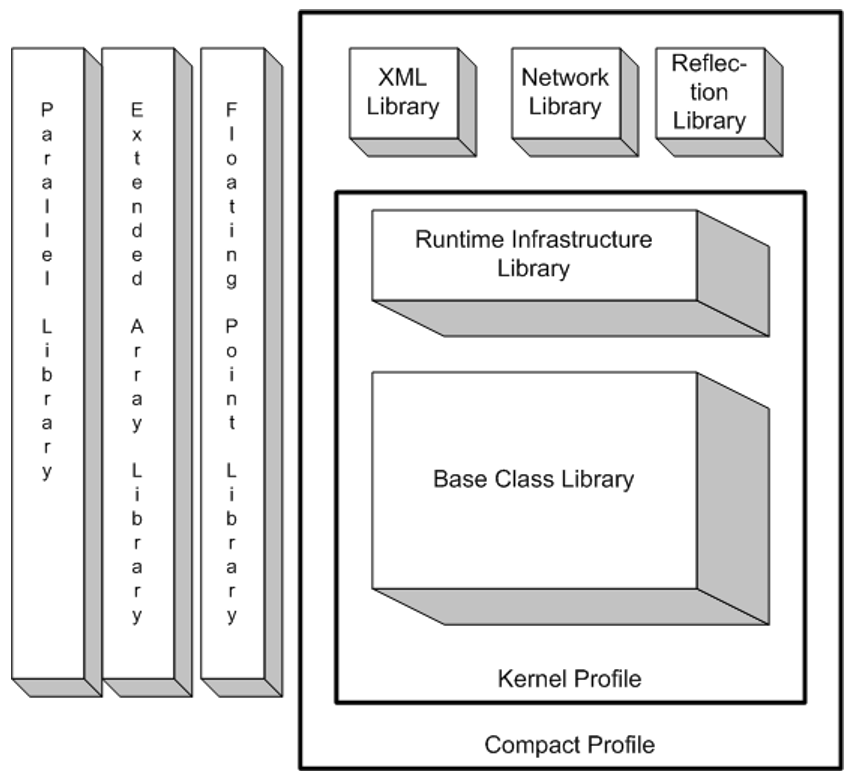
The Extended Array and Extended Numerics Libraries are not part of either Profile, but can be combined with either of them. Doing so adds the appropriate methods, exceptions, and interfaces to the types specified in the Profile.
There are two Standard Profiles. The smallest conforming implementation of the CLI is the Kernel Profile, while the Compact Profile contains additional features useful for applications targeting a more resource-rich set of devices.
A conforming implementation of the CLI shall throw an appropriate
exception (e.g., System.NotImplementedException,
System.MissingMethodException, or
System.ExecutionEngineException) when it encounters a
feature specified in this Standard but not supported by the particular
Profile (see Partition
III).
[Note: Implementers should consider providing tools that statically detect features they do not support so users have an option of checking programs for the presence of such features before running them. end note]
[Note: Vendors of compliant CLI implementations should specify exactly which configurations of Standard Libraries and Standard Profiles they support. end note]
[Note: "Features" can be something like the use of a floating-point CIL instruction in the implementation of a method when the CLI upon which it is running does not support the Extended Numerics Library. Or, the "feature" might be a call to a method that this Standard specifies exists only when a particular Library is implemented and yet the code making the call is running on an implementation of the CLI that does not support that particular library. end note]
This Profile is the minimal possible conforming implementation of the CLI. It contains the types commonly found in a modern programming language class library, plus the types needed by compilers targeting the CLI.
Contents: Base Class Library, Runtime Infrastructure Library
This Profile is designed to allow implementation on devices with only modest amounts of physical memory yet provides more functionality than the Kernel Profile alone. It also contains everything required to implement the proposed ECMAScript compact Profile.
Contents: Kernel Profile, XML Library, Network Library, Reflection Library
All conforming implementations of the CLI support at least the Kernel Profile. Consequently, all CLI features required by the Kernel Profile shall be implemented by all conforming implementations. This clause defines that minimal feature set, by enumerating the set of features that are not required; i.e., a minimal conforming implementation shall implement all CLI features except those specified in the remainder of this clause. The feature requirements of individual Libraries as specified in §IV.5 are defined by reference to restricted items described in this clause. For ease of reference, each feature has a name indicated by the name of the clause or subclause heading. Where Libraries do not specify any additional feature requirement, it shall be assumed that only the features of the Kernel Profile as described in this clause are required.
The following internal data types and constructs, specified elsewhere in this Standard, are not required of CLI implementations that conform only to the Kernel Profile. All other CLI features are required.
The floating point feature set consists of the
user-visible floating-point data types float32 and
float64, and support for an internal representation of
floating-point numbers.
If omitted: The CIL instructions that deal
specifically with these data types throw the
System.NotImplementedException exception. These
instructions are: ckfinite, conv.r.un,
conv.r4, conv.r8, ldc.r4,
ldc.r8, ldelem.r4, ldelem.r8,
ldind.r4, ldind.r8, stelem.r4,
stelem.r8, stind.r4, stind.r8.
Any attempt to reference a signature including the floating-point data
types shall throw the System.NotImplementedException
exception. The precise timing of the exception is not specified.
[Note: These restrictions guarantee that the VES will not
encounter any floating-point data. Hence the implementation of the
arithmetic instructions (such as add) need not handle those
types. end note]
Part of Library: Extended Numerics (§IV.5.7)
The non-vector arrays feature set includes support for arrays with more than one dimension or with lower bounds other than zero. This includes support for signatures referencing such arrays, runtime representations of such arrays, and marshalling of such arrays to and from native data types.
If omitted: Any attempt to reference a signature
including a non-vector array shall throw the
System.NotImplementedException exception. The precise
timing of the exception is not specified.
[Note: The type System.Array is part of the
Kernel Profile and is available in all conforming implementations of the
CLI. An implementation that does not provide the non-vector array
feature set can correctly assume that all instances of that type are
vectors. end note]
Part of Library: Extended Arrays (see §IV.5.8).
The reflection feature set supports full reflection on data types. All of its functionality is exposed through methods in the Reflection Library.
If omitted: The Kernel Profile specifies an opaque
type, System.Type, instances of which uniquely represent
any type in the system and provide access to the name of the type.
[Note: With just the Kernel Profile there is no requirement,
for example, to determine the members of the type, dynamically create
instances of the type, or invoke methods of the type given an instance
of System.Type. This can simplify the implementation of the
CLI compared to that required when the Reflection Library is available.
end note]
Part of Library: Reflection (see §IV.5.5).
The application domain feature set supports multiple application domains. The Kernel Profile requires that a single application domain exist.
If omitted: Methods for creating application domains
(part of the Base Class Library, see §IV.5.3) throw the
System.NotImplementedException exception.
Part of Library: (none)
The remoting feature set supports remote method
invocation. It is provided primarily through special semantics of the
class System.MarshalByRefObject as described in Partition
I.
If omitted: The class
System.MarshalByRefObject shall be treated as a simple
class with no special meaning.
Part of Library: (none)
The vararg feature set supports variable-length argument lists and runtime-typed pointers.
If omitted: Any attempt to reference a method with
the vararg calling convention or the signature
encodings associated with vararg methods (see Partition II)
shall throw the System.NotImplementedException exception.
Methods using the CIL instructions arglist,
refanytype, mkrefany, and
refanyval shall throw the
System.NotImplementedException exception. The precise
timing of the exception is not specified. The type
System.TypedReference need not be defined.
Part of Library: Vararg (see §IV.5.9).
The frame growth feature set supports dynamically extending a stack frame.
If omitted: Methods using the CIL
localloc instruction shall throw the
System.NotImplementedException exception. The precise
timing of the exception is not specified.
Part of Library: (none)
The filtered exceptions feature set supports user-supplied filters for exceptions.
If omitted: Methods using the CIL
endfilter instruction or with an
exceptionentry that contains a non-null
filterstart (see Partition
I) shall throw the System.NotImplementedException
exception. The precise timing of the exception is not specified.
Part of Library: (none)
The detailed content of each Library, in terms of the types it provides and the changes it makes to types in other Libraries, is provided in XML form. This clause provides a brief description of each Library’s purpose as well as specifying the features of the CLI required by each Library beyond those required by the Kernel Profile.
Unless stated otherwise in the documentation of a method, all copy
operations are shallow, not deep. Some methods traffic in "default
values". For a reference type, the default value is null; for a nullable
value type, the default value is HasValue returns false;
for a non-nullable value type, the default value is all-bits-zero (which
for Boolean represents false, and for all arithmetic types represents
zero).
The Runtime Infrastructure Library is part of the Kernel Profile. It
provides the services needed by a compiler to target the CLI and the
facilities needed to dynamically load types from a stream in the file
format specified in Partition
II. For example, it provides
System.BadImageFormatException, which is thrown when a
stream that does not have the correct format is loaded.
Name used in XML: RuntimeInfrastructure
CLI Feature Requirement: None
The Base Class Library is part of the Kernel Profile. It is a simple runtime library for modern programming languages. It serves as the Standard for the runtime library for the language C# as well as one of the CLI Standard Libraries. It provides types to represent the built-in data types of the CLI, simple file access, custom attributes, security attributes, string manipulation, formatting, streams, collections, among other things.
Name used in XML: BCL
CLI Feature Requirement: None
The Network Library is part of the Compact Profile. It provides simple networking services including direct access to network ports as well as HTTP support.
Name used in XML: Networking
CLI Feature Requirement: None
The Reflection Library is part of the Compact Profile. It provides the ability to examine the structure of types, create instances of types, and invoke methods on types, all based on a description of the type.
Name used in XML: Reflection
CLI Feature Requirement: Must support Reflection, see §IV.5.1.
The XML Library is part of the Compact Profile. It provides a simple "pull-style" parser for XML. It is designed for resource-constrained devices, yet provides a simple user model. A conforming implementation of the CLI that includes the XML Library shall also implement the Network Library (see §IV.5.4).
Name used in XML: XML
CLI Feature Requirement: None
The Extended Numerics Library is not part of any Profile, but can be
supplied as part of any CLI implementation. It provides the support for
floating-point (System.Single, System.Double)
and extended-precision (System.Decimal) data types. Like
the Base Class Library, this Library is directly referenced by the C#
Standard.
[Note: Programmers who use this library will benefit if implementations specify which arithmetic operations on these data types are implemented primarily through hardware support. end note]
[Rationale: The Extended Numerics Library is kept separate because some commonly available processors do not provide direct support for the data types. While software emulation can be provided, the performance difference is often so large (1,000-fold or more) that it is unreasonable to build software using floating-point operations without being aware of whether the underlying implementation is hardware-based. end rationale]
Name used in XML: ExtendedNumerics
CLI Feature Requirement: Floating Point, see §IV.4.1.1.
This Library is not part of any Profile, but can be supplied as part of any CLI implementation. It provides support for non-vector arrays. That is, arrays that have more than one dimension, or arrays that have non-zero lower bounds.
CLI Feature Requirement: Non-vector Arrays, see §IV.4.1.2.
The Vararg Library is not part of any Profile. It provides support for dealing with variable-length argument lists.
Name used in XML: Vararg
CLI Feature Requirement: None
This Library is not part of any Profile, but can be supplied as part of any CLI implementation. The purpose of the extended threading library is twofold:
Provide easy parallelism for non-expert programmers, so that multithreaded CPUs can be exploited. The Profile stresses simplicity over large scalability.
Not require changing the virtual machine or source languages. All features of the Profile can be implemented as a library on top of the existing CLI. The Profile can be used in conjunction with any CLI language that supports delegates.
The loop class hierarchy is summarized below:
ParallelLoop
       ParallelWhile
       ParallelForEach
       ParallelFor
The base class ParallelLoop factors out common
functionality for parallel looping over a collection of values. The
three derived classes distinguish three common kinds of parallel
looping. If the collection might grow while being processed, then use
ParallelWhile. Otherwise, if the collection implements
IEnumerable, use ParallelForEach. If the
collection or collections are indexible by int32, use
ParallelFor. To choose the kind of loop to use in a
specific situation, consider how the loop could be written sequentially.
If the loop could be written using
"for (int i=0; i<n; ++i )", and n is known
before the loop executes, use ParallelFor. If the loop
could be written with a foreach statement, over collection
that does not change while the foreach is running, use
ParallelForEach. If the loop could be written
"while (collection is not yet empty) {remove item from collection and process it}",
use ParallelWhile. When there is a choice, use
ParallelFor if possible, because it is significantly more
efficient.
Name used in XML: Parallel
CLI Feature Requirement: BCL
Implementers are encouraged to extend or modify the types specified
in this Standard to provide additional functionality. Implementers
should notice, however, that type names beginning with
"System." and bearing the special Standard Public Key are
intended for use by the Standard Libraries: such names not currently in
use might be defined in a future version of this Standard.
To allow programs compiled against the Standard Libraries to work when run on implementations that have extended or modified the Standard Libraries, such extensions or modifications shall obey the following rules:
The contract specified by virtual methods shall be maintained in new classes that override them.
New exceptions can be thrown, but where possible these should be
derived classes of the exceptions already specified as thrown rather
than entirely new exception types. Exceptions initiated by methods of
types defined in the Standard Libraries shall be derived from
System.Exception.
Interfaces and virtual methods shall not be added to an existing interface. Nor shall they be added to an abstract class unless that class provides an implementation.
[Rationale: An interface or virtual method can be added only where it carries an implementation. This allows programs written when the interface or method was not present to continue to work. end rationale]
Instance methods shall not be implemented as virtual methods.
[Rationale: Methods specified as instance (non-static, non-virtual) in this standard are not permitted to be implemented as virtual methods in order to reduce the likelihood of creating non-portable files by using implementation-supplied libraries at compile time. Even though a compiler need not take a dependence on the distinction between virtual and instance methods, it is easy for a user to inadvertently override a virtual method and thus create non-portable code. The alternative of providing special files corresponding to this Standard for use at compile time is prone to user error. end rationale]
The accessibility of fields and non-virtual methods can be widened from than specified in this Standard.
[Note: The following common extensions are permitted by these rules.
Adding new members to existing types.
Concrete (non-abstract) classes can implement interfaces not defined in this standard.
Adding fields (values) to enumerations.
An implementation can insert a new type into the hierarchy between a type specified in this standard and the type specified as its base type. That is, this standard specifies an inheritance relation between types but does not specify the immediate base type.
Implementations can add overrides to existing virtual methods, provided the new overrides satisfy the existing contract. end note]
[Rationale: An implementation might wish to split functionality across several types in order to provide non-standard extension mechanisms, or might wish to provide additional non-standard functionality through the new base type. As long as programs do not reference these nonstandard types, they will remain portable across conforming implementations of the CLI. end rationale]
The XML specification conforms to the Document Type Definition (DTD) in Figure 0-4. Only types that are included in a specified library are included in the XML.
There are three types of elements/attributes:
Normative: An element or attribute is normative such that the XML specification would be incomplete without it.
Informative: An element or attribute is informative if it specifies information that helps clarify the XML specification, but without it the specification still stands alone.
Rendering/Formatting: An element or attribute is for rendering or formatting if it specifies information to help an XML rendering tool.
Unless explicitly stated otherwise, the text associated with an
element or an attribute (e.g., #PCDATA,
#CDATA) is normative or informative depending on the
element or attribute with which it is associated, as described in the
figure.
[Note: Many of the elements and attributes in the DTD are for rendering purposes. end note]
<?xml version="1.0" encoding="UTF-8"?>
<!ELEMENT AssemblyCulture (#PCDATA)>
(Normative) Specifies the culture of the assembly that defines the current type. Currently this value is always "none". It is reserved for future use.
<!ELEMENT AssemblyInfo (AssemblyName, ((AssemblyPublicKey, AssemblyVersion) | (AssemblyVersion, AssemblyPublicKey)), AssemblyCulture, Attributes)>(Normative) Specifies information about the assembly of a given type. This information corresponds to sections of the metadata of an assembly as described in Partition II, and includes information from the
AssemblyName,AssemblyPublicKey,AssemblyVersion,AssemblyCultureandAttributeselements.<!ELEMENT AssemblyName (#PCDATA)>(Normative) Specifies the name of the assembly to which a given type belongs. For example, all of the types in the BCL are members of the "mscorlib" assembly.
<!ELEMENT AssemblyPublicKey (#PCDATA)>(Normative) Specifies the public key of the assembly. The public key is represented as a 128-bit value.
<!ELEMENT AssemblyVersion (#PCDATA)>(Normative) Specifies the version of the assembly in the form 2.0.x.y, where x is a build number and y is a revision number.
<!ELEMENT Attribute (AttributeName, Excluded?, ExcludedTypeName?, ExcludedLibraryName?)>(Normative) Specifies the text for a custom attribute on a type or a member of a type. This includes the attribute name and whether or not the attribute type itself is contained in another library. If the
Excludedelement is omitted, it is assumed to have a value of 0.<!ELEMENT AttributeName (#PCDATA)>(Normative) Specifies the name of the custom attribute associated with a type or member of a type. Also contains the data needed to instantiate the attribute.
<!ELEMENT Attributes (Attribute*)>(Normative) Specifies the list of the attributes on a given type or member of a type.
<!ELEMENT Base (BaseTypeName?, ExcludedBaseTypeName?, ExcludedLibraryName?)>(Normative) Specifies the information related to the base type of the current type. Although the
ExcludedBaseTypeNameandExcludedLibraryNameelements are rarely found within this element, they are required when a type inherits from a type not found in the current library.<!ELEMENT BaseTypeName (#PCDATA)>(Normative) Specifies the fully qualified name of the class from which a type inherits (i.e., the type's base class).
<!ELEMENT Constraints (ParameterAttribute+, BaseTypeName?) >(Normative) Specifies the constraints for a covariant or contravariant type parameter.
<!ELEMENT Docs ((summary?, altmember?, altcompliant?, typeparam*, param*, returns?, value?, exception*, threadsafe?, remarks?, example?, permission?) | (typeparam*, param*, summary?, altmember?, altcompliant?, returns?, value?, exception*, threadsafe?, remarks?, example?, permission?) | (summary?, altmember?, altcompliant?, typeparam*, param*, returns?, value?, remarks?, threadsafe?, exception*, example?, permission?) | (typeparam*, param*, summary?, altmember?, altcompliant?, returns?, value?, remarks?, threadsafe?, exception*, example?, permission?))>(Normative) Specifies the textual documentation of a given type or member of a type.
<!ELEMENT Excluded (#PCDATA)>(Normative) Specifies, by a '0' or '1', whether a given member can be excluded from the current type in the absence of a given library. '0' specifies that it cannot be excluded.
<!ELEMENT ExcludedBaseTypeName (#PCDATA)>(Normative) Specifies the fully qualified name of the type that the current type must inherit from if a given library were present in an implementation. The library name is specified in the
ExcludedLibraryNameelement. An example is theSystem.Typeclass that inherits fromSystem.Object, but if the Reflection library is present, it must inherit fromSystem.Reflection.MemberInfo.<!ELEMENT ExcludedLibrary (#PCDATA)>(Normative) Specifies the library that must be present in order for a given member of a type to be required to be implemented. For example,
System.Console.WriteLine(double)need only be implemented if the ExtendedNumerics library is available.<!ELEMENT ExcludedLibraryName (#PCDATA)>(Normative) This element appears only in the description of custom attributes. It specifies the name of the library that defines the described attribute. For example, the member that is invoked when no member name is specified for
System.Text.StringBuilder(in C#, this is the indexer) is called "Chars". The attribute needed for this isSystem.Reflection.DefaultMemberAttribute. This is found in the RuntimeInfrastructure library. This element is used with theExcludedTypeNameelement.<!ELEMENT ExcludedTypeName (#PCDATA)>(Normative) Specifies the fully qualified name of the attribute that is needed for a member to succesfully specify the given attribute. This element is related to the
ExcludedLibraryNameelement and is used for attributes.<!ELEMENT Interface (InterfaceName, Excluded?)>(Normative) Specifies information about an interface that a type implements. This element contains subelements specifying the interface name and whether another library is needed for the interface to be required in the current library. If the
Excludedelement is omitted, it is assumed to have a value of 0.<!ELEMENT InterfaceName (#PCDATA)>(Normative) Represents the fully-qualified interface name that a type implements.
<!ELEMENT Interfaces (Interface*)>(Normative) Specifies information on the interfaces, if any, a type implements. There is one
Interfaceelement for each interface implemented by the type.<!ELEMENT Libraries (Types+)>(Normative) This is the root element. Specifies all of the information necessary for all of the class libraries of the standard. This includes all of the types and all children elements underneath.
<!ELEMENT Member (MemberSignature+, MemberType, Attributes?, ReturnValue, TypeParameters?, Parameters, MemberValue?, Docs, Excluded?, ExcludedLibrary*)>(Normative) Specifies information about a member of a type. This information includes the signatures, type of the member, co/contra-variant type parameters, parameters, etc., all of which are elements in the XML specification. If the
Excludedelement is omitted, it is assumed to have a value of 0.<!ATTLIST Member MemberName NMTOKEN #REQUIRED(Normative)
MemberNamespecifies the name of the current member.> <!ELEMENT MemberOfLibrary (#PCDATA)>(Normative)
PCDATAis the name of the library containing the type.<!ELEMENT MemberSignature EMPTY>(Normative) Specifies the text (in source code format) for the signature of a given member of a type.
<!ATTLIST MemberSignature
  Language CDATA #REQUIRED
(Normative) CDATA is the programming language in which the signature is written. All members are described in both ILAsm and C#.
Value CDATA #REQUIRED(Normative) CDATA is the text of the member signature in a given language.
>

<!ELEMENT MemberType (#PCDATA)>
(Normative) Specifies the kind of the current member. The member kinds are: method, property, constructor, field, and event.
<!ELEMENT MemberValue (#PCDATA)>(Normative) Specifies the value of a static literal field.
<!ELEMENT Members (Member*)>(Normative) Specifies information about all of the members of a given type.
<!ELEMENT PRE EMPTY>(Rendering/Formatting) This element exists for rendering purposes only to specify, for example, that future text should be separated from the previous text
<!ELEMENT Parameter (Attributes?)>(Normative) Specifies the information about a specific parameter of a method or property.
  <!ATTLIST Parameter
    Name NMTOKEN #REQUIRED
(Normative) Specifies the name of the parameter.
Type CDATA #REQUIRED(Normative) Specifies the fully-qualified name of the type of the parameter.
RefType CDATA #IMPLIED(Informative) Specifies whether the parameter is a ref, out or in parameter.
>

<!ELEMENT ParameterAttribute (#PCDATA) >
(Normative) Specifies the constraint attribute for a type parameter.
<!ELEMENT Parameters (Parameter*)>(Normative) Specifies information for the parameters of a given method or property. The information specified is included in each Parameter element of this element. This element will contain one
Parameterfor each parameter of the method or property.<!ELEMENT ReturnType (#PCDATA)>(Normative) Specifies the fully-qualified name of the type that the current member returns.
<!ELEMENT ReturnValue (ReturnType?)>(Normative) Specifies the return type of a member.
ReturnTypeshall be present for all kinds of members except constructors.<!ELEMENT SPAN (#PCDATA | para | paramref | SPAN | see | block)*>(Rendering/Formatting) This element specifies that the text should be segmented from other text (e.g., with a carriage return). References to parameters, other types, and even blocks of text can be included within a
SPANelement.<!ELEMENT ThreadingSafetyStatement (#PCDATA)>(Normative) Specifies a thread safety statement for a given type.
<!ELEMENT Type (TypeSignature+, MemberOfLibrary, AssemblyInfo, ThreadingSafetyStatement?, TypeParameters?, ((Docs, Parameters?, ReturnValue?, Base, Interfaces?) | (Base, Interfaces?, Parameters?, ReturnValue?, Docs)) , Attributes?, Members?, TypeExcluded)>(Normative) Specifies all of the information for a given type.
<!ATTLIST Type
  Name CDATA #REQUIRED
(Informative) Specifies the simple name (e.g., "
String" rather than "System.String") of a given type.FullName CDATA #REQUIRED(Normative) Specifies the fully-qualified name of a given type. For generic types, this includes the spelling of generic parameter names.
FullNameSP CDATA #REQUIRED(Informative) Specifies the fully-qualified name with each '
.' of the fully qualified name replaced by an '_'.> <!ELEMENT TypeExcluded (#PCDATA)>(Normative)
PCDATAshall be '0'.<!ELEMENT TypeParameter (Constraints*) >(Normative) Specifies information about a specific type parameter in a class member.
<!ATTLIST TypeParameter
  Name CDATA #REQUIRED
 >
(Normative) Specifies the name of a specific type parameter.
<!ELEMENT TypeParameters (TypeParameter*)>(Normative) Specifies information about all of the type parameters in a class member.
<!ELEMENT TypeSignature EMPTY>(Normative) Specifies the text for the signature (in code representation) of a given type.
<!ATTLIST TypeSignature
  Language CDATA #REQUIRED
(Normative) Specifies the language the specified type signature is written in. All type signatures are specified in both ILAsm and C#.
Value CDATA #REQUIRED(Normative)
CDATAis the type signature in the specified language.> <!ELEMENT Types (Type+)>(Normative) Specifies information about all of the types of a library.
<!ATTLIST Types
  Library NMTOKEN #REQUIRED
(Normative) Specifies the library in which all of the types are defined. An example of such a library is "BCL".
>

<!ELEMENT altcompliant EMPTY>
(Informative) Specifies that an alternative, CLS compliant method call exists for the current non-CLS compliant method. For example, this element exists in the
System.IO.TextWriter.WriteLine(ulong)method to show thatSystem.IO.TextWriter.WriteLine(long)is an alternative, CLS compliant method.<!ATTLIST altcompliant cref CDATA #REQUIRED(Informative) Specifies the link to the actual documentation for the alternative CLS compliant method. [Note: In this specification,
CDATAmatches the documentation comment format specified in Appendix E of the C# language standard.]> <!ELEMENT altmember EMPTY>element is used for operator overloads.
<!ATTLIST altmember
  cref CDATA #REQUIRED
(Informative) Specifies the link to the actual documentation for the alternative member call. [Note: In this specification,
CDATAmatches the documentation comment format specified in Appendix E of the C# language standard.]> <!ELEMENT block (#PCDATA | see | para | paramref | list | block | c | subscript | code | sup | pi)*>(Rendering/Formatting) Specifies that the children should be formatted according to the type specified as an attribute.
<!ATTLIST block
  subset CDATA #REQUIRED
(Rendering/Formatting) This attribute is reserved for future use and currently only has the value of 'none'.
type NMTOKEN #REQUIRED(Rendering/Formatting) Specifies the type of block that follows, one of: usage, overrides, note, example, default, behaviors.
>

<!ELEMENT c (#PCDATA | para | paramref | code | see)*>
(Rendering/Formatting) Specifies that the text is the output of a code sample.
<!ELEMENT code (#PCDATA)>(Informative) Specifies the text is a code sample.
<!ATTLIST code
  lang CDATA #IMPLIED
(Informative) Specifies the programming language of the code sample. This specification uses C# as the language for the samples.
>

<!ELEMENT codelink EMPTY>
(Informative) Specifies a piece of code to which a link might be made from another sample. [Note: the XML format specified here does not provide a means of creating such a link.]
<!ATTLIST codelink
  SampleID CDATA #REQUIRED
(Informative)
SampleIDis the unique id assigned to this code sample.SnippetID CDATA #REQUIRED(Informative)
SnippetIDis the unique id assigned to a section of text within the sample code.> <!ELEMENT description (#PCDATA | SPAN | paramref | para | see | c | permille | block | sub)*>(Normative) Specifies the text for a description for a given term element in a list or table. This element also specifies the text for a column header in a table.
<!ELEMENT example (#PCDATA | para | code | c | codelink | see)*>(Informative) Specifies that the text will be an example on the usage of a type or a member of a given type.
<!ELEMENT exception (#PCDATA | paramref | see | para | SPAN | block)*>(Normative) Specifies text that provides the information for an exception that shall be thrown by a member of a type, unless specified otherwise. This element can contain just text or other rendering options such as blocks, etc.
<!ATTLIST exception
  cref CDATA #REQUIRED
(Rendering/Formatting) Specifies a link to the documentation of the exception. [Note: In this specification,
CDATAmatches the documentation comment format specified in Appendix E of the C# language standard.]> <!ELEMENT i (#PCDATA)>(Rendering/Formatting) Specifies that the text should be italicized.
<!ELEMENT item (term, description*)>(Rendering/Formatting) Specifies a specific item of a list or a table.
<!ELEMENT list (listheader?, item*)>(Rendering/Formatting) Specifies that the text should be displayed in a list format.
<!ATTLIST list
  type NMTOKEN #REQUIRED
(Rendering/Formatting) Specifies the type of list in which the following text will be represented. Values in the specification are: bullet, number and table.
>

<!ELEMENT listheader (term, description+)>
(Rendering/Formatting) Specifies the header of all columns in a given list or table.
<!ELEMENT onequarter EMPTY>(Rendering/Formatting) Specifies that text, in the form of ¼, is to be displayed.
<!ELEMENT para (#PCDATA | see | block | paramref | c | onequarter | superscript | sup | permille | SPAN | list | pi | theta | sub)*>(Rendering/Formatting) Specifies that the text is part of what can be considered a paragraph of its own.
<!ELEMENT param (#PCDATA | c | paramref | see | block | para | SPAN)*>(Normative) Specifies the information on the meaning or purpose of a parameter. The name of the parameter and a textual description will be associated with this element.
<!ATTLIST param
  name CDATA #REQUIRED
(Nomrative) Specifies the name of the parameter being described.
>

<!ELEMENT paramref EMPTY>
(Rendering/Formatting) Specifies a reference to a parameter of a member of a type.
<!ATTLIST paramref
  name CDATA #REQUIRED
(Rendering/Formatting) Specifies the name of the parameter to which the paramref element is referring.
>

<!ELEMENT permille EMPTY>
(Rendering/Formatting) Represents the current text is to be displayed as the '‰' symbol.
<!ELEMENT permission (#PCDATA | see | paramref | para | block)*>(Normative) Specifies the permission, given as a fully-qualified type name and supportive text, needed to call a member of a type.
<!ATTLIST permission
  cref CDATA #REQUIRED
(Rendering/Formatting) Specifies a link to the documentation of the permission. [Note: In this specification,
CDATAmatches the documentation comment format specified in Appendix E of the C# language standard.]> <!ELEMENT pi EMPTY>(Rendering/Fomatting) Represents the current text is to be displayed as the 'π' symbol
<!ELEMENT pre EMPTY>(Rendering/Formatting) Specifies a break between the preceding and following text.
<!ELEMENT remarks (#PCDATA | para | block | list | c | paramref | see | pre | SPAN | code | PRE)*>(Normative) Specifies additional information, beyond that supplied by the summary, on a type or member of a type.
<!ELEMENT returns (#PCDATA | para | list | paramref | see)*>(Normative) Specifies text that describes the return value of a given type member.
<!ELEMENT see EMPTY>(Informative) Specifies a link to another type or member.
<!ATTLIST see
  cref CDATA #IMPLIED
(Informative)
crefspecifies the fully-qualified name of the type or member to link to. [Note: In this specification,CDATAmatches the documentation comment format specified in Appendix E of the C# language standard.]langword CDATA #IMPLIED(Informative)
langwordspecifies that the link is to a language agnostic keyword such as "null".qualify CDATA #IMPLIED(Informative)
qualifyindicates that the type or member specified in the link must be displayed as fully-qualified. Value of this attribute is 'true' or 'false', with a default value of 'false'> <!ELEMENT sub (#PCDATA | paramref)*>(Rendering/Formatting) Specifies that current piece of text is to be displayed in subscript notation.
<!ELEMENT subscript EMPTY>(Rendering/Formatting) Specifies that current piece of text is to be displayed in subscript notation.
<!ATTLIST subscript
  term CDATA #REQUIRED
(Rendering/Formatting) Specifies the value to be rendered as a subscript.
>

<!ELEMENT summary (#PCDATA | para | see | block | list)*>
(Normative) Specifies a summary description of a given type or member of a type.
<!ELEMENT sup (#PCDATA | i | paramref)*>(Rendering/Formatting) Specifies that the current piece of text is to be displayed in superscript notation.
<!ELEMENT superscript EMPTY>(Rendering/Formatting) Specifies that current piece of text is to be displayed in superscript notation.
<!ATTLIST superscript
  term CDATA #REQUIRED
(Rendering/Formatting) Specifies the value to be rendered as a superscript.
>

<!ELEMENT term (#PCDATA | block | see | paramref | para | c | sup | pi | theta)*>
(Rendering/Formatting) Specifies the text is a list item or an item in the primary column of a table.
<!ELEMENT theta EMPTY>(Rendering/Formatting) Specifies that text, in the form of 'θ', is to be displayed.
<!ELEMENT threadsafe (para+)>(Normative) Specifies that the text describes additional detail, beyond that specified by
ThreadingSafetyStatement, the thread safety implications of the current type. For example, the text will describe what an implementation must do in terms of synchronization.<!ELEMENT typeparam (#PCDATA | c | paramref | see | block | para | SPAN | geq | leq | whitespace)*>(Normative) Specifies description information on a given type parameter for a class member.
<!ATTLIST typeparam
  name CDATA #REQUIRED
>
(Normative) Specifies the name of the type parameter that will be described.
<!ELEMENT value (#PCDATA | para | list | see)*>(Normative) Specifies description information on the "value" passed into the set method of a property.
Throughout the textual descriptions of methods in the XML, there are
places where a parameter of type object or an interface
type is expected, but the description refers to passing a value type for
that parameter. In these cases, the caller shall box the value type
before making the call.
Many members of types defined in the XML have associated exception conditions. Unless it is stated otherwise in a member's definition, the exceptions listed for any given member shall be thrown when the stated conditions occur.
For each type and member described in the XML, there is an ILAsm and C# signature pair. These are intended to be equivalent and to provide sufficient information to allow these types and members to be implemented correctly. Each signature pair shows both the low-level and one high-level view of these signatures. However, as written in the XML, the members of a given pair of signatures are not always written in an equivalent manner, even though they are intended to produce identical behavior. The differences in signature notation are described in this subclause
As shown in the ILAsm signatures, many of the types in the standard library have the predefined attribute serializable attached. A type that is marked with this attribute is to be serialized as part of the persistent state of a value of the type. This standard does not require that a conforming implementation provide support for serialization (or its counterpart, deserialization), nor does it specify the mechanism by which these operations might be accomplished.
Consider the ILAsm and C# signatures in the XML for
System.String:
[ILAsm]
.class public sealed serializable String …

[C#]
public sealed class String …
Although the C# standard does not address the issue of serialization,
if this library type is written in C#, when the C# declaration above is
compiled, the intent is that the code generated for the class contains
the serializable attribute as shown. [Note:
Some implementations provide an attribute type,
System.SerializableAttribute, for this purpose. end
note]
The standard library contains a number of delegate types. However, as
recorded in the XML, their ILAsm signatures are incomplete. Consider
System.EventHandler as an example; its ILAsm signature is
defined in the XML as follows:
.class public sealed serializable EventHandler extends System.Delegate
{
.method public hidebysig newslot virtual instance void Invoke(object
   sender, class System.EventArgs e) }
However, this type also has a constructor and two optional
asynchronous methods, BeginInvoke and
EndInvoke, all of which are described in Partition II,
"Delegates". The signatures for these three members for
System.EventHandler are as follows:
.method public hidebysig specialname rtspecialname void .ctor(object
   'object', native int 'method')
.method public hidebysig newslot virtual class System.IAsyncResult
   BeginInvoke(object sender, class System.EventArgs e, class
   System.AsyncCallback callback, object 'object')
.method public hidebysig newslot virtual void EndInvoke(
       class System.IAsyncResult result)
The other standard delegate types have a corresponding constructor
and method pair whose signatures can be deduced from the ILAsm in the
XML and the information in Partition II,
"Delegates". Unless stated otherwise, a standard delegate type
provides the two optional asynchronous methods, BeginInvoke
and EndInvoke.
The standard library contains many types that have properties.
However, as recorded in the XML, their ILAsm signatures are incomplete.
Consider the read-write instance property
System.Collections.ArrayList.Capacity. Its ILAsm signature
is defined in the XML as follows:
.property int32 Capacity {
  public hidebysig virtual specialname int32 get_Capacity()
  public hidebysig virtual specialname void set_Capacity(int32 value)
}
However, this is an abbreviation of the ILAsm syntax. The complete (and correct) signature for this property is as follows:
.property instance int32 Capacity() {
  .get instance int32 ArrayList::get_Capacity()
  .set instance void ArrayList::set_Capacity(int32)
}
.method public hidebysig newslot specialname virtual instance int32
       get_Capacity() { … }
.method public hidebysig newslot specialname virtual instance void
       set_Capacity(int32 'value') { … }
As a second example, consider the readonly static property
System.DateTime.Now; its ILAsm signature is defined in the
XML as follows:
.property valuetype System.DateTime Now {
  public hidebysig static specialname valuetype System.DateTime
    get_Now()
}
However, the complete (and correct) signature for this property is:
.property valuetype System.DateTime Now() {
  .get valuetype System.DateTime DateTime::get_Now()
}
.method public hidebysig specialname static valuetype System.DateTime
   get_Now() { ... }
All other properties (including those that are indexed) are formatted in the XML in a similar abbreviated manner.
With one exception, the definitions of all members of any given type
are contained in the XML for that type. The exception is for nested
types. Nested types have their own definition in the XML, where their
names are qualified by the name of the type in which they are nested.
[Example: The type
System.Collections.Generic.List<T> contains the
nested type Enumerator. These types are described in the
BCL library of the XML under the names List<T> and
List<T>.Enumerator, respectively. end
example]
Portable CILDB files provide a standard way to interchange debugging information between CLI producers and consumers. This partition serves to fill in gaps not covered by metadata, notably the names of local variables and source line correspondences.
All integers are stored in little-endian format, except for those in signatures, which are encoded as described in Partition II.
A CILDB file starts with a 72-byte header, whose layout is as follows:
| Offset | Size | Field | Description |
|---|---|---|---|
| 0 | 16 | Signature | Magic signature for CILDB "_ildb_signature\0" |
| 16 | 16 | GUID | Version GUID |
| 32 | 4 | UserEntryPoint | MethodDef token of the entry point. |
| 36 | 4 | CountOfMethods | Number of rows in the SymMethod table. |
| 40 | 4 | CountOfScopes | Number of rows in the SymScopes table. |
| 44 | 4 | CountOfVars | Number of rows in the SymVariable table. |
| 48 | 4 | CountOfUsing | Number of rows in the SymUsing table. |
| 52 | 4 | CountOfConstants | Number of rows in the SymConstant table. |
| 56 | 4 | CountOfDocuments | Number of rows in the SymDocument table. |
| 60 | 4 | CountOfSequencePoints | Number of rows in the SymSequencePoint table. |
| 64 | 4 | CountOfMiscBytes | Number of bytes in the SymMisc heap. |
| 68 | 4 | CountOfStringBytes | Number of bytes in the SymString heap. |
The version GUID is the 16-byte sequence shown below:
0x7F  0x55  0xE7  0xF1  0x3C  0x42  0x17  0x41
0x8D 0xA9 0xC7 0xA3 0xCD 0x98 0x8D 0xF1The CILDB header is immediately followed by various tables and heaps, in the following order:
SymConstant
SymMethod
SymScopes
SymVariable
SymUsing
SymSequencePoint
SymDocument
SymMisc
SymString
Some of the tables contain CIL offsets. These offsets are in bytes, and the offset of the first instruction is zero. The offsets do not necessarily match the beginning of a CIL instruction. For example, offsets denoting the end of a range of bytes often refer to the last byte of an instruction. Lengths are also in bytes.
The rows in each of the tables 3–7 above that belong to the same method must be contiguous within their parent table.
Each row of the SymConstant table describes a constant, as follows:
| Offset | Size | Field | Description |
|---|---|---|---|
| 0 | 4 | Scope | Index of parent scope |
| 4 | 4 | Name | Index of the name in the SymString heap |
| 8 | 4 | Signature | Index of the signature in the SymMisc heap |
| 12 | 4 | SignatureSize | Length of the signature |
| 16 | 4 | Value | Index of the value in the SymMisc heap |
| 20 | 4 | ValueSize | Length of the value. |
The value of the constant is encoded just like a Blob for the Value column of a Constant metadata table in Partition II, except that there is no length prefix.
Each row of a SymDocument describes a source document, as shown below. The document can either be referred to indirectly (by its URL) or incorporated directly into the CILDB file as part of the SymMisc heap. The GUID values referred to in this subclause are not defined by this Standard; space is simply reserved for them.
| Offset | Size | Field | Description |
|---|---|---|---|
| 0 | 16 | Language | GUID for the language. |
| 16 | 16 | LanguageVendor | GUID for the language vendor. |
| 32 | 16 | DocumentType | GUID for the document type. |
| 48 | 16 | AlgorithmId | GUID of the checksum algorithm; or 0 if there is no checksum. |
| 64 | 4 | CheckSumSize | Size of the checksum; or 0 if there is no checksum. |
| 68 | 4 | CheckSumEntry | Index of the checksum in the SymMisc heap; or 0 if there is no checksum. |
| 72 | 4 | SourceSize | Size of the source in the SymMisc heap; or 0 if the source document is not directly incorporated into the file. |
| 76 | 4 | SourceEntry | Index of the source in the SymMisc heap; or 0 if the source document is not directly incorporated into the file. |
| 80 | 4 | UrlEntry | Index of the document URL in the SymString heap. |
Each row of a SymMethod table has the following format:
| Offset | Size | Field | Description |
|---|---|---|---|
| 0 | 4 | MethodToken | A MethodDef metadata token. |
| 4 | 8 | Scopes | [Start,Stop) range of SymScope table. |
| 12 | 8 | Vars | [Start,Stop) range of SymVariable table. |
| 20 | 8 | Using | [Start,Stop) range of SymUsing table. |
| 28 | 8 | Constant | [Start,Stop) range of SymConstant table. |
| 36 | 8 | Documents | [Start,Stop) range of SymDocument table. |
| 44 | 8 | SequencePoints | [Start,Stop) range of SymSequencePoint table. |
Each [Start,Stop) range is represented as two 4-byte integers. The first integer is the index of the first related table row; the second integer is the index of one past the last related table row.
The rows of a SymMethod table are sorted in ascending order of the MethodToken field. There is at most one row for each method.
Each row of a SymSequencePoint table describes a sequence point, as follows:
| Offset | Size | Field | Description |
|---|---|---|---|
| 0 | 4 | Offset | CIL offset of the sequence point. |
| 4 | 4 | StartLine | Starting line of the source document. |
| 8 | 4 | StartColumn | Starting column, or 0 if not specified. |
| 12 | 4 | EndLine | Ending line of the source document, or 0 if not specified. |
| 16 | 4 | EndColumn | Ending column, or 0 if not specified. |
| 20 | 4 | Doc | Index of the source document in the SymString heap. |
Together, EndLine and EndColumn specify the column "one past" the last byte position associated with the sequence point. In other words, they specify the end of a half-open interval [start,end).
Rows of the SymSequencePoint belonging to the same Method must be contiguous and sorted in ascending order of Offset.
Each row of a SymScope table describes a scope, as follows:
| Offset | Size | Field | Description |
|---|---|---|---|
| 0 | 4 | Parent | Index of parent SymScope row, or -1 if scope has no parent. |
| 4 | 4 | StartOffset | CIL offset of the first byte in the scope. |
| 8 | 4 | EndOffset | CIL offset of the last byte in the scope. |
| 12 | 4 | HasChildren | 1 if scope has child scopes; 0 otherwise |
| 16 | 4 | HasVars | 1 if scope has variables; 0 otherwise |
The scopes belonging to a method must form a tree, with the following constraints:
A parent scope must precede its child scopes.
The StartOffset and EndOffset of a child scope must be within the (inclusive) range of offsets specified by its parent's scope.
Each row of a SymVariable table describes a local variable.
| Offset | Size | Field | Description |
|---|---|---|---|
| 0 | 4 | Scope | Index of the parent scope |
| 4 | 4 | Name | Index of the variable's name in the SymString heap. |
| 8 | 4 | Attributes | Flags describing the variable (see below). |
| 12 | 4 | Signature | Index of the signature in the SymMisc heap. |
| 16 | 4 | SignatureSize | Length of the signature. |
| 20 | 4 | AddressKind | Always 1. |
| 24 | 4 | Address1 | Local variable number. |
| 28 | 4 | Address2 | Always 0. |
| 32 | 4 | Address3 | Always 0. |
| 36 | 4 | StartOffset | CIL offset where the variable is first visible. |
| 40 | 4 | EndOffset | CIL offset where the variable is last visible. |
| 44 | 4 | Sequence | Always 0. |
| 48 | 4 | IsParam | Always 0. |
| 52 | 4 | IsHidden | 1 if variable should be hidden from debugger; 0 otherwise. |
The least-significant bit of Attributes indicates whether the variable is user-generated (0) or compiler-generated (1). The other bits are reserved and should be set to zero.
Because parameters are fully described by the Metadata, they do not appear in the SymVariable table.
Each row of the SymUsing table describes importation of a namespace, as follows:
| Offset | Size | Field | Description |
|---|---|---|---|
| 0 | 4 | Scope | Index of the parent scope |
| 4 | 4 | Namespace | Index of the namespace in the SymString heap |
The SymMisc heap holds various byte sequences (e.g., signatures and checksums).
The stream of bytes in the SymString heap has the same form as those for the #Strings heap (see Partition II).
Signatures of variables and constants are encoded as an index into
the SymMisc heap, and a signature size. The values of the bytes
are similar to those for a FieldSig (see Partition II),
and include the prefix FIELD (0x6), even though the
variables are not fields. Because the length of the signature is encoded
in the tables, it is not included in the SymMisc heap. For
example, type int32 is encoded as "0x06 0x08".
VI.Annex A this annex.
VI.Annex B contains a number of sample programs written in CIL Assembly Language (ILAsm)
VI.Annex C contains information about a particular implementation of an assembler, which provides a superset of the functionality of the syntax described in Partition II. It also provides a machine-readable description of the CIL instruction set which can be used to derive parts of the grammar used by this assembler as well as other tools that manipulate CIL.
VI.Annex D contains a set of guidelines used in the design of the libraries of Partition IV. The rules are provided here since they have proven themselves effective in designing cross-language APIs. They also serve as guidelines for those intending to supply additional functionality in a way that meshes seamlessly with the standardized libraries.
VI.Annex E contains information of interest to implementers with respect to the latitude they have in implementing the CLI.
VI.Annex F contains information of interest to implementers with respect to relaxed fault handling.
VI.Annex G shows several complete examples written using the parallel library.
This clause contains only informative text.
This Annex shows several complete examples written using ILAsm.
The following is an example of a mutually recursive program that uses tail calls. The methods below determine whether a number is even or odd.
[Example:
.assembly extern mscorlib { }
.assembly test.exe { }
.class EvenOdd
{ .method private static bool IsEven(int32 N) cil managed
  { .maxstack   2
    ldarg.0              // N
    ldc.i4.0
    bne.un      NonZero
    ldc.i4.1
    ret

NonZero:
    ldarg.0
    ldc.i4.1
    sub
    tail.
    call        bool EvenOdd::IsOdd(int32)
    ret
  } // end of method ‘EvenOdd::IsEven’

  .method private static bool IsOdd(int32 N) cil managed
  { .maxstack   2
    // Demonstrates use of argument names and labels
    // Notice that the assembler does not convert these
    // automatically to their short versions
    ldarg       N
    ldc.i4.0
    bne.un      NonZero
    ldc.i4.0
    ret

NonZero:
    ldarg       N
    ldc.i4.1
    sub
    tail.
    call        bool EvenOdd::IsEven(int32)
    ret
  } // end of method ‘EvenOdd::IsOdd’

  .method public static void Test(int32 N) cil managed
  { .maxstack   1
    ldarg       N
    call        void [mscorlib]System.Console::Write(int32)
    ldstr       " is "
    call        void [mscorlib]System.Console::Write(string)
    ldarg       N
    call        bool EvenOdd::IsEven(int32)
    brfalse     LoadOdd
    ldstr       "even"

Print:
    call        void [mscorlib]System.Console::WriteLine(string)
    ret

LoadOdd:
    ldstr       "odd"
    br          Print
  } // end of method ‘EvenOdd::Test’
} // end of class ‘EvenOdd’

//Global method
.method public static void main() cil managed
{ .entrypoint
  .maxstack     1
  ldc.i4.5
  call          void EvenOdd::Test(int32)
  ldc.i4.2
  call          void EvenOdd::Test(int32)
  ldc.i4        100
  call          void EvenOdd::Test(int32)
  ldc.i4        1000001
  call          void EvenOdd::Test(int32)
  ret
} // end of global method ‘main’
end example]
The following program shows how rational numbers can be implemented using value types.
[Example:
.assembly extern mscorlib { }
.assembly rational.exe { }
.class private sealed Rational extends [mscorlib]System.ValueType
         implements mscorlib]System.IComparable
{ .field public int32 Numerator
  .field public int32 Denominator

  .method virtual public int32 CompareTo(object o)
  // Implements IComparable::CompareTo(Object)
  { ldarg.0
    // 'this' as a managed pointer
    ldfld int32 value class Rational::Numerator
    ldarg.1     // 'o' as an object
    unbox value class Rational
    ldfld int32 value class Rational::Numerator
    beq.s TryDenom
    ldc.i4.0
    ret

TryDenom:
    ldarg.0     // 'this' as a managed pointer
    ldfld int32 value class Rational::Denominator
    ldarg.1     // 'o' as an object
    unbox value class Rational
    ldfld int32 class Rational::Denominator
    ceq
    ret
  }

  .method virtual public string ToString()
  // Implements Object::ToString
  { .locals init (class [mscorlib]System.Text.StringBuilder SB,
                  string S, object N, object D)
    newobj void [mscorlib]System.Text.StringBuilder::.ctor()
    stloc.s SB
    ldstr "The value is: {0}/{1}"
    stloc.s S
    ldarg.0     // Managed pointer to self
    dup
    ldfld int32 value class Rational::Numerator
    box [mscorlib]System.Int32
    stloc.s N
    ldfld int32 value class Rational::Denominator
    box [mscorlib]System.Int32
    stloc.s D
    ldloc.s SB
    ldloc.s S
    ldloc.s N
    ldloc.s D
    call instance class [mscorlib]System.Text.StringBuilder
      [mscorlib]System.Text.StringBuilder::AppendFormat(string,
        object, object)
    callvirt instance string [mscorlib]System.Object::ToString()
    ret
  }

  .method public value class Rational Mul(value class Rational)
  {
    .locals init (value class Rational Result)
    ldloca.s Result
    dup
    ldarg.0     // 'this'
    ldfld int32 value class Rational::Numerator
    ldarga.s    1     // arg
    ldfld int32 value class Rational::Numerator
    mul
    stfld int32 value class Rational::Numerator
    ldarg.0     // this
    ldfld int32 value class Rational::Denominator
    ldarga.s    1     // arg
    ldfld int32 value class Rational::Denominator
    mul
    stfld int32 value class Rational::Denominator
    ldloc.s Result
    ret
  }
}

.method static void main()
{
  .entrypoint
  .locals init (value class Rational Half,
                value class Rational Third,
                value class Rational Temporary,
                object H, object T)

  // Initialize Half, Third, H, and T
  ldloca.s Half
  dup
  ldc.i4.1
  stfld int32 value class Rational::Numerator
  ldc.i4.2
  stfld  int32 value class Rational::Denominator
  ldloca.s Third
  dup
  ldc.i4.1
  stfld int32 value class Rational::Numerator
  ldc.i4.3
  stfld int32 value class Rational::Denominator
  ldloc.s Half
  box value class Rational
  stloc.s H
  ldloc.s Third
  box value class Rational
  stloc.s T
  // WriteLine(H.IComparable::CompareTo(H))
  // Call CompareTo via interface using boxed instance
  ldloc H
  dup
  callvirt int32 [mscorlib]System.IComparable::CompareTo(object)
  call void [mscorlib]System.Console::WriteLine(bool)
  // WriteLine(Half.CompareTo(T))
  // Call CompareTo via value type directly
  ldloca.s Half
  ldloc T
  call instance int32
  value class Rational::CompareTo(object)
  call void [mscorlib]System.Console::WriteLine(bool)
  // WriteLine(Half.ToString())
  // Call virtual method via value type directly
  ldloca.s Half
  call instance string class Rational::ToString()
  call void [mscorlib]System.Console::WriteLine(string)
  // WriteLine(T.ToString)
  // Call virtual method inherited from Object, via boxed instance
  ldloc T
  callvirt string [mscorlib]System.Object::ToString()
  call void [mscorlib]System.Console::WriteLine(string)
  // WriteLine((Half.Mul(T)).ToString())
  // Mul is called on two value types, returning a value type
  // ToString is then called directly on that value type
  // Note that we are required to introduce a temporary variable
  //   since the call to ToString requires
  //   a managed pointer (address)
  ldloca.s Half
  ldloc.s Third
  call instance value class Rational
         Rational::Mul(value class Rational)
  stloc.s Temporary
  ldloca.s Temporary
  call instance string Rational::ToString()
  call void [mscorlib]System.Console::WriteLine(string)
  ret
}
end example]
[Example:
This subclause includes many example uses of custom attributes to
help clarify the grammar and rules described above. The examples are
written in C#, and each one shows a collection of one or more
attributes, applied to a class (called "App"). The hex and
'translation' of the custom attribute blobs are shown as comments. The
following abbreviations are used:
FIELD = ELEMENT_TYPE_FIELDPROPERTY = 0x54STRING = ELEMENT_TYPE_STRINGSZARRAY = ELEMENT_TYPE_SZARRAYU1 = ELEMENT_TYPE_U1I4 = ELEMENT_TYPE_I4OBJECT = 0x51 // ********************************************************************************
// CustomSimple.cs
using System;
[AttributeUsage(AttributeTargets.Class, AllowMultiple=true)]
class B : Attribute { public B(int i, ushort u) {} }
[B(7,9)] // 01 00 // Prolog
// 07 00 00 00 // 0x00000007
// 09 00 // 0x0009
// 00 00 // NumNamed
class App { static void Main() {} }
// ********************************************************************************
// CustomString.cs
using System;
[AttributeUsage(AttributeTargets.Class, AllowMultiple=true)]
class A : Attribute {
public string field; // field
private string back; // backing field for property
public string prop { // property
get { return back; }
set { back = value; }
}
public A(string x) {} // ctor
}
[A(null)] // 01 00 // Prolog
// FF // null
// 00 00 // NumNamed
[A("")] // 01 00 // Prolog
// 00 // zero-length string
// 00 00 // NumNamed
[A("ab",field="cd",prop="123")] // 01 00 // Prolog
// 02 61 62 // "ab"
// 02 00 // NumNamed
// 53 0e // FIELD, STRING
// 05 66 69 65 6c 64 // "field" as counted-UTF8
// 02 63 64 // "cd" as counted-UTF8
// 54 0e // PROPERTY, STRING
// 04 70 72 6f 70 // "prop" as counted-UTF8
// 03 31 32 33 // "123" as counted-UTF8
class App { static void Main() {} }
// ********************************************************************************
// CustomType.cs
using System;
[AttributeUsage(AttributeTargets.Class, AllowMultiple=true)]
class C : Attribute {
public C(Type t) {}
}
[C(typeof(C))]
// 01 00 // Prolog
// 01 43 // "C" as counted-UTF8
// 00 00 // NumNamed
[C(typeof(string))]
// 01 00 // Prolog
// 0d 53 79 73 74 65 6d 2e 53 74 72 69 6e 67 // "System.String" as counted-UTF8
// 00 00 // NumNamed
[C(typeof(System.Windows.Forms.Button))]
// 01 00 // Prolog
// 76 53 79 73 74 65 6d 2e 57 69 6e 64 6f 77 // "System.Window
// 73 2e 46 6f 72 6d 73 2e 42 75 74 74 6f 6e 2c 53 // s.Forms.Button,S
// 79 73 74 65 6d 2e 57 69 6e 64 6f 77 73 2e 46 6f // ystem.Windows.Fo
// 72 6d 73 2c 20 56 65 72 73 69 6f 6e 3d 32 2e 30 // rms, Version=2.0
// 2e 33 36 30 30 2e 30 2c 20 43 75 6c 74 75 72 65 // .3600.0, Culture
// 3d 6e 65 75 74 72 61 6c 2c 20 50 75 62 6c 69 63 // =neutral, Public
// 4b 65 79 54 6f 6b 65 6e 3d 62 37 37 61 35 63 35 // KeyToken=b77a5c5
// 36 31 39 33 34 65 30 38 39 00 00 // 61934e089"
// 00 00 // NumNamed
class App { static void Main() {} }Notice how various types are 'stringified': if the type is defined in the local assembly, or in mscorlib, then only its full name is required; if the type is defined in a different assembly, then its fully-qualified assembly name is required, includeing Version, Culture and PublicKeyToken, if non-defaulted.
// ********************************************************************************
// CustomByteArray.cs
using System;
class D : Attribute {
   public  byte[] field;                             // field
   private byte[] back;                              // backing field for property
   public  byte[] prop {                             // property
      get { return back;  }
      set { back = value; }
   }
   public D(params byte[] bs) {}                     // ctor
}

[D(1,2, field=new byte[]{3,4},prop=new byte[]{5})]
// 01 00                                             // Prolog
// 02 00 00 00                                       // NumElem
// 01 02                                             // 1,2
// 02 00                                             // NumNamed
// 53 1d 05                                          // FIELD, SZARRAY, U1
// 05 66 69 65 6c 64                                 // "field" as counted-UTF8
// 02 00 00 00                                       // NumElem = 0x00000002
// 03 04                                             // 3,4
// 54 1d 05                                          // PROPERTY, SZARRAY, U1
// 04 70 72 6f 70                                    // "prop" as counted-UTF8
// 01 00 00 00                                       // NumElem = 0x00000001
// 05                                                // 5
class App { static void Main() {} }

// ********************************************************************************
// CustomBoxedValuetype.cs
using System;
[AttributeUsage(AttributeTargets.Class, AllowMultiple=true)]
class E : Attribute {
   public object obj;                           // field called "obj"
   public object o {                            // property called "o"
      get { return o; }
      set { o = value; }
   }
   public E() {}                                // default ctor
   public E(object x) {}
}

[E(42)]                                         // boxed 42
// 01 00                                        // Prolog
// 08                                           // I4
// 2a 00 00 00                                  // 0x0000002A
// 00 00                                        // NumNamed

[E(obj=7)]                                      // named field
// 01 00                                        // Prolog
// 01 00                                        // NumNamed
// 53 51                                        // FIELD, OBJECT
// 03 6f 62 6a                                  // "obj" as counted-UTF8
// 08                                           // I4
// 07 00 00 00                                  // 0x00000007

[E(o=0xEE)]                                     // named property
// 01 00                                        // Prolog
// 01 00                                        // NumNamed
// 54 51                                        // PROPERTY, OBJECT
// 01 6f                                        // "o" as counted-UTF8
// 08                                           // I4
// ee 00 00 00                                  // 0x000000EE
class App { static void Main() {} }
This example illustrates how to construct blobs for a custom
attribute that accepts a System.Object in its constructor,
as a named field, and as a named property. In each case, the argument
given is an int32, which is boxed automatically by the C#
compiler.
Notice the OBJECT = 0x51 byte. This is emitted for
"named" fields or properties of type System.Object.
// ********************************************************************************
// CustomShortArray.cs
using System;
[AttributeUsage(AttributeTargets.Class, AllowMultiple=true)]
class F : Attribute {
    public F(params short[] cs) {}    // ctor
}

[F()]
// 01 00                            // Prolog
// 00 00 00 00                      // NumElem
// 00 00                            // NumNamed

[F(null)]
// 01 00                            // Prolog
// ff ff ff ff                      // NumElem = -1 => null
// 00 00                            // NumNamed

[F(1,2)]
// 01 00                            // Prolog
// 02 00 00 00                      // NumElem
// 01 00 02 00                      // 0x0001, 0x0002
// 00 00                            // NumNamed
class App { static void Main() {} }
end example]
The following informative text, shows a partial implementation for a naive phone-book class. It shows the source first, as written in ILAsm, followed by the equivalent (much shorter) code, written in C#. The section then goes on to examine the metadata generated for this code.
.assembly extern mscorlib {}
.assembly Phone {}
.class private Phone`2<([mscorlib]System.Object) K, ([mscorlib]System.Object) V>
    extends  [mscorlib]System.Object {
   .field private int32 hi
   .field private !0[]  keys
   .field private !1[]  vals
   .method public instance void Add(!0 k, !1 v) {
      .maxstack  4
      .locals init (int32 temp)
      ldarg.0
      ldfld      !0[] class Phone`2<!0,!1>::keys
      ldarg.0
      dup
      ldfld      int32 class Phone`2<!0,!1>::hi
      ldc.i4.1
      add
      dup
      stloc.0
      stfld      int32 class Phone`2<!0,!1>::hi
      ldloc.0
      ldarg.1
      stelem     !0
      ldarg.0
      ldfld      !1[] class Phone`2<!0,!1>::vals
      ldarg.0
      ldfld      int32 class Phone`2<!0,!1>::hi
      ldarg.2
      stelem     !1
      ret
   }  // end of Method Add
}  // end of class Phone

.class App extends [mscorlib]System.Object {
   .method static void Main() {
      .entrypoint
      .maxstack  3
      .locals init (class Phone`2<string,int32> temp)
      newobj     instance void class   Phone`2<string,int32>::.ctor()
      stloc.0
      ldloc.0
      ldstr      "Jim"
      ldc.i4.7
      callvirt   instance void class   Phone`2<string,int32>::Add(!0, !1)
      ret
   }  // end of method Main
} // end of class Appusing System;
class Phone<K,V> {
private int hi = -1;
private K[] keys;
private V[] vals;
public Phone() { keys = new K[10]; vals = new V[10]; }
public void Add(K k, V v) { keys[++hi] = k; vals[hi] = v; }
}
class App {
static void AddOne<KK,VV>(Phone<KK,VV> phone, KK kk, VV vv) {
phone.Add(kk, vv);
}
static void Main() {
Phone<string, int> d = new Phone<string, int>();
d.Add("Jim", 7);
AddOne(d, "Joe", 8);
}
}As detailed in §II.23.2.12, the Type non-terminal now includes a production for generic instantiations, as follows:
| Type ::= &hellip |
|---|
| GENERICINST (CLASS |
VALUETYPE) TypeDefOrRefEncoded
GenArgCount Type * |
Following this production, the Phone<string,int>
instantiation above is encoded as:
0x15  ELEMENT_TYPE_GENERICINST
0x12  ELEMENT_TYPE_CLASS
0x08  TypeDefOrRef coded index for class "Phone<K,V>"
0x02  GenArgCount = 2
0x0E     ELEMENT_TYPE_STRING
0x08     ELEMENT_TYPE_I4
Similarly, the signature for the field vals is encoded
as:
0x06  FIELD
0x1D  ELEMENT_TYPE_SZARRAY
0x13  ELEMENT_TYPE_VAR
0x01  1, representing generic argument number 1 (i.e., "V")
Similarly, the signature for the (rather contrived) static method
AddOne is encoded as:
0x10  IMAGE_CEE_CS_CALLCONV_GENERIC
0x02  GenParamCount = 2 (2 generic parameters for this method: KK and VV
0x03  ParamCount = 3 (phone, kk and vv)
0x01  RetType = ELEMENT_TYPE_VOID
0x15  Param-0:  ELEMENT_TYPE_GENERICINST
0x12            ELEMENT_TYPE_CLASS
0x08            TypeDefOrRef coded index for class "Phone<KK,VV>"
0x02            GenArgCount = 2
0x1e               ELEMENT_TYPE_MVAR
0x00               !!0 (KK in AddOne<KK,VV>)
0x1e               ELEMENT_TYPE_MVAR
0x01               !!1 (VV in AddOne<KK,VV>)
0x1e  Param-1   ELEMENT_TYPE_MVAR
0x00            !!0 (KK in AddOne<KK,VV>)
0x1e  Param-2   ELEMENT_TYPE_MVAR
0x01            !!1 (VV in AddOne<KK,VV>)
Notice that the above example uses indenting to help denote loops
over the three method parameters, and the two generic parameters on
Phone.
This clause contains only informative text.
This clause provides information about a particular assembler for CIL, called ilasm. It supports a superset of the syntax defined normatively in Partition II, and provides a concrete syntax for the CIL instructions specified in Partition III.
Even for those who have no interest in this particular assembler, §VI.C.1 and §VI.C.3 might be of interest. The former is a machine-readable file (ready for input to a C or C++ preprocessor) that partially describes the CIL instructions. It can be used to generate tables for use by a wide variety of tools that deal with CIL. The latter contains a concrete syntax for CIL instructions, which is not described elsewhere.
This subclause provides a complete list of the keywords used by ilasm. If users wish to use any of these as simple identifiers within programs they just make use of the appropriate escape notation (single or double quotation marks as specified in the grammar). This assembler is casesensitive.
| | ---- | #line | .addon |
.assembly | .cctor | .class |
.corflags | .ctor | .custom |
.data | .emitbyte | .entrypoint |
.event | .export | .field |
.file | .fire | .get |
.hash | .imagebase | .import |
.language | .line | .locale |
.localized | .locals |
.manifestres | .maxstack |
.method | .module | .mresource |
.namespace | .other | .override |
.pack | .param | .pdirect |
.permission | .permissionset |
.property | .publickey |
.publickeytoken | .removeon |
.set | .size | .subsystem |
.try | .ver | .vtable |
.vtentry | .vtfixup | .zeroinit |
^THE_END^ | abstract | add |
add.ovf | add.ovf.un | algorithm
| alignment | and | ansi |
any | arglist | array |
as | assembly | assert |
at | auto | autochar |
beforefieldinit | beq | beq.s |
bge | bge.s | bge.un |
bge.un.s | bgt | bgt.s |
bgt.un | bgt.un.s | ble |
ble.s | ble.un | ble.un.s |
blob | blob_object | blt |
blt.s | blt.un | blt.un.s |
bne.un | bne.un.s | bool |
box | br | br.s |
break | brfalse | brfalse.s |
brinst | brinst.s | brnull |
brnull.s | brtrue | brtrue.s |
brzero | brzero.s | bstr |
bytearray | byvalstr | call |
calli | callmostderived |
callvirt | carray | castclass |
catch | cdecl | ceq |
cf | cgt | cgt.un |
char | cil | ckfinite |
class | clsid | clt |
clt.un | const | constrained. |
conv.i | conv.i1 | conv.i2 |
conv.i4 | conv.i8 | conv.ovf.i |
conv.ovf.i.un | conv.ovf.i1 |
conv.ovf.i1.un | conv.ovf.i2 |
conv.ovf.i2.un | conv.ovf.i4 |
conv.ovf.i4.un | conv.ovf.i8 |
conv.ovf.i8.un | conv.ovf.u |
conv.ovf.u.un | conv.ovf.u1 |
conv.ovf.u1.un | conv.ovf.u2 |
conv.ovf.u2.un | conv.ovf.u4 |
conv.ovf.u4.un | conv.ovf.u8 |
conv.ovf.u8.un | conv.r.un |
conv.r4 | conv.r8 | conv.u |
conv.u1 | conv.u2 | conv.u4 |
conv.u8 | cpblk | cpobj |
currency | custom | date |
decimal | default | default |
demand | deny | div |
div.un | dup | endfault |
endfilter | endfinally | endmac |
enum | error | explicit |
extends | extern | false |
famandassem | family | famorassem
| fastcall | fastcall | fault |
field | filetime | filter |
final | finally | fixed |
float | float32 | float64 |
forwardref | fromunmanaged |
handler | hidebysig | hresult |
idispatch | il | illegal |
implements | implicitcom |
implicitres | import | in |
inheritcheck | init | initblk |
initobj | initonly | instance |
int | int16 | int32 |
int64 | int8 | interface |
internalcall | isinst | iunknown
| jmp | lasterr | lcid |
ldarg | ldarg.0 | ldarg.1 |
ldarg.2 | ldarg.3 | ldarg.s |
ldarga | ldarga.s | ldc.i4 |
ldc.i4.0 | ldc.i4.1 | ldc.i4.2 |
ldc.i4.3 | ldc.i4.4 | ldc.i4.5 |
ldc.i4.6 | ldc.i4.7 | ldc.i4.8 |
ldc.i4.M1 | ldc.i4.m1 | ldc.i4.s
| ldc.i8 | ldc.r4 | ldc.r8 |
ldelem | ldelem.i | ldelem.i1 |
ldelem.i2 | ldelem.i4 | ldelem.i8
| ldelem.r4 | ldelem.r8 |
ldelem.ref | ldelem.u1 |
ldelem.u2 | ldelem.u4 | ldelem.u8
| ldelema | ldfld | ldflda |
ldftn | ldind.i | ldind.i1 |
ldind.i2 | ldind.i4 | ldind.i8 |
ldind.r4 | ldind.r8 | ldind.ref |
ldind.u1 | ldind.u2 | ldind.u4 |
ldind.u8 | ldlen | ldloc |
ldloc.0 | ldloc.1 | ldloc.2 |
ldloc.3 | ldloc.s | ldloca |
ldloca.s | ldnull | ldobj |
ldsfld | ldsflda | ldstr |
ldtoken | ldvirtftn | leave |
leave.s | linkcheck | literal |
localloc | lpstr | lpstruct |
lptstr | lpvoid | lpwstr |
managed | marshal | method |
mkrefany | modopt | modreq |
mul | mul.ovf | mul.ovf.un |
native | neg | nested |
newarr | newobj | newslot |
noappdomain | no. | noinlining |
nomachine | nomangle | nometadata
| noncasdemand | noncasinheritance |
noncaslinkdemand | nop |
noprocess | not | not_in_gc_heap
| notremotable | notserialized |
null | nullref | object |
objectref | opt | optil |
or | out | permitonly |
pinned | pinvokeimpl | pop |
prefix1 | prefix2 | prefix3 |
prefix4 | prefix5 | prefix6 |
prefix7 | prefixref | prejitdeny
| prejitgrant | preservesig |
private | privatescope |
protected | public | readonly. |
record | refany | refanytype |
refanyval | rem | rem.un |
reqmin | reqopt | reqrefuse |
reqsecobj | request | ret |
rethrow | retval | rtspecialname
| runtime | safearray | sealed |
sequential | serializable | shl |
shr | shr.un | sizeof |
special | specialname | starg |
starg.s | static | stdcall |
stdcall | stelem | stelem.i |
stelem.i1 | stelem.i2 | stelem.i4
| stelem.i8 | stelem.r4 |
stelem.r8 | stelem.ref | stfld |
stind.i | stind.i1 | stind.i2 |
stind.i4 | stind.i8 | stind.r4 |
stind.r8 | stind.ref | stloc |
stloc.0 | stloc.1 | stloc.2 |
stloc.3 | stloc.s | stobj |
storage | stored_object | stream
| streamed_object | string |
struct | stsfld | sub |
sub.ovf | sub.ovf.un | switch |
synchronized | syschar |
sysstring | tail. | tbstr |
thiscall | thiscall | throw |
tls | to | true |
typedref | unaligned. | unbox |
unbox.any | unicode | unmanaged |
unmanagedexp | unsigned | unused
| userdefined | value | valuetype
| vararg | variant | vector |
virtual | void | volatile. |
wchar | winapi | with |
wrapper | xor
This subclause contains text, which is intended for use with the C or
C++ preprocessor. By appropriately defining the macros
OPDEF and OPALIAS before including this text,
it is possible to use this to produce tables or code for handling CIL
instructions. The OPDEF macro is passed 10 arguments, in
the following order:
A symbolic name for the opcode, beginning with
CEE_
A string that constitutes the name of the opcode and corresponds to the names given in Partition III.
Data removed from the stack to compute this operations result. The possible values here are the following:
Pop0 – no inputs
Pop1 – one value type specified by data
flow
Pop1+Pop1 – two input values, types specified by
data flow
PopI – one machine-sized integer
PopI+Pop1 – Top of stack is described by data flow,
next item is a native pointer
PopI+PopI – Top two items on stack are integers
(size can vary by instruction)
PopI+PopI+PopI – Top three items on stack are
machine-sized integers
PopI8+Pop8 – Top of stack is an 8-byte integer, next
is a native pointer
PopI+PopR4 – Top of stack is a 4-byte floating point
number, next is a native pointer
PopI+PopR8 – Top of stack is an 8-byte floating
point number, next is a native pointer
PopRef – Top of stack is an object
reference
PopRef+PopI – Top of stack is an integer (size can
vary by instruction), next is an object reference
PopRef+PopI+PopI – Top of stack has two integers
(size can vary by instruction), next is an object reference
PopRef+PopI+PopI8 – Top of stack is an 8-byte
integer, then a native-sized integer, then an object reference
PopRef+PopI+PopR4 – Top of stack is an 4-byte
floating point number, then a native-sized integer, then an object
reference
PopRef+PopI+PopR8 – Top of stack is an 8-byte
floating point number, then a native-sized integer, then an object
reference
VarPop – variable number of items used, see Partition
III for details
Amount and type of data pushed as a result of the instruction. The possible values here are the following:
Push0 – no output value
Push1 – one output value, type defined by data
flow.
Push1+Push1 – two output values, type defined by
data flow
PushI – push one native integer or pointer
PushI8 – push one 8-byte integer
PushR4 – push one 4-byte floating point
number
PushR8 – push one 8-byte floating point
number
PushRef – push one object reference
VarPush – variable number of items pushed, see Partition
III for details
Type of in-line argument to instruction. The in-line argument is stored with least significant byte first ("little endian"). The possible values here are the following:
InlineBrTarget – Branch target, represented as a
4-byte signed integer from the beginning of the instruction following
the current instruction.
InlineField – Metadata token (4 bytes) representing
a FieldRef (i.e., a MemberRef to a field) or
FieldDef
InlineI – 4-byte integer
InlineI8 – 8-byte integer
InlineMethod – Metadata token (4 bytes) representing
a MethodRef (i.e., a MemberRef to a method) or
MethodDef
InlineNone – No in-line argument
InlineR – 8-byte floating point number
InlineSig – Metadata token (4 bytes) representing a
standalone signature
InlineString – Metadata token (4 bytes) representing
a UserString
InlineSwitch – Special for the switch instructions,
see Partition
III for details
InlineTok – Arbitrary metadata token (4 bytes), used
for ldtoken instruction, see Partition
III for details
InlineType – Metadata token (4 bytes) representing a
TypeDef, TypeRef, or TypeSpec
InlineVar – 2-byte integer representing an argument
or local variable
ShortInlineBrTarget – Short branch target,
represented as 1 signed byte from the beginning of the instruction
following the current instruction.
ShortInlineI – 1-byte integer, signed or unsigned
depending on instruction
ShortInlineR – 4-byte floating point number
ShortInlineVar – 1-byte integer representing an
argument or local variable
Type of opcode. The current classification is of no current value, but is retained for historical reasons.
Number of bytes for the opcode. Currently 1 or 2, can be 4 in future
First byte of 2-byte encoding, or 0xFF if single byte instruction.
One byte encoding, or second byte of 2-byte encoding.
Control flow implications of instruction. The possible values here are the following:
BRANCH – unconditional branchCALL – method callCOND_BRANCH – conditional branchMETA – unused operation or prefix codeNEXT – control flow unaltered ("fall through")RETURN – return from methodTHROW – throw or rethrow an exceptionThe OPALIAS macro takes three arguments:
A symbolic name for a "new instruction" which is simply an alias (renaming for the assembler) of an existing instruction.
A string name for the "new instruction."
The symbolic name for an instruction introduced using the OPDEF macro. The "new instruction" is really just an alternative name for this instruction.
#ifndef __OPCODE_DEF_
#define __OPCODE_DEF_
#define MOOT 0x00 // Marks unused second byte when encoding single
#define STP1 0xFE // Prefix code 1 for Standard Map
#define REFPRE 0xFF // Prefix for Reference Code Encoding
#define RESERVED_PREFIX_START 0xF7
#endif
// If the first byte of the standard encoding is 0xFF, then
// the second byte can be used as 1 byte encoding. Otherwise
// the encoding is two bytes.
// Canonical Name String Name Stack Behaviour Operand Params Opcode Kind h 1 2 Control Flow
// ------------------------------------------------------------------------------------------------------------------------------------------------------
OPDEF(CEE_NOP, "nop", Pop0, Push0, InlineNone, IPrimitive, 1, 0xFF, 0x00, NEXT)
OPDEF(CEE_BREAK, "break", Pop0, Push0, InlineNone, IPrimitive, 1, 0xFF, 0x01, BREAK)
OPDEF(CEE_LDARG_0, "ldarg.0", Pop0, Push1, InlineNone, IMacro, 1, 0xFF, 0x02, NEXT)
OPDEF(CEE_LDARG_1, "ldarg.1", Pop0, Push1, InlineNone, IMacro, 1, 0xFF, 0x03, NEXT)
OPDEF(CEE_LDARG_2, "ldarg.2", Pop0, Push1, InlineNone, IMacro, 1, 0xFF, 0x04, NEXT)
OPDEF(CEE_LDARG_3, "ldarg.3", Pop0, Push1, InlineNone, IMacro, 1, 0xFF, 0x05, NEXT)
OPDEF(CEE_LDLOC_0, "ldloc.0", Pop0, Push1, InlineNone, IMacro, 1, 0xFF, 0x06, NEXT)
OPDEF(CEE_LDLOC_1, "ldloc.1", Pop0, Push1, InlineNone, IMacro, 1, 0xFF, 0x07, NEXT)
OPDEF(CEE_LDLOC_2, "ldloc.2", Pop0, Push1, InlineNone, IMacro, 1, 0xFF, 0x08, NEXT)
OPDEF(CEE_LDLOC_3, "ldloc.3", Pop0, Push1, InlineNone, IMacro, 1, 0xFF, 0x09, NEXT)
OPDEF(CEE_STLOC_0, "stloc.0", Pop1, Push0, InlineNone, IMacro, 1, 0xFF, 0x0A, NEXT)
OPDEF(CEE_STLOC_1, "stloc.1", Pop1, Push0, InlineNone, IMacro, 1, 0xFF, 0x0B, NEXT)
OPDEF(CEE_STLOC_2, "stloc.2", Pop1, Push0, InlineNone, IMacro, 1, 0xFF, 0x0C, NEXT)
OPDEF(CEE_STLOC_3, "stloc.3", Pop1, Push0, InlineNone, IMacro, 1, 0xFF, 0x0D, NEXT)
OPDEF(CEE_LDARG_S, "ldarg.s", Pop0, Push1, ShortInlineVar, IMacro, 1, 0xFF, 0x0E, NEXT)
OPDEF(CEE_LDARGA_S, "ldarga.s", Pop0, PushI, ShortInlineVar, IMacro, 1, 0xFF, 0x0F, NEXT)
OPDEF(CEE_STARG_S, "starg.s", Pop1, Push0, ShortInlineVar, IMacro, 1, 0xFF, 0x10, NEXT)
OPDEF(CEE_LDLOC_S, "ldloc.s", Pop0, Push1, ShortInlineVar, IMacro, 1, 0xFF, 0x11, NEXT)
OPDEF(CEE_LDLOCA_S, "ldloca.s", Pop0, PushI, ShortInlineVar, IMacro, 1, 0xFF, 0x12, NEXT)
OPDEF(CEE_STLOC_S, "stloc.s", Pop1, Push0, ShortInlineVar, IMacro, 1, 0xFF, 0x13, NEXT)
OPDEF(CEE_LDNULL, "ldnull", Pop0, PushRef, InlineNone, IPrimitive, 1, 0xFF, 0x14, NEXT)
OPDEF(CEE_LDC_I4_M1, "ldc.i4.m1", Pop0, PushI, InlineNone, IMacro, 1, 0xFF, 0x15, NEXT)
OPDEF(CEE_LDC_I4_0, "ldc.i4.0", Pop0, PushI, InlineNone, IMacro, 1, 0xFF, 0x16, NEXT)
OPDEF(CEE_LDC_I4_1, "ldc.i4.1", Pop0, PushI, InlineNone, IMacro, 1, 0xFF, 0x17, NEXT)
OPDEF(CEE_LDC_I4_2, "ldc.i4.2", Pop0, PushI, InlineNone, IMacro, 1, 0xFF, 0x18, NEXT)
OPDEF(CEE_LDC_I4_3, "ldc.i4.3", Pop0, PushI, InlineNone, IMacro, 1, 0xFF, 0x19, NEXT)
OPDEF(CEE_LDC_I4_4, "ldc.i4.4", Pop0, PushI, InlineNone, IMacro, 1, 0xFF, 0x1A, NEXT)
OPDEF(CEE_LDC_I4_5, "ldc.i4.5", Pop0, PushI, InlineNone, IMacro, 1, 0xFF, 0x1B, NEXT)
OPDEF(CEE_LDC_I4_6, "ldc.i4.6", Pop0, PushI, InlineNone, IMacro, 1, 0xFF, 0x1C, NEXT)
OPDEF(CEE_LDC_I4_7, "ldc.i4.7", Pop0, PushI, InlineNone, IMacro, 1, 0xFF, 0x1D, NEXT)
OPDEF(CEE_LDC_I4_8, "ldc.i4.8", Pop0, PushI, InlineNone, IMacro, 1, 0xFF, 0x1E, NEXT)
OPDEF(CEE_LDC_I4_S, "ldc.i4.s", Pop0, PushI, ShortInlineI, IMacro, 1, 0xFF, 0x1F, NEXT)
OPDEF(CEE_LDC_I4, "ldc.i4", Pop0, PushI, InlineI, IPrimitive, 1, 0xFF, 0x20, NEXT)
OPDEF(CEE_LDC_I8, "ldc.i8", Pop0, PushI8, InlineI8, IPrimitive, 1, 0xFF, 0x21, NEXT)
OPDEF(CEE_LDC_R4, "ldc.r4", Pop0, PushR4, ShortInlineR, IPrimitive, 1, 0xFF, 0x22, NEXT)
OPDEF(CEE_LDC_R8, "ldc.r8", Pop0, PushR8, InlineR, IPrimitive, 1, 0xFF, 0x23, NEXT)
OPDEF(CEE_UNUSED49, "unused", Pop0, Push0, InlineNone, IPrimitive, 1, 0xFF, 0x24, NEXT)
OPDEF(CEE_DUP, "dup", Pop1, Push1+Push1, InlineNone, IPrimitive, 1, 0xFF, 0x25, NEXT)
OPDEF(CEE_POP, "pop", Pop1, Push0, InlineNone, IPrimitive, 1, 0xFF, 0x26, NEXT)
OPDEF(CEE_JMP, "jmp", Pop0, Push0, InlineMethod, IPrimitive, 1, 0xFF, 0x27, CALL)
OPDEF(CEE_CALL, "call", VarPop, VarPush, InlineMethod, IPrimitive, 1, 0xFF, 0x28, CALL)
OPDEF(CEE_CALLI, "calli", VarPop, VarPush, InlineSig, IPrimitive, 1, 0xFF, 0x29, CALL)
OPDEF(CEE_RET, "ret", VarPop, Push0, InlineNone, IPrimitive, 1, 0xFF, 0x2A, RETURN)
OPDEF(CEE_BR_S, "br.s", Pop0, Push0, ShortInlineBrTarget,IMacro, 1, 0xFF, 0x2B, BRANCH)
OPDEF(CEE_BRFALSE_S, "brfalse.s", PopI, Push0, ShortInlineBrTarget,IMacro, 1, 0xFF, 0x2C, COND_BRANCH)
OPDEF(CEE_BRTRUE_S, "brtrue.s", PopI, Push0, ShortInlineBrTarget,IMacro, 1, 0xFF, 0x2D, COND_BRANCH)
OPDEF(CEE_BEQ_S, "beq.s", Pop1+Pop1, Push0, ShortInlineBrTarget,IMacro, 1, 0xFF, 0x2E, COND_BRANCH)
OPDEF(CEE_BGE_S, "bge.s", Pop1+Pop1, Push0, ShortInlineBrTarget,IMacro, 1, 0xFF, 0x2F, COND_BRANCH)
OPDEF(CEE_BGT_S, "bgt.s", Pop1+Pop1, Push0, ShortInlineBrTarget,IMacro, 1, 0xFF, 0x30, COND_BRANCH)
OPDEF(CEE_BLE_S, "ble.s", Pop1+Pop1, Push0, ShortInlineBrTarget,IMacro, 1, 0xFF, 0x31, COND_BRANCH)
OPDEF(CEE_BLT_S, "blt.s", Pop1+Pop1, Push0, ShortInlineBrTarget,IMacro, 1, 0xFF, 0x32, COND_BRANCH)
OPDEF(CEE_BNE_UN_S, "bne.un.s", Pop1+Pop1, Push0, ShortInlineBrTarget,IMacro, 1, 0xFF, 0x33, COND_BRANCH)
OPDEF(CEE_BGE_UN_S, "bge.un.s", Pop1+Pop1, Push0, ShortInlineBrTarget,IMacro, 1, 0xFF, 0x34, COND_BRANCH)
OPDEF(CEE_BGT_UN_S, "bgt.un.s", Pop1+Pop1, Push0, ShortInlineBrTarget,IMacro, 1, 0xFF, 0x35, COND_BRANCH)
OPDEF(CEE_BLE_UN_S, "ble.un.s", Pop1+Pop1, Push0, ShortInlineBrTarget,IMacro, 1, 0xFF, 0x36, COND_BRANCH)
OPDEF(CEE_BLT_UN_S, "blt.un.s", Pop1+Pop1, Push0, ShortInlineBrTarget,IMacro, 1, 0xFF, 0x37, COND_BRANCH)
OPDEF(CEE_BR, "br", Pop0, Push0, InlineBrTarget, IPrimitive, 1, 0xFF, 0x38, BRANCH)
OPDEF(CEE_BRFALSE, "brfalse", PopI, Push0, InlineBrTarget, IPrimitive, 1, 0xFF, 0x39, COND_BRANCH)
OPDEF(CEE_BRTRUE, "brtrue", PopI, Push0, InlineBrTarget, IPrimitive, 1, 0xFF, 0x3A, COND_BRANCH)
OPDEF(CEE_BEQ, "beq", Pop1+Pop1, Push0, InlineBrTarget, IMacro, 1, 0xFF, 0x3B, COND_BRANCH)
OPDEF(CEE_BGE, "bge", Pop1+Pop1, Push0, InlineBrTarget, IMacro, 1, 0xFF, 0x3C, COND_BRANCH)
OPDEF(CEE_BGT, "bgt", Pop1+Pop1, Push0, InlineBrTarget, IMacro, 1, 0xFF, 0x3D, COND_BRANCH)
OPDEF(CEE_BLE, "ble", Pop1+Pop1, Push0, InlineBrTarget, IMacro, 1, 0xFF, 0x3E, COND_BRANCH)
OPDEF(CEE_BLT, "blt", Pop1+Pop1, Push0, InlineBrTarget, IMacro, 1, 0xFF, 0x3F, COND_BRANCH)
OPDEF(CEE_BNE_UN, "bne.un", Pop1+Pop1, Push0, InlineBrTarget, IMacro, 1, 0xFF, 0x40, COND_BRANCH)
OPDEF(CEE_BGE_UN, "bge.un", Pop1+Pop1, Push0, InlineBrTarget, IMacro, 1, 0xFF, 0x41, COND_BRANCH)
OPDEF(CEE_BGT_UN, "bgt.un", Pop1+Pop1, Push0, InlineBrTarget, IMacro, 1, 0xFF, 0x42, COND_BRANCH)
OPDEF(CEE_BLE_UN, "ble.un", Pop1+Pop1, Push0, InlineBrTarget, IMacro, 1, 0xFF, 0x43, COND_BRANCH)
OPDEF(CEE_BLT_UN, "blt.un", Pop1+Pop1, Push0, InlineBrTarget, IMacro, 1, 0xFF, 0x44, COND_BRANCH)
OPDEF(CEE_SWITCH, "switch", PopI, Push0, InlineSwitch, IPrimitive, 1, 0xFF, 0x45, COND_BRANCH)
OPDEF(CEE_LDIND_I1, "ldind.i1", PopI, PushI, InlineNone, IPrimitive, 1, 0xFF, 0x46, NEXT)
OPDEF(CEE_LDIND_U1, "ldind.u1", PopI, PushI, InlineNone, IPrimitive, 1, 0xFF, 0x47, NEXT)
OPDEF(CEE_LDIND_I2, "ldind.i2", PopI, PushI, InlineNone, IPrimitive, 1, 0xFF, 0x48, NEXT)
OPDEF(CEE_LDIND_U2, "ldind.u2", PopI, PushI, InlineNone, IPrimitive, 1, 0xFF, 0x49, NEXT)
OPDEF(CEE_LDIND_I4, "ldind.i4", PopI, PushI, InlineNone, IPrimitive, 1, 0xFF, 0x4A, NEXT)
OPDEF(CEE_LDIND_U4, "ldind.u4", PopI, PushI, InlineNone, IPrimitive, 1, 0xFF, 0x4B, NEXT)
OPDEF(CEE_LDIND_I8, "ldind.i8", PopI, PushI8, InlineNone, IPrimitive, 1, 0xFF, 0x4C, NEXT)
OPDEF(CEE_LDIND_I, "ldind.i", PopI, PushI, InlineNone, IPrimitive, 1, 0xFF, 0x4D, NEXT)
OPDEF(CEE_LDIND_R4, "ldind.r4", PopI, PushR4, InlineNone, IPrimitive, 1, 0xFF, 0x4E, NEXT)
OPDEF(CEE_LDIND_R8, "ldind.r8", PopI, PushR8, InlineNone, IPrimitive, 1, 0xFF, 0x4F, NEXT)
OPDEF(CEE_LDIND_REF, "ldind.ref", PopI, PushRef, InlineNone, IPrimitive, 1, 0xFF, 0x50, NEXT)
OPDEF(CEE_STIND_REF, "stind.ref", PopI+PopI, Push0, InlineNone, IPrimitive, 1, 0xFF, 0x51, NEXT)
OPDEF(CEE_STIND_I1, "stind.i1", PopI+PopI, Push0, InlineNone, IPrimitive, 1, 0xFF, 0x52, NEXT)
OPDEF(CEE_STIND_I2, "stind.i2", PopI+PopI, Push0, InlineNone, IPrimitive, 1, 0xFF, 0x53, NEXT)
OPDEF(CEE_STIND_I4, "stind.i4", PopI+PopI, Push0, InlineNone, IPrimitive, 1, 0xFF, 0x54, NEXT)
OPDEF(CEE_STIND_I8, "stind.i8", PopI+PopI8, Push0, InlineNone, IPrimitive, 1, 0xFF, 0x55, NEXT)
OPDEF(CEE_STIND_R4, "stind.r4", PopI+PopR4, Push0, InlineNone, IPrimitive, 1, 0xFF, 0x56, NEXT)
OPDEF(CEE_STIND_R8, "stind.r8", PopI+PopR8, Push0, InlineNone, IPrimitive, 1, 0xFF, 0x57, NEXT)
OPDEF(CEE_ADD, "add", Pop1+Pop1, Push1, InlineNone, IPrimitive, 1, 0xFF, 0x58, NEXT)
OPDEF(CEE_SUB, "sub", Pop1+Pop1, Push1, InlineNone, IPrimitive, 1, 0xFF, 0x59, NEXT)
OPDEF(CEE_MUL, "mul", Pop1+Pop1, Push1, InlineNone, IPrimitive, 1, 0xFF, 0x5A, NEXT)
OPDEF(CEE_DIV, "div", Pop1+Pop1, Push1, InlineNone, IPrimitive, 1, 0xFF, 0x5B, NEXT)
OPDEF(CEE_DIV_UN, "div.un", Pop1+Pop1, Push1, InlineNone, IPrimitive, 1, 0xFF, 0x5C, NEXT)
OPDEF(CEE_REM, "rem", Pop1+Pop1, Push1, InlineNone, IPrimitive, 1, 0xFF, 0x5D, NEXT)
OPDEF(CEE_REM_UN, "rem.un", Pop1+Pop1, Push1, InlineNone, IPrimitive, 1, 0xFF, 0x5E, NEXT)
OPDEF(CEE_AND, "and", Pop1+Pop1, Push1, InlineNone, IPrimitive, 1, 0xFF, 0x5F, NEXT)
OPDEF(CEE_OR, "or", Pop1+Pop1, Push1, InlineNone, IPrimitive, 1, 0xFF, 0x60, NEXT)
OPDEF(CEE_XOR, "xor", Pop1+Pop1, Push1, InlineNone, IPrimitive, 1, 0xFF, 0x61, NEXT)
OPDEF(CEE_SHL, "shl", Pop1+Pop1, Push1, InlineNone, IPrimitive, 1, 0xFF, 0x62, NEXT)
OPDEF(CEE_SHR, "shr", Pop1+Pop1, Push1, InlineNone, IPrimitive, 1, 0xFF, 0x63, NEXT)
OPDEF(CEE_SHR_UN, "shr.un", Pop1+Pop1, Push1, InlineNone, IPrimitive, 1, 0xFF, 0x64, NEXT)
OPDEF(CEE_NEG, "neg", Pop1, Push1, InlineNone, IPrimitive, 1, 0xFF, 0x65, NEXT)
OPDEF(CEE_NOT, "not", Pop1, Push1, InlineNone, IPrimitive, 1, 0xFF, 0x66, NEXT)
OPDEF(CEE_CONV_I1, "conv.i1", Pop1, PushI, InlineNone, IPrimitive, 1, 0xFF, 0x67, NEXT)
OPDEF(CEE_CONV_I2, "conv.i2", Pop1, PushI, InlineNone, IPrimitive, 1, 0xFF, 0x68, NEXT)
OPDEF(CEE_CONV_I4, "conv.i4", Pop1, PushI, InlineNone, IPrimitive, 1, 0xFF, 0x69, NEXT)
OPDEF(CEE_CONV_I8, "conv.i8", Pop1, PushI8, InlineNone, IPrimitive, 1, 0xFF, 0x6A, NEXT)
OPDEF(CEE_CONV_R4, "conv.r4", Pop1, PushR4, InlineNone, IPrimitive, 1, 0xFF, 0x6B, NEXT)
OPDEF(CEE_CONV_R8, "conv.r8", Pop1, PushR8, InlineNone, IPrimitive, 1, 0xFF, 0x6C, NEXT)
OPDEF(CEE_CONV_U4, "conv.u4", Pop1, PushI, InlineNone, IPrimitive, 1, 0xFF, 0x6D, NEXT)
OPDEF(CEE_CONV_U8, "conv.u8", Pop1, PushI8, InlineNone, IPrimitive, 1, 0xFF, 0x6E, NEXT)
OPDEF(CEE_CALLVIRT, "callvirt", VarPop, VarPush, InlineMethod, IObjModel, 1, 0xFF, 0x6F, CALL)
OPDEF(CEE_CPOBJ, "cpobj", PopI+PopI, Push0, InlineType, IObjModel, 1, 0xFF, 0x70, NEXT)
OPDEF(CEE_LDOBJ, "ldobj", PopI, Push1, InlineType, IObjModel, 1, 0xFF, 0x71, NEXT)
OPDEF(CEE_LDSTR, "ldstr", Pop0, PushRef, InlineString, IObjModel, 1, 0xFF, 0x72, NEXT)
OPDEF(CEE_NEWOBJ, "newobj", VarPop, PushRef, InlineMethod, IObjModel, 1, 0xFF, 0x73, CALL)
OPDEF(CEE_CASTCLASS, "castclass", PopRef, PushRef, InlineType, IObjModel, 1, 0xFF, 0x74, NEXT)
OPDEF(CEE_ISINST, "isinst", PopRef, PushI, InlineType, IObjModel, 1, 0xFF, 0x75, NEXT)
OPDEF(CEE_CONV_R_UN, "conv.r.un", Pop1, PushR8, InlineNone, IPrimitive, 1, 0xFF, 0x76, NEXT)
OPDEF(CEE_UNUSED58, "unused", Pop0, Push0, InlineNone, IPrimitive, 1, 0xFF, 0x77, NEXT)
OPDEF(CEE_UNUSED1, "unused", Pop0, Push0, InlineNone, IPrimitive, 1, 0xFF, 0x78, NEXT)
OPDEF(CEE_UNBOX, "unbox", PopRef, PushI, InlineType, IPrimitive, 1, 0xFF, 0x79, NEXT)
OPDEF(CEE_THROW, "throw", PopRef, Push0, InlineNone, IObjModel, 1, 0xFF, 0x7A, THROW)
OPDEF(CEE_LDFLD, "ldfld", PopRef, Push1, InlineField, IObjModel, 1, 0xFF, 0x7B, NEXT)
OPDEF(CEE_LDFLDA, "ldflda", PopRef, PushI, InlineField, IObjModel, 1, 0xFF, 0x7C, NEXT)
OPDEF(CEE_STFLD, "stfld", PopRef+Pop1, Push0, InlineField, IObjModel, 1, 0xFF, 0x7D, NEXT)
OPDEF(CEE_LDSFLD, "ldsfld", Pop0, Push1, InlineField, IObjModel, 1, 0xFF, 0x7E, NEXT)
OPDEF(CEE_LDSFLDA, "ldsflda", Pop0, PushI, InlineField, IObjModel, 1, 0xFF, 0x7F, NEXT)
OPDEF(CEE_STSFLD, "stsfld", Pop1, Push0, InlineField, IObjModel, 1, 0xFF, 0x80, NEXT)
OPDEF(CEE_STOBJ, "stobj", PopI+Pop1, Push0, InlineType, IPrimitive, 1, 0xFF, 0x81, NEXT)
OPDEF(CEE_CONV_OVF_I1_UN, "conv.ovf.i1.un", Pop1, PushI, InlineNone, IPrimitive, 1, 0xFF, 0x82, NEXT)
OPDEF(CEE_CONV_OVF_I2_UN, "conv.ovf.i2.un", Pop1, PushI, InlineNone, IPrimitive, 1, 0xFF, 0x83, NEXT)
OPDEF(CEE_CONV_OVF_I4_UN, "conv.ovf.i4.un", Pop1, PushI, InlineNone, IPrimitive, 1, 0xFF, 0x84, NEXT)
OPDEF(CEE_CONV_OVF_I8_UN, "conv.ovf.i8.un", Pop1, PushI8, InlineNone, IPrimitive, 1, 0xFF, 0x85, NEXT)
OPDEF(CEE_CONV_OVF_U1_UN, "conv.ovf.u1.un", Pop1, PushI, InlineNone, IPrimitive, 1, 0xFF, 0x86, NEXT)
OPDEF(CEE_CONV_OVF_U2_UN, "conv.ovf.u2.un", Pop1, PushI, InlineNone, IPrimitive, 1, 0xFF, 0x87, NEXT)
OPDEF(CEE_CONV_OVF_U4_UN, "conv.ovf.u4.un", Pop1, PushI, InlineNone, IPrimitive, 1, 0xFF, 0x88, NEXT)
OPDEF(CEE_CONV_OVF_U8_UN, "conv.ovf.u8.un", Pop1, PushI8, InlineNone, IPrimitive, 1, 0xFF, 0x89, NEXT)
OPDEF(CEE_CONV_OVF_I_UN, "conv.ovf.i.un", Pop1, PushI, InlineNone, IPrimitive, 1, 0xFF, 0x8A, NEXT)
OPDEF(CEE_CONV_OVF_U_UN, "conv.ovf.u.un", Pop1, PushI, InlineNone, IPrimitive, 1, 0xFF, 0x8B, NEXT)
OPDEF(CEE_BOX, "box", Pop1, PushRef, InlineType, IPrimitive, 1, 0xFF, 0x8C, NEXT)
OPDEF(CEE_NEWARR, "newarr", PopI, PushRef, InlineType, IObjModel, 1, 0xFF, 0x8D, NEXT)
OPDEF(CEE_LDLEN, "ldlen", PopRef, PushI, InlineNone, IObjModel, 1, 0xFF, 0x8E, NEXT)
OPDEF(CEE_LDELEMA, "ldelema", PopRef+PopI, PushI, InlineType, IObjModel, 1, 0xFF, 0x8F, NEXT)
OPDEF(CEE_LDELEM_I1, "ldelem.i1", PopRef+PopI, PushI, InlineNone, IObjModel, 1, 0xFF, 0x90, NEXT)
OPDEF(CEE_LDELEM_U1, "ldelem.u1", PopRef+PopI, PushI, InlineNone, IObjModel, 1, 0xFF, 0x91, NEXT)
OPDEF(CEE_LDELEM_I2, "ldelem.i2", PopRef+PopI, PushI, InlineNone, IObjModel, 1, 0xFF, 0x92, NEXT)
OPDEF(CEE_LDELEM_U2, "ldelem.u2", PopRef+PopI, PushI, InlineNone, IObjModel, 1, 0xFF, 0x93, NEXT)
OPDEF(CEE_LDELEM_I4, "ldelem.i4", PopRef+PopI, PushI, InlineNone, IObjModel, 1, 0xFF, 0x94, NEXT)
OPDEF(CEE_LDELEM_U4, "ldelem.u4", PopRef+PopI, PushI, InlineNone, IObjModel, 1, 0xFF, 0x95, NEXT)
OPDEF(CEE_LDELEM_I8, "ldelem.i8", PopRef+PopI, PushI8, InlineNone, IObjModel, 1, 0xFF, 0x96, NEXT)
OPDEF(CEE_LDELEM_I, "ldelem.i", PopRef+PopI, PushI, InlineNone, IObjModel, 1, 0xFF, 0x97, NEXT)
OPDEF(CEE_LDELEM_R4, "ldelem.r4", PopRef+PopI, PushR4, InlineNone, IObjModel, 1, 0xFF, 0x98, NEXT)
OPDEF(CEE_LDELEM_R8, "ldelem.r8", PopRef+PopI, PushR8, InlineNone, IObjModel, 1, 0xFF, 0x99, NEXT)
OPDEF(CEE_LDELEM_REF, "ldelem.ref", PopRef+PopI, PushRef, InlineNone, IObjModel, 1, 0xFF, 0x9A, NEXT)
OPDEF(CEE_STELEM_I, "stelem.i", PopRef+PopI+PopI, Push0, InlineNone, IObjModel, 1, 0xFF, 0x9B, NEXT)
OPDEF(CEE_STELEM_I1, "stelem.i1", PopRef+PopI+PopI, Push0, InlineNone, IObjModel, 1, 0xFF, 0x9C, NEXT)
OPDEF(CEE_STELEM_I2, "stelem.i2", PopRef+PopI+PopI, Push0, InlineNone, IObjModel, 1, 0xFF, 0x9D, NEXT)
OPDEF(CEE_STELEM_I4, "stelem.i4", PopRef+PopI+PopI, Push0, InlineNone, IObjModel, 1, 0xFF, 0x9E, NEXT)
OPDEF(CEE_STELEM_I8, "stelem.i8", PopRef+PopI+PopI8, Push0, InlineNone, IObjModel, 1, 0xFF, 0x9F, NEXT)
OPDEF(CEE_STELEM_R4, "stelem.r4", PopRef+PopI+PopR4, Push0, InlineNone, IObjModel, 1, 0xFF, 0xA0, NEXT)
OPDEF(CEE_STELEM_R8, "stelem.r8", PopRef+PopI+PopR8, Push0, InlineNone, IObjModel, 1, 0xFF, 0xA1, NEXT)
OPDEF(CEE_STELEM_REF, "stelem.ref", PopRef+PopI+PopRef, Push0, InlineNone, IObjModel, 1, 0xFF, 0xA2, NEXT)
OPDEF(CEE_UNUSED2, "unused", Pop0, Push0, InlineNone, IPrimitive, 1, 0xFF, 0xA3, NEXT)
OPDEF(CEE_UNUSED3, "unused", Pop0, Push0, InlineNone, IPrimitive, 1, 0xFF, 0xA4, NEXT)
OPDEF(CEE_UNUSED4, "unused", Pop0, Push0, InlineNone, IPrimitive, 1, 0xFF, 0xA5, NEXT)
OPDEF(CEE_UNUSED5, "unused", Pop0, Push0, InlineNone, IPrimitive, 1, 0xFF, 0xA6, NEXT)
OPDEF(CEE_UNUSED6, "unused", Pop0, Push0, InlineNone, IPrimitive, 1, 0xFF, 0xA7, NEXT)
OPDEF(CEE_UNUSED7, "unused", Pop0, Push0, InlineNone, IPrimitive, 1, 0xFF, 0xA8, NEXT)
OPDEF(CEE_UNUSED8, "unused", Pop0, Push0, InlineNone, IPrimitive, 1, 0xFF, 0xA9, NEXT)
OPDEF(CEE_UNUSED9, "unused", Pop0, Push0, InlineNone, IPrimitive, 1, 0xFF, 0xAA, NEXT)
OPDEF(CEE_UNUSED10, "unused", Pop0, Push0, InlineNone, IPrimitive, 1, 0xFF, 0xAB, NEXT)
OPDEF(CEE_UNUSED11, "unused", Pop0, Push0, InlineNone, IPrimitive, 1, 0xFF, 0xAC, NEXT)
OPDEF(CEE_UNUSED12, "unused", Pop0, Push0, InlineNone, IPrimitive, 1, 0xFF, 0xAD, NEXT)
OPDEF(CEE_UNUSED13, "unused", Pop0, Push0, InlineNone, IPrimitive, 1, 0xFF, 0xAE, NEXT)
OPDEF(CEE_UNUSED14, "unused", Pop0, Push0, InlineNone, IPrimitive, 1, 0xFF, 0xAF, NEXT)
OPDEF(CEE_UNUSED15, "unused", Pop0, Push0, InlineNone, IPrimitive, 1, 0xFF, 0xB0, NEXT)
OPDEF(CEE_UNUSED16, "unused", Pop0, Push0, InlineNone, IPrimitive, 1, 0xFF, 0xB1, NEXT)
OPDEF(CEE_UNUSED17, "unused", Pop0, Push0, InlineNone, IPrimitive, 1, 0xFF, 0xB2, NEXT)
OPDEF(CEE_CONV_OVF_I1, "conv.ovf.i1", Pop1, PushI, InlineNone, IPrimitive, 1, 0xFF, 0xB3, NEXT)
OPDEF(CEE_CONV_OVF_U1, "conv.ovf.u1", Pop1, PushI, InlineNone, IPrimitive, 1, 0xFF, 0xB4, NEXT)
OPDEF(CEE_CONV_OVF_I2, "conv.ovf.i2", Pop1, PushI, InlineNone, IPrimitive, 1, 0xFF, 0xB5, NEXT)
OPDEF(CEE_CONV_OVF_U2, "conv.ovf.u2", Pop1, PushI, InlineNone, IPrimitive, 1, 0xFF, 0xB6, NEXT)
OPDEF(CEE_CONV_OVF_I4, "conv.ovf.i4", Pop1, PushI, InlineNone, IPrimitive, 1, 0xFF, 0xB7, NEXT)
OPDEF(CEE_CONV_OVF_U4, "conv.ovf.u4", Pop1, PushI, InlineNone, IPrimitive, 1, 0xFF, 0xB8, NEXT)
OPDEF(CEE_CONV_OVF_I8, "conv.ovf.i8", Pop1, PushI8, InlineNone, IPrimitive, 1, 0xFF, 0xB9, NEXT)
OPDEF(CEE_CONV_OVF_U8, "conv.ovf.u8", Pop1, PushI8, InlineNone, IPrimitive, 1, 0xFF, 0xBA, NEXT)
OPDEF(CEE_UNUSED50, "unused", Pop0, Push0, InlineNone, IPrimitive, 1, 0xFF, 0xBB, NEXT)
OPDEF(CEE_UNUSED18, "unused", Pop0, Push0, InlineNone, IPrimitive, 1, 0xFF, 0xBC, NEXT)
OPDEF(CEE_UNUSED19, "unused", Pop0, Push0, InlineNone, IPrimitive, 1, 0xFF, 0xBD, NEXT)
OPDEF(CEE_UNUSED20, "unused", Pop0, Push0, InlineNone, IPrimitive, 1, 0xFF, 0xBE, NEXT)
OPDEF(CEE_UNUSED21, "unused", Pop0, Push0, InlineNone, IPrimitive, 1, 0xFF, 0xBF, NEXT)
OPDEF(CEE_UNUSED22, "unused", Pop0, Push0, InlineNone, IPrimitive, 1, 0xFF, 0xC0, NEXT)
OPDEF(CEE_UNUSED23, "unused", Pop0, Push0, InlineNone, IPrimitive, 1, 0xFF, 0xC1, NEXT)
OPDEF(CEE_REFANYVAL, "refanyval", Pop1, PushI, InlineType, IPrimitive, 1, 0xFF, 0xC2, NEXT)
OPDEF(CEE_CKFINITE, "ckfinite", Pop1, PushR8, InlineNone, IPrimitive, 1, 0xFF, 0xC3, NEXT)
OPDEF(CEE_UNUSED24, "unused", Pop0, Push0, InlineNone, IPrimitive, 1, 0xFF, 0xC4, NEXT)
OPDEF(CEE_UNUSED25, "unused", Pop0, Push0, InlineNone, IPrimitive, 1, 0xFF, 0xC5, NEXT)
OPDEF(CEE_MKREFANY, "mkrefany", PopI, Push1, InlineType, IPrimitive, 1, 0xFF, 0xC6, NEXT)
OPDEF(CEE_UNUSED59, "unused", Pop0, Push0, InlineNone, IPrimitive, 1, 0xFF, 0xC7, NEXT)
OPDEF(CEE_UNUSED60, "unused", Pop0, Push0, InlineNone, IPrimitive, 1, 0xFF, 0xC8, NEXT)
OPDEF(CEE_UNUSED61, "unused", Pop0, Push0, InlineNone, IPrimitive, 1, 0xFF, 0xC9, NEXT)
OPDEF(CEE_UNUSED62, "unused", Pop0, Push0, InlineNone, IPrimitive, 1, 0xFF, 0xCA, NEXT)
OPDEF(CEE_UNUSED63, "unused", Pop0, Push0, InlineNone, IPrimitive, 1, 0xFF, 0xCB, NEXT)
OPDEF(CEE_UNUSED64, "unused", Pop0, Push0, InlineNone, IPrimitive, 1, 0xFF, 0xCC, NEXT)
OPDEF(CEE_UNUSED65, "unused", Pop0, Push0, InlineNone, IPrimitive, 1, 0xFF, 0xCD, NEXT)
OPDEF(CEE_UNUSED66, "unused", Pop0, Push0, InlineNone, IPrimitive, 1, 0xFF, 0xCE, NEXT)
OPDEF(CEE_UNUSED67, "unused", Pop0, Push0, InlineNone, IPrimitive, 1, 0xFF, 0xCF, NEXT)
OPDEF(CEE_LDTOKEN, "ldtoken", Pop0, PushI, InlineTok, IPrimitive, 1, 0xFF, 0xD0, NEXT)
OPDEF(CEE_CONV_U2, "conv.u2", Pop1, PushI, InlineNone, IPrimitive, 1, 0xFF, 0xD1, NEXT)
OPDEF(CEE_CONV_U1, "conv.u1", Pop1, PushI, InlineNone, IPrimitive, 1, 0xFF, 0xD2, NEXT)
OPDEF(CEE_CONV_I, "conv.i", Pop1, PushI, InlineNone, IPrimitive, 1, 0xFF, 0xD3, NEXT)
OPDEF(CEE_CONV_OVF_I, "conv.ovf.i", Pop1, PushI, InlineNone, IPrimitive, 1, 0xFF, 0xD4, NEXT)
OPDEF(CEE_CONV_OVF_U, "conv.ovf.u", Pop1, PushI, InlineNone, IPrimitive, 1, 0xFF, 0xD5, NEXT)
OPDEF(CEE_ADD_OVF, "add.ovf", Pop1+Pop1, Push1, InlineNone, IPrimitive, 1, 0xFF, 0xD6, NEXT)
OPDEF(CEE_ADD_OVF_UN, "add.ovf.un", Pop1+Pop1, Push1, InlineNone, IPrimitive, 1, 0xFF, 0xD7, NEXT)
OPDEF(CEE_MUL_OVF, "mul.ovf", Pop1+Pop1, Push1, InlineNone, IPrimitive, 1, 0xFF, 0xD8, NEXT)
OPDEF(CEE_MUL_OVF_UN, "mul.ovf.un", Pop1+Pop1, Push1, InlineNone, IPrimitive, 1, 0xFF, 0xD9, NEXT)
OPDEF(CEE_SUB_OVF, "sub.ovf", Pop1+Pop1, Push1, InlineNone, IPrimitive, 1, 0xFF, 0xDA, NEXT)
OPDEF(CEE_SUB_OVF_UN, "sub.ovf.un", Pop1+Pop1, Push1, InlineNone, IPrimitive, 1, 0xFF, 0xDB, NEXT)
OPDEF(CEE_ENDFINALLY, "endfinally", Pop0, Push0, InlineNone, IPrimitive, 1, 0xFF, 0xDC, RETURN)
OPDEF(CEE_LEAVE, "leave", Pop0, Push0, InlineBrTarget, IPrimitive, 1, 0xFF, 0xDD, BRANCH)
OPDEF(CEE_LEAVE_S, "leave.s", Pop0, Push0, ShortInlineBrTarget,IPrimitive, 1, 0xFF, 0xDE, BRANCH)
OPDEF(CEE_STIND_I, "stind.i", PopI+PopI, Push0, InlineNone, IPrimitive, 1, 0xFF, 0xDF, NEXT)
OPDEF(CEE_CONV_U, "conv.u", Pop1, PushI, InlineNone, IPrimitive, 1, 0xFF, 0xE0, NEXT)
OPDEF(CEE_UNUSED26, "unused", Pop0, Push0, InlineNone, IPrimitive, 1, 0xFF, 0xE1, NEXT)
OPDEF(CEE_UNUSED27, "unused", Pop0, Push0, InlineNone, IPrimitive, 1, 0xFF, 0xE2, NEXT)
OPDEF(CEE_UNUSED28, "unused", Pop0, Push0, InlineNone, IPrimitive, 1, 0xFF, 0xE3, NEXT)
OPDEF(CEE_UNUSED29, "unused", Pop0, Push0, InlineNone, IPrimitive, 1, 0xFF, 0xE4, NEXT)
OPDEF(CEE_UNUSED30, "unused", Pop0, Push0, InlineNone, IPrimitive, 1, 0xFF, 0xE5, NEXT)
OPDEF(CEE_UNUSED31, "unused", Pop0, Push0, InlineNone, IPrimitive, 1, 0xFF, 0xE6, NEXT)
OPDEF(CEE_UNUSED32, "unused", Pop0, Push0, InlineNone, IPrimitive, 1, 0xFF, 0xE7, NEXT)
OPDEF(CEE_UNUSED33, "unused", Pop0, Push0, InlineNone, IPrimitive, 1, 0xFF, 0xE8, NEXT)
OPDEF(CEE_UNUSED34, "unused", Pop0, Push0, InlineNone, IPrimitive, 1, 0xFF, 0xE9, NEXT)
OPDEF(CEE_UNUSED35, "unused", Pop0, Push0, InlineNone, IPrimitive, 1, 0xFF, 0xEA, NEXT)
OPDEF(CEE_UNUSED36, "unused", Pop0, Push0, InlineNone, IPrimitive, 1, 0xFF, 0xEB, NEXT)
OPDEF(CEE_UNUSED37, "unused", Pop0, Push0, InlineNone, IPrimitive, 1, 0xFF, 0xEC, NEXT)
OPDEF(CEE_UNUSED38, "unused", Pop0, Push0, InlineNone, IPrimitive, 1, 0xFF, 0xED, NEXT)
OPDEF(CEE_UNUSED39, "unused", Pop0, Push0, InlineNone, IPrimitive, 1, 0xFF, 0xEE, NEXT)
OPDEF(CEE_UNUSED40, "unused", Pop0, Push0, InlineNone, IPrimitive, 1, 0xFF, 0xEF, NEXT)
OPDEF(CEE_UNUSED41, "unused", Pop0, Push0, InlineNone, IPrimitive, 1, 0xFF, 0xF0, NEXT)
OPDEF(CEE_UNUSED42, "unused", Pop0, Push0, InlineNone, IPrimitive, 1, 0xFF, 0xF1, NEXT)
OPDEF(CEE_UNUSED43, "unused", Pop0, Push0, InlineNone, IPrimitive, 1, 0xFF, 0xF2, NEXT)
OPDEF(CEE_UNUSED44, "unused", Pop0, Push0, InlineNone, IPrimitive, 1, 0xFF, 0xF3, NEXT)
OPDEF(CEE_UNUSED45, "unused", Pop0, Push0, InlineNone, IPrimitive, 1, 0xFF, 0xF4, NEXT)
OPDEF(CEE_UNUSED46, "unused", Pop0, Push0, InlineNone, IPrimitive, 1, 0xFF, 0xF5, NEXT)
OPDEF(CEE_UNUSED47, "unused", Pop0, Push0, InlineNone, IPrimitive, 1, 0xFF, 0xF6, NEXT)
OPDEF(CEE_UNUSED48, "unused", Pop0, Push0, InlineNone, IPrimitive, 1, 0xFF, 0xF7, NEXT)
OPDEF(CEE_PREFIX7, "prefix7", Pop0, Push0, InlineNone, IInternal, 1, 0xFF, 0xF8, META)
OPDEF(CEE_PREFIX6, "prefix6", Pop0, Push0, InlineNone, IInternal, 1, 0xFF, 0xF9, META)
OPDEF(CEE_PREFIX5, "prefix5", Pop0, Push0, InlineNone, IInternal, 1, 0xFF, 0xFA, META)
OPDEF(CEE_PREFIX4, "prefix4", Pop0, Push0, InlineNone, IInternal, 1, 0xFF, 0xFB, META)
OPDEF(CEE_PREFIX3, "prefix3", Pop0, Push0, InlineNone, IInternal, 1, 0xFF, 0xFC, META)
OPDEF(CEE_PREFIX2, "prefix2", Pop0, Push0, InlineNone, IInternal, 1, 0xFF, 0xFD, META)
OPDEF(CEE_PREFIX1, "prefix1", Pop0, Push0, InlineNone, IInternal, 1, 0xFF, 0xFE, META)
OPDEF(CEE_PREFIXREF, "prefixref", Pop0, Push0, InlineNone, IInternal, 1, 0xFF, 0xFF, META)
OPDEF(CEE_ARGLIST, "arglist", Pop0, PushI, InlineNone, IPrimitive, 2, 0xFE, 0x00, NEXT)
OPDEF(CEE_CEQ, "ceq", Pop1+Pop1, PushI, InlineNone, IPrimitive, 2, 0xFE, 0x01, NEXT)
OPDEF(CEE_CGT, "cgt", Pop1+Pop1, PushI, InlineNone, IPrimitive, 2, 0xFE, 0x02, NEXT)
OPDEF(CEE_CGT_UN, "cgt.un", Pop1+Pop1, PushI, InlineNone, IPrimitive, 2, 0xFE, 0x03, NEXT)
OPDEF(CEE_CLT, "clt", Pop1+Pop1, PushI, InlineNone, IPrimitive, 2, 0xFE, 0x04, NEXT)
OPDEF(CEE_CLT_UN, "clt.un", Pop1+Pop1, PushI, InlineNone, IPrimitive, 2, 0xFE, 0x05, NEXT)
OPDEF(CEE_LDFTN, "ldftn", Pop0, PushI, InlineMethod, IPrimitive, 2, 0xFE, 0x06, NEXT)
OPDEF(CEE_LDVIRTFTN, "ldvirtftn", PopRef, PushI, InlineMethod, IPrimitive, 2, 0xFE, 0x07, NEXT)
OPDEF(CEE_UNUSED56, "unused", Pop0, Push0, InlineNone, IPrimitive, 2, 0xFE, 0x08, NEXT)
OPDEF(CEE_LDARG, "ldarg", Pop0, Push1, InlineVar, IPrimitive, 2, 0xFE, 0x09, NEXT)
OPDEF(CEE_LDARGA, "ldarga", Pop0, PushI, InlineVar, IPrimitive, 2, 0xFE, 0x0A, NEXT)
OPDEF(CEE_STARG, "starg", Pop1, Push0, InlineVar, IPrimitive, 2, 0xFE, 0x0B, NEXT)
OPDEF(CEE_LDLOC, "ldloc", Pop0, Push1, InlineVar, IPrimitive, 2, 0xFE, 0x0C, NEXT)
OPDEF(CEE_LDLOCA, "ldloca", Pop0, PushI, InlineVar, IPrimitive, 2, 0xFE, 0x0D, NEXT)
OPDEF(CEE_STLOC, "stloc", Pop1, Push0, InlineVar, IPrimitive, 2, 0xFE, 0x0E, NEXT)
OPDEF(CEE_LOCALLOC, "localloc", PopI, PushI, InlineNone, IPrimitive, 2, 0xFE, 0x0F, NEXT)
OPDEF(CEE_UNUSED57, "unused", Pop0, Push0, InlineNone, IPrimitive, 2, 0xFE, 0x10, NEXT)
OPDEF(CEE_ENDFILTER, "endfilter", PopI, Push0, InlineNone, IPrimitive, 2, 0xFE, 0x11, RETURN)
OPDEF(CEE_UNALIGNED, "unaligned.", Pop0, Push0, ShortInlineI, IPrefix, 2, 0xFE, 0x12, META)
OPDEF(CEE_VOLATILE, "volatile.", Pop0, Push0, InlineNone, IPrefix, 2, 0xFE, 0x13, META)
OPDEF(CEE_TAILCALL, "tail.", Pop0, Push0, InlineNone, IPrefix, 2, 0xFE, 0x14, META)
OPDEF(CEE_INITOBJ, "initobj", PopI, Push0, InlineType, IObjModel, 2, 0xFE, 0x15, NEXT)
OPDEF(CEE_UNUSED68, "unused", Pop0, Push0, InlineNone, IPrimitive, 2, 0xFE, 0x16, NEXT)
OPDEF(CEE_CPBLK, "cpblk", PopI+PopI+PopI, Push0, InlineNone, IPrimitive, 2, 0xFE, 0x17, NEXT)
OPDEF(CEE_INITBLK, "initblk", PopI+PopI+PopI, Push0, InlineNone, IPrimitive, 2, 0xFE, 0x18, NEXT)
OPDEF(CEE_UNUSED69, "unused", Pop0, Push0, InlineNone, IPrimitive, 2, 0xFE, 0x19, NEXT)
OPDEF(CEE_RETHROW, "rethrow", Pop0, Push0, InlineNone, IObjModel, 2, 0xFE, 0x1A, THROW)
OPDEF(CEE_UNUSED51, "unused", Pop0, Push0, InlineNone, IPrimitive, 2, 0xFE, 0x1B, NEXT)
OPDEF(CEE_SIZEOF, "sizeof", Pop0, PushI, InlineType, IPrimitive, 2, 0xFE, 0x1C, NEXT)
OPDEF(CEE_REFANYTYPE, "refanytype", Pop1, PushI, InlineNone, IPrimitive, 2, 0xFE, 0x1D, NEXT)
OPDEF(CEE_UNUSED52, "unused", Pop0, Push0, InlineNone, IPrimitive, 2, 0xFE, 0x1E, NEXT)
OPDEF(CEE_UNUSED53, "unused", Pop0, Push0, InlineNone, IPrimitive, 2, 0xFE, 0x1F, NEXT)
OPDEF(CEE_UNUSED54, "unused", Pop0, Push0, InlineNone, IPrimitive, 2, 0xFE, 0x20, NEXT)
OPDEF(CEE_UNUSED55, "unused", Pop0, Push0, InlineNone, IPrimitive, 2, 0xFE, 0x21, NEXT)
OPDEF(CEE_UNUSED70, "unused", Pop0, Push0, InlineNone, IPrimitive, 2, 0xFE, 0x22, NEXT)
// These are not real opcodes, but they are handy internally in the EE
OPDEF(CEE_ILLEGAL, "illegal", Pop0, Push0, InlineNone, IInternal, 0, MOOT, MOOT, META)
OPDEF(CEE_MACRO_END, "endmac", Pop0, Push0, InlineNone, IInternal, 0, MOOT, MOOT, META)
#ifndef OPALIAS
#define _OPALIAS_DEFINED_
#define OPALIAS(canonicalName, stringName, realOpcode)
#endif
OPALIAS(CEE_BRNULL, "brnull", CEE_BRFALSE)
OPALIAS(CEE_BRNULL_S, "brnull.s", CEE_BRFALSE_S)
OPALIAS(CEE_BRZERO, "brzero", CEE_BRFALSE)
OPALIAS(CEE_BRZERO_S, "brzero.s", CEE_BRFALSE_S)
OPALIAS(CEE_BRINST, "brinst", CEE_BRTRUE)
OPALIAS(CEE_BRINST_S, "brinst.s", CEE_BRTRUE_S)
OPALIAS(CEE_LDIND_U8, "ldind.u8", CEE_LDIND_I8)
OPALIAS(CEE_LDELEM_U8, "ldelem.u8", CEE_LDELEM_I8)
OPALIAS(CEE_LDC_I4_M1x, "ldc.i4.M1", CEE_LDC_I4_M1)
OPALIAS(CEE_ENDFAULT, "endfault", CEE_ENDFINALLY)
#ifdef _OPALIAS_DEFINED_
#undef OPALIAS
#undef _OPALIAS_DEFINED_
#endifThis grammar provides a number of ease-of-use features not provided in the grammar of Partition II, as well as supporting some features which are not portable across implementations and hence are not part of this standard. Unlike the grammar of Partition II, this one is designed for ease of programming rather than ease of reading; it can be converted directly into a YACC grammar.
Hello_There2)"hi\n")'hi')235,
03423, 0x34FFF)-2353453636235234, 0x34FFFFFFFFFF)-0.2323, 354.3423,
3435.34E-5)opcode.def).START : decls
;
decls : /* EMPTY */
| decls decl
;
decl : classHead '{' classDecls '}'
| nameSpaceHead '{' decls '}'
| methodHead methodDecls '}'
| fieldDecl
| dataDecl
| vtableDecl
| vtfixupDecl
| extSourceSpec
| fileDecl
| assemblyHead '{' assemblyDecls '}'
| assemblyRefHead '{' assemblyRefDecls '}'
| comtypeHead '{' comtypeDecls '}'
| manifestResHead '{' manifestResDecls '}'
| moduleHead
| secDecl
| customAttrDecl
| '.subsystem' int32
| '.corflags' int32
| '.file' 'alignment' int32
| '.imagebase' int64
| languageDecl
;
compQstring : QSTRING
| compQstring '+' QSTRING
;
languageDecl : '.language' SQSTRING
| '.language' SQSTRING ',' SQSTRING
| '.language' SQSTRING ',' SQSTRING ',' SQSTRING
;
customAttrDecl : '.custom' customType
| '.custom' customType '=' compQstring
| customHead bytes ')'
| '.custom' '(' ownerType ')' customType
| '.custom' '(' ownerType ')' customType '=' compQstring
| customHeadWithOwner bytes ')'
;
moduleHead : '.module'
| '.module' name1
| '.module' 'extern' name1
;
vtfixupDecl : '.vtfixup' '[' int32 ']' vtfixupAttr 'at' id
;
vtfixupAttr : /* EMPTY */
| vtfixupAttr 'int32'
| vtfixupAttr 'int64'
| vtfixupAttr 'fromunmanaged'
| vtfixupAttr 'callmostderived'
;
vtableDecl : vtableHead bytes ')'
;
vtableHead : '.vtable' '=' '('
;
nameSpaceHead : '.namespace' name1
;
classHead : '.class' classAttr id extendsClause implClause
;
classAttr : /* EMPTY */
| classAttr 'public'
| classAttr 'private'
| classAttr 'value'
| classAttr 'enum'
| classAttr 'interface'
| classAttr 'sealed'
| classAttr 'abstract'
| classAttr 'auto'
| classAttr 'sequential'
| classAttr 'explicit'
| classAttr 'ansi'
| classAttr 'unicode'
| classAttr 'autochar'
| classAttr 'import'
| classAttr 'serializable'
| classAttr 'nested' 'public'
| classAttr 'nested' 'private'
| classAttr 'nested' 'family'
| classAttr 'nested' 'assembly'
| classAttr 'nested' 'famandassem'
| classAttr 'nested' 'famorassem'
| classAttr 'beforefieldinit'
| classAttr 'specialname'
| classAttr 'rtspecialname'
;
extendsClause : /* EMPTY */
| 'extends' className
;
implClause : /* EMPTY */
| 'implements' classNames
;
classNames : classNames ',' className
| className
;
classDecls : /* EMPTY */
| classDecls classDecl
;
classDecl : methodHead methodDecls '}'
| classHead '{' classDecls '}'
| eventHead '{' eventDecls '}'
| propHead '{' propDecls '}'
| fieldDecl
| dataDecl
| secDecl
| extSourceSpec
| customAttrDecl
| '.size' int32
| '.pack' int32
| exportHead '{' comtypeDecls '}'
| '.override' typeSpec '::' methodName 'with' callConv type typeSpec '::' methodName '(' sigArgs0 ')'
| languageDecl
;
fieldDecl : '.field' repeatOpt fieldAttr type id atOpt initOpt
;
atOpt : /* EMPTY */
| 'at' id
;
initOpt : /* EMPTY */
| '=' fieldInit
;
repeatOpt : /* EMPTY */
| '[' int32 ']'
;
customHead : '.custom' customType '=' '('
;
customHeadWithOwner : '.custom' '(' ownerType ')' customType '=' '('
;
memberRef : methodSpec callConv type typeSpec '::' methodName '(' sigArgs0 ')'
| methodSpec callConv type methodName '(' sigArgs0 ')'
| 'field' type typeSpec '::' id
| 'field' type id
;
customType : callConv type typeSpec '::' '.ctor' '(' sigArgs0 ')'
| callConv type '.ctor' '(' sigArgs0 ')'
;
ownerType : typeSpec
| memberRef
;
eventHead : '.event' eventAttr typeSpec id
| '.event' eventAttr id
;
eventAttr : /* EMPTY */
| eventAttr 'rtspecialname' /**/
| eventAttr 'specialname'
;
eventDecls : /* EMPTY */
| eventDecls eventDecl
;
eventDecl : '.addon' callConv type typeSpec '::' methodName '(' sigArgs0 ')'
| '.addon' callConv type methodName '(' sigArgs0 ')'
| '.removeon' callConv type typeSpec '::' methodName '(' sigArgs0 ')'
| '.removeon' callConv type methodName '(' sigArgs0 ')'
| '.fire' callConv type typeSpec '::' methodName '(' sigArgs0 ')'
| '.fire' callConv type methodName '(' sigArgs0 ')'
| '.other' callConv type typeSpec '::' methodName '(' sigArgs0 ')'
| '.other' callConv type methodName '(' sigArgs0 ')'
| extSourceSpec
| customAttrDecl
| languageDecl
;
propHead : '.property' propAttr callConv type id '(' sigArgs0 ')' initOpt
;
propAttr : /* EMPTY */
| propAttr 'rtspecialname' /**/
| propAttr 'specialname'
;
propDecls : /* EMPTY */
| propDecls propDecl
;
propDecl : '.set' callConv type typeSpec '::' methodName '(' sigArgs0 ')'
| '.set' callConv type methodName '(' sigArgs0 ')'
| '.get' callConv type typeSpec '::' methodName '(' sigArgs0 ')'
| '.get' callConv type methodName '(' sigArgs0 ')'
| '.other' callConv type typeSpec '::' methodName '(' sigArgs0 ')'
| '.other' callConv type methodName '(' sigArgs0 ')'
| customAttrDecl
| extSourceSpec
| languageDecl
;
methodHeadPart1 : '.method'
;
methodHead : methodHeadPart1 methAttr callConv paramAttr type methodName '(' sigArgs0 ')' implAttr '{'
| methodHeadPart1 methAttr callConv paramAttr type 'marshal' '(' nativeType ')' methodName '(' sigArgs0 ')' implAttr '{'
;
methAttr : /* EMPTY */
| methAttr 'static'
| methAttr 'public'
| methAttr 'private'
| methAttr 'family'
| methAttr 'final'
| methAttr 'specialname'
| methAttr 'virtual'
| methAttr 'abstract'
| methAttr 'assembly'
| methAttr 'famandassem'
| methAttr 'famorassem'
| methAttr 'privatescope'
| methAttr 'hidebysig'
| methAttr 'newslot'
| methAttr 'rtspecialname' /**/
| methAttr 'unmanagedexp'
| methAttr 'reqsecobj'
| methAttr 'pinvokeimpl' '(' compQstring 'as' compQstring pinvAttr ')'
| methAttr 'pinvokeimpl' '(' compQstring pinvAttr ')'
| methAttr 'pinvokeimpl' '(' pinvAttr ')'
;
pinvAttr : /* EMPTY */
| pinvAttr 'nomangle'
| pinvAttr 'ansi'
| pinvAttr 'unicode'
| pinvAttr 'autochar'
| pinvAttr 'lasterr'
| pinvAttr 'winapi'
| pinvAttr 'cdecl'
| pinvAttr 'stdcall'
| pinvAttr 'thiscall'
| pinvAttr 'fastcall'
;
methodName : '.ctor'
| '.cctor'
| name1
;
paramAttr : /* EMPTY */
| paramAttr '[' 'in' ']'
| paramAttr '[' 'out' ']'
| paramAttr '[' 'opt' ']'
| paramAttr '[' int32 ']'
;
fieldAttr : /* EMPTY */
| fieldAttr 'static'
| fieldAttr 'public'
| fieldAttr 'private'
| fieldAttr 'family'
| fieldAttr 'initonly'
| fieldAttr 'rtspecialname' /**/
| fieldAttr 'specialname' /* commented out because PInvoke for fields is not supported by EE
| fieldAttr 'pinvokeimpl' '(' compQstring 'as' compQstring pinvAttr ')'
| fieldAttr 'pinvokeimpl' '(' compQstring pinvAttr ')'
| fieldAttr 'pinvokeimpl' '(' pinvAttr ')' */
| fieldAttr 'marshal' '(' nativeType ')'
| fieldAttr 'assembly'
| fieldAttr 'famandassem'
| fieldAttr 'famorassem'
| fieldAttr 'privatescope'
| fieldAttr 'literal'
| fieldAttr 'notserialized'
;
implAttr : /* EMPTY */
| implAttr 'native'
| implAttr 'cil'
| implAttr 'optil'
| implAttr 'managed'
| implAttr 'unmanaged'
| implAttr 'forwardref'
| implAttr 'preservesig'
| implAttr 'runtime'
| implAttr 'internalcall'
| implAttr 'synchronized'
| implAttr 'noinlining'
;
localsHead : '.locals'
;
methodDecl : '.emitbyte' int32
| sehBlock
| '.maxstack' int32
| localsHead '(' sigArgs0 ')'
| localsHead 'init' '(' sigArgs0 ')'
| '.entrypoint'
| '.zeroinit'
| dataDecl
| instr
| id ':'
| secDecl
| extSourceSpec
| languageDecl
| customAttrDecl
| '.export' '[' int32 ']'
| '.export' '[' int32 ']' 'as' id
| '.vtentry' int32 ':' int32
| '.override' typeSpec '::' methodName
| scopeBlock
| '.param' '[' int32 ']' initOpt
;
scopeBlock : scopeOpen methodDecls '}'
;
scopeOpen : '{'
;
sehBlock : tryBlock sehClauses
;
sehClauses : sehClause sehClauses
| sehClause
;
tryBlock : tryHead scopeBlock
| tryHead id 'to' id
| tryHead int32 'to' int32
;
tryHead : '.try'
;
sehClause : catchClause handlerBlock
| filterClause handlerBlock
| finallyClause handlerBlock
| faultClause handlerBlock
;
filterClause : filterHead scopeBlock
| filterHead id
| filterHead int32
;
filterHead : 'filter'
;
catchClause : 'catch' className
;
finallyClause : 'finally'
;
faultClause : 'fault'
;
handlerBlock : scopeBlock
| 'handler' id 'to' id
| 'handler' int32 'to' int32
;
methodDecls : /* EMPTY */
| methodDecls methodDecl
;
dataDecl : ddHead ddBody
;
ddHead : '.data' tls id '='
| '.data' tls
;
tls : /* EMPTY */
| 'tls'
;
ddBody : '{' ddItemList '}'
| ddItem
;
ddItemList : ddItem ',' ddItemList
| ddItem
;
ddItemCount : /* EMPTY */
| '[' int32 ']'
;
ddItem : 'char' '*' '(' compQstring ')'
| '&' '(' id ')'
| bytearrayhead bytes ')'
| 'float32' '(' float64 ')' ddItemCount
| 'float64' '(' float64 ')' ddItemCount
| 'int64' '(' int64 ')' ddItemCount
| 'int32' '(' int32 ')' ddItemCount
| 'int16' '(' int32 ')' ddItemCount
| 'int8' '(' int32 ')' ddItemCount
| 'float32' ddItemCount
| 'float64' ddItemCount
| 'int64' ddItemCount
| 'int32' ddItemCount
| 'int16' ddItemCount
| 'int8' ddItemCount
;
fieldInit : 'float32' '(' float64 ')'
| 'float64' '(' float64 ')'
| 'float32' '(' int64 ')'
| 'float64' '(' int64 ')'
| 'int64' '(' int64 ')'
| 'int32' '(' int64 ')'
| 'int16' '(' int64 ')'
| 'char' '(' int64 ')'
| 'int8' '(' int64 ')'
| 'bool' '(' truefalse ')'
| compQstring
| bytearrayhead bytes ')'
| 'nullref'
;
bytearrayhead : 'bytearray' '('
;
bytes : /* EMPTY */
| hexbytes
;
hexbytes : HEXBYTE
| hexbytes HEXBYTE
;
instr_r_head : INSTR_R '('
;
instr_tok_head : INSTR_TOK
;
methodSpec : 'method'
;
instr : INSTR_NONE
| INSTR_VAR int32
| INSTR_VAR id
| INSTR_I int32
| INSTR_I8 int64
| INSTR_R float64
| INSTR_R int64
| instr_r_head bytes ')'
| INSTR_BRTARGET int32
| INSTR_BRTARGET id
| INSTR_METHOD callConv type typeSpec '::' methodName '(' sigArgs0 ')'
| INSTR_METHOD callConv type methodName '(' sigArgs0 ')'
| INSTR_FIELD type typeSpec '::' id
| INSTR_FIELD type id
| INSTR_TYPE typeSpec
| INSTR_STRING compQstring
| INSTR_STRING bytearrayhead bytes ')'
| INSTR_SIG callConv type '(' sigArgs0 ')'
| INSTR_RVA id
| INSTR_RVA int32
| instr_tok_head ownerType /* ownerType ::= memberRef
typeSpec */
| INSTR_SWITCH '(' labels ')'
| INSTR_PHI int16s
;
sigArgs0 : /* EMPTY */
| sigArgs1
;
sigArgs1 : sigArg
| sigArgs1 ',' sigArg
;
sigArg : '...'
| paramAttr type
| paramAttr type id
| paramAttr type 'marshal' '(' nativeType ')'
| paramAttr type 'marshal' '(' nativeType ')' id
;
name1 : id
| DOTTEDNAME
| name1 '.' name1
;
className : '[' name1 ']' slashedName
| '[' '.module' name1 ']' slashedName
| slashedName
;
slashedName : name1
| slashedName '/' name1
;
typeSpec : className
| '[' name1 ']'
| '[' '.module' name1 ']'
| type
;
callConv : 'instance' callConv
| 'explicit' callConv
| callKind
;
callKind : /* EMPTY */
| 'default'
| 'vararg'
| 'unmanaged' 'cdecl'
| 'unmanaged' 'stdcall'
| 'unmanaged' 'thiscall'
| 'unmanaged' 'fastcall'
;
nativeType : /* EMPTY */
| 'custom' '(' compQstring ',' compQstring ',' compQstring ',' compQstring ')'
| 'custom' '(' compQstring ',' compQstring ')'
| 'fixed' 'sysstring' '[' int32 ']'
| 'fixed' 'array' '[' int32 ']'
| 'variant'
| 'currency'
| 'syschar'
| 'void'
| 'bool'
| 'int8'
| 'int16'
| 'int32'
| 'int64'
| 'float32'
| 'float64'
| 'error'
| 'unsigned' 'int8'
| 'unsigned' 'int16'
| 'unsigned' 'int32'
| 'unsigned' 'int64'
| nativeType '*'
| nativeType '[' ']'
| nativeType '[' int32 ']'
| nativeType '[' int32 '+' int32 ']'
| nativeType '[' '+' int32 ']'
| 'decimal'
| 'date'
| 'bstr'
| 'lpstr'
| 'lpwstr'
| 'lptstr'
| 'objectref'
| 'iunknown'
| 'idispatch'
| 'struct'
| 'interface'
| 'safearray' variantType
| 'safearray' variantType ',' compQstring
| 'int'
| 'unsigned' 'int'
| 'nested' 'struct'
| 'byvalstr'
| 'ansi' 'bstr'
| 'tbstr'
| 'variant' 'bool'
| methodSpec
| 'as' 'any'
| 'lpstruct'
;
variantType : /* EMPTY */
| 'null'
| 'variant'
| 'currency'
| 'void'
| 'bool'
| 'int8'
| 'int16'
| 'int32'
| 'int64'
| 'float32'
| 'float64'
| 'unsigned' 'int8'
| 'unsigned' 'int16'
| 'unsigned' 'int32'
| 'unsigned' 'int64'
| '*'
| variantType '[' ']'
| variantType 'vector'
| variantType '&'
| 'decimal'
| 'date'
| 'bstr'
| 'lpstr'
| 'lpwstr'
| 'iunknown'
| 'idispatch'
| 'safearray'
| 'int'
| 'unsigned' 'int'
| 'error'
| 'hresult'
| 'carray'
| 'userdefined'
| 'record'
| 'filetime'
| 'blob'
| 'stream'
| 'storage'
| 'streamed_object'
| 'stored_object'
| 'blob_object'
| 'cf'
| 'clsid'
;
type : 'class' className
| 'object'
| 'string'
| 'value' 'class' className
| 'valuetype' className
| type '[' ']'
| type '[' bounds1 ']'
/* uncomment when and if this type is supported by the Runtime
| type 'value' '[' int32 ']' */
| type '&'
| type '*'
| type 'pinned'
| type 'modreq' '(' className ')'
| type 'modopt' '(' className ')'
| '!' int32
| methodSpec callConv type '*' '(' sigArgs0 ')'
| 'typedref'
| 'char'
| 'void'
| 'bool'
| 'int8'
| 'int16'
| 'int32'
| 'int64'
| 'float32'
| 'float64'
| 'unsigned' 'int8'
| 'unsigned' 'int16'
| 'unsigned' 'int32'
| 'unsigned' 'int64'
| 'native' 'int'
| 'native' 'unsigned' 'int'
| 'native' 'float'
;
bounds1 : bound
| bounds1 ',' bound
;
bound : /* EMPTY */
| '...'
| int32
| int32 '...' int32
| int32 '...'
;
labels : /* empty */
| id ',' labels
| int32 ',' labels
| id
| int32
;
id : ID
| SQSTRING
;
int16s : /* EMPTY */
| int16s int32
;
int32 : INT64
;
int64 : INT64
;
float64 : FLOAT64
| 'float32' '(' int32 ')'
| 'float64' '(' int64 ')'
;
secDecl : '.permission' secAction typeSpec '(' nameValPairs ')'
| '.permission' secAction typeSpec
| psetHead bytes ')'
;
psetHead : '.permissionset' secAction '=' '('
;
nameValPairs : nameValPair
| nameValPair ',' nameValPairs
;
nameValPair : compQstring '=' caValue
;
truefalse : 'true'
| 'false'
;
caValue : truefalse
| int32
| 'int32' '(' int32 ')'
| compQstring
| className '(' 'int8' ':' int32 ')'
| className '(' 'int16' ':' int32 ')'
| className '(' 'int32' ':' int32 ')'
| className '(' int32 ')'
;
secAction : 'request'
| 'demand'
| 'assert'
| 'deny'
| 'permitonly'
| 'linkcheck'
| 'inheritcheck'
| 'reqmin'
| 'reqopt'
| 'reqrefuse'
| 'prejitgrant'
| 'prejitdeny'
| 'noncasdemand'
| 'noncaslinkdemand'
| 'noncasinheritance'
;
extSourceSpec : '.line' int32 SQSTRING
| '.line' int32
| '.line' int32 ':' int32 SQSTRING
| '.line' int32 ':' int32
| P_LINE int32 QSTRING
;
fileDecl : '.file' fileAttr name1 fileEntry hashHead bytes ')' fileEntry
| '.file' fileAttr name1 fileEntry
;
fileAttr : /* EMPTY */
| fileAttr 'nometadata'
;
fileEntry : /* EMPTY */
| '.entrypoint'
;
hashHead : '.hash' '=' '('
;
assemblyHead : '.assembly' asmAttr name1
;
asmAttr : /* EMPTY */
| asmAttr 'noappdomain'
| asmAttr 'noprocess'
| asmAttr 'nomachine'
;
assemblyDecls : /* EMPTY */
| assemblyDecls assemblyDecl
;
assemblyDecl : '.hash' 'algorithm' int32
| secDecl
| asmOrRefDecl
;
asmOrRefDecl : publicKeyHead bytes ')'
| '.ver' int32 ':' int32 ':' int32 ':' int32
| '.locale' compQstring
| localeHead bytes ')'
| customAttrDecl
;
publicKeyHead : '.publickey' '=' '('
;
publicKeyTokenHead : '.publickeytoken' '=' '('
;
localeHead : '.locale' '=' '('
;
assemblyRefHead : '.assembly' 'extern' name1
| '.assembly' 'extern' name1 'as' name1
;
assemblyRefDecls : /* EMPTY */
| assemblyRefDecls assemblyRefDecl
;
assemblyRefDecl : hashHead bytes ')'
| asmOrRefDecl
| publicKeyTokenHead bytes ')'
;
comtypeHead : '.class' 'extern' comtAttr name1
;
exportHead : '.export' comtAttr name1
;
comtAttr : /* EMPTY */
| comtAttr 'private'
| comtAttr 'public'
| comtAttr 'nested' 'public'
| comtAttr 'nested' 'private'
| comtAttr 'nested' 'family'
| comtAttr 'nested' 'assembly'
| comtAttr 'nested' 'famandassem'
| comtAttr 'nested' 'famorassem'
;
comtypeDecls : /* EMPTY */
| comtypeDecls comtypeDecl
;
comtypeDecl : '.file' name1
| '.class' 'extern' name1
| '.class' int32
| customAttrDecl
;
manifestResHead : '.mresource' manresAttr name1
;
manresAttr : /* EMPTY */
| manresAttr 'public'
| manresAttr 'private'
;
manifestResDecls : /* EMPTY */
| manifestResDecls manifestResDecl
;
manifestResDecl : '.file' name1 'at' int32
| '.assembly' 'extern' name1
| customAttrDecl
;While each subclause specifies the exact list of instructions that are included in a grammar class, this information is subject to change over time. The precise format of an instruction can be found by combining the information in §VI.C.1 with the information in the following table:
| Grammar Class | Format(s) Specified in §VI.C.1 |
|---|---|
| <instr_brtarget> | InlineBrTarget, ShortInlineBrTarget |
| <instr_field> | InlineField |
| <instr_i> | InlineI, ShortInlineI |
| <instr_i8> | InlineI8 |
| <instr_method> | InlineMethod |
| <instr_none> | InlineNone |
| <instr_phi> | InlinePhi |
| <instr_r> | InlineR, ShortInlineR |
| <instr_rva> | InlineRVA |
| <instr_sig> | InlineSig |
| <instr_string> | InlineString |
| <instr_switch> | InlineSwitch |
| <instr_tok> | InlineTok |
| <instr_type> | InlineType |
| <instr_var> | InlineVar, ShortInlineVar |
| <instr> ::= | |
|---|---|
| <instr_brtarget> <int32> | |
| | <instr_brtarget> <label> | |
| <instr_field> <type> [
<typeSpec> :: ] <id> |
|
| | <instr_i> <int32> | |
| | <instr_i8> <int64> | |
| <instr_method> <callConv>
<type> [ <typeSpec> :: ]
<methodName> ( <parameters>
) |
|
| | <instr_none> | |
| | <instr_phi> <int16>* | |
| <instr_r> ( <bytes>
) |
<bytes> represent the binary image of float or double (4 or 8 bytes, respectively) |
| | <instr_r> <float64> | |
| | <instr_r> <int64> | integer is converted to float with possible loss of precision |
| <instr_sig> <callConv>
<type> ( <parameters>
) |
|
| <instr_string> bytearray
( <bytes> ) |
|
| | <instr_string> <QSTRING> | |
| <instr_switch> (
<labels> ) |
|
| <instr_tok> field
<type> [ <typeSpec> :: ]
<id> |
|
| <instr_tok> b <callConv>
<type> [ <typeSpec> :: ]
<methodName> ( <parameters>
) |
|
| | <instr_tok> <typeSpec> | |
| | <instr_type> <typeSpec> | |
| | <instr_var> <int32> | |
| | <instr_var> <localname> |
These instructions require no operands, so they simply appear by themselves.
| <instr> ::= <instr_none> |
|---|
| <instr_none> ::= | Derived from opcode.def |
|---|---|
add |
|
| add.ovf |
|
| add.ovf.un |
|
| and |
|
| arglist |
|
| break |
|
| ceq |
|
| cgt |
|
| cgt.un |
|
| ckfinite |
|
| clt |
|
| clt.un |
|
| conv.i |
|
| conv.i1 |
|
| conv.i2 |
|
| conv.i4 |
|
| conv.i8 |
|
| conv.ovf.i |
|
| conv.ovf.i.un |
|
| conv.ovf.i1 |
|
| conv.ovf.i1.un |
|
| conv.ovf.i2 |
|
| conv.ovf.i2.un |
|
| conv.ovf.i4 |
|
| conv.ovf.i4.un |
|
| conv.ovf.i8 |
|
| conv.ovf.i8.un |
|
| conv.ovf.u |
|
| conv.ovf.u.un |
|
| conv.ovf.u1 |
|
| conv.ovf.u1.un |
|
| conv.ovf.u2 |
|
| conv.ovf.u2.un |
|
| conv.ovf.u4 |
|
| conv.ovf.u4.un |
|
| conv.ovf.u8 |
|
| conv.ovf.u8.un |
|
| conv.r.un |
|
| conv.r4 |
|
| conv.r8 |
|
| conv.u |
|
| conv.u1 |
|
| conv.u2 |
|
| conv.u4 |
|
| conv.u8 |
|
| cpblk |
|
| div |
|
| div.un |
|
| dup |
|
| endfault |
|
| endfilter |
|
| endfinally |
|
| initblk |
|
| ldarg.0 |
|
| ldarg.1 |
|
| ldarg.2 |
|
| ldarg.3 |
|
| ldc.i4.0 |
|
| ldc.i4.1 |
|
| ldc.i4.2 |
|
| ldc.i4.3 |
|
| ldc.i4.4 |
|
| ldc.i4.5 |
|
| ldc.i4.6 |
|
| ldc.i4.7 |
|
| ldc.i4.8 |
|
| ldc.i4.M1 |
|
| ldelem.i |
|
| ldelem.i1 |
|
| ldelem.i2 |
|
| ldelem.i4 |
|
| ldelem.i8 |
|
| ldelem.r4 |
|
| ldelem.r8 |
|
| ldelem.ref |
|
| ldelem.u1 |
|
| ldelem.u2 |
|
| ldelem.u4 |
|
| ldind.i |
|
| ldind.i1 |
|
| ldind.i2 |
|
| ldind.i4 |
|
| ldind.i8 |
|
| ldind.r4 |
|
| ldind.r8 |
|
| ldind.ref |
|
| ldind.u1 |
|
| ldind.u2 |
|
| ldind.u4 |
|
| ldlen |
|
| ldloc.0 |
|
| ldloc.1 |
|
| ldloc.2 |
|
| ldloc.3 |
|
| ldnull |
|
| localloc |
|
| mul |
|
| mul.ovf |
|
| mul.ovf.un |
|
| neg |
|
| nop |
|
| not |
|
| or |
|
| pop |
|
| refanytype |
|
| rem |
|
| rem.un |
|
| ret |
|
| rethrow |
|
| shl |
|
| shr |
|
| shr.un |
|
| stelem.i |
|
| stelem.i1 |
|
| stelem.i2 |
|
| stelem.i4 |
|
| stelem.i8 |
|
| stelem.r4 |
|
| stelem.r8 |
|
| stelem.ref |
|
| stind.i |
|
| stind.i1 |
|
| stind.i2 |
|
| stind.i4 |
|
| stind.i8 |
|
| stind.r4 |
|
| stind.r8 |
|
| stind.ref |
|
| stloc.0 |
|
| stloc.1 |
|
| stloc.2 |
|
| stloc.3 |
|
| sub |
|
| sub.ovf |
|
| sub.ovf.un |
|
| tail. |
|
| throw |
|
| volatile. |
|
| xor |
ldlen
notThese instructions take one operand, which references a parameter or local variable of the current method. The variable can be referenced by its number (starting with variable 0) or by name (if the names are supplied as part of a signature using the form that supplies both a type and a name).
| <instr> ::= |
|---|
| <instr_var> <int32> |
| | <instr_var> <localname> |
| <instr_var> ::= | Derived from opcode.def |
|---|---|
| ldarg |
|
| ldarg.s |
|
| ldarga |
|
| ldarga.s |
|
| ldloc |
|
| ldloc.s |
|
| ldloca |
|
| ldloca.s |
|
| starg |
|
| starg.s |
|
| stloc |
|
| stloc.s |
stloc 0     // store into 0th local
ldarg X3 // load from argument named X3These instructions take one operand, which must be a 32-bit integer.
| <instr> ::= |
|---|
| <instr_i> <int32> |
| <instr_i> ::= | Derived from opcode.def |
|---|---|
ldc.i4 |
|
| ldc.i4.s |
|
| unaligned. |
ldc.i4 123456    // Load the number 123456
ldc.i4.s 10 // Load the number 10These instructions take one operand, which must be a 64-bit integer.
| <instr> ::= |
|---|
| <instr_i8> <int64> |
| <instr_i8> ::= | Derived from opcode.def |
|---|---|
ldc.i8 |
ldc.i8 0x123456789AB
ldc.i8 12These instructions take one operand, which must be a floating point number.
| <instr> ::= | | ---- | ---- |
<instr_r> <float64> | |
<instr_r> <int64> | |
<instr_r> ( <bytes>
) | <bytes> is binary image
| <instr_r> ::= | Derived from opcode.def |
|---|---|
ldc.r4 |
|
| ldc.r8 |
ldc.r4 10.2
ldc.r4 10
ldc.r4 0x123456789ABCDEF
ldc.r8 (00 00 00 00 00 00 F8 FF)The assembler does not optimize branches. The branch must be specified explicitly as using either the short or long form of the instruction. If the displacement is too large for the short form, then the assembler will display an error.
| <instr> ::= |
|---|
| <instr_brtarget> <int32> |
| | <instr_brtarget> <label> |
| <instr_brtarget> ::= | Derived from opcode.def |
|---|---|
| beq | |
| beq.s |
|
| bge |
|
| bge.s |
|
| bge.un |
|
| bge.un.s |
|
| bgt |
|
| bgt.s |
|
| bgt.un |
|
| bgt.un.s |
|
| ble |
|
| ble.s |
|
| ble.un |
|
| ble.un.s |
|
| blt |
|
| blt.s |
|
| blt.un |
|
| blt.un.s |
|
| bne.un |
|
| bne.un.s |
|
| br |
|
| br.s |
|
| brfalse |
|
| brfalse.s |
|
| brtrue |
|
| brtrue.s |
|
| leave |
|
| leave. |
br.s 22
br fooThese instructions reference a method, either in another class (first instruction format) or in the current class (second instruction format).
| <instr> ::= |
|---|
<instr_method> <callConv>
<type> [ <typeSpec> :: ]
<methodName> ( ) |
| <instr_method> ::= | Derived from opcode.def |
|---|---|
call |
|
| callvirt |
|
| jmp |
|
| ldftn |
|
| ldvirtftn |
|
| newobj |
call instance int32 C.D.E::X(class W, native int)
ldftn vararg char F(...) // Global Function FThese instructions reference a field of a class.
| <instr> ::= |
|---|
<instr_field> <type>
<typeSpec> :: <id> |
| <instr_field> ::= | Derived from opcode.def |
|---|---|
ldfld |
|
| ldflda |
|
| ldsfld |
|
| ldsflda |
|
| stfld |
|
| stsfld |
ldfld native int X::IntField
stsfld int32 Y::AnotherFieldThese instructions reference a type.
| <instr> ::= |
|---|
| <instr_type> <typeSpec> |
| <instr_type> ::= | Derived from opcode.def |
|---|---|
box |
|
| castclass |
|
| cpobj |
|
| initobj |
|
| isinst |
|
| ldelema |
|
| ldobj |
|
| mkrefany |
|
| newarr |
|
| refanyval |
|
| sizeof |
|
| stobj |
|
| unbox |
initobj [mscorlib]System.Console
sizeof class XThese instructions take a string as an argument.
| <instr> ::= |
|---|
| <instr_string> <QSTRING> |
| <instr_string> ::= | Derived from opcode.def |
|---|---|
ldstr |
ldstr "This is a string"
ldstr "This has a\nnewline in it"These instructions take a stand-alone signature as an argument.
| <instr> ::= |
|---|
<instr_sig> <callConv>
<type> ( <parameters>
) |
| <instr_sig> ::= | Derived from opcode.def |
|---|---|
calli |
calli class A.B(wchar *)
calli vararg bool(int32[,] X, ...)
// Returns a boolean, takes at least one argument. The first
// argument, named X, must be a two-dimensional array of
// 32-bit intsThis instruction takes a metadata token as an argument. The token can reference a type, a method, or a field of a class.
| <instr> ::= |
|---|
| <instr_tok> <typeSpec> |
| <instr_tok> method
<callConv> <type>
<typeSpec> :: <methodName>
( <parameters> ) |
| <instr_tok> method
<callConv> <type>
<methodName> ( <parameters>
) |
| <instr_tok> field
<type> <typeSpec> ::
<id> |
| <instr_tok> ::= | Derived from opcode.def |
|---|---|
ldtoken |
ldtoken class [mscorlib]System.Console
ldtoken method int32 X::Fn()
ldtoken method bool GlobalFn(int32 &)
ldtoken field class X.Y Class::FieldThe switch instruction takes a set of labels or decimal
relative values.
| <instr> ::= |
|---|
<instr_switch> ( <labels>
) |
| <instr_switch> ::= | Derived from opcode.def |
|---|---|
switch |
switch (0x3, -14, Label1)
switch (5, Label2)This clause contains only informative text
Information on this topic can be found at the following location:
This clause gathers together information about areas where this Standard deliberately leaves leeway to implementations. This leeway is intended to allow compliant implementations to make choices that provide better performance or add value in other ways. But this leeway inherently makes programs non-portable. This clause describes the techniques that can be used to ensure that programs operate the same way independent of the particular implementation of the CLI.
Note that code can be portable even though the data is not, both due to size of integer type and direction of bytes in words. Read/write invariance holds provided the read method corresponds to the write method (i.e., write as int read as int works, but write as string read as int might not).
The following aspects of program behavior are implementation dependent. Many of these items will be familiar to programmers used to writing code designed for portability (for example, the fact that the CLI does not impose a minimum size for heap or stack).
Behavior relative to asynchronous exceptions (see
System.Thread.Abort)
Globalization is not supported, so every implementation specifies its culture information including such user-visible features as sort order for strings.
Threads cannot be assumed to be either pre-emptively or non-pre-emptively scheduled. This decision is implementation specific.
Locating assemblies is an implementation-specific mechanism.
Security policy is an implemenation-specific mechanism.
File names are implementation-specific.
Timer resolution (granularity) is implementation-specific, although the unit is specified.
The following aspects of program behavior can be controlled through language design or careful generation of CIL by a language-specific compiler. The CLI provides all the support necessary to control the behavior, but the default is to allow implementation-specific optimizations.
Unverifiable code can access arbitrary memory and cannot be guaranteed to be portable
Floating point – compiler can force all intermediate values to known precision
Integer overflow – compiler can force overflow checking
Native integer type need not be exposed, or can be exposed for opaque handles only, or can reliably recast with overflow check to known size values before use. Note that "free conversion" between native integer and fixed-size integer without overflow checks will not be portable.
Deterministic initialization of types is portable, but "before first reference to static variable" is not. Language design can either force all initialization to be deterministic (cf. Java) or can restrict initialization to deterministic cases (i.e., simple static assignments).
The following aspects of program behavior can be controlled directly by the programmer.
Code that is not thread-safe might operate differently even on a single implementation. In particular, the atomicity guarantees around 64-bit must be adhered to and testing on 64-bit implementations might not be sufficient to find all such problems. The key is never to use both normal read/write and interlocked access to the same 64-bit datum.
Calls to unmanaged code or calls to non-standardized extensions to libraries
Do not depend on the relative order of finalization of objects.
Do not use explicit layout of data.
Do not rely on the relative order of exceptions within a single CIL instruction or a given library method call.
This clause contains only informative text
Some CIL instructions perform implicit run-time checks that ensure memory and type safety. Originally, the CLI guaranteed that exceptions were precise, meaning that program state was preserved when an exception was thrown. However, enforcing precise exceptions for implicit checks makes some important optimizations practically impossible to apply. Programmers can now declare, via a custom attribute, that a method is "relaxed", which says that exceptions arising from implicit run-time checks need not be precise. Relaxed checks preserve verifiability (by preserving memory and type safety) while permitting optimizations that reorder instructions. In particular, it enables the following optimizations:
Hoisting implicit run-time checks out of loops.
Reordering loop iterations (e.g., vectorization and automatic multithreading)
Interchanging loops
Inlining that makes an inlined method as least as fast as the equivalent macro
Programs that always perform explicit checks and explicit throws, instead of relying on implicit run-time checks, are never visibly affected by relaxation, except for variations already permitted by the existing CLI standard (e.g., non-determinism of cross-thread non-volatile reads and writes). Furthermore, only control dependences induced by implicit run-time checks are relaxed. Nonetheless, data dependences must be respected.
Authors of strict methods can reason about their behavior without knowing details about whether their callers or callees are relaxed, because strict instructions act as a fence. On the other hand, we want calls from E-relaxed methods to E-relaxed methods to be inlinable "as if" they were inlined by hand at the source level. That is why an E-relaxed sequence is allowed to span between methods.
Inliners must be careful when dealing with a call to a method of different strictness. A call from a method to a more relaxed method can be inlined, conservatively, by treating the callee as strict as the caller; i.e., by ignoring any additional latitude granted the callee. Otherwise, if the strictness of the caller and callee differ, inlining the call requires either careful tracking of whether each check is relaxed or strict, or demoting the entire caller and inlined copy of the callee to a strictness that is at least as strict as the strictnesses of the caller and callee.
Because relaxed sequences cannot span across protected non-trivial region boundaries, this guarantee still holds. This is essential for preserving the usual idiom for acquiring and releasing a resource:
[Example:
bool acquired = false;
try {
    acquire(ref acquired);
    S1;
}
finally {
    if (acquired) release resource;
}
end example]
Quite often, the programmer knows little about how S1 might fail. If the "acquire", S1, and "release" were allowed to be part of the same relaxed sequence, and S1 failed, then the acquire and/or release portions could be suppressed at whim (by the rest of the rules). By forcing the three parts to be in three separate sequences, we eliminate problems with regard to S1 failing. Of course, we do not eliminate problems that might arise if something else in the sequence for "acquire" fails, but that is a problem that can't be dealt with at the CLI level, and must be left to the programmer.
Relaxed sequences are allowed to span trivial region boundaries because optimizers were already allowed to remove such regions even when strict exception handling is specified.
One potential hazard that users should look out for is that when a relaxed method calls another relaxed method, checks can appear to migrate from callee to caller and vice versa. Thus, methods that enforce program invariants that must be maintained in spite of faults should be marked as being strict for faults whose retiming may break the invariant.
For example, the method T.M below keeps
x+y invariant.
[Example:
.class M {
  .field public int32 x;
  .field public int32 y;
  .method public void T() cil managed {
    .maxstack 2
    ldarg.0   // Compute x=x-1

    dup
    ldfld x
    ldc.i4.1
    sub
    stfld x

    ldarg.0   // Compute y=y+1

    dup
    ldfld y
    ldc.i4.1
    add
    stfld y
  }
  ...
}
end example]
If this method is relaxed, and the caller is also relaxed, then the
caller would be allowed, in the absence of constraining data or control
dependences, to interleave the call with other instructions in the
caller. If one of those other interleaved instructions faults, then any
or all of M's side effects might be suppressed. Thus,
method M should be marked as strict if it is important to
prevent a fault from destroying the invariant.
This "interference" from the caller is potentially annoying, but seems to be intrinsic to any definition of relaxed exceptions that permits both:
instruction reordering and
inlined method calls are at least as fast as manual inlining.
This subclause explains why some alternative ideas for "check fence" rules that were rejected.
Volatile operations were a candidate, since they already prevent some kinds of reordering. Treating volatile memory operations as check fences would prevent interference in critical sections. However, there are two arguments against this. First, not all situations that need check fences have anything to do with volatile operations. Second, it would penalize volatile references, which exist for sake of fast cross-thread communication.
This subclause shows some classic optimizations, and how relaxed exceptions make them much easier to apply than strict exceptions.
In a relaxed method, bounds checks for arithmetically progressing indices can be hoisted out of a loop, and only the extremes are checked. For example, consider:
for( int i=lower; i<upper; ++i ) {
    a[i] = b[i];
    c[i] = d[i];
}
In a strict method, the bounds checks on a and
b are difficult to hoist, because the assignment to
c[i] is control-dependent on success of all the bounds
checks in the loop. If a fault causes the loop to end prematurely, the
initial prefixes of a and c must be written up
to where the fault occurred. The hoisting can be of course done via "two
versioning", but that would double the size of the generated code.
In relaxed methods, the bounds checks can easily be hoisted without resorting to two-versioning, so that the code executes as if written:
if(lower < upper) {
    // “Landing pad” in compiler parlance.
    if( lower < 0 || upper > a.Length || upper > b.Length || upper > c.Length
        || upper > d.Length)
        throw IndexOutOfRangeException;
    int i=lower;
    do {
        a[i] = b[i]; // Unchecked
        c[i] = d[i]; // Unchecked
    }
    while( ++i<upper );
}
Notice that the rewrite implicitly hoists the check for
NullReferenceException too. With strict exceptions, that
hoisting would not be valid, because perhaps a[0]=b[0]
succeeds but then c is null. For similar reasons, relaxed
exceptions (specifically, with the exceptions indicated by
CompilationRelaxations.RelaxedArrayExceptions and
CompilationRelaxations.RelaxedNullReferenceException
relaxed) enables the hoisting of the checks for
ArrayTypeMismatchException for both assignments. Notice
that relaxation allows the checks to be hoisted, not removed.
Vectorizing a loop usually requires knowing two things:
The loop iterations are independent
The number of loop iterations is known.
In a method relaxed for the checks that might fault, part 1 is frequently false, because the possibility of a fault induces a control dependence from each loop iteration to succeeding loop iterations. In a relaxed method, those control dependences can be ignored.
In most cases, relaxed methods simplify vectorization by allowing checks to be hoisted out of a loop. Nevertheless, even when such hoisting is not possible, ignoring cross-iteration dependences implied by faults can be crucial to vectorization for "short vector" SIMD hardware such as IA-32 SSE or PowerPC Altivec.
For example, consider this loop:
for (k = 0; k < n; k++) {
    x[k] = x[k] + y[k] * s[k].a;
}
where s is an array of references. The checks for null
references cannot be hoisted out of the loop, even in a relaxed context.
But relaxed does allow "unroll-and-jam" to be applied successfully. The
loop can be unrolled by a factor of 4 to create aggregate iterations,
and the checks hoisted to the top of each aggregate iteration.
Below is a C# rendition of the key routine for a sparse matrix multiply from the SciMark 2.0 suite:
int M = row.Length - 1;
for (int r=0; r<M; r++) {
    double sum = 0.0;
    int rowR = row[r];
    int rowRp1 = row[r + 1];
    for (int i = rowR; i < rowRp1; i++)
        sum += x[ col[i] ] * val[i];
    y[r] = sum;
}
This is an attractive candidate for parallelizing the outer loop. In
a strict method, doing so is quite difficult; either we have to know
x[col[i]] never faults, or have a way to make the writes to
y[r] speculative.
If the method is relaxed for the possible faults, parallelizing the
outer loop is only a matter of solving the usual data dependence problem
("Does y[r] ever alias x[col[i]]"). If any
iteration of the loop faults, the relaxed exceptions allows the other
iterations to quit early or keep going without concern for what state
they leave y in.
This clause contains only informative text
This Annex shows several complete examples written using the parallel library
The classes in System.Threading.Parallel enable you to
write parallel loops that take advantage of hardware that can execute
multiple threads in parallel, without having to get involved in the
details of dispatching and synchronizing multiple threads.
[Example: The library lets you take an ordinary sequential loop like this:
for( int i=0; i<n; ++i ) {
    loop body
}
and rewrite it as a parallel loop like this:
new ParallelFor().Run( delegate( int i ) {
    loop body
});
end example]
The programmer is responsible for ensuring that the loop iterations
are independent (for sake of correctness) and have sufficient
grain size (for sake of efficiency.) Loop iterations are
independent if they can be carried out in arbitrary order, or
concurrently and still produce the right answer. The grain size
is the amount of work performed by a loop iteration. If the grain size
is too small, the overhead (calling the delegate, synchronizing with
other threads, etc.) may overwhelm the intended work. The ideal is to
make the grain size large and uniform, but not so large as to make it
difficult to distribute work evenly across physical threads. For
efficiency, ParallelFor is the preferred loop class when
there is a choice. It tends to be the most efficient because it has the
least general iteration space.
ParallelFor should be used when parallelizing a loop
whose index takes on values from 0 to n-1. Below is an example
of how ParallelFor might be used in C# to parallelize the
iterations in a cellular automaton on a grid. The variables
oldState and newState are two-dimensional
arrays the respectively hold the old and new states of the cells.
[Example:
int n = oldState.GetLength(0);
new ParallelFor(n-2).Run(delegate(int iteration) {
    int i = iteration+1;
    for (int j = 1; j < n-1; j++){
        int count =
            (oldState[i-1,j-1] + oldState[i-1,j] + oldState[i-1,j+1] +
             oldState[  i,j-1] +                   oldState[  i,j+1] +
             oldState[i+1,j-1] + oldState[i+1,j] + oldState[i+1,j+1]);
             byte s = (count | oldState[i, j]) == 3 ? Live : Dead;
             newState[i, j] = s;
    }
});
end example] There are two key points to notice. First, the
outer loop logically iterates i from 1 to n-1.
However, the ParallelFor class always iterates starting at
0. Hence the desired logical value of i is computed from
the physical loop iteration number iteration. Second, outer loop is
parallel; the inner loop is sequential. In general, if the loop
iterations are independent for both inner and outer loops, it is better
to parallelize the outer loop because doing so yields the largest grain
size.
ParallelForEach should be used to parallelize a loop
that iterates over a collection that supports the usual enumerator
pattern. Below is an example that iterates over a list of file
names.
[Example:
List<string> files = ...;
new ParallelForEach(files).Run( delegate(filename) {
    FileStream f = new FileStream( filename, FileMode.Open );
    ...read file f and process it...
    f.Close();
});
end example]
Use ParallelWhile to parallelize a loop over a
collection that grows while it is being processed. Below is an excerpt
showing how ParallelWhile might be used for parallel update
of cells in a spreadsheet. Each cell is presumed to have a set
Successors of cells that depend upon it, and a field
PredecessorCount that is initially zero. Each cell must be
updated before any of its successors is updated.
[Example:
void UpdateAll() {
    // Phase 1: Count predecessors
    foreach (Cell c in SetOfAllCells)
        foreach (Cell dependent in currentCell.Sucessors)
            ++dependent.PredecessorCount

   // Phase 2: Find cells with no predecessors
    ParallelWhile<Cell> parallelWhile = new ParallelWhile<Cell>();
    foreach (Cell c in SetOfAllCells)
        if (c.PredecessorCount]==0)
            parallelWhile.Add(c);

   // Phase 3: Do the updating
    parallelWhile.Run( delegate(Cell c) {
        ....update value of cell c...
        foreach (Cell dependent in c.Sucessors)
            if (Interlocked.Decrement(ref dependent.PredecessorCount)==0)
                parallelWhile.Add(dependent);
    });
}
end example]
The example is structured as a classic topological sort. Phases 1 and
2 are sequential code. Because they are sequential, they do not have to
update PredecessorCount in a thread-safe manner. Phase 3 is
parallel: it starts processing all cells that phase 2 found were ready
to update, and any cells found by phase 3 itself that were found ready
to run. Because phase 3 is parallel, it updates
PredecessorCount in a thread-safe manner.
During initial debugging, set
System.Threading.Parallel.ParallelEnvironment.MaxThreads to
1, which causes sequential execution of the parallel loop classes. Once
your code runs correctly sequentially, experiment with setting
System.Threading.Parallel.ParallelEnvironment.MaxThreads to
higher values. In final production code, it is preferable to not set it
at all, because it affects parallel loops everywhere in the application
domain.